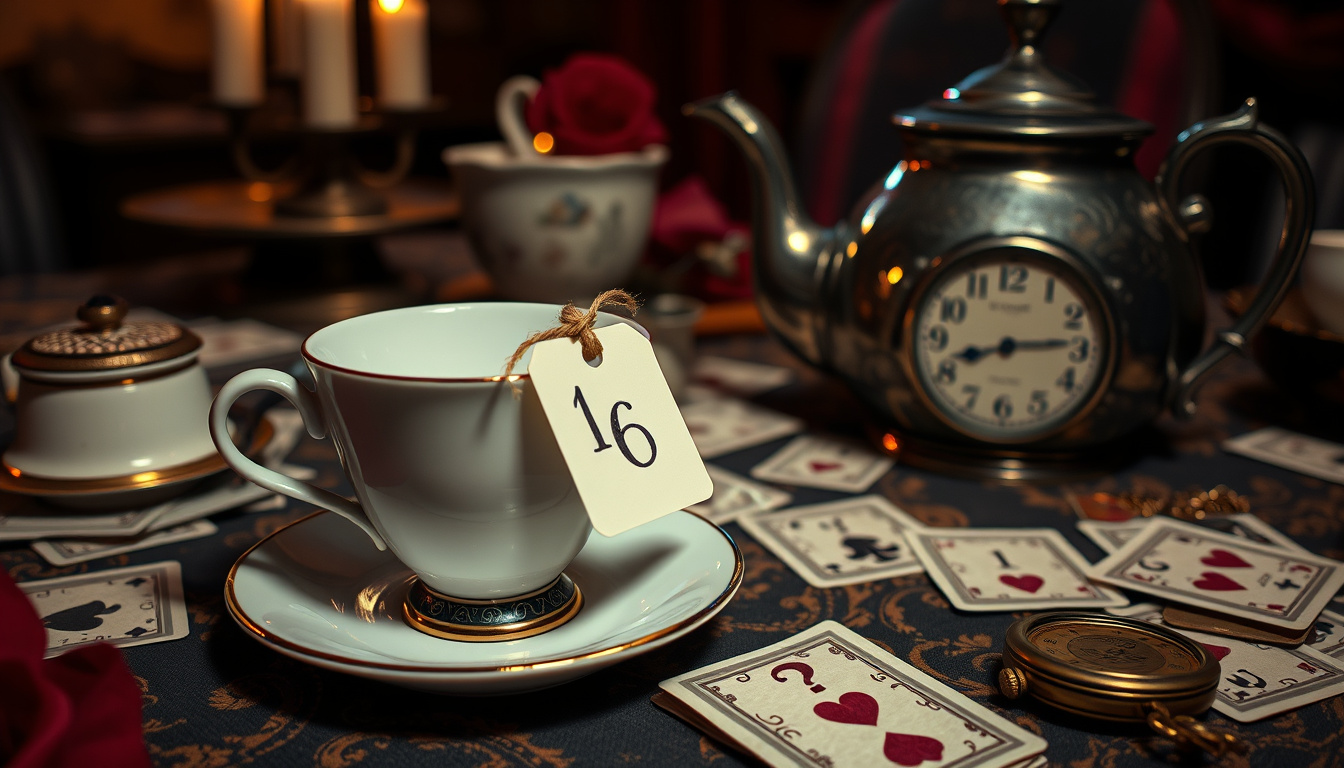
There’s a strange magic in a character who shows up for tea, never leaves, and asks a riddle that has no answer. The Mad Hatter has been baffling readers, inspiring filmmakers, and haunting hat-makers for over 150 years — but the real story is even richer than the fiction.
Year of first appearance: 1865 ·
Book: Alice’s Adventures in Wonderland ·
Creator: Lewis Carroll ·
DC Comics debut: 1948 ·
Real-world origin: Theophilus Carter
Quick snapshot
- Lewis Carroll introduced the Hatter in 1865 (TheCollector (arts & culture analysis))
- The hat label 10/6 means ten shillings and sixpence (TheCollector (arts & culture analysis))
- The phrase “mad as a hatter” predates Carroll and is linked to mercury poisoning (Healthline (medical reference))
- Whether Carroll intended the character to represent a specific mental illness
- The exact real-world inspiration (Theophilus Carter is a candidate but unproven)
- The origin of the riddle “Why is a raven like a writing-desk?” — Carroll later admitted it had no answer
- 1865: Alice’s Adventures in Wonderland published
- 1948: Mad Hatter debuts in Batman #49
- 2010: Johnny Depp portrays the character in Tim Burton’s film
- New scholarly and medical interest in the real-world “mad hatter” disease
- Ongoing reinterpretations in comics and film explore trauma and eccentricity
The table below summarizes key facts about the Mad Hatter.
| Fact | Detail |
|---|---|
| First appearance | 1865, Alice’s Adventures in Wonderland |
| Creator | Lewis Carroll |
| Notable quote | “Why is a raven like a writing-desk?” |
| Hat label | 10/6 (ten shillings and sixpence) |
| DC Comics name | Jervis Tetch |
| Real-world analogue | Theophilus Carter |
What does being a Mad Hatter mean?
The phrase “mad as a hatter” didn’t start with Lewis Carroll. It was already in use in the 19th century, referring to hat-makers who suffered from mercury poisoning. The neurological condition — known medically as erethism or mad hatter disease — caused tremors, excitability, slurred speech, and psychosis (Healthline (medical reference)). Industrial workers exposed to mercury vapors during hat production often became so confused that bystanders mistook them for drunks (University of Connecticut Digital Commons (public health archive)). Carroll, living in an era when mercury was used in hat-making, likely knew the expression and wove it into his character.
In the book, the Hatter is never explicitly called “mad” — the text refers to him simply as “the Hatter.” But his behavior (the endless tea party, the nonsensical riddles, the timepiece that’s stuck at 6 p.m.) makes the subtext obvious. A 1995 case report in PubMed (peer-reviewed medical journal) described a patient with chronic mercury poisoning who exhibited psychiatric symptoms indistinguishable from the fictional Hatter’s personality — a clinical echo of the literary archetype.
What does “mad hatter” symbolize?
The Hatter is one of the most potent symbols in Wonderland — and interpretations vary widely. Some see him as the embodiment of absurdity and the nonsensical logic that governs Wonderland (TheCollector (literary analysis)). Others read him as a critique of unpleasant or irritating human traits — the party guest who never leaves, the conversational partner who refuses to make sense.
A deeper interpretation ties the Hatter to the Victorian fascination with madness and mental illness (Culture Frontier (literary studies)). In a society that was beginning to categorize and medicalise mental conditions, the Hatter represented a wild, untameable chaos — a figure who could not be reasoned with or cured.
The Hatter is both a product of industrial disease and a celebration of irrational freedom. He suffers from mercury poisoning — but he’s also the only character in Wonderland who seems to enjoy himself.
What mental illness does Mad Hatter represent?
There is no single diagnosis for the Hatter. Some modern psychologists and literary critics point to bipolar disorder, given the character’s rapid shifts between exuberance and melancholy. Others align his symptoms with mercury-induced psychosis — erethism — which mimics schizophrenia in its hallucinatory and disorganised features (Medical News Today (health publication)).
A research paper from Brazilian Journal of Development (academic journal) documents how chronic mercury vapor exposure can cause motor coordination problems, tremor, paresis, and severe neurotoxicity — symptoms that align with the character’s twitchy, erratic demeanor. But whether Carroll intentionally coded the Hatter as mentally ill remains speculation: the author never confirmed any specific diagnosis.
The implication: the Hatter’s link to industrial disease and literary nonsense creates a layered symbol of madness.
What is the story behind Mad Hatter?
Lewis Carroll (real name Charles Dodgson) introduced the Hatter in Alice’s Adventures in Wonderland, published in 1865. The character appears during the famous Mad Tea Party — a scene where the Hatter, the March Hare, and the Dormouse sit at a table set for an endless afternoon tea, perpetually stuck at 6 p.m. because the Hatter’s watch is broken (Wikipedia (encyclopedia)).
The character returned in Carroll’s 1871 sequel Through the Looking-Glass, this time as a minor figure named Hatta, a prisoner who has been “brought back” from Wonderland’s justice system. Across both books, the Hatter’s defining traits are his rudeness, his obsession with time, and his refusal to answer questions directly.
A possible real-life inspiration for the Hatter is Theophilus Carter, an Oxford furniture dealer known for his eccentric behaviour. According to local lore, Carroll saw Carter wearing a top hat and acting oddly, and based the character partly on him (Wikipedia (encyclopedia)). The theory has been cited for decades but remains unconfirmed — one of the enduring mysteries of Wonderland.
Why is Mad Hatter a villain?
In Alice’s Adventures in Wonderland, the Hatter is not a villain. He’s rude, yes — he interrogates Alice with illogical riddles and dips his watch in tea — but he never threatens her physically and doesn’t act with malice. He’s a chaotic neutral figure, not an antagonist.
The transformation from eccentric tea-drinker to supervillain happened in 1948, when DC Comics introduced the Mad Hatter in Batman #49 (Wikipedia (encyclopedia)). In this version, the character is Jervis Tetch, a neuroscientist who becomes obsessed with Lewis Carroll’s Wonderland and models himself after the Hatter. His signature weapon: a hat that allows him to control minds.
DC’s Mad Hatter is a recurring Batman adversary, preying on victims by fitting them with mind-control devices disguised as hats. His obsession with Alice is literalised — he kidnaps women who remind him of Carroll’s heroine. The character has appeared in dozens of comic storylines, as well as in animated series, video games, and live-action adaptations such as Gotham.
The implication: the Hatter’s journey from harmless oddball to criminal mastermind reflects how modern storytelling reimagines classic characters to fit new genres. Carroll’s Hatter was a philosophical nuisance. DC’s Hatter is a technological threat.
What was Mad Hatter’s famous line?
The Mad Hatter’s most famous line is also his most frustrating: “Why is a raven like a writing-desk?” It’s a riddle posed during the tea party, and neither Alice nor the reader ever receives an answer. Carroll himself later admitted the riddle had no intended answer — it was pure nonsense, a joke at the expense of readers who sought meaning in everything (TheCollector (arts & culture analysis)).
Over the years, fans have proposed dozens of solutions: “Both have quills” (referencing both the bird’s feather and the pen) is the most popular. But the lack of a definitive answer is the point — the riddle embodies the nonsense at the heart of Wonderland.
What did Hatter whisper to Alice?
In Tim Burton’s 2010 film Alice in Wonderland, the Hatter (played by Johnny Depp) whispers to Alice: “I’m afraid I can’t explain myself, sir. Because I’m not myself, you know?” The line plays with identity confusion and fragmentation — themes that run through both the book and the film. It’s a moment of vulnerability from a character usually defined by bravado and rudeness.
What is the Mad Hatter’s riddle?
The riddle is “Why is a raven like a writing-desk?” It appears in Chapter 7 of Alice’s Adventures in Wonderland, during the tea party scene. Alice gives up after several attempts, and the Hatter reveals that he doesn’t know the answer either. The moment is a meta-commentary on the Victorian obsession with puzzles and moral lessons — Carroll deliberately offered a riddle with no solution.
What does Mad Hatter say to Alice at the end?
In the 1951 Disney animated film, the Hatter bids Alice farewell with the line: “You’re entirely bonkers. But I’ll tell you a secret: all the best people are.” The line has become one of the most quoted from the film and is often shared as a self-affirmation — an inversion of the earlier nonsense, recast as a celebration of eccentricity.
What does 10/6 mean for the Mad Hatter?
The number 10/6 on the Mad Hatter’s hat is a price tag. In pre-decimal British currency, it meant ten shillings and sixpence — the cost of the hat. It’s a literal, mundane detail in a world of absurdity: the Hatter is simultaneously a madman and a tradesman, selling the very hat that marks him as insane (TheCollector (arts & culture analysis)).
The tag is a visual pun — a joke about the intersection of commerce and madness. Why would a hatter at an endless tea party need to price his hat? Because in Wonderland, logic is broken in ways both subtle and hilarious.
Why does the Mad Hatter’s hat have 10’6″ on it?
The notation is often misread as a measurement (10 feet, 6 inches), but it’s actually a price. In Victorian Britain, prices were frequently written as fractions: 10/6 means 10 shillings and 6 pence. The confusion between price and height is itself a kind of Wonderland logic — a deliberate ambiguity that rewards careful readers.
What is rule 42 in Alice in Wonderland?
Rule 42 appears in the trial scene near the end of Alice’s Adventures in Wonderland. The King of Hearts reads it aloud: “All persons more than a mile high must leave the court.” Since Alice has grown to a towering height, the rule is invoked to expel her. It’s a parody of arbitrary legal systems — a rule invented on the spot to serve a purpose, with no grounding in justice or consistency. The parallel to the Hatter’s nonsensical tea-party logic is clear: in Wonderland, rules exist only to be broken or weaponised.
The pattern: Carroll uses absurdity to critique commerce and law.
Timeline
- 1865 — Alice’s Adventures in Wonderland published, introducing the Hatter
- 1871 — Through the Looking-Glass published; Hatta appears as a minor character
- 1948 — Mad Hatter debuts as a DC Comics villain in Batman #49
- 2010 — Johnny Depp portrays Mad Hatter in Tim Burton’s Alice in Wonderland
- 2025 — Hekint article revisits the truth about the Mad Hatter and mad hatter disease
The timeline shows a character who has been reinvented every few decades — from literary oddity to industrial-symbol to supervillain. The next reinvention may come from neuroscience, as researchers continue to explore how mercury poisoning shaped the expression “mad as a hatter.”
The timeline reveals ongoing reinvention.
Confirmed facts
- Lewis Carroll created the Mad Hatter character in 1865 (TheCollector)
- The hat label 10/6 means ten shillings and sixpence
- The phrase “mad as a hatter” predates Carroll and is linked to mercury poisoning in hat-making (Healthline)
- Mad hatter disease is a form of chronic mercury poisoning (Medical News Today)
- DC’s Mad Hatter is Jervis Tetch, a neuroscientist who uses mind-control hats (Wikipedia)
- Mercury poisoning can cause neurological symptoms including tremors, excitability, and psychosis (Healthline)
These facts anchor the Hatter in both fiction and medical history.
What’s unclear
- Whether Carroll intended the Hatter to represent a specific mental illness
- The exact real-world inspiration for the Hatter (Theophilus Carter is a strong candidate but not proven) (Wikipedia)
- The origin of the riddle “Why is a raven like a writing-desk?” — Carroll later admitted it had no answer
These uncertainties keep the Hatter open to interpretation.
“Why is a raven like a writing-desk?”
— The Mad Hatter, Alice’s Adventures in Wonderland (1865) (TheCollector)
“You’re entirely bonkers. But I’ll tell you a secret: all the best people are.”
— The Mad Hatter, Disney’s Alice in Wonderland (1951)
“I’m afraid I can’t explain myself, sir. Because I’m not myself, you know?”
— The Mad Hatter (Johnny Depp), Tim Burton’s Alice in Wonderland (2010)
Summary
The Mad Hatter is three figures in one: a literary character born from nonsense, a cautionary symbol of industrial disease, and a comic-book villain shaped by obsession. What connects them is the idea that madness — whether playful, tragic, or dangerous — is never just one thing. For readers still puzzling over the raven and the writing-desk, the takeaway is fittingly Carrollian: some questions don’t have answers, but they’re worth asking anyway. For fans of the DC Comics Mad Hatter, the implication is darker: the line between eccentricity and criminality is thinner than we’d like to admit.
Related reading: **Support Mental Health** · **Ken Barlow: Bipolar, Stroke, Marriages & Future on Corrie**
Frequently asked questions
Is the Mad Hatter a villain in Alice in Wonderland?
No. In Lewis Carroll’s original books, the Hatter is a rude and nonsensical character but not a villain. He doesn’t harm Alice or attempt to stop her. The villainous version is a DC Comics creation, introduced in 1948.
What is the origin of the phrase “mad as a hatter”?
The phrase predates Carroll and refers to hat-makers who suffered from mercury poisoning. Chronic exposure to mercury vapors caused neurological symptoms including tremors, slurred speech, and psychosis (Healthline).
Are there real-life cases of mad hatter disease?
Yes. Mad hatter disease is a form of chronic mercury poisoning. A 1995 case report in PubMed (peer-reviewed medical journal) documents a patient with mercury poisoning who exhibited psychiatric symptoms consistent with erethism, the medical name for mad hatter syndrome.
How does the Mad Hatter differ in the book vs. Disney movie?
In the book, the Hatter is a terse, irritable character who speaks in riddles. In Disney’s 1951 animated film, he’s more whimsical and sings “The Unbirthday Song.” The film adds the famous line “You’re entirely bonkers” and softens his personality significantly.
What does the Mad Hatter’s hat look like?
The Mad Hatter wears a large top hat, typically with a price tag reading “10/6” attached to the band. In most illustrations and adaptations, the hat is tall and slightly crumpled, and its band is often a bright color such as red or purple.
Why does the Mad Hatter have a tea party that never ends?
The Hatter, the March Hare, and the Dormouse are stuck at 6 p.m. forever because the Hatter’s watch is broken — and time itself has stopped for them. It’s a punishment from the Queen of Hearts, who sentenced the Hatter to perpetual tea after he “murdered the time” by singing a song she didn’t like.
Who played the Mad Hatter in the 2010 film?
Johnny Depp portrayed the Mad Hatter in Tim Burton’s 2010 film Alice in Wonderland. His performance emphasized the character’s vulnerability and trauma, including a whispered confession about identity loss.
What is the Mad Hatter’s real name in DC Comics?
His real name is Jervis Tetch. He is a neuroscientist who becomes obsessed with Lewis Carroll’s Wonderland and uses mind-control devices disguised as hats to commit crimes (Wikipedia).
Related stories



Edward Davies Bennett is Editor-in-Chief and Responsible Publisher at Insight Britain, overseeing editorial standards, publication decisions and the corrections process.