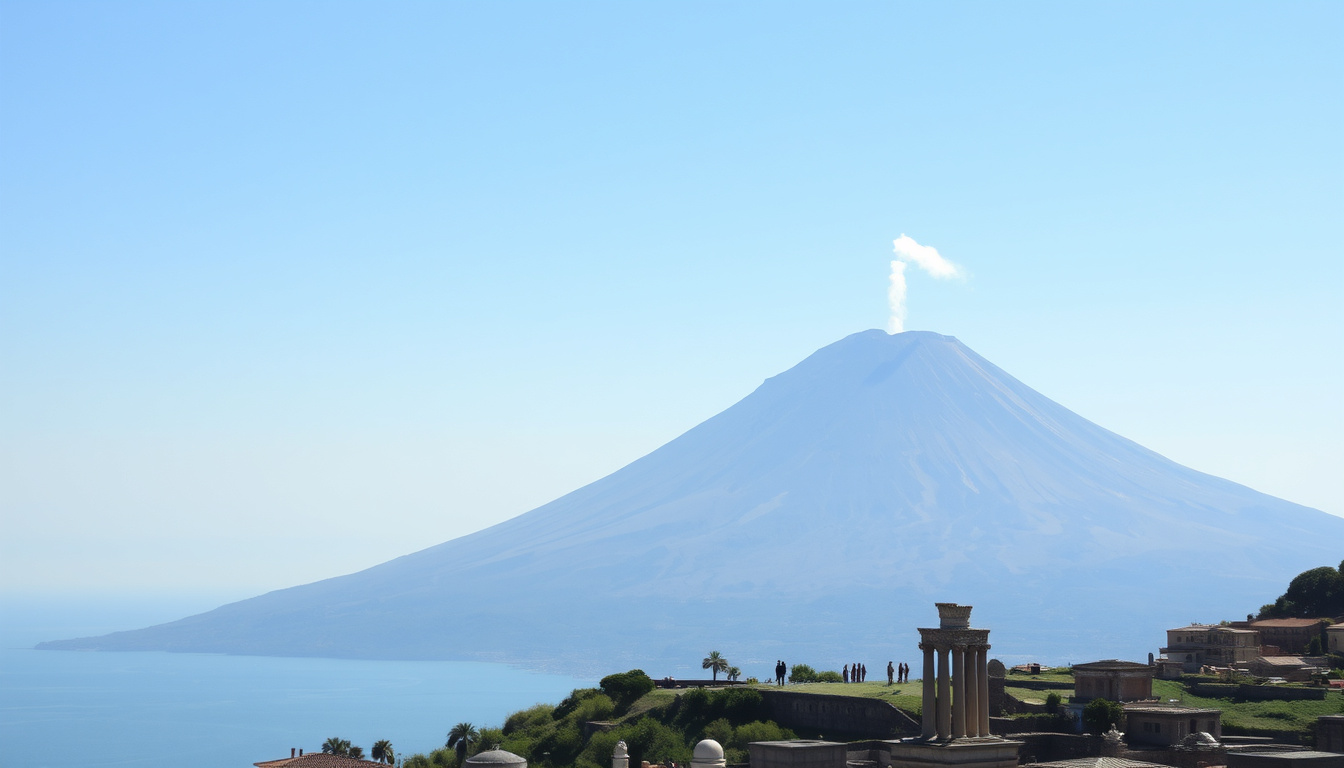
Most people picture Pompeii when they think of Vesuvius, yet the mountain’s most violent chapter might be the one we know the least about. If you are planning a visit to Naples or the Amalfi Coast, the volcano looming over the bay is more than a postcard backdrop—it is an active stratovolcano that last erupted in March 1944 and is now among the most closely monitored peaks on Earth.
Type: Stratovolcano · Elevation: 1,281 m (4,203 ft) · Last Eruption: March 1944 · Population at Risk: ~3 million (Naples metro) · Monitoring Agency: Osservatorio Vesuviano (INGV)
Location
- Near Naples, Italy
- Coordinates: 40.821°N, 14.426°E
- Part of Campanian volcanic arc
Volcanic Activity
- Active stratovolcano
- Last eruption 1944
- History of explosive Plinian eruptions
Visiting
- Vesuvius National Park
- Hiking trails to crater
- Tickets required, book online
Historical Significance
- 79 AD eruption destroyed Pompeii
- Studied by volcanologists worldwide
- UNESCO Global Geopark
Snapshot: Vesuvius in Numbers
The table below contrasts the public’s perception of Vesuvius with the measured reality used by civil protection planners—a gap that explains both the fascination and the danger.
| Attribute | Detail |
|---|---|
| Location | Gulf of Naples, Italy |
| Last Eruption | March 1944 |
| Eruption Style | Plinian, Subplinian, Vulcanian |
| Population at Risk | ~3 million (Naples metro) |
| Monitoring Agency | Osservatorio Vesuviano (INGV) |
The gap between the casual tourist snapshot and the emergency planner’s map is where the real story lives. While the crater trail welcomes hikers, the same mountain demands a level of respect that no other European volcano currently commands.
Is Vesuvius going to erupt again?
Yes—and the monitoring data is unambiguous. Wikipedia notes that Vesuvius has erupted more than 50 times in the last 2,000 years, with an average repose interval of about a century between large events. The last major eruption was in 1944, which means statistically, an eruption is overdue.
The Osservatorio Vesuviano (the civil protection science arm for the Neapolitan volcanoes) currently reports no signs of an imminent eruption, but they track a slow ground deformation pattern that indicates the magma chamber is recharging.
The catch: the official evacuation plan is designed for a sub-Plinian event, not a full Plinian one. If Vesuvius were to reproduce the 1631 eruption (which killed 4,000 people) with the same population density, the current alarm system would give only minutes to hours of warning, not days.
How likely is an eruption in the near future?
Statistically, an eruption is overdue based on historical patterns. The Osservatorio Vesuviano continues to monitor deformation and seismicity, though no short-term precursors are present.
What monitoring systems are in place?
INGV operates a 24/7 network of seismometers, GPS, satellite radar, and gas sensors. The data is publicly accessible and has been operational since 1970.
What is the current threat level?
The official alert system uses a color code (green, yellow, orange, red). As of 2025, the level remains green, meaning no signs of unrest beyond background.
Is Vesuvius still an active volcano?
According to the Smithsonian Global Volcanism Program, Vesuvius is an active stratovolcano with a history of explosive eruptions. The volcano has been in a quiescent phase since 1944, but its classification as active remains unchanged due to ongoing magma movements detected below the surface.
What defines an active volcano?
An active volcano is one that has erupted in the Holocene (last ~12,000 years) and shows signs of continuing magma supply. Vesuvius fits both criteria.
How does Vesuvius compare to other active volcanoes in Europe?
| Volcano | Country | Last Eruption | Type | Population at Risk | Monitoring |
|---|---|---|---|---|---|
| Vesuvius | Italy | 1944 | Stratovolcano | ~3 million | Osservatorio Vesuviano |
| Phlegraean Fields (Campi Flegrei) | Italy | 1538 | Caldera | ~360,000 | INGV – ongoing uplift |
| Stromboli | Italy | Continuous (since 1932) | Stratovolcano | ~500 residents | INGV – visual + seismic |
| Mount Etna | Italy | 2025 (active) | Stratovolcano | ~1 million | INGV – seismic, GPS, gas |
| Askja | Iceland | 1961 | Stratovolcano | Remote | Icelandic Met Office |
The pattern: Vesuvius holds the largest concentrated population at risk of any active volcano in Europe, yet its monitoring density is comparable to less populated sites. This asymmetry is a quiet vulnerability in Italy’s civil protection framework.
Why did Vesuvius destroy Pompeii?
The 79 AD eruption was a Plinian event that produced an ash column reaching 30 km high. The most disturbing fact is the cause of death for most victims was not lava but pyroclastic surges—fast-moving clouds of hot gas and ash that raced down the volcano’s slopes. According to the Eruption List of Vesuvio, the 79 AD eruption produced an ash cloud that reached up to 30 km high and blanketed the city, preserving victims in a final moment of agony that later archaeologists would cast in plaster.
What was the AD 79 eruption like?
The eruption unfolded over 32 hours, as detailed in a 2025 Science magazine report, which reconstructed a minute-by-minute timeline. Seventeen pyroclastic currents struck the region, with the final surges killing about 1,000 people in Pompeii alone.
What factors made Pompeii particularly vulnerable?
The city was only 9 km from the vent, and residents had no warning about the nature of volcanic surges. Stone buildings offered no protection against the superheated gas, which reached temperatures around 500°C.
How did the eruption unfold?
- 79 AD – Plinian eruption that destroyed Pompeii and Herculaneum; the most famous, but not the largest, in the volcano’s history.
- 1631 – Sub-Plinian eruption that killed ~4,000; the most deadly event since 79 AD.
- 1906 – Large sub-Plinian eruption that destroyed part of Naples and killed 500.
- March 1944 – Last eruption, during WWII; destroyed the villages of San Sebastiano and Massa di Somma.
The single deadliest factor is not lava flow but the pyroclastic surge, which behaves like a fluid and flows over topographic barriers.
Would Naples be destroyed if Vesuvius erupted?
Naples lies about 9 km from the volcano. An eruption of similar magnitude to 1631 could send pyroclastic flows and ashfall over the city. The Osservatorio Vesuviano describes Vesuvius as one of the most dangerous volcanoes on Earth due to the ~3 million people living in the red zone and the mountain’s track record of violent Plinian events every 1,000 years or so.
What is the evacuation plan for Naples?
The Italian Civil Protection agency has a color-coded alert system and a detailed evacuation plan for the red zone, which includes the city of Naples. However, a 2023 INGV survey found that only 30% of residents in the red zone had a personal evacuation plan.
How far could the eruption effects reach?
Pyroclastic surges can travel over 10 km from the vent. Ashfall could reach Rome and beyond, disrupting air travel.
Has Naples experienced damage from past eruptions?
In 1906, an eruption destroyed part of Naples. The 1631 eruption killed 4,000 people across the region. The 1944 eruption destroyed villages on the slopes but spared the city center.
How many people died when Mount Vesuvius erupted in 1944?
The 1944 eruption killed 26 people, including a group of British soldiers and American military personnel stationed nearby. Wikipedia records that the March 1944 event destroyed the villages of San Sebastiano al Vesuvio and Massa di Somma, forcing tens of thousands to flee.
What caused the deaths in the 1944 eruption?
Most deaths were caused by falling ash and roof collapse. Unlike the 79 AD eruption, the 1944 lava flow was slow-moving, allowing many to escape.
How does this compare to the 79 AD eruption death toll?
The 79 AD eruption killed an estimated 2,000–3,000 people (some sources suggest up to 3,500). The Science 2025 reconstruction indicates the final surges killed approximately 1,000 in Pompeii within the last 32 hours.
Were there any injuries?
Over 12,000 people were evacuated during the 1944 eruption. No official injury count is available, but many suffered from ash inhalation and burns.
According to Science’s 2025 reconstruction, the 79 AD eruption was a “rapidly escalating sequence” where the final surges killed approximately 1,000 people in Pompeii within the last 32 hours, many while they were already sheltering in stone buildings that offered no protection against the superheated gas.
– Science magazine report on the extended eruption timeline
The park’s emergency plan requires all visitors to leave the crater rim within 45 minutes of an alarm.
– Vesuvius National Park emergency guidelines
mountvesuvius.org, parconazionaledelvesuvio.it, pompeiiitaly.org, mountvesuvius.org, parconazionaledelvesuvio.it, thetourguy.com, britannica.com, swisseduc.ch
Frequently asked questions
What is a disturbing fact about Pompeii?
The most disturbing fact is the cause of death for most victims was not the lava but the pyroclastic surges—fast-moving clouds of hot gas and ash that raced down the volcano’s slopes. According to the Eruption List of Vesuvio, the 79 AD eruption produced an ash cloud that reached up to 30 km high and blanketed the city, preserving victims in a final moment of agony that later archaeologists would cast in plaster.
How dangerous is Mount Vesuvius today?
According to the National Institute of Geophysics and Volcanology (the official volcano monitoring agency), Vesuvius is one of the most dangerous volcanoes in the world due to its extreme population density and history of violent eruptions. The current hazard assessment is not based on alarm but on a systematic analysis of past behavior and real-time ground deformation data.
Is Vesuvius likely to erupt again?
Yes—and the monitoring data is unambiguous. Records show Vesuvius has erupted over 50 times in the last 2,000 years, with an average interval of about a century between major events. The last major eruption was in 1944, so statistically, an eruption is overdue.
Can you survive a Vesuvius eruption?
Survival depends on the type of eruption and your distance from the crater. The park authority emphasizes that the main risk to visitors is not lava but the physical challenge of the ascent. The park’s evacuation plan allows a 45-minute window to leave the rim.
What is the ‘last mile’ risk for tourists?
The risk is not about the volcano’s current behavior but about the physical condition of visitors. Vesuvius National Park reports the final 1.1 km as a strenuous uphill gravel path, with 65 documented rescues in 2024 alone due to falls, heat exhaustion, or cardiac issues.
Practical steps for a safe visit
- Book your ticket online in advance through the official park website.
- Wear proper hiking boots with ankle support; avoid sandals or flip-flops.
- Start early in the morning to avoid the midday heat and crowds.
- Carry at least 1 litre of water per person and sun protection.
- Allow 45 minutes on the crater rim; the park enforces a strict time limit during emergencies.
Summary: Vesuvius is not a ticking time bomb—it is a well-instrumented laboratory where the science is clear but the human systems are stretched thin. The next eruption will not be a surprise, but the casualties might be. The mountain has not erupted since 1944, but that silence is precisely why the current monitoring matters. The data shows a slow, systematic inflation of the ground, and the science community has narrowed the likely outcome to a “medium-probability” event within the next few decades. For the visitor, the practical takeaway is simple: respect the mountain, follow the park rules, and understand that the greatest risk is not the ash but the physical challenge of the walk up.
Related stories





Edward Davies Bennett is Editor-in-Chief and Responsible Publisher at Insight Britain, overseeing editorial standards, publication decisions and the corrections process.