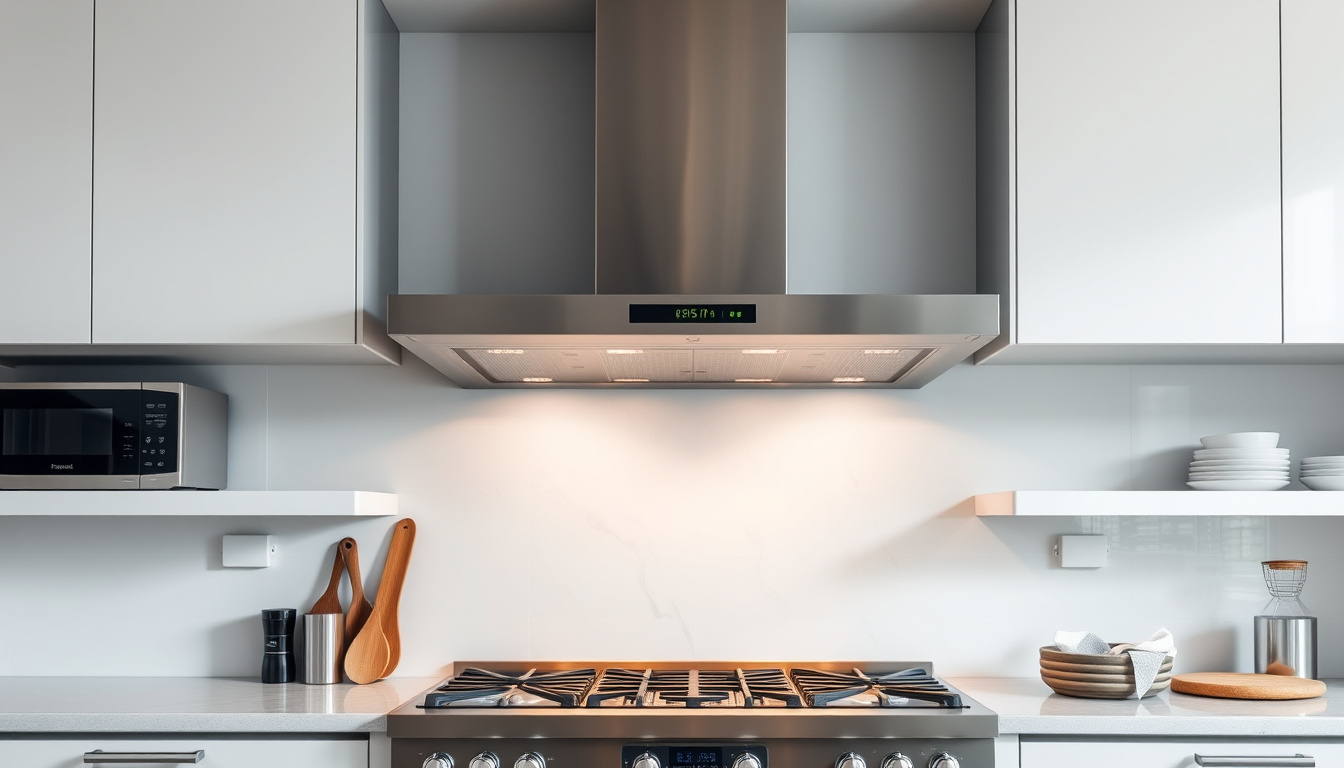
Anyone who’s cooked a steak indoors knows the moment when the smoke alarm starts judging you and the kitchen smells like dinner for the next three days. A cooker hood is the appliance that quietly decides whether that happens — and whether you can hear yourself think.
Typical suction range (CFM): 200–600 ·
Average noise level: 40–65 dB ·
Price range: $100–$1,500 ·
Common widths: 60 cm, 70 cm, 90 cm ·
Ducted vs ductless split: ~70% ducted, ~30% ductless (US estimate)
Quick snapshot
- Exhaust mode runs quieter than recirculation mode (IKEA kitchen hood guide).
- Selected NEFF hoods operate at 38 dB(A) in normal mode (NEFF Home UK buying guide).
- Ducted hoods remove more air than ductless models. (IKEA kitchen hood guide)
- Which brand takes the 2026 top spot — new models and reviews are still settling the ranking.
- The exact link between CFM ratings and real odor removal in open-plan kitchens.
- Whether premium smart features justify their cost over a hood’s 10–15-year lifespan.
- Charcoal filters need replacing every 6–12 months on recirculating models. (NEFF Home UK buying guide)
- NEFF recommends 120 mm duct diameter as a minimum, with 150 mm preferred (NEFF Home UK buying guide).
- Longer or narrower pipes, and more 90° bends, push noise up (IKEA kitchen hood guide).
- Set a noise target under 60 dB for open-plan kitchens before comparing models. (AEG Australia rangehood guide)
- Ducted mode moves smoke, steam, heat and odor-filled air outside (AEG Australia rangehood guide).
- Check for an external vent route before you fall for a ductless-only deal. (AEG Australia rangehood guide)
The hoods that perform best in real kitchens publish their noise and airflow specs instead of hiding them behind adjectives.
| Fact | Value |
|---|---|
| Average cost for professional installation | $150–$300 |
| Typical lifespan of a cooker hood | 10–15 years |
| Energy use (average per hour) | 100–300 watts |
| Percentage of homes with ducted hoods (US) | ~70% |
| Sound level of quietest hoods | 35 dB (similar to a library) |
| Sound output considered very quiet (Siemens Home Appliances) | 40–60 dB |
| Grease filter type for ducted mode | Metal mesh |
| Filter type for ductless mode | Charcoal, replaced every 6–12 months |
Which is better, a cooker hood or extractor fan?
In UK kitchens, “cooker hood” and “extractor fan” are often two names for the same appliance. The comparison that changes your buying decision is ducted versus ductless: where the air goes after it leaves the pan.
Ducted vs ductless performance
- Ducted models connect to the outdoors and remove smoke, steam, heat and odor-filled air, while ductless models use a filter to purify air before returning it to the kitchen (AEG Australia rangehood guide).
- Recirculation models generally offer a reduced extraction rate at a higher noise level than ducted models (Homebuilding buying guide).
- Cooker hoods generally offer stronger suction and better grease filtration than simple extractor fans.
The pattern is consistent across manufacturers and independent buying guides: if you can get the air outside, ducted does more work per watt. The catch is that “if” depends on your walls, your floors and your building’s rules.
The average hood runs at 60–70 dB, while “very quiet” starts at 40–60 dB, according to Siemens Home Appliances. In an open-plan room, that gap is the difference between a kitchen that hums and one you have to shout over.
Noise level differences
- Open-plan comfort threshold: 60 dB or below (CATA Appliances).
- Quiet engineering: AEG’s SilenceTech range reduces loud volumes to 54 dB (AEG Australia rangehood guide).
- Hoods with documented dB(A) levels are easier to compare than ones that just claim to be “quiet”.
Noise is where many open-plan dreams die. The gap between 38 dB(A) and 65 dB is not a rounding error — it’s the difference between a background hum and a kitchen you have to talk over. And since the sofa shares the same airspace as the hob, that hum becomes a living-room fixture.
Installation complexity
- Extractor fans are typically cheaper and easier to install but less powerful.
- Ducted hoods need ductwork routed to an outside vent; ductless hoods need only a power source and regular filter changes.
- Keep duct runs short and straight — long, narrow or bend-heavy pipework is a common cause of noisy hoods.
Installation is where the trade-off bites. A ductless hood can go almost anywhere; a ducted hood needs a route outside. The quality of that route — length, diameter, number of bends — is part of the noise spec, whether or not the datasheet includes it.
Do all cooker hoods need to be vented outside?
No — and this is the decision most buyers get stuck on. Whether a hood needs outside venting depends on which mode it supports.
Ducted (vented) hoods
- A ducted hood needs a route for air to leave the building — usually an external wall or roof exit.
- Ducted hoods are more effective at removing moisture and odors than ductless recirculating models.
- The duct should be as short and straight as the layout allows.
Ductless (recirculating) hoods
- Ductless models pull air through filters and return it to the kitchen, with no outside vent needed.
- They are the practical fit for flats, rentals and kitchens with no external wall access.
- Charcoal filters in ductless mode need replacing every 6–12 months.
The cost of that flexibility is performance: recirculating models deliver less effective air removal in return for easier placement. If you cook a lot — or cook smelly things — that trade-off will show up on the first steak night.
Conversion kits and filter types
- Some hoods can be installed in either mode using a conversion kit.
- Ducted mode uses a metal grease filter; ductless mode adds a charcoal filter for odor absorption.
- Charcoal filters wear out with use, which is why replacements are a recurring budget item.
If you’re not sure which mode you’ll need, a convertible hood is the safer middle ground: install it ductless now, run ducting later, or the reverse. Just remember that every mode change affects which filters you buy.
The implication: “Does it need venting?” is really “Can I install ducting in my building?” If yes, ducted is the stronger default. If no, ductless is a legitimate plan — with a performance tax you should know about before you buy.
Do you need an electrician to fit a cooker hood?
It depends on how the hood gets its power — plug-in or hardwired.
Hardwired vs plug-in models
- Plug-in cooker hoods can be installed without an electrician if a nearby outlet exists.
- Hardwired hoods connect directly to the house circuit and usually need a dedicated circuit.
- Hardwired installation should be done by a licensed electrician.
Most budget and mid-range hoods ship with a plug. Integrated and high-power models are more likely to be hardwired. If you’re replacing an existing hood, check whether the old unit was plugged in or wired into a spur — that tells you what the new one will need.
Local electrical codes
- Building codes in many regions mandate professional installation for hardwired appliances.
- A licensed electrician will verify the circuit rating and earthing before connecting the hood.
- If your kitchen is being remodeled, the hood’s electrical point is planned before the wall is finished.
Codes exist for a reason: a cooker hood sits above a heat source, collects grease and runs for hours. Getting the circuit wrong is not a DIY-oops moment — it’s a fire-safety issue.
When to call a professional
- Call an electrician for any hardwired connection.
- Call a kitchen fitter or builder if ducting must run through walls, joists or cabinets.
- Book the installation before the hood arrives, so you are not stuck with a unit you cannot use.
Professional installation typically runs $150–$300 on top of the hood itself. Factor that in before you chase a bargain-priced unit.
A quiet hood only stays quiet if the installation cooperates. Long duct runs, narrow pipes and sharp bends undo the dB(A) rating printed on the box, and that damage is permanent until you redo the ductwork.
Which is the best cooker hood to buy?
“Best” depends on your hob, your room and your tolerance for noise. UK shoppers tend to start with familiar names such as Bosch, Beko and Cookology — all of which make solid units — but the spec sheet matters more than the badge.
Top-rated brands (Bosch, Beko, Cookology)
- Bosch, Beko and Cookology are common starting points for UK buyers.
- Premium manufacturers such as NEFF and Siemens publish detailed noise and airflow data, which makes comparisons easier.
- Retailer best-seller lists shift with stock and promotions, so brand alone is a weak filter.
The published specs make this part easy: Homebuilding notes that the quietest hoods have a noise level of 50 dB or less (Homebuilding buying guide). Whatever the badge on the front, these two numbers — airflow and decibels — separate a hood that works from one that just runs.
Features to prioritize (CFM, noise, filters)
- Suction: high-CFM hoods (≥400 CFM) are recommended for gas ranges.
- Noise: quiet models (≤55 dB) often come with brushed DC motors.
- Filters: metal grease filters for ducted mode; charcoal filters for ductless.
- Space: integrated hoods save room but may have lower suction than chimney styles.
Match suction to the way you actually cook. Gas ranges throw up more heat and combustion byproducts, which is why the higher CFM recommendation exists. Electric hobs are easier on the hood, so you can spend your budget on quietness instead of raw power.
Price-to-performance sweet spot
- Entry-level hoods cover basic needs but tend to be noisier.
- Mid-range models deliver the best balance of suction, noise and build quality.
- Premium hoods add dual motors, smart controls and better filtration.
The sweet spot for most open-plan kitchens sits in the mid-range, where you get documented dB(A) levels and a motor that doesn’t drown out the room.
How much should I spend on a cooker hood?
Cooker hood pricing looks simple from the outside: $100 at the budget end, $1,500 and beyond at the premium end. Installation and filter consumables change that math.
Budget range ($100–$300)
- Entry-level hoods offer basic functionality but may be noisy and less efficient.
- Installation ($150–$300) can double the total cost.
- They suit small kitchens, low cooking frequency and ductless setups.
Mid-range ($300–$700)
- Mid-range hoods provide better build quality, quieter operation and stronger suction.
- This is where you find brushed DC motors and published noise levels.
- Best value for open-plan kitchens with average cooking loads.
Premium ($800+)
- Premium hoods include advanced features like dual motors, smart controls and superior filtration.
- They often ship in larger widths (90 cm) for professional-style ranges.
- Expect the quietest performance in the range.
If you are remodeling the whole room, a hood is one line in a bigger budget — our guide to kitchen cabinet costs, fit and remodel order shows where it fits in the renovation sequence. Before you set a budget, add the extras: installation at $150–$300, ducting materials if you are venting, and charcoal filter replacements every 6–12 months on ductless models. A $200 hood with $300 of installation and $40 a year in filters is no longer a cheap hood.
The pattern: spend enough to get documented noise and airflow data, not more to get a badge. For most kitchens, the $300–$700 band is where the hood’s performance and your sanity meet.
Ducted vs Ductless: The Side-by-Side
Four decision points, one pattern: ducted does more work when you can vent outside, and ductless charges its flexibility in filter upkeep and extraction loss.
| Decision point | Ducted (vented) | Ductless (recirculating) |
|---|---|---|
| Where the air goes | Smoke, steam, heat and odor removed outdoors | Filtered and returned to the kitchen |
| Noise | Quieter and more effective when an external wall or roof exit is accessible (CATA Appliances) | Reduced extraction rate at a higher noise level |
| Installation | Requires external vent route | No outside vent needed; flexible placement |
| Filter maintenance | Clean metal grease filter regularly | Replace charcoal filter every 6–12 months |
The pattern: ducted is the performance play, ductless is the placement play. You can fix a noisy ductless hood only by replacing it; you can fix a noisy ducted hood by improving the duct run.
Cooker Hood Specs at a Glance
Eight specs, one pattern: airflow, noise and duct diameter decide real-world behavior; everything else is convenience.
| Spec | Typical value |
|---|---|
| Suction power (CFM) | 200–600 CFM typical; 400+ CFM recommended for gas ranges |
| Noise level | 40–65 dB typical; quietest documented models from 38 dB(A) |
| Common widths | 60 cm, 70 cm, 90 cm |
| Price range | $100–$1,500 |
| Professional installation | $150–$300 |
| Energy use per hour | 100–300 watts |
| Typical lifespan | 10–15 years |
| Duct diameter (ducted mode) | 120 mm minimum; 150 mm preferred |
The takeaway: a hood’s price buys style and features, but its CFM, dB(A) and duct compatibility decide whether it makes your kitchen better or just busier.
Cooker Hood Pros and Cons
Three upsides, three downsides — the case for buying a proper hood instead of relying on an open window.
Upsides
- Ducted models pull smoke, steam, heat and odors out of the living space, not just away from the pan.
- Quiet models in the 38–50 dB range exist for open-plan rooms.
- The two specs that matter — airflow and noise — can be documented before you buy.
Downsides
- Professional installation adds $150–$300 for hardwired or ducted setups.
- Ductless models need charcoal filter replacements every 6–12 months.
- Ducting mistakes — long runs, narrow pipes, tight bends — are paid for in noise for the life of the install.
The balance: the downsides are mostly one-time installation decisions. Get the duct route and electrical point right, and a hood quietly adds value for 10–15 years.
How to Plan a Cooker Hood Installation
Five steps between “I need a hood” and “it works quietly”. The order matters more than the brand.
- Decide ducted or ductless first. Check whether your kitchen has a practical route for ducting to an outside wall or roof.
- Measure your hob and choose a hood width: 60 cm for standard hobs, 70 cm for larger ranges, 90 cm for professional-style setups.
- Plan the duct run: keep it short and straight, with 120 mm diameter at minimum and 150 mm preferred where possible.
- Sort out power: a plug-in model is the simplest; a hardwired model needs a licensed electrician and a dedicated circuit.
- Book installation before the hood arrives, especially if ducting work is involved — professional installation adds roughly $150–$300.
The sequence matters because each decision locks in the next. Choose ductless first and you can skip half of step three; go ducted and the duct route becomes the most important measurement in the project. For the wider room budget, our breakdown of kitchen cabinet quality and supplier costs for 2026 sits next to this one in the remodel plan.
What We Know vs What’s Still Unclear
The fundamentals are settled. The 2026 model picture is not — and that distinction should shape how much you trust any single review.
Confirmed facts
- Ducted hoods remove more air than ductless.
- Charcoal filters need replacement every 6–12 months.
- Hardwired hoods must comply with local electrical codes.
What’s unclear
- Which brand will be top-rated for 2026 — new models and reviews are still settling the ranking.
- The exact correlation between CFM and actual cooking odor removal in open-plan spaces.
- Whether premium smart features justify their cost over a 10–15-year lifespan.
The proportion here is healthy: the boring facts (ducting works, filters wear out, codes exist) are solid, while the exciting claims (which brand wins 2026) are still in motion. Buy the boring facts; let the reviews argue about the winner.
What the Sources Say
Four manufacturers and independent guides, one consistent message: ducted is quieter when you can vent, and the quietest models are measured in decibels, not adjectives.
For open-plan homes, the advice is to choose the quietest cooker hood model possible.
IKEA kitchen hood guide
Selected extractor hoods operate at sound levels as low as 38 dB(A) in normal operation.
NEFF Home UK buying guide
Recirculation models generally offer a reduced extraction rate at a higher noise level than ducted models.
Ducted extraction is quieter and more effective when an external wall or roof exit is accessible.
The consistency across these sources is the signal: when an open-plan kitchen is the target, ducted extraction and low dB(A) ratings are the two specs that matter.
Making the Call in 2026
For anyone renovating an open-plan kitchen in 2026, the choice is clear: if you can run a short, straight duct to an outside wall or roof, buy the quietest ducted model your budget allows — it will clear the air and stay out of the conversation. If you cannot, buy the quietest ductless model you can find and budget for charcoal filter replacements every 6–12 months, because that ongoing cost is the real price of not venting outside.
hometosight.com, reidomkitchen.com, buildwithrise.com, propertypriceadvice.co.uk, hauslane.com, neff-home.com
Frequently asked questions
Straight answers to the questions buyers ask most.
Which cooker hoods have strong suction?
Look for hoods with airflow ratings of 400 CFM or more if you cook on gas. Ducted models generally deliver stronger effective suction than ductless ones, because they push air outside instead of pushing it back through filters into the room.
What is the quietest cooker hood for a 60cm range?
For a standard 60 cm hob, focus on models that publish dB(A) levels at or below 50 dB — the quietest documented hoods start around 38 dB(A) in normal operation. For open-plan kitchens, set your limit at 60 dB or below.
Should a cooker hood touch the ceiling?
Chimney-style hoods often extend to the ceiling for a built-in look, but the functional spec is duct length, not ceiling contact. Longer ducts increase resistance and noise, so the best installation is the shortest, straightest route to the outside — whether that ends at the ceiling or not.
Which brand of vent hood is considered the best?
There is no settled 2026 winner yet — new models and reviews are still forming the rankings. What separates the leading brands is published data: manufacturers that document noise levels and airflow clearly make a spec-led comparison possible.
What type of cooker hood is best for my kitchen?
Match the hood to your cooking surface and room layout. Gas ranges benefit from higher airflow (around 400 CFM or more); electric hobs need less. Open-plan kitchens should prioritize low noise, with 60 dB or below as a practical target. A ducted model is the best default when you can vent outside.
Can a cooker hood be installed without a vent?
Yes. Ductless (recirculating) hoods filter air through charcoal filters and return it to the kitchen, so they need no outside vent. They are the practical choice for flats, rentals and kitchens without external wall access — just budget for filter replacements every 6–12 months.
How often should I clean the cooker hood filters?
Metal grease filters should be cleaned regularly — roughly monthly for heavy cooking. Charcoal filters in ductless models typically need replacing every 6–12 months to keep odor removal working.
If you only remember one answer, make it this: the duct route decides everything else. Choose that first, and the rest of the buying questions get easier.
Related stories





Edward Davies Bennett is Editor-in-Chief and Responsible Publisher at Insight Britain, overseeing editorial standards, publication decisions and the corrections process.