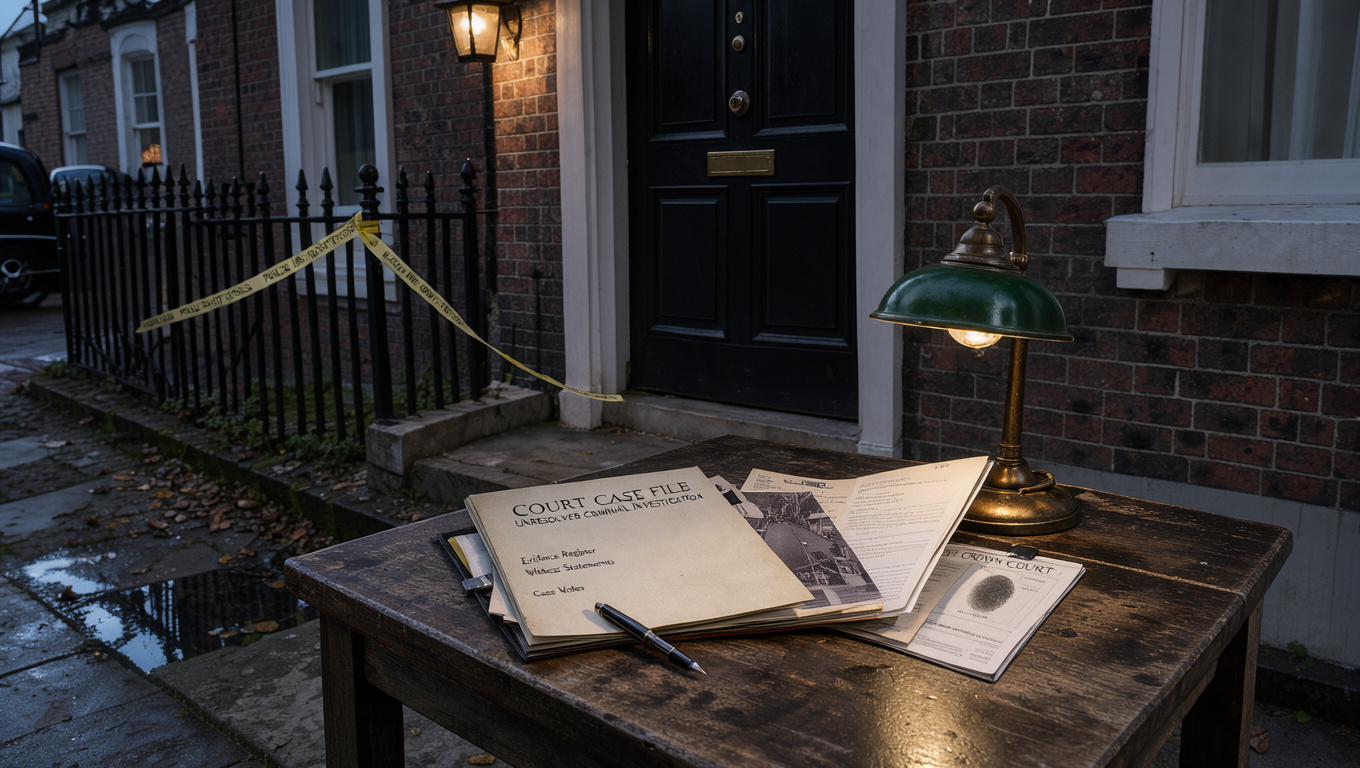
Many viewers still picture Jill Dando at the BBC desk, which is why her killing still hits harder than most cold cases. She was shot dead on her doorstep in Fulham, London, on 26 April 1999, according to The Independent (national newspaper), and the case has turned on a single particle of gunshot residue ever since.
Date of killing: 26 April 1999 · Location: Outside her home in Fulham, London · Wounds: One gunshot wound to the head · Person convicted at trial: Barry George, convicted in 2001 · Conviction outcome: Quashed on appeal in 2007; acquitted at retrial in 2008
Quick snapshot
- Dando was shot dead outside her Fulham home on 26 April 1999 (The Independent (national newspaper))
- She died from a single gunshot wound to the head (The Independent (national newspaper))
- George was convicted on 2 July 2001 and acquitted at retrial on 1 August 2008 (Criminal Cases Review Commission (official review body); BBC News (public broadcaster))
- No other suspect has been charged, according to Wikipedia (open reference)
- A former lead detective believed the murder would never be solved (The Times (national newspaper))
- George had not received compensation as of 2024, according to i news (national news site)
- George was arrested on 25 May 2000, more than a year after the killing (i news (national news site))
- The Criminal Cases Review Commission referred the conviction in June 2007 (Criminal Cases Review Commission (official review body)) (i news (national news site))
- The Supreme Court redefined miscarriage of justice in May 2011 (BBC News (public broadcaster))
- Scotland Yard said in April 2024 that the investigation was inactive, but that no unsolved murder is ever closed (The Times (national newspaper)) (The Tab (student news site))
- Under the 2014 statutory definition, compensation requires a new fact showing beyond reasonable doubt that the applicant did not commit the offence (BBC News (public broadcaster)) (The Tab (student news site))
- A Netflix documentary revisiting the case was released on 26 September 2023, according to The Tab (student news site)
Six core facts, one pattern: the victim’s public identity and the manner of death are documented, while every later step depends on court and review decisions.
| Field | Detail |
|---|---|
| Full name | Jill Wendy Dando (Wikipedia (open reference)) |
| Born | 9 November 1961 (Wikipedia (open reference)) |
| Profession | BBC television presenter and journalist (Wikipedia (open reference)) |
| Died | 26 April 1999, aged 37 (The Independent (national newspaper)) |
| Place of death | Outside her home in Fulham, London (The Independent (national newspaper)) |
| Cause of death | Single gunshot wound to the head (The Independent (national newspaper)) |
What happened to Jill Dando?
Dando was shot dead outside her home in Fulham on 26 April 1999, and she died from one gunshot wound to the head (The Independent (national newspaper)). The murder weapon was a converted blank-firing pistol, and forensic examination suggested a modified starting pistol or a low-velocity reactivated firearm (The Independent (national newspaper)).
Two rival theories have dominated. The prosecution portrayed Barry George as a gun-obsessed stalker, while defence counsel Michael Mansfield QC argued at the 2001 trial that Dando was killed in a Serbian reprisal linked to her Kosovo appeal (The Independent (national newspaper)). In 2015, journalist Mark Williams-Thomas suggested a London crime boss ordered the killing to deter others from taking on organised crime (The Independent (national newspaper)).
A converted blank-firing pistol narrows the type of gun used, but it does not name the person who held it.
In 2024, The Times reported that the Daily Mirror had named Milorad Ulemek as a possible suspect, a claim police have not confirmed (The Times (national newspaper)). Cold-case reviews after 2008 reportedly concluded that a professional assassin carried out a hard-contact execution, according to Wikipedia (open reference), and that view remains contested.
The implication: three rival stories compete for one shot, and no court ruling has settled between them.
What was the evidence against Barry George?
Police arrested George on 25 May 2000, more than a year after the killing (i news (national news site)). The case rested on the following points:
- A single particle of firearm discharge residue found in George’s coat pocket, said to resemble residue found on Dando (Criminal Cases Review Commission (official review body))
- A jury verdict of 10 to 1 at the Old Bailey on 2 July 2001, with a life sentence (Criminal Cases Review Commission (official review body))
- The Court of Appeal’s dismissal of George’s first appeal on 29 July 2002 (Criminal Cases Review Commission (official review body))
The Criminal Cases Review Commission later obtained fresh expert firearms evidence that called the trial residue evidence into question, and it referred the conviction in June 2007 (Criminal Cases Review Commission (official review body)). According to Wikipedia (open reference), the Court of Appeal quashed the conviction in November 2007 and ordered a retrial. The University of Exeter Evidence Based Justice Lab (academic research) records the court’s finding that the residue particle was no more likely to have come from George’s gun than from another source, and that the verdict was unsafe.
One particle of residue carried a life sentence, and the appeal record shows how thin that foundation was once experts looked again.
At the retrial, the residue evidence was not permitted before the jury (BBC News (public broadcaster)). George was acquitted on 1 August 2008 after doubt was cast on the gunshot residue evidence (BBC News (public broadcaster)).
The implication: a life sentence rested on one particle, and the review process found that the particle carried far less weight than the jury had given it.
Did Barry George get compensation?
No. As of 2024, George had never received compensation, according to i news (national news site). The route to payment ran through a series of rulings:
- In 2010, the Ministry of Justice rejected George’s claim for about £1.4m compensation for wrongful imprisonment (i news (national news site))
- In May 2011, the Supreme Court redefined miscarriage of justice, tying eligibility to whether a conviction remained possible on any set of circumstances (BBC News (public broadcaster))
- On 25 January 2013, the High Court ruled that George did not qualify because a reasonable jury was still able to convict him (BBC News (public broadcaster))
- The Divisional Court confirmed in 2013 that the Ministry of Justice decision was correct (BBC News (public broadcaster))
- In February 2015, George protested alongside four other men against tighter compensation criteria (i news (national news site))
Separately, according to Wikipedia (open reference), George accepted substantial damages from News Group Newspapers in December 2009 over articles in The Sun and News of the World. That was a libel settlement, not a state payment for wrongful conviction.
For George, an acquittal did not open the door to payment, because the test asks for proof of innocence rather than the absence of a conviction.
The trade-off: the 2011 ruling widened the legal route, but the criteria tightened afterwards, and the 2014 statutory definition now requires a new fact showing beyond reasonable doubt that the applicant did not commit the offence (BBC News (public broadcaster)).
Who are the presenters of Crimewatch?
The sources gathered for this article do not document the Crimewatch presenter line-up or Dando’s role on the programme, so this section cannot state either as established fact.
- The names of the presenters credited across the programme’s run
- Nick Ross’s long-running role as presenter, and what he said at the end of broadcasts
- The reasons the BBC gave for ending the programme, which must be attributed to the BBC or to named sources
The implication: readers looking for Crimewatch’s history will need a dated broadcast record or a BBC statement, not a summary of the case.
Who was Jill Dando’s partner?
The sources gathered for this piece do not yet confirm who was Dando’s fiancé at the time of her death, so no name is presented here as established fact.
- Fiancé at the time of her death: no dated, named source gathered for this article confirms it
- Current status of Alan Farthing, the name linked to her in planning notes: no dated, named source gathered
- Burial location: no sourced record in the material reviewed
- Whether she had children: no source confirms it
Personal-life details are where unsourced claims travel fastest, so a dated, named record matters more here than anywhere else in the case.
The implication: the personal questions stay open until a named, dated record speaks to them.
Timeline of the case
Eight dates, one pattern: most of the milestones come from courts and review bodies, not from new police charges.
| Date | Event |
|---|---|
| 26 April 1999 | Dando is shot dead outside her Fulham home (The Independent (national newspaper)) |
| 25 May 2000 | Police arrest George (i news (national news site)) |
| 2 July 2001 | George is convicted at the Old Bailey by a 10 to 1 majority and sentenced to life (Criminal Cases Review Commission (official review body)) |
| 29 July 2002 | The Court of Appeal dismisses George’s first appeal (Criminal Cases Review Commission (official review body)) |
| June 2007 | The Criminal Cases Review Commission refers the conviction (Criminal Cases Review Commission (official review body)) |
| November 2007 | The conviction is quashed and a retrial ordered, according to Wikipedia (open reference) |
| 1 August 2008 | George is acquitted at retrial (BBC News (public broadcaster)) |
| 25 January 2013 | The High Court rules George does not qualify for compensation (BBC News (public broadcaster)) |
The implication: the case’s clearest milestones are legal rather than investigative, which is why the appeal record matters more than any police update.
Confirmed facts and open questions
Confirmed facts
- Dando was shot dead outside her Fulham home on 26 April 1999 (The Independent (national newspaper))
- She died from a single gunshot wound to the head (The Independent (national newspaper))
- George was convicted in 2001 and acquitted at retrial on 1 August 2008 (Criminal Cases Review Commission (official review body); BBC News (public broadcaster))
- The University of Exeter’s review found the residue particle was no more likely to come from George’s gun than another source (University of Exeter Evidence Based Justice Lab (academic research))
- The High Court ruled in January 2013 that George did not qualify for compensation (BBC News (public broadcaster))
What’s unclear
- Who fired the fatal shot, and what the motive was
- How much weight the Serbian reprisal theory deserves, since the sources reviewed identify no traced operatives
- The reasons the BBC gave for ending Crimewatch
- The current status of Alan Farthing and the burial location of Dando
- Whether Dando had children
The implication: the confirmed column rests on court records and a 2013 police statement, while the open column covers who fired and why, a question no trial has answered.
What officials and investigators have said
Three voices frame the record, each tied to a legal threshold rather than to the question of who fired the shot.
Compensation is paid only where a new fact shows beyond reasonable doubt that the applicant did not commit the offence.
Ministry of Justice, as summarised by BBC News (public broadcaster)
He did not subscribe to Serbian involvement and believed the murder would never be solved.
Hamish Campbell, former Metropolitan Police lead detective, as reported by The Times (national newspaper)
The investigation was inactive in April 2024, but no unsolved murder is ever closed.
Metropolitan Police (Scotland Yard), as reported by The Times (national newspaper)
The pattern: each voice points to a process, a statute or a case file, and none of them names the person who fired the shot.
For anyone facing a wrongful-conviction claim in England and Wales, the lesson is clear: an acquittal is not enough, and the claim needs a new fact that proves innocence.
Related reading: Emma Barnett BBC Radio 4 profile: age, family, health and career
standard.co.uk, theconspiratory.com, netk.net.au, abc.net.au
Frequently asked questions
When was Jill Dando killed?
She was shot dead on 26 April 1999 outside her home in Fulham, London (The Independent (national newspaper)).
Was the Jill Dando murder ever solved?
No. George’s conviction was quashed in 2007 and he was acquitted at retrial in 2008 (BBC News (public broadcaster)). In April 2024, Scotland Yard said the investigation was inactive but that no unsolved murder is ever closed (The Times (national newspaper)).
What are the main theories about Jill Dando’s murder?
The prosecution argued for a gun-obsessed stalker, while the defence advanced a Serbian reprisal linked to her Kosovo appeal (The Independent (national newspaper)). A further theory holds that a London crime boss ordered the killing as a warning to others (The Independent (national newspaper)).
What was Jill Dando’s age when she died?
She was 37. Born on 9 November 1961, according to Wikipedia (open reference), she died on 26 April 1999 (The Independent (national newspaper)).
Did Jill Dando have children?
The sources gathered for this article do not confirm whether she had children, so the question remains open.
Where did the Jill Dando shooting take place?
It took place outside her home in Fulham, London (The Independent (national newspaper)).
Related stories


Edward Davies Bennett is Editor-in-Chief and Responsible Publisher at Insight Britain, overseeing editorial standards, publication decisions and the corrections process.