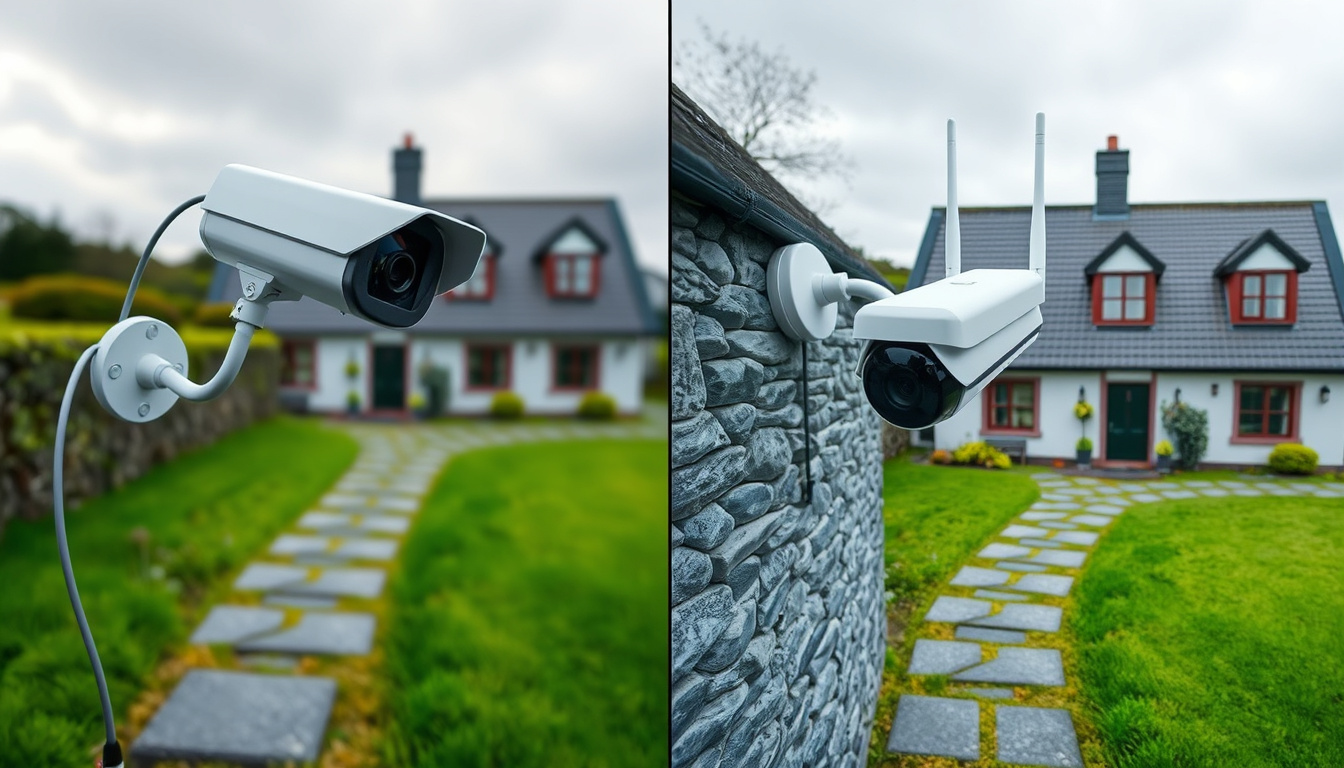
There’s a particular kind of frustration that comes with scrolling through generic CCTV advice online, only to find recommendations that don’t quite fit Irish homes—wrong voltages, unavailable brands, privacy rules that simply don’t apply here. If you’re looking to secure your house in Dublin or rural Kerry, the choices between wired and wireless systems matter differently than they do in a US buying guide. This article cuts through the noise with picks you can actually buy in Ireland, a clear breakdown of how each system works, and the privacy rules that actually govern domestic CCTV on this island.
Typical CCTV footage retention: 30 days · Common resolution for home CCTV: 1080p or 4K · Popular brands in Ireland: HiLook by Hikvision · Wireless CCTV range: Up to 100m · Wired CCTV reliability: 100% uptime without power loss
Quick snapshot
- CCTV works without internet via local storage like NVR or SD card (Coram.ai)
- Subscription-free cameras save €50–120 per camera every year (eufy Ireland)
- eufy SoloCam S340 ranks 1st for wire-free 3K pan-and-tilt (Telegraph)
- Exact best model varies by home size and layout — no universal winner fits every Irish property
- Rural homes with weak broadband may face connectivity issues not well-covered in urban-focused reviews
- Ring Outdoor Cam Plus released with 2K wireless in 2025 (Independent)
- Consumer Reports published 2026 best wireless cameras list with 16 tested models (Consumer Reports)
- 4G cellular cameras emerging as alternative for rural Irish homes without reliable broadband
- Subscription-free trend expected to accelerate as cloud storage costs rise
The table below consolidates the core facts driving any CCTV purchase decision for Irish buyers.
| Label | Value |
|---|---|
| Top Irish Retailer | Currys.ie |
| Popular Kit Brand | HiLook by Hikvision |
| CCTV Guide Source | Screwfix.ie |
| Outdoor Specialist | Ultrasecure.ie |
| Typical Retention | 30 days |
| Common Resolution | 1080p or 4K |
| Wireless Range | Up to 100m |
What is the best CCTV camera for home use?
For most Irish homes, the answer hinges on three things: where you’re mounting it, whether you want to drill cables, and how you feel about monthly subscriptions. Currys.ie stocks wireless CCTV kits that work straight out of the box, while RF Concepts sells HiLook by Hikvision kits built for more permanent setups. Screwfix.ie offers a detailed buying guide covering dome cameras, bullet cameras, and PTZ (pan-tilt-zoom) options if you want to go deeper on types.
Top picks from Irish retailers
The eufy Ireland blog narrows the field to models you can actually buy locally. Their top wired recommendation: the eufy PoE NVR Security System S4 Max, praised as the strongest wired CCTV-style system available in Ireland. For wireless, the eufy SoloCam S340 delivers 4K clarity without ongoing costs—a combination that consistently ranks it highest in independent testing. The Telegraph placed the SoloCam S340 at number one for wire-free pan-and-tilt performance.
Factors to consider for home setup
Most Irish homes benefit from 2K or 4K wireless cameras based on property size, according to eufy Ireland. Key variables include how many cameras you need (single-storey semidetached vs large rear garden coverage), whether you rent (wireless wins for tenant-friendly installation), and whether you want 24/7 recording or motion-triggered clips only. Selectra.ie notes that Ireland favors wireless for homes, with wired systems more common in commercial and industrial settings.
eufy SoloCam S340 ranks 1st for wire-free performance and costs nothing monthly. For Irish buyers who want reliability without subscriptions, it sets the benchmark—provided your property layout doesn’t demand multiple wired feeds.
Upsides
- No drilling or cable runs for wireless options
- Most systems include local storage, eliminating cloud fees
- Remote viewing via smartphone app standard across major brands
- 2K and 4K models now affordable for home budgets
Downsides
- Wi-Fi signal strength directly affects footage quality
- Battery-powered wireless cameras need recharging every few months
- Wired installation requires professional help for clean results
- Some brands lock features behind subscription paywalls
Which CCTV camera is best, wired or wireless?
This is the central question for any Irish homeowner, and the honest answer is: it depends on your property and priorities. TP-Link’s comparison breaks it down cleanly—wired cameras are more reliable with less signal interference and higher quality images, but they require professional installation and drilling for cabling. Wireless cameras are preferable for Irish home installation due to easier setup without drilling, per Selectra.ie.
Pros and cons of wired CCTV
Wired cameras use Ethernet or coaxial cables for power and data, linked to an NVR or DVR for on-site storage. PoE (Power over Ethernet) cameras need only one cable for both power and data, reducing clutter, according to Coram.ai. The advantages are substantial: 24/7 full-resolution footage without compression or lag, stable power via PoE, and wired connections more secure against cybersecurity attacks than wireless. Verkada confirms wired cameras deliver consistent high-speed data transfer without interference. The downside is clear: professional installation typically required, drilling through walls, and harder to relocate once fitted.
Pros and cons of wireless CCTV
Wireless WiFi cameras offer easier setup, remote monitoring via app, and smart home integration, per Coram.ai. They’re preferable for Irish homes where running cables is challenging or where tenants need a non-permanent solution. The catch is signal dependency—wireless cameras depend on Wi-Fi strength, risking blurry or delayed footage if your router is far from the camera location, warns Ackerman Security. Also, many wireless cameras still require wired power, despite Wi-Fi data transmission, according to Consumer Reports.
Best for Irish homes
For standard Irish residential properties—detached houses with medium-sized gardens, semi-detached townhouses, or apartments—a wireless system covers most needs. Selectra.ie confirms that Ireland’s residential market strongly favors wireless. Wired makes sense when you need more than six cameras, require 24/7 continuous recording without battery concerns, or want maximum security against signal interception. Local storage in wired/NVR systems enhances privacy over cloud-dependent wireless, notes Coram.ai—relevant for Irish homeowners cautious about data handling.
Wired systems win on reliability and security; wireless wins on installation simplicity. Irish homeowners in rented properties or older homes with limited cable routing options should default to wireless unless they have specific security requirements that demand wired infrastructure.
Can CCTV cameras work without internet?
Yes—and for privacy-conscious Irish homeowners, this is a significant feature. CCTV systems work without internet via local storage devices like DVRs, NVRs, or onboard SD cards. Coram.ai confirms that local storage in wired/NVR systems enhances privacy over cloud-dependent wireless setups. The footage never leaves your property, which means no subscription fees and no third-party data handling to worry about under GDPR considerations.
Local storage options
Wired systems connect to an NVR (Network Video Recorder) or DVR (Digital Video Recorder) that stores footage on internal hard drives—typically 1TB to 4TB, allowing 30 days of retention or more depending on resolution and frame rate settings. Wireless cameras with local storage use onboard SD cards (usually up to 128GB) or a base station with hard drive storage. eufy cameras offer local storage and AI motion detection with no monthly fees, according to eufy Ireland.
Viewing footage offline
Accessing stored footage without internet requires either a monitor directly connected to the NVR/DVR or app access on your local network. When the recorder and your phone are on the same Wi-Fi network (even without internet), most apps allow local playback. For fully offline scenarios—say, a remote rural property with no broadband—you’ll need a monitor or TV connected via HDMI to the recorder itself. This setup is common in farm security applications where broadband coverage is unreliable.
What is the difference between a security camera and CCTV?
The terms get used interchangeably, but they describe different setups. CCTV (Closed-Circuit Television) typically refers to multi-camera wired systems where all cameras feed back to a central recorder (DVR or NVR). Think traditional commercial installations—bank lobbies, car parks, retail floors. Coram.ai explains that wired cameras use Ethernet or coaxial cables linked to NVR/DVR for on-site storage—the defining CCTV architecture.
CCTV systems overview
Traditional CCTV systems are built around a centralized recording architecture. Cameras are hardwired to a central DVR or NVR, which handles recording, storage, and usually remote viewing. These systems handle more cameras per system than wireless, per TP-Link. Wired systems enable 24/7 recording without battery concerns via PoE, notes eufy.
Standalone security cameras
Modern security cameras—often IP-based wireless devices—are standalone units that connect to your home network and typically store footage in the cloud or on a local base station. They integrate with smartphone apps for alerts and live viewing. Yale indoor/outdoor cameras fall into this category, offering no subscription fee and easy setup, per Independent. The Ring Outdoor Cam Plus, new for 2025, is a wireless standalone with 2K video—designed for plug-and-play home security without a full DVR system.
CCTV and security cameras are converging. Many “smart” cameras now offer NVR-style local storage and multi-camera viewing via apps, blurring the distinction. For Irish buyers, the practical difference comes down to scale: a single camera covers an entrance or room; CCTV systems cover whole properties with multiple zones.
Can my neighbour have CCTV pointing at my house in Ireland?
This is a real source of neighbour disputes in Irish residential areas, and the rules are clearer than most people assume. Under GDPR and Ireland’s data protection framework, CCTV is considered personal data processing. If your neighbour’s camera captures images beyond the boundary of their own property—onto your garden, driveway, or home—you may have grounds to raise a concern. The Privacy Shield Authority (now integrated into the DPC) has published guidance on domestic CCTV that applies to both homeowners installing cameras and those affected by neighbours’ systems.
Irish data protection rules
The Data Protection Commission (DPC) guidance states that domestic CCTV operators must ensure their cameras are positioned to minimize intrusion into neighbouring properties or public spaces. Capturing areas beyond your own property without justification can constitute a data protection breach. Practical steps for homeowners: angle cameras to cover only your own property, use privacy masks on software where available, and keep footage only as long as necessary (typically 30 days). If you believe a neighbour’s camera is capturing your property illegally, you can make a complaint to the DPC.
How to address privacy concerns
Before escalating, a direct and friendly conversation often resolves the issue—many neighbours simply aren’t aware their camera angle affects you. Ask them to adjust the positioning or explain the privacy concern politely. If that doesn’t work, document the intrusion with photos and check whether your local authority has specific guidelines. For renters, check your tenancy agreement—some leases include clauses about external modifications including CCTV mounting. eufy’s guide on blocking neighbour cameras suggests privacy screens and directional adjustment as first steps before formal complaints.
How to choose and install your home CCTV system
Eight steps separate a vague idea from a working CCTV setup in your Irish home. Each stage involves decisions that affect cost, complexity, and long-term usability.
- Audit your property: Walk the perimeter and identify entry points, blind spots, and areas requiring coverage. Detached homes need different strategies than apartments.
- Decide wired vs wireless: If you own the property long-term and can run cables, wired PoE systems offer the best reliability. Renters or those wanting flexibility should choose wireless with local storage.
- Select your resolution: 1080p covers basic needs; 2K offers good detail for identifying faces; 4K is ideal for large gardens or parking areas where you need to read number plates from distance.
- Choose local or cloud storage: Local storage (NVR or SD card) avoids subscriptions and keeps data private. Cloud storage offers remote access convenience but adds monthly costs.
- Check broadband and Wi-Fi coverage: Wireless cameras need a stable Wi-Fi signal at the installation point. Consider a Wi-Fi extender or Mesh network if your garden or outbuildings are far from your router.
- Source from Irish retailers: Currys.ie, RF Concepts, Screwfix.ie, and Ultrasecure.ie offer products with Irish warranties and availability. Checkorus.ie lists current pricing across retailers for popular models.
- Install and test: For wireless cameras, installation is straightforward: mount the bracket, attach the camera, connect to app. For wired systems, consider professional installation to ensure clean cable routing and correct NVR configuration.
- Configure alerts and retention: Set motion detection zones, adjust sensitivity, configure notification preferences, and ensure footage retention aligns with your needs (typically 30 days for home use).
Professional installation for wired systems costs €100–300 depending on property size, but it eliminates the most common DIY failure: cables routed poorly through walls or clips that fail within a year. Weigh installation cost against the risk of re-doing it yourself.
Comparing wired and wireless CCTV for Irish homes
Seven factors separate the two technologies on points that matter for Irish residential use. Wired systems lead on reliability and image quality; wireless systems lead on installation simplicity and flexibility.
The head-to-head comparison below summarizes where each approach wins and loses for typical Irish home installations.
| Factor | Wired | Wireless |
|---|---|---|
| Installation complexity | Requires cable routing, often professional | DIY-friendly, no cables needed |
| Image quality | 24/7 full-resolution, no compression | Dependent on Wi-Fi bandwidth; may compress |
| Reliability | 100% uptime via PoE, no signal drop | Signal strength dependent; may lag or blur |
| Storage | NVR with 1–4TB local storage standard | SD card or base station; cloud optional |
| Security | More secure against signal interception | Wi-Fi vulnerability if not encrypted |
| Flexibility | Fixed once installed | Easy to reposition or relocate |
| Scalability | Handles more cameras per system | Limited by Wi-Fi network capacity |
Specifications for popular home CCTV options
Four popular models represent the range of options available to Irish buyers—from budget-friendly to premium, from wired to wireless, with pricing and performance that reflects those differences.
| Model | Type | Resolution | Storage | Subscription | Notable strength |
|---|---|---|---|---|---|
| eufy PoE NVR S4 Max | Wired PoE | 4K | NVR, local | None | Strongest wired option for Ireland |
| eufy SoloCam S340 | Wireless | 4K (3K pan-tilt) | Local / base station | None | Top-ranked wire-free camera |
| Ring Outdoor Cam Plus | Wireless | 2K | Cloud (optional) | Optional | 2025 release, smart integration |
| Reolink E1 Pro | Wireless | 1440p (2K) | SD / cloud | Optional | Excellent video quality, fast response |
Reolink E1 Pro scored excellent for video quality, response time, and data security in Consumer Reports testing—making it a strong alternative if eufy’s availability is uncertain in your area.
What experts say about home CCTV
Most Irish homes get excellent protection from a 2K or 4K wireless security camera.
— eufy Ireland (Brand Expert)
Subscription-free cameras can save you €50–120 per camera every year.
— eufy Ireland (Brand Expert)
Wired cameras are ideal for most situations where wiring is possible.
— Verkada (Security Expert)
If you can’t run wires around your property, then the next best thing is a Wi-Fi camera that uses an outlet.
— Security Camera Guide (Tech Reviewer)
Related reading: Best Cordless Vacuum Cleaner UK
Popular eufy CCTV picks often pair well with doorbell cameras, where the detailed detailed Eufy doorbell camera guide outlines dual-lens features and easy offline setup for Irish homes.
Frequently asked questions
How to use a security camera without Wi-Fi?
Security cameras work without Wi-Fi through local storage options. Wired cameras connect directly to an NVR or DVR that records footage to internal hard drives. Wireless cameras with SD card slots store footage onboard—simply remove the card and view recordings on any computer. Some cameras also support cellular connectivity via SIM card for locations without broadband.
Can someone video record you without permission in Ireland?
Under GDPR and Irish data protection law, recording someone without their knowledge on private property is a nuanced area. Domestic CCTV operators are expected to position cameras to minimize intrusion into neighbouring properties. Recording private conversations without consent is illegal. If you believe someone’s camera is capturing your property illegally, you can raise a complaint with the Data Protection Commission.
How long do CCTV recordings usually last?
Most home CCTV systems retain footage for 30 days by default, with storage capacity determining the actual window. Higher resolution settings (4K) consume more storage and may reduce retention to 14–21 days on the same hard drive. Many systems allow you to configure retention period based on available storage.
Can I connect my security camera to my phone without Wi-Fi?
Yes, using a local network connection. If your camera and phone are on the same Wi-Fi network—without internet access—most apps allow live viewing and playback through local network access. For completely offline scenarios (no router involved), some cameras create their own direct Wi-Fi hotspot that your phone connects to temporarily.
What features to look for in outdoor CCTV?
Outdoor cameras need weatherproofing (IP65 or higher rating), night vision capability, sufficient resolution for your coverage area (2K minimum for identifying faces), local or cloud storage options, and reliable motion detection that distinguishes between people, vehicles, and animals. Consider wide dynamic range for handling changing outdoor lighting conditions.
Are there CCTV cameras for sale in Ireland?
Yes. Major Irish retailers include Currys.ie (wireless kits and smart home cameras), RF Concepts (HiLook by Hikvision professional kits), Screwfix.ie (range of camera types with buying guides), and Ultrasecure.ie (specialist outdoor and 4G options). Online retailers like Amazon.co.uk also deliver to Ireland, though warranty and return policies may differ.
For Irish homeowners, the choice between wired and wireless CCTV isn’t really about which technology is objectively better—it’s about matching the system to your property, your tenure situation, and your privacy priorities. Wireless systems cover most standard homes without the hassle of cable routing. Wired systems earn their installation cost when you need maximum reliability, multi-camera coverage, or 24/7 recording on a large property. Either way, the privacy rules are clear: angle your cameras inward, keep footage local where possible, and if a neighbour’s camera captures your property, start with a conversation before reaching for the Data Protection Commission.

Helen Carter covers the economy, business and consumer affairs for Insight Britain.