
If you’ve been feeling wiped out even after a full night’s sleep, it’s easy to blame a busy schedule, but sometimes the culprit isn’t overwork — it’s your iron levels. Millions of people, especially women, live with low iron without knowing it, mistaking symptoms like fatigue and brain fog for everyday stress.
Global prevalence of iron deficiency: affects 2 billion people (WHO) ·
Women of reproductive age: 30% are iron deficient ·
Most common symptom: fatigue in up to 80% of cases ·
Daily iron requirement for women: 18 mg (19–50 years)
Quick snapshot
- Fatigue is a primary symptom (Mayo Clinic (leading U.S. hospital))
- Iron deficiency can cause anemia (American Society of Hematology (medical society))
- Heavy menstrual bleeding is a common cause (Cleveland Clinic (academic medical center))
- Low ferritin can cause symptoms before anemia develops (Yale Medicine (academic medical center))
- Exact mechanism linking pica (ice cravings) to low iron is unknown (American Society of Hematology (medical society))
- No routine screening guidelines for iron deficiency in U.S. for healthy adults (Yale Medicine (academic medical center))
- Symptoms worsen as iron levels fall and anemia becomes more severe (Mayo Clinic (leading U.S. hospital))
- Symptoms may occur before blood counts meet anemia threshold (GoodRx (health information platform))
- Schedule blood test (CBC, ferritin) if symptoms persist (NHS (U.K. national health authority))
- Dietary changes and supplements can correct deficiency in weeks to months (GoodRx (health information platform))
Women between 19 and 50 need 18 mg of iron daily — yet nearly a third in that age group don’t get enough. The disconnect isn’t about willpower; it’s about symptom awareness. Missing the early, vague signs means many don’t seek care until deficiency has already progressed to anemia.
Four key facts lay the groundwork for recognizing low iron:
| Factor | Details |
|---|---|
| Global prevalence | 2 billion people affected (WHO (global health authority)) |
| Women of reproductive age | 30% are iron deficient (Yale Medicine (academic medical center)) |
| Most common symptom | fatigue (Mayo Clinic (leading U.S. hospital)) |
| Daily iron requirement (women 19-50) | 18 mg (NIH Office of Dietary Supplements (U.S. federal agency)) |
What are 5 signs of low iron?
Iron deficiency sends a mix of well-known and sneakier signals. Here are five signs that span both ends of the spectrum, backed by medical authorities.
What are the most common symptoms?
- Fatigue and weakness — Up to 80% of people with low iron report fatigue as their primary complaint, per American Society of Hematology (medical society). It happens because iron is needed to make hemoglobin, which carries oxygen to tissues.
- Pale skin — Reduced hemoglobin gives skin, gums, and nail beds a paler appearance. This can be one of the earliest visible signs (Mayo Clinic (leading U.S. hospital)).
- Shortness of breath — Even climbing a single flight of stairs can leave you winded when your blood can’t carry enough oxygen (NHS (U.K. national health authority)).
- Heart palpitations — A fast or pounding heartbeat is the heart trying to compensate for low oxygen by pumping harder (American Society of Hematology (medical society)).
- Dizziness or lightheadedness — Especially when standing up quickly, due to reduced oxygen delivery to the brain (Mayo Clinic (leading U.S. hospital)).
What unexpected signs should you watch for?
Beyond the obvious, iron deficiency often reveals itself through curiosities that don’t immediately scream “low iron.”
- Brittle nails and dry hair — Iron is essential for healthy cell growth in nails and hair follicles. Spoon-shaped nails (koilonychia) can develop in chronic cases (GoodRx (health information platform)).
- Restless legs syndrome (RLS) — An uncontrollable urge to move the legs, especially at night. Research published by Mayo Clinic (leading U.S. hospital) confirms a strong link between low iron and RLS.
- Pica (craving ice or non-food items) — Craving ice, clay, or even dirt. The exact mechanism isn’t fully understood, but the association is well-documented (American Society of Hematology (medical society)).
- Cold hands and feet — Poor oxygen circulation makes extremities feel colder than the rest of your body (NHS (U.K. national health authority)).
- Tongue soreness or smoothness — A swollen, tender, or unusually smooth tongue can be a sign of long-standing anemia (GoodRx (health information platform)).
How do symptoms differ in women?
Women face distinct patterns because of menstruation, pregnancy, and hormonal factors, and many attribute their symptoms to something else entirely.
- Heavier baseline symptom load — Many women mistake fatigue, dizziness, and brain fog for poor sleep or stress, per Yale Medicine (academic medical center).
- Iron deficiency without anemia is real in women — Low ferritin (stored iron) can still cause fatigue, hair thinning, restless legs, and mood changes even when hemoglobin is normal (Yale Medicine (academic medical center)).
- Hair loss — Women often report increased hair shedding with low iron. The GoodRx (health information platform) notes this is one of the more distressing early signs.
- Menstrual connection — Heavy periods (menorrhagia) are a leading cause of iron deficiency in women of reproductive age (Cleveland Clinic (academic medical center)).
How can I tell if my iron is low?
Knowing whether you’re low on iron involves a combination of self-symptom tracking and lab work. No single home test replaces a doctor’s evaluation, but the clues build a strong case.
Self-assessment of symptoms
Start by checking yourself against the most common checklist:
- Do you feel fatigued even after a good night’s sleep?
- Are you short of breath during mild activities you used to handle easily?
- Have you noticed paler skin, especially in your inner eyelids or nail beds?
- Do you crave ice or chew on non-food items occasionally?
- Are your hands and feet often cold even in a warm room?
- Do you experience restless legs at night?
- Have you noticed brittle nails or increased hair shedding?
Answering “yes” to two or more of these, especially in combination with fatigue, warrants a conversation with a healthcare provider.
When to see a doctor
The NHS (U.K. national health authority) advises seeing a GP if you experience persistent fatigue, shortness of breath with minimal exertion, heart palpitations, or pale complexion. The American Society of Hematology (medical society) adds that chest pain with activity, pounding in the ears, and a rapid heartbeat are also red flags that warrant prompt evaluation.
Blood tests for iron deficiency
A doctor can order a complete blood count (CBC) and a ferritin test. Key numbers to know:
- Hemoglobin: Normal ranges are 12-15.5 g/dL for women and 13.5-17.5 g/dL for men. Levels below indicate anemia.
- Ferritin: Measures stored iron. Levels below 30 ng/mL suggest iron depletion; below 12-15 ng/mL is a sign of deficiency (GoodRx (health information platform)).
- Transferrin saturation: Typically below 16% indicates inadequate iron supply for red blood cell production (Yale Medicine (academic medical center)).
What drains iron from your body?
Understanding what depletes your iron stores helps you solve the root cause — not just treat the symptom.
Blood loss (menstruation, GI bleeding)
- Heavy menstrual periods are the leading cause of iron deficiency in women of reproductive age, per Cleveland Clinic (academic medical center). Losing more than 80 mL of blood per cycle can deplete iron stores in a matter of months.
- Gastrointestinal bleeding from ulcers, hemorrhoids, or conditions like colon cancer can cause chronic, subtle blood loss — sometimes the only sign is low iron discovered on a routine lab test (Mayo Clinic (leading U.S. hospital)).
- Frequent blood donation — Donating blood several times a year can lower iron stores. The NHS recommends donor iron repletion and monitoring.
Dietary factors
Your diet matters as much as what you lose. Iron exists in two forms:
- Heme iron (from meat, poultry, fish) is absorbed at 15-35% efficiency (NIH Office of Dietary Supplements (U.S. federal agency)).
- Non-heme iron (from plants, fortified foods) is absorbed at only 2-20% efficiency. Vegan and vegetarian diets require careful planning to meet iron needs.
- Iron absorption inhibitors: Tannins in tea and coffee, calcium in dairy, and phytates in whole grains can reduce absorption by 50% or more when consumed with meals (GoodRx (health information platform)).
Medical conditions (celiac, IBD)
- Celiac disease damages the villi in the small intestine, reducing the surface area that absorbs iron. It can cause iron deficiency even without classic GI symptoms (Mayo Clinic (leading U.S. hospital)).
- Inflammatory bowel disease (IBD) — Crohn’s and ulcerative colitis involve chronic intestinal inflammation and blood loss, both of which drain iron (American Society of Hematology (medical society)).
- Pregnancy increases iron demand dramatically — from around 18 mg/day to 27 mg/day during the second and third trimesters — to support fetal development and expanded blood volume (NIH Office of Dietary Supplements (U.S. federal agency)).
Treating a symptom without identifying the root cause means low iron can recur. For young women, heavy periods often drive the deficiency. In older adults, GI bleeding from polyps or cancer could be the hidden cause. A one-off iron supplement might fix the lab numbers, but without a cause investigation, you could miss something serious.
How to boost iron immediately?
If you suspect your iron is low, you can start improving your levels today — but strategy matters more than volume. Follow these steps:
- Choose the right supplement form (ferrous sulfate, ferrous fumarate, or ferrous gluconate). Ferrous sulfate is typically recommended for cost and absorption.
- Take on an empty stomach at least one hour before or two hours after meals.
- Avoid tea, coffee, and calcium within two hours of taking iron to prevent absorption interference.
- Pair with vitamin C (e.g., a glass of orange juice) to boost absorption by 30% or more.
- Start with a low dose and gradually increase over a week to minimize gastrointestinal side effects.
Iron-rich foods (meats, vegetables)
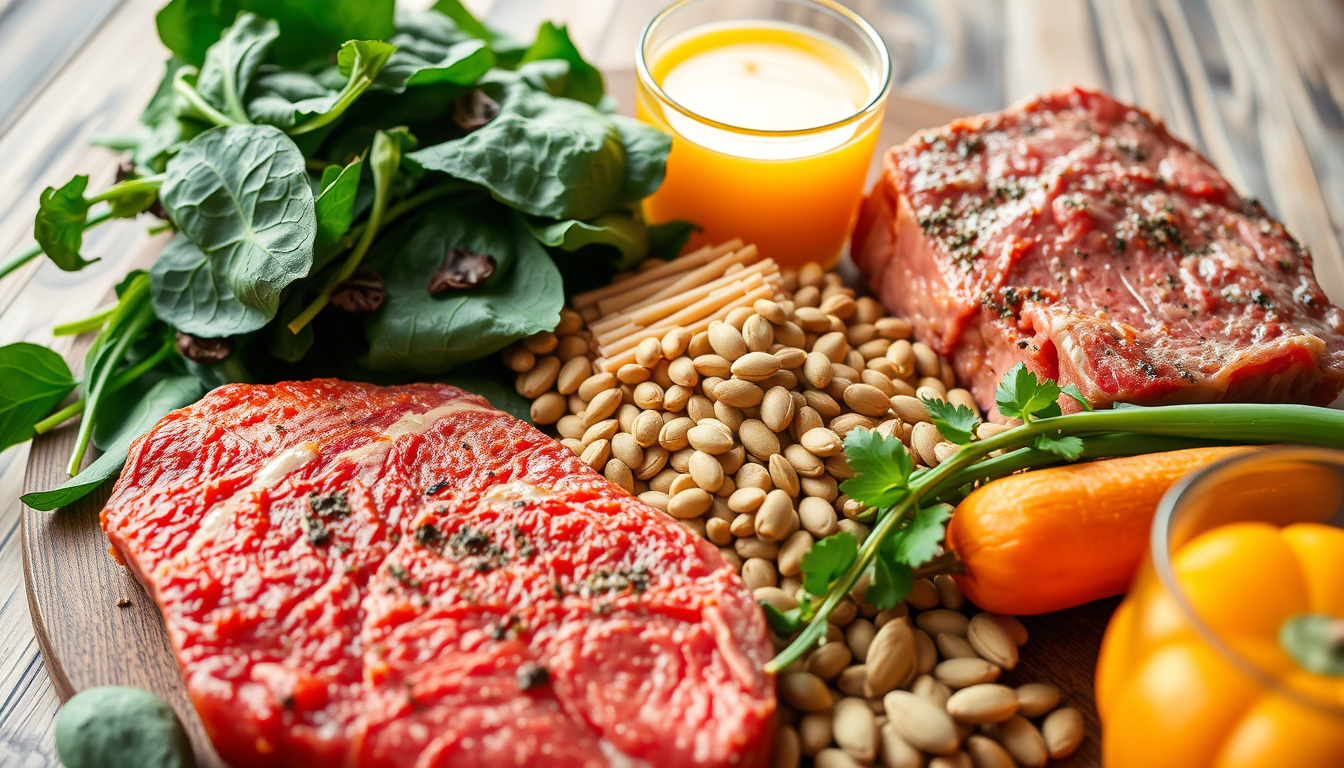
Four foods, one pattern: absorption efficiency varies sharply. Pair foods strategically.
- Red meat (beef, lamb, liver) — Provides heme iron, which bypasses many absorption inhibitors. A 3-ounce serving of beef provides about 2-3 mg iron (NIH Office of Dietary Supplements (U.S. federal agency)).
- Spinach and leafy greens — Rich in non-heme iron, but also high in oxalates that reduce absorption. Cooking spinach reduces oxalate content and can increase available iron by 15-30%.
- Legumes (lentils, chickpeas, beans) — A cup of cooked lentils provides 6.6 mg iron. Pair with vitamin C for better non-heme absorption.
- Fortified cereals — Many breakfast cereals contain 8-18 mg iron per serving. Check labels; ferrous fumarate or ferrous sulfate are common forms.
High-iron drinks
Drinks that pack a notable iron punch include:
- Blackstrap molasses in warm water — One tablespoon contains about 3.5 mg iron.
- Prune juice — One cup provides about 3 mg iron plus vitamin C.
- Iron-fortified plant milks — Some brands provide up to 4 mg per serving. Always shake well, as iron can settle.
- Smoothie with spinach + orange — The vitamin C from orange can increase non-heme iron absorption by up to 6-fold (GoodRx (health information platform)).
Iron supplements and timing
- Choose the right form — Ferrous sulfate, ferrous fumarate, and ferrous gluconate are common. Ferrous sulfate is typically recommended for its cost and absorption profile.
- Take on an empty stomach — For best absorption, take iron supplements with water or juice at least one hour before or two hours after meals (NHS (U.K. national health authority)).
- Avoid tea, coffee, and calcium within two hours of taking iron. Tannins and calcium sharply reduce absorption (GoodRx (health information platform)).
- Pair with vitamin C — A glass of orange juice or a vitamin C supplement taken at the same time can boost absorption by 30% or more.
- Start low, go slow — Taking the full recommended dose (usually 60-120 mg elemental iron daily) from day one can cause nausea, constipation, or stomach pain. Build up over a week.
What this means: combining strategic food choices with proper supplement timing can restore iron levels efficiently, but only after ruling out hidden blood loss.
What are the 3 stages of iron deficiency?
Iron deficiency doesn’t happen overnight. It progresses through three distinct stages, each with different lab findings and symptoms. Дізнайтеся більше про причини тривалого кашлю за цим посиланням причини тривалого кашлю.
Stage 1: Iron depletion
- What happens: Your body’s stored iron in the form of ferritin begins to drop. Bone marrow, liver, and spleen release stored iron to keep hemoglobin at normal levels.
- Lab markers: Ferritin falls below 30 ng/mL. Hemoglobin remains normal, and serum iron may still be in range.
- Symptoms: Many people have no symptoms at this stage, but some may feel mild fatigue, brain fog, or hair thinning (GoodRx (health information platform)).
Stage 2: Iron-deficient erythropoiesis
- What happens: Stored iron is exhausted. The bone marrow struggles to produce enough red blood cells. Transferrin (the iron transport protein) saturation drops.
- Lab markers: Transferrin saturation falls below 16%. TIBC (total iron-binding capacity) rises. Hemoglobin may still be normal or borderline low.
- Symptoms: Fatigue becomes more noticeable. Restless legs, cravings for ice, and subtle paleness may appear (American Society of Hematology (medical society)).
Stage 3: Iron deficiency anemia
- What happens: Hemoglobin production drops significantly. Red blood cells become smaller (microcytic) and paler (hypochromic) than normal.
- Lab markers: Hemoglobin falls below normal — typically below 12 g/dL in women or 13.5 g/dL in men. Ferritin is very low (<12 ng/mL). Mean corpuscular volume (MCV) drops.
- Symptoms: All the classic symptoms appear: severe fatigue, shortness of breath with minimal exertion, chest pain, fast heartbeat, dizziness, pale skin, and cold intolerance (Mayo Clinic (leading U.S. hospital)).
The implication: By the time anemia is diagnosed, you’ve already been in a deficient state for weeks or months. That’s why catching the first stage — iron depletion — is critical. A ferritin test, not just a CBC, can detect it before symptoms become severe.
What we know for sure — and what remains unclear
Confirmed facts
- Fatigue is a primary symptom of iron deficiency (Mayo Clinic (leading U.S. hospital))
- Iron deficiency can cause anemia (American Society of Hematology (medical society))
- Heavy menstrual bleeding is a common cause (Cleveland Clinic (academic medical center))
What’s unclear
- Exact mechanism linking pica (ice cravings) to low iron remains unknown (American Society of Hematology (medical society))
- No routine screening guidelines exist in the U.S. for healthy adults (Yale Medicine (academic medical center))
- Symptoms may occur before blood counts meet anemia threshold (GoodRx (health information platform))
“Iron deficiency anemia may be so mild at first that symptoms are not noticed.”
Mayo Clinic (leading U.S. hospital)
“Many women mistake iron deficiency symptoms such as fatigue, dizziness, and brain fog for poor sleep or stress.”
Yale Medicine (academic medical center)
Iron deficiency is highly treatable, yet it remains underdiagnosed because its earliest signals blend into daily life. For the woman who chalks up her fatigue to a packed calendar, or the man who ignores his shortness of breath as a sign of getting older, the real cost is delayed treatment and prolonged discomfort. A single blood test — ferritin plus CBC — can separate lack of sleep from lack of iron. For the roughly 2 billion people worldwide living with deficiency, the choice is clear: pay attention to the subtle signs, or risk letting a fixable problem turn into a chronic health drain.
Frequently asked questions
Can low iron cause hair loss?
Yes. Iron deficiency, particularly when ferritin levels are low, can lead to telogen effluvium — a temporary increase in hair shedding. The GoodRx (health information platform) lists hair loss as one of the common signs of iron deficiency in women. Hair usually regrows once iron levels normalize.
Does low iron affect sleep?
Yes, in two ways. First, restless legs syndrome associated with low iron can disrupt sleep onset and quality. Second, night sweats and frequent awakenings are reported by some people with iron deficiency anemia (American Society of Hematology (medical society)).
Can you have low iron without anemia?
Absolutely. This is called iron deficiency without anemia. Your ferritin levels are low, so your iron stores are depleted, but your hemoglobin is still in the normal range. Symptoms can still include fatigue, brain fog, brittle nails, and hair thinning (Yale Medicine (academic medical center)).
Is it safe to take iron supplements daily?
Taking iron supplements daily is safe for most people when following the recommended dose on the label or as advised by a healthcare provider. However, excess iron can be toxic, causing nausea, constipation, and in severe cases, organ damage. Never take more than the recommended dose without medical supervision (NIH Office of Dietary Supplements (U.S. federal agency)).
What is the best time to take iron?
Take iron supplements on an empty stomach (at least one hour before a meal or two hours after) for best absorption. Taking iron in the morning with a glass of orange juice (vitamin C) and avoiding tea/coffee for two hours before and after minimizes absorption interference (NHS (U.K. national health authority)).
How long does it take to correct iron deficiency with supplements?
Most people start feeling better within 1-2 weeks of consistent supplementation. Hemoglobin levels typically improve noticeably within 2-4 weeks. However, it can take 2-3 months to fully replenish iron stores (ferritin levels). The GoodRx (health information platform) recommends continuing supplements for at least 3-6 months after hemoglobin normalizes to rebuild ferritin.
Can low iron cause heart palpitations?
Yes. Palpitations (a feeling of a racing, pounding, or irregular heartbeat) are a common symptom of iron deficiency anemia. When your blood can’t carry enough oxygen, the heart compensates by beating faster and harder. The American Society of Hematology (medical society) lists rapid heartbeat among the key symptoms of iron-deficiency anemia.
What are 5 unexpected signs of low iron?
The five most overlooked signs are: (1) craving ice or non-food items (pica), (2) brittle nails that may develop a spoon shape, (3) restless legs syndrome at night, (4) a sore or unusually smooth tongue, and (5) cold hands and feet even in warm environments (Mayo Clinic (leading U.S. hospital)).
For women tracking their health, the link between bowel cancer symptoms in women and iron deficiency is clinically significant — colorectal cancer can cause chronic internal blood loss that depletes iron stores. Similarly, if you experience heart palpitations with other symptoms, check how to stop heart palpitations and consider whether iron deficiency could be the underlying cause.
Related stories





Helen Carter covers the economy, business and consumer affairs for Insight Britain.