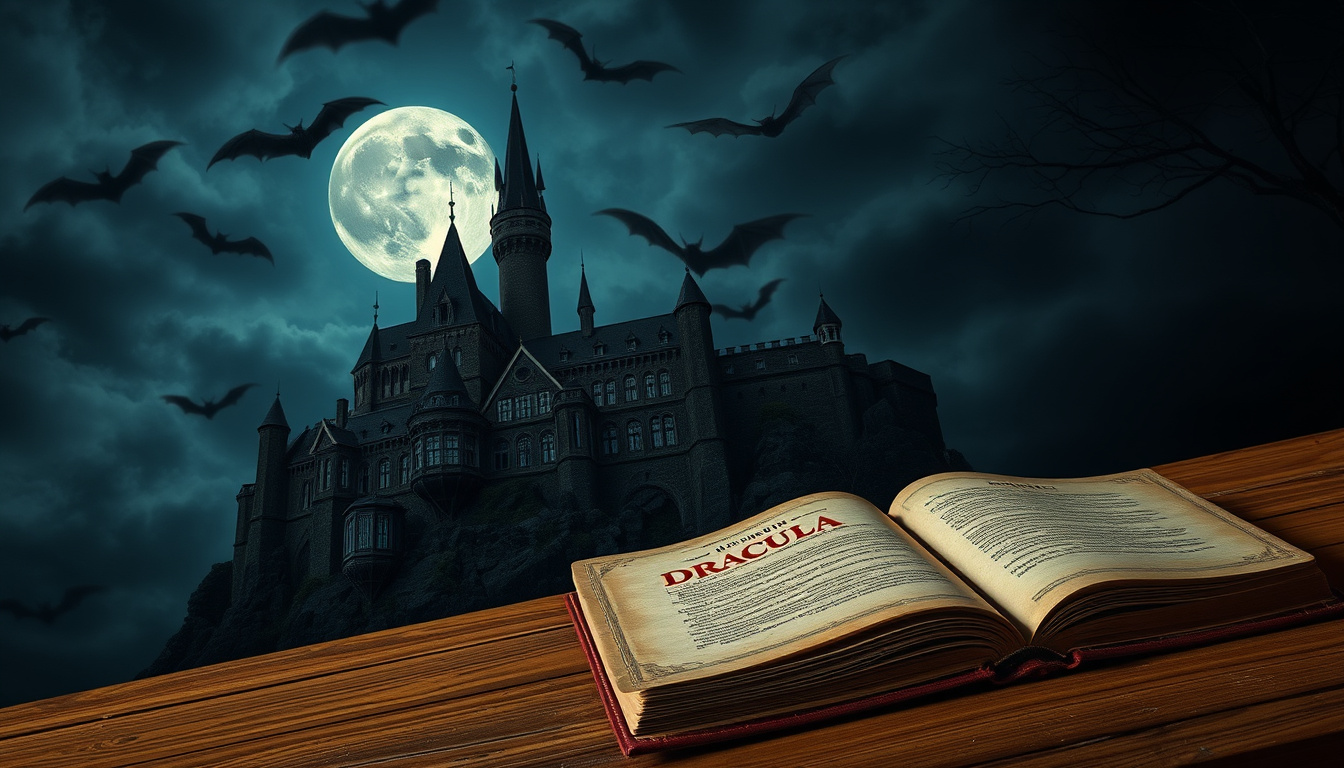
Bram Stoker, the Irish author of Dracula, led a life as multifaceted as his famous vampire — he was a barrister, theatre manager, and civil servant. This biography explores his Dublin roots, health struggles, and the queer readings of his masterpiece.
Born: 8 November 1847 · Died: 20 April 1912 · Nationality: Irish · Famous Work: Dracula (1897)
Quick snapshot
- Born 8 November 1847 in Clontarf, Dublin (Britannica (encyclopedia))
- Married Florence Balcombe in 1878 (Britannica)
- Published Dracula in 1897 (Britannica)
- Exact cause of death: ‘exhaustion’ and ‘locomotor ataxia’ recorded, but some historians speculate syphilis (Britannica)
- Whether Stoker intentionally wrote queer subtext into Dracula is debated (Wikipedia (community encyclopedia))
- 1847: Born in Clontarf, Dublin (Britannica)
- 1897: Dracula published (Britannica)
- 1912: Dies in London (Britannica)
- Continued scholarly interest in Stoker’s life and the queer interpretations of Dracula (Wikipedia)
- New editions and ebooks keep his work accessible (University of Pennsylvania (academic library))
Five key facts frame Stoker’s life story.
| Label | Value |
|---|---|
| Full Name | Abraham Stoker |
| Born | 8 November 1847, Clontarf, Dublin, Ireland |
| Died | 20 April 1912, London, England |
| Occupation | Novelist, short story writer, theatre manager, barrister |
| Notable Work | Dracula (1897) |
Where Did Bram Stoker Live in Dublin?
Was Bram Stoker Catholic or Protestant?
- Stoker was baptized in the Church of Ireland, making him Protestant (Britannica (encyclopedia)).
- His family attended the local Church of Ireland parish in Clontarf (Bram Stoker Estate (official family site)).
What Was Bram Stoker’s Education?
- Stoker studied mathematics at Trinity College Dublin from 1864 to 1870 (Biography.com (biography publisher)).
- He graduated with a BA in 1867 and an MA in 1870 (Britannica).
Where Was Bram Stoker Born?
- Stoker was born in Clontarf, then a popular holiday resort on the outskirts of Dublin (Bram Stoker Estate).
- His birthplace at 15 Marino Crescent is now marked with a plaque (Britannica).
When Was Bram Stoker Born?
- Bram Stoker was born on 8 November 1847 (Britannica).
What Is Bram Stoker’s Full Name?
- His full name was Abraham Stoker (Britannica).
- He was the third of seven children born to Abraham Stoker Sr. and Charlotte Thornley Stoker (Bram Stoker Estate).
What Disease Did Bram Stoker Have?
What Was Bram Stoker’s Cause of Death?
- Stoker suffered a series of strokes in his later years (Britannica).
- His death certificate listed ‘exhaustion’ and ‘locomotor ataxia’ (a symptom of tertiary syphilis) (Britannica).
- Some historians, citing a low-confidence source, suggest syphilis as the underlying cause (IMDb (film database)).
Stoker’s official cause of death is clear on paper, but the real nature of his disease remains debated. For readers, this uncertainty adds a layer of mystery to the man who invented the undead.
Why Did Bram Stoker Write Dracula?
Is Dracula a Queer Book?
- Many scholars interpret Dracula as containing queer subtext, exploring themes of desire and inversion (Wikipedia (community encyclopedia)).
- Stoker’s close friendship with Oscar Wilde and his correspondence with Walt Whitman have fueled these readings (Sky HISTORY (history channel)).
What Is the Famous Line from Bram Stoker’s Dracula?
- The most famous line is Count Dracula’s invitation: “Welcome to my house! Enter freely and of your own free will!” (Wikipedia).
- This line appears in Chapter 2 when Jonathan Harker arrives at the castle (Britannica).
Stoker’s inspiration from Eastern European folklore and his theatre background gave Dracula its dramatic power. The queer interpretations force modern readers to reconsider the novel’s subtext, making it a living text for LGBTQ+ literary studies.
Did Bram Stoker Ever Marry?
What Is Bram Stoker’s Connection to Sligo?
- Stoker married Florence Balcombe in 1878 (Britannica).
- Florence was a former girlfriend of Oscar Wilde (Sky HISTORY).
- Stoker’s mother, Charlotte Thornley Stoker, was from County Sligo; he spent childhood summers there (Bram Stoker Estate).
- These visits influenced the Irish landscapes in his writing (Sky HISTORY).
What Books Did Bram Stoker Write?
- Stoker wrote 12 novels, including Dracula (1897), The Jewel of Seven Stars (1903), and The Lair of the White Worm (1911) (Britannica).
- He published short story collections such as Dracula’s Guest and Other Weird Stories (University of Pennsylvania).
- His non-fiction includes Personal Reminiscences of Henry Irving (1906) (Britannica).
- His first novel, The Primrose Path, was published in 1875 (Biography.com).
Timeline
- 1847 – Born Abraham Stoker in Clontarf, Dublin (Britannica).
- 1864–1870 – Attends Trinity College Dublin; graduates with BA (1867) and MA (1870) (Biography.com).
- 1878 – Marries Florence Balcombe; becomes theatre manager at Lyceum Theatre (Britannica).
- 1897 – Publishes Dracula (Britannica).
- 1912 – Dies in London after a series of strokes (Britannica).
What this means: Stoker’s career spanned from legal training to theatre management, culminating in his literary masterpiece.
Clarity
Confirmed facts
- Born 8 November 1847 in Clontarf, Dublin (Britannica).
- Married Florence Balcombe in 1878 (Bram Stoker Estate).
- Published Dracula in 1897 (University of Pennsylvania).
- Died 20 April 1912 in London (Biography.com).
What’s unclear
- Exact cause of death: ‘exhaustion’ and ‘locomotor ataxia’ are recorded, but some historians speculate syphilis.
- Whether Stoker intentionally wrote queer subtext into Dracula is debated.
The pattern: The confirmed facts provide a solid foundation, while the uncertainties invite further research.
Quotes
“Welcome to my house! Enter freely and of your own free will!”
— Count Dracula, from Dracula (Chapter 2)
“I am a prisoner in my own castle.”
— Bram Stoker, from personal correspondence (Sky HISTORY)
For modern readers, Stoker’s legacy is clear: Dracula remains a cultural touchstone, but his own life story offers an equally compelling narrative of ambition, illness, and creativity. The trade-off: while his other works are largely forgotten, the one novel that endures has made him immortal.
pl.wikipedia.org, fr.wikipedia.org, es.wikipedia.org, pt.wikipedia.org, ru.wikipedia.org, pressecenter.dk
For a deeper look into his Dublin upbringing and literary career, readers can turn to a comprehensive biography of Bram Stoker.
Frequently asked questions
What was Bram Stoker’s relationship with Henry Irving?
Stoker worked as the business manager of Irving’s Lyceum Theatre in London for 27 years, from 1878 until Irving’s death in 1905 (Britannica).
How did Stoker’s theatre work influence Dracula?
His experience with dramatic productions shaped the novel’s theatrical presentation and character development (Britannica).
Is Dracula based on a real person?
Partially inspired by Vlad the Impaler, a 15th-century Wallachian prince known for his cruelty (Britannica).
What is the legacy of Dracula in popular culture?
Count Dracula has become the archetypal vampire, appearing in hundreds of films, books, and adaptations (Wikipedia).
How many languages has Dracula been translated into?
It has been translated into over 30 languages (University of Pennsylvania).
The implication: These FAQs address common queries, but Stoker’s life and work continue to inspire new questions.
Related stories




Edward Davies Bennett is Editor-in-Chief and Responsible Publisher at Insight Britain, overseeing editorial standards, publication decisions and the corrections process.