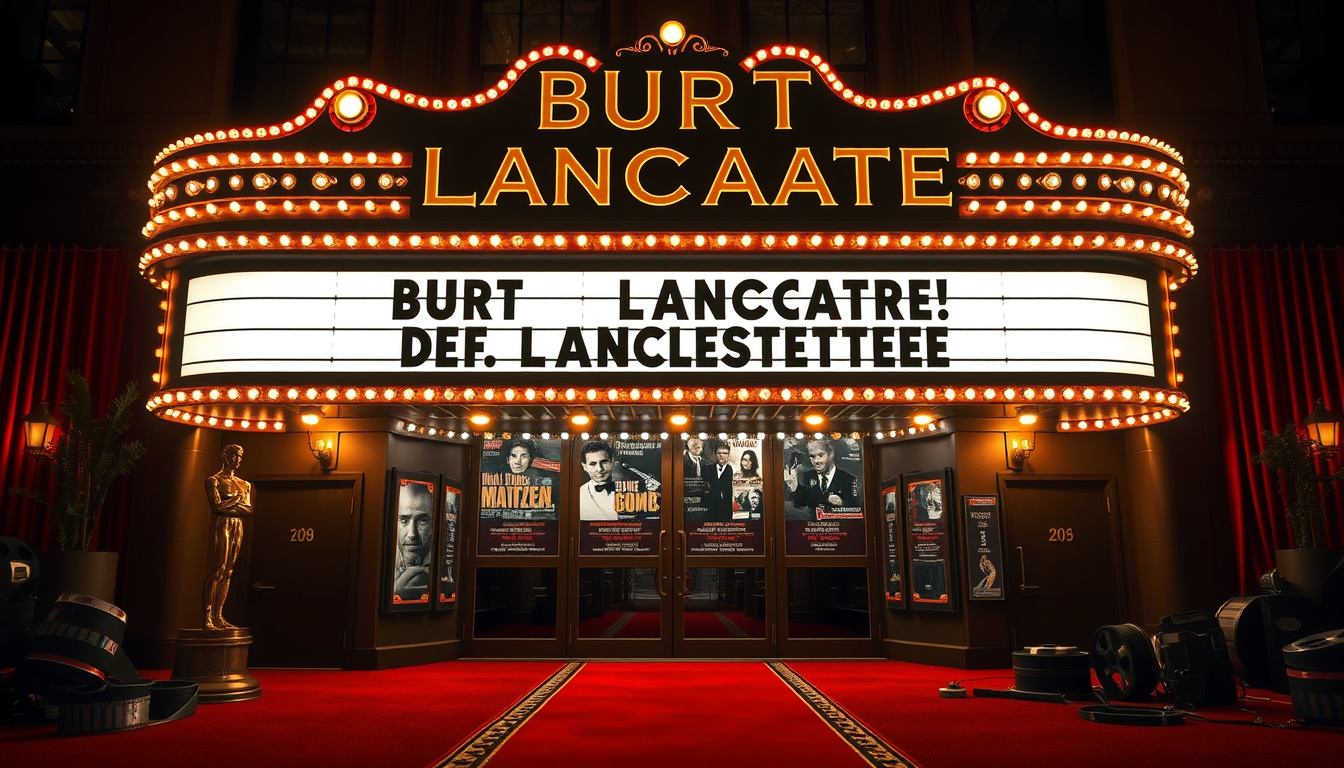

If you’ve ever watched a film from the golden age of Hollywood and wondered which actor could shift from a swaggering tough guy to a vulnerable romantic lead in the same scene, Burt Lancaster is your answer. He wasn’t just a star—he was a force who shaped postwar cinema both in front of the camera and behind it, winning an Oscar for Elmer Gantry and leaving a trail of unforgettable performances.
Born: 1913-11-02 ·
Died: 1994-10-20 ·
Academy Awards: 1 win, 4 nominations ·
BAFTA Awards: 2 wins ·
Films Directed: 2
Quick snapshot
- Full name: Burton Stephen Lancaster (Britannica Facts)
- Born 1913-11-02 in New York City (Britannica)
- Died 1994-10-20 in Century City, California (Britannica)
- Won Oscar for Best Actor in Elmer Gantry (Britannica)
- Exact number of films produced by Hecht-Hill-Lancaster is debated (IMDb (community database))
- The precise year of his first stage appearance is not documented in primary sources (IMDb (community database))
- 1946: Film debut in The Killers (Britannica)
- 1953: First Oscar nomination for From Here to Eternity (Wikipedia)
- 1960: Wins Oscar for Elmer Gantry (Britannica)
- 1994: Dies at age 80 (Britannica)
- Digitally restored versions of his films continue to be released on Blu-ray and streaming platforms
- Biographical research remains active, with new archival discoveries surfacing
Early Life and Background
Born Burton Stephen Lancaster on 1913-11-02 in New York City, he grew up in East Harlem, the son of a mailman and a homemaker (Britannica (encyclopedia)). Lancaster’s athletic build—honed as a circus acrobat before acting—set him apart from the polished studio stars of the era. He served in the U.S. Army during World War II, then turned to theater and film.
His early versatility was evident: he could play a villain, a hero, or a conflicted man caught in moral dilemmas. The Hollywood Walk of Fame (official star registry) describes him as “athletic, smiling, and later willing to play roles against his original tough-guy image.”
Lancaster’s circus background gave him a physicality that few actors of his generation could match, but it was his willingness to shed that image that made him a lasting artist.
Film Career and Major Roles
Lancaster’s debut came in 1946 with The Killers, but his breakout arrived in 1953 when he played Sergeant Milton Warden in From Here to Eternity (Britannica). That role earned him his first Academy Award nomination. He followed with a string of classics: Sweet Smell of Success (1957), Birdman of Alcatraz (1962), Seven Days in May (1964), and The Leopard (1963) (Golden Globes (Hollywood Foreign Press)).
One pattern stands out: Lancaster often chose roles that challenged the audience’s expectations. In The Train (1964) he played a French resistance fighter; in Atlantic City (1980) he portrayed an aging small-time gangster, earning his fourth Oscar nomination (Wikipedia (community encyclopedia)). His later career included acclaimed performances in Local Hero (1983) and Field of Dreams (1989) (Golden Globes (Hollywood Foreign Press)).
Building on his early successes, Lancaster built a pattern of choosing scripts that subverted his physique.
| Film | Year | Role | Accolade |
|---|---|---|---|
| From Here to Eternity | 1953 | Sgt. Milton Warden | Oscar nomination (Best Actor) |
| Elmer Gantry | 1960 | Elmer Gantry | Oscar win (Best Actor) |
| Birdman of Alcatraz | 1962 | Robert Stroud | Oscar nomination |
| Atlantic City | 1980 | Lou Pascal | Oscar nomination |
The implication: Lancaster’s four Oscar nominations across three decades prove his enduring relevance, but his one win—for Elmer Gantry—remains the signature performance that defined his career.
Awards and Accolades
Lancaster’s trophy case goes beyond the Oscars. He won two BAFTA Awards, one Golden Globe for Best Lead Actor, a Silver Bear at the Berlin International Film Festival, and a Volpi Cup at the Venice Film Festival (Wikipedia (community encyclopedia)). He also received two David di Donatello awards from Italy.
- Academy Award: 1 win, 4 nominations (Britannica)
- BAFTA Awards: 2 wins (Wikipedia)
- Golden Globe: 1 win (Golden Globes)
- Silver Bear (Berlin): 1 win (Wikipedia)
- Volpi Cup (Venice): 1 win (Wikipedia)
- David di Donatello: 2 wins (Wikipedia)
International recognition from European festivals and academies shows Lancaster’s appeal transcended Hollywood—he was embraced by auteur cinema abroad, especially in Italy (Volpi Cup, David di Donatello) and Germany (Silver Bear).
Production Work and Directing
Lancaster was not just a performer; he co-founded Hecht-Hill-Lancaster, a production company that produced Marty (1955) and The Catered Affair (1956) (IMDb (community database)). He also directed two films: The Kentuckian (1955) and The Midnight Man (1974) (Hollywood Walk of Fame (official star registry)).
His production company gave him creative control rare for actors at the time. Marty won the Academy Award for Best Picture, proving that Lancaster’s business instincts matched his artistic ones.
Later Career and Legacy
In the 1980s, Lancaster continued to take on challenging roles: Local Hero (1983), Rocket Gibraltar (1988), and Field of Dreams (1989) (Golden Globes (Hollywood Foreign Press)). His final film appearance was in The Phantom of the Opera (1990?), though his career spanned from the late 194

Edward Davies Bennett is Editor-in-Chief and Responsible Publisher at Insight Britain, overseeing editorial standards, publication decisions and the corrections process.