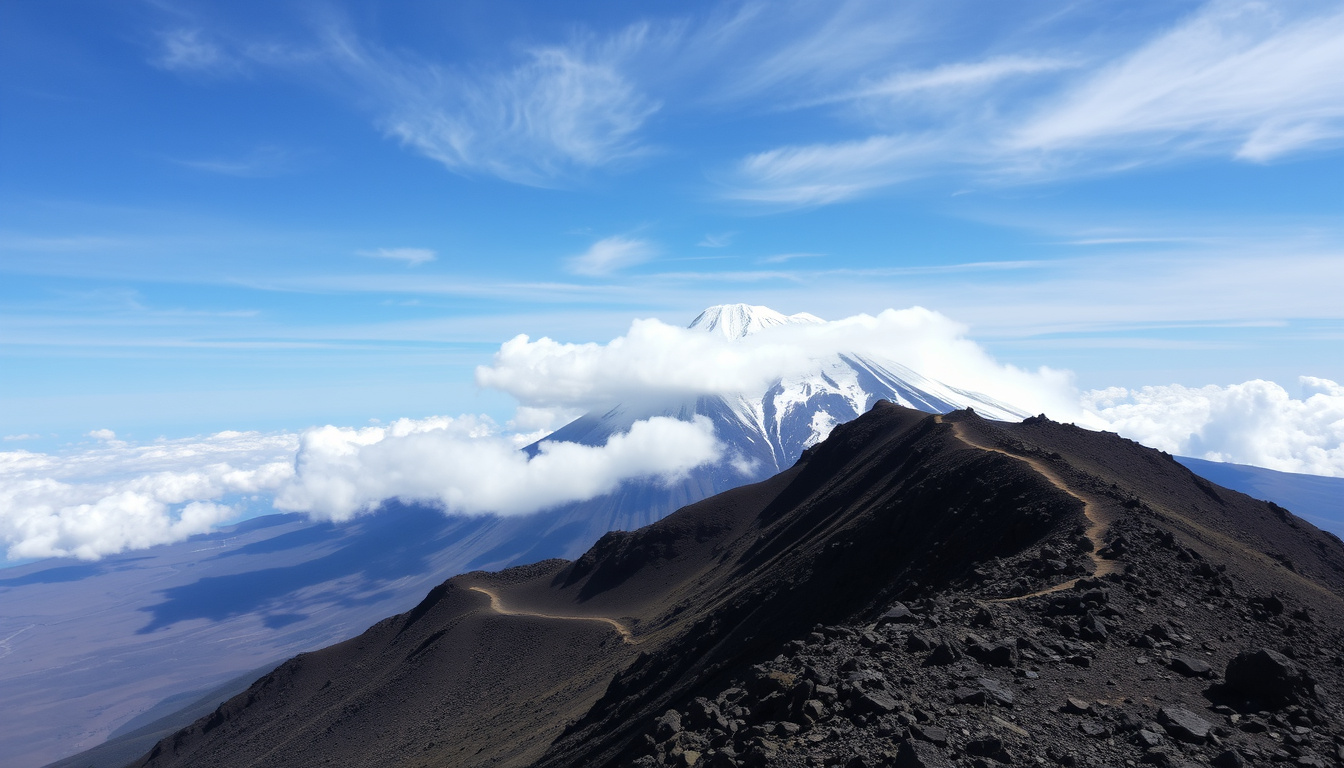
There’s a moment on the final approach to Uhuru Peak when the only thing that exists is the next step and the rasp of your own breathing. It’s not a feeling reserved for elite mountaineers — Mount Kilimanjaro, Africa’s highest peak at 5,895 metres, is a non-technical trek that tens of thousands of people attempt each year.
Elevation: 5,895 m (19,341 ft) ·
Continent: Africa ·
Country: Tanzania ·
Type: Free-standing stratovolcano ·
Climbing Duration: 5 to 9 days ·
Annual Climbers: Approximately 35,000
Quick snapshot
- Non-technical hike, no ropes or climbing gear needed (The Extreme Wilderness climbing guide)
- Altitude is the primary challenge (The Extreme Wilderness climbing guide)
- Longer routes have higher summit success rates (Mount Kilimanjaro Guide route logistics)
- No prior climbing experience required (The Extreme Wilderness climbing guide)
- Physical fitness and training recommended (Climbing Kilimanjaro operator guidance)
- Guided climbs provide support and safety (The Extreme Wilderness climbing guide)
- Average 10-15 deaths per year out of 35,000 climbers (Mount Kilimanjaro Guide safety data)
- Altitude sickness is the main risk (The Extreme Wilderness climbing guide)
- Proper acclimatization reduces danger (Mount Kilimanjaro Guide route logistics)
- Sleep in huts or tents at camps along the route (Climbing Kilimanjaro operator guidance)
- Public toilets available at camps, pee bottles needed at night (Climbing Kilimanjaro operator guidance)
- Temperatures can drop below freezing (The Extreme Wilderness climbing guide)
| Attribute | Value |
|---|---|
| Height | 5,895 m (19,341 ft) |
| Location | Tanzania, East Africa |
| Mountain Type | Stratovolcano (dormant) |
| First Ascent | 1889 by Hans Meyer and Ludwig Purtscheller |
| Climbing Duration | 5 to 9 days depending on route |
| Annual Visitors | Approximately 35,000 climbers per year |
| Number of Routes | Seven main routes |
| Highest Camp | Uhuru Peak at 5,895 m |
How difficult is the Mount Kilimanjaro climb?
Six routes, seven days, one summit — but the difficulty isn’t what most people imagine. Kilimanjaro is not a technical climb. On standard routes like Marangu or Machame, you walk. No ropes, no ice axes, no prior climbing experience required, according to The Extreme Wilderness climbing guide. The real challenge is altitude.
Is Kilimanjaro a technical climb?
- No technical climbing gear needed — standard trekking poles suffice (The Extreme Wilderness climbing guide)
- Routes follow well-defined trails, not rock faces (WildToSea Tanzania specialist)
- Guided groups handle all logistics, including permits and porters (Climbing Kilimanjaro operator guidance)
What makes Kilimanjaro challenging?
- Altitude: 5,895 m means oxygen pressure is about half of sea level (The Extreme Wilderness climbing guide)
- Acute Mountain Sickness is the primary reason climbers fail (The Extreme Wilderness climbing guide)
- Mild AMS is extremely common above 3,000 metres (The Extreme Wilderness climbing guide)
- Shorter itineraries increase risk because they require a faster ascent (Mount Kilimanjaro Guide route logistics)
What is the success rate on Kilimanjaro?
- One guide reports a 35-45% failure rate (Mount Kilimanjaro Guide route logistics)
- Longer routes (7+ days) have higher success through better acclimatization (Mount Kilimanjaro Guide route logistics)
- Acclimatization strategy: climb high, sleep low — standard on Lemosho and Northern Circuit (Mount Kilimanjaro Guide route logistics)
A first-time climber who chooses a 7-day route instead of a 5-day route nearly doubles their odds of standing on Uhuru Peak. The trade-off is three extra days of walking and roughly USD 400 more in cost.
Can beginners climb Kilimanjaro?
Yes — but the margin for error is narrower than most promotional materials admit. Beginners can climb Kilimanjaro with proper preparation, according to The Extreme Wilderness climbing guide. Physical training beforehand is highly recommended, and guided climbs are standard for all experience levels.
What fitness level is needed for Kilimanjaro?
- Good cardiovascular fitness helps, but you don’t need to be an athlete (The Extreme Wilderness climbing guide)
- Long days of hiking at altitude — 6 to 10 hours — are the physical test (Climbing Kilimanjaro operator guidance)
- Leg strength and endurance matter more than upper-body strength (WildToSea Tanzania specialist)
What training is recommended for Kilimanjaro?
- Aim for 3-4 months of hiking with a loaded daypack on varied terrain (The Extreme Wilderness climbing guide)
- Stair-climbing builds the specific muscle groups for steep sections (Climbing Kilimanjaro operator guidance)
- Practice with the exact gear you intend to bring — boots, layers, pack weight (Climbing Kilimanjaro operator guidance)
Can someone with no hiking experience climb Kilimanjaro?
- Yes, with a reputable guided group — but the learning curve is steep (The Extreme Wilderness climbing guide)
- No prior hiking experience means you must be diligent about pacing and hydration (Mount Kilimanjaro Guide route logistics)
- Experienced hikers have an advantage in pack management and terrain reading (WildToSea Tanzania specialist)
A beginner who trains four months and chooses the Lemosho route (7-8 days) has a realistic shot at the summit. A beginner who books a 5-day Marangu climb without training faces a 50% chance of turning back early.
How many climbers died on Kilimanjaro?
Reported averages from tour operators and news data suggest 10-15 deaths occur per year, according to Mount Kilimanjaro Guide safety data. That’s out of approximately 35,000 climbers annually — a low fatality rate relative to the number of participants, but each death is a preventable tragedy.
What are the main causes of death on Kilimanjaro?
- Altitude sickness leading to HACE (high-altitude cerebral edema) or HAPE (high-altitude pulmonary edema) (Mount Kilimanjaro Guide safety data)
- Falls, often on loose scree or during summit descent (The Extreme Wilderness climbing guide)
- Hypothermia from inadequate gear or weather changes (The Extreme Wilderness climbing guide)
Is Kilimanjaro a dangerous climb?
- Relative to its height, it’s safer than technical mountains like Everest or Denali (WildToSea Tanzania specialist)
- Most deaths are avoidable with proper acclimatization and experienced guides (The Extreme Wilderness climbing guide)
- A good guide conducts regular health checks including oxygen saturation readings (The Extreme Wilderness climbing guide)
The exact number of deaths per year is not centrally tracked by a government body — tour operators self-report. The 10-15 figure is the best available aggregate but should be treated as indicative, not authoritative.
Why is Mount Kilimanjaro so famous?
Seven summiteers need it, Instagram explorers want it, and Tanzania built an economy around it. Kilimanjaro is Africa’s highest peak at 5,895 m (19,341 ft) and the tallest free-standing mountain in the world, according to Mount Kilimanjaro Guide route logistics. Its accessibility — a non-technical hike — makes it one of the few high-altitude summits available to normal people.
What makes Kilimanjaro unique?
- Free-standing: it rises from the plains, not a mountain range, giving it dramatic visual isolation (Mount Kilimanjaro Guide route logistics)
- Five distinct climate zones from rainforest to arctic summit (WildToSea Tanzania specialist)
- Snow-capped summit visible for hundreds of kilometers, even though the glaciers are receding (WildToSea Tanzania specialist)
Is Kilimanjaro the highest mountain in Africa?
- Yes, at 5,895 m (19,341 ft), it is the highest peak on the continent (Mount Kilimanjaro Guide route logistics)
- Second-highest is Mount Kenya at 5,199 m (WildToSea Tanzania specialist)
- It’s one of the Seven Summits — the highest peak on each continent (WildToSea Tanzania specialist)
What is harder, Everest or Kilimanjaro?
Everest requires technical climbing and extreme altitude; Kilimanjaro is a hike. Summiting Everest is far more dangerous and demanding. Kilimanjaro is often compared to the Everest Base Camp trek in difficulty. But the comparison matters because many prospective climbers use Everest as their reference point.
Five key differences, one pattern: Everest is a full expedition, Kilimanjaro is a long hike at serious altitude.
| Factor | Mount Kilimanjaro | Mount Everest |
|---|---|---|
| Summit elevation | 5,895 m (19,341 ft) | 8,848 m (29,029 ft) |
| Technical difficulty | Non-technical trek | Technical climbing (ice, rock, fixed ropes) |
| Duration | 5-9 days | 60-90 days (including acclimatization rotations) |
| Oxygen use | Not required (supplemental available) | Required above Camp 3 |
| Cost | USD 2,000-3,500 (all-inclusive) | USD 35,000-85,000 (guided expedition) |
| Death rate (per climber) | ~0.03% (10-15 among 35,000) | ~1-2% (summit attempts) |
| Experience required | None technical; basic fitness | Previous high-altitude experience |
The implication: Kilimanjaro costs 10-15x less than Everest but still delivers altitude serious enough to kill. For a non-climber, it’s the highest achievable summit without learning ropes, jumars, or crampon techniques.
Do you need a pee bottle for Kilimanjaro?
Yes — and it’s not a joke. Pee bottles are recommended for night use in camps. Public toilets are available at camps but not on the trail. Summit night requires a pee bottle because temperatures at high camp can drop below freezing, and leaving your tent to walk to a toilet shelter is a genuine hypothermia risk.
Are there toilets on Kilimanjaro?
- Public pit toilets exist at all designated camps (Climbing Kilimanjaro operator guidance)
- No toilets on the trail between camps (Climbing Kilimanjaro operator guidance)
- Summit night: no facilities on the final push. A pee bottle is standard gear (Climbing Kilimanjaro operator guidance)
What are the bathroom facilities during the climb?
- Camp toilets are basic but functional — bring your own toilet paper and hand sanitizer (The Extreme Wilderness climbing guide)
- Porters may carry a portable toilet for group use on some routes (Climbing Kilimanjaro operator guidance)
- Female climbers often use a product called a Shewee or a funnel with a wide-mouth bottle (Climbing Kilimanjaro operator guidance)
Where do you sleep when you climb Kilimanjaro?
Route design determines whether you sleep in huts or tents. The Marangu route uses mountain huts; Machame, Lemosho, and others rely on tents at designated camps. Both options involve sleeping above 3,000 m with temperatures that can drop below freezing.
What are the sleeping conditions on Kilimanjaro?
- Huts (Marangu route): dormitory-style, mattresses provided, around -5°C to 5°C at night (Climbing Kilimanjaro operator guidance)
- Tents (Machame, Lemosho, Rongai, Northern Circuit): four-season mountaineering tents provided by the operator (Climbing Kilimanjaro operator guidance)
- All camping gear (mattress, sleeping bag, pillow) is included in all-inclusive packages (Climbing Kilimanjaro operator guidance)
Do you stay in huts or tents on Kilimanjaro?
- Marangu: huts only — the only route with hut accommodation throughout (Climbing Kilimanjaro operator guidance)
- All other routes: tent camping at designated camp sites (Climbing Kilimanjaro operator guidance)
- Summit night: you rest at high camp (e.g., Barafu at 4,673 m) then start the final ascent around midnight (Climbing Kilimanjaro operator guidance)
Hut routes are tempting for comfort but have shorter itineraries (Marangu is 5-6 days), which increases altitude sickness risk. Tent routes force you to camp, but the longer 7-9 day schedules give your body more time to adapt. Comfort vs safety — choose safety.
Route comparison: which Kilimanjaro route should you choose?
Seven main routes, one pattern: longer routes succeed where shorter ones fail. The route you choose determines your altitude profile, camp quality, and odds of summit success.
| Route | Minimum Duration | Max Elevation (Sleep) | Approx. Success Rate | Est. Cost (all-inclusive) |
|---|---|---|---|---|
| Marangu | 5-6 days | 4,730 m (Horombo) | 50-65% | USD 2,790+ |
| Machame | 6-7 days | 4,673 m (Barafu) | 65-75% | USD 2,800+ |
| Lemosho | 7-8 days | 4,630 m (Barafu) | 80-85% | USD 2,850+ |
| Rongai | 6-7 days | 4,730 m (Kibo) | 70-80% | USD 2,850+ |
| Northern Circuit | 8-9 days | 4,360 m (Moar) | 85-90% | USD 3,405+ |
| Umbwe | 5-6 days | 4,630 m (Barafu) | 40-55% | USD 2,500+ |
| Shira | 6-7 days | 4,673 m (Barafu) | 65-75% | USD 2,800+ |
Price data from Climbing Kilimanjaro operator pricing page for all-inclusive packages. Success rates are industry estimates from multiple operator and guide sources.
How to prepare for Kilimanjaro: a step-by-step guide
Step 1: Choose your route and operator
- Select a route that matches your experience and time availability
- Book with an established operator (The Extreme Wilderness climbing guide) that includes porters, qualified guides, and emergency oxygen
- Check that the operator is licensed by the Kilimanjaro National Park authority
Step 2: Train physically
- Begin training 3-4 months before departure (The Extreme Wilderness climbing guide)
- Focus on long hikes with a loaded daypack (10-15 kg)
- Add stair-climbing and hill repeats for elevation gain
Step 3: Acclimatization strategy
- Choose a route 7 days or longer for proper ascent profile (Mount Kilimanjaro Guide route logistics)
- Hydrate 3-4 liters per day during the climb (Mount Kilimanjaro Guide safety advice)
- Consult a doctor about Diamox (acetazolamide) for altitude prophylaxis
Step 4: Gear up
- Four-season sleeping bag rated to -15°C (Climbing Kilimanjaro operator guidance)
- Insulated boots with gaiters for summit night
- Layered clothing system: base, mid, shell for -10°C to 25°C range
- Pee bottle (wide-mouth with secure lid) and toilet paper
Step 5: Health and safety on the mountain
- A good guide conducts daily oxygen saturation checks (The Extreme Wilderness climbing guide)
- If saturation drops below 80% and is not improving with rest, descent is recommended (The Extreme Wilderness climbing guide)
- Know the symptoms of AMS (headache, nausea, dizziness) and HACE/HAPE (confusion, coughing, extreme fatigue)
Pros and cons of climbing Kilimanjaro as a beginner
Upsides
- No technical skills required — if you can walk, you can attempt it (The Extreme Wilderness climbing guide)
- Relatively short commitment — 5-9 days from start to finish
- Cost is modest compared to other high-altitude expeditions (USD 2,000-3,500)
- Guided climbs handle all logistics — porters, meals, permits (Climbing Kilimanjaro operator)
- Stunning biodiversity — five climate zones in a single trek (WildToSea Tanzania specialist)
Downsides
- Altitude sickness is a real risk — over 50% of climbers experience symptoms (The Extreme Wilderness climbing guide)
- Shorter routes (5-6 days) have low success rates (50-65%)
- Death rate of 10-15 per year, though low in percentage terms (Mount Kilimanjaro Guide safety data)
- No solo climbing — guides are mandatory, which some experienced hikers dislike
- Physical demand is real — 6-10 hour days at altitude are taxing even for fit people
authentickilimanjaro.com, wildtosea.com, africanheart.com, snowafricaadventure.com, maplebrief.org
Frequently asked questions
What is the best time of year to climb Kilimanjaro?
The best months are January-March and June-October. January-March is drier but colder; June-October is the main dry season with clearer skies but more climbers. April-May is the long rainy season and is avoided by most operators.
How much does it cost to climb Kilimanjaro?
A legitimate all-inclusive package for a 7-day route like Machame or Lemosho typically ranges from USD 2,000 to USD 3,500 per person, according to The Extreme Wilderness climbing guide. Cheaper packages may cut corners on safety, guide ratios, and equipment quality.
Do I need a guide to climb Kilimanjaro?
Yes. Tanzanian law requires all climbers to be accompanied by a licensed guide. Independent or solo climbing is not permitted on the mountain.
What gear do I need for Kilimanjaro?
Essential gear includes: four-season sleeping bag (-15°C rating), insulated boots with gaiters, layered clothing (base, mid, shell), headlamp, trekking poles, water bottles/hydration system, sunscreen, and — critically — a pee bottle for summit night.
Can I climb Kilimanjaro solo?
No. Solo climbing is not permitted. You must join a guided group. However, you can hire a private guide and porter team for a solo-style experience within a group structure.
What is the shortest route up Kilimanjaro?
The shortest route is Marangu, which can be done in 5 days. However, the high speed increases altitude sickness risk significantly. Umbwe is also short (5-6 days) but is steeper and more exposed. Most guides recommend a minimum of 6-7 days for any route.
How do I train for Kilimanjaro?
Start 3-4 months beforehand with regular hiking (loaded pack), stair-climbing, and cardiovascular exercise. Build up to 8-10 km hikes with 500-800 m elevation gain. Practice with your actual gear — boots, pack, and layers — to avoid surprises.
For the beginner who does the preparation, Kilimanjaro is an achievable summit — not a mountaineering feat, but a genuine high-altitude challenge. For the person who books a short route without training, the mountain has a way of revealing the gap between ambition and preparedness. The choice of route, duration, and operator is the single biggest determinant of whether you return with a summit photo or a lesson in humility. For the first-time climber, the smart move is clear: take the longer route, train properly, and respect the altitude.

Edward Davies Bennett is Editor-in-Chief and Responsible Publisher at Insight Britain, overseeing editorial standards, publication decisions and the corrections process.