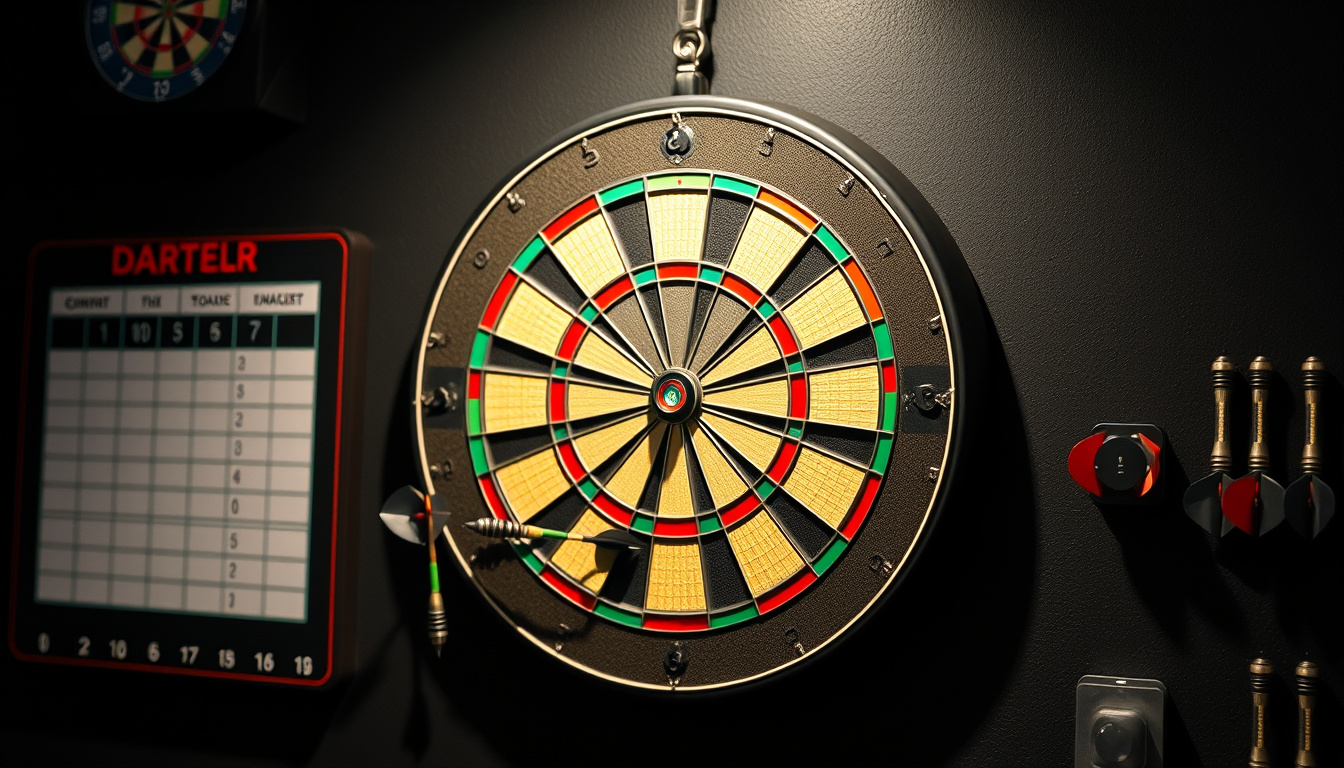
Picking a dartboard sounds simple until you realise there are bristle boards, electronic boards, magnetic boards, and a dozen sizes to choose from. Most Irish sports shops stock a handful of options, but the wrong choice can mean bounce-outs in weeks rather than years. This guide walks you through the official dimensions used by Irish darts leagues, the real price differences between cheap and professional boards, and where to buy them in Dublin and beyond.
Official dartboard height (bullseye): 1.73 m (5 ft 8 in) ·
Oche distance: 2.37 m (7 ft 9.25 in) ·
Standard dartboard diameter: 45 cm (17.75 in) ·
Preferred material for professional boards: Sisal (bristle) ·
Average price range for a quality bristle board: €50 – €150
Quick snapshot
- Height to bullseye: 1.73 m (5 ft 8 in) (Western Australia Department of Creative Industries, Tourism and Sport)
- Oche distance: 2.37 m (7 ft 9.25 in) (Shot Darts)
- Board diameter: 45 cm (17.75 in) (WA Department of Creative Industries)
- Thickness: 40 mm recommended (Elverys guide) (Western Australia Department of Creative Industries, Tourism and Sport)
- Material: sisal bristle for durability (Elverys)
- Wire system: blade wire for fewer bounce-outs (Elverys)
- Brand reputation and warranty (general)
- Budget: €50-€100 for good quality (see price range below)
The official dimensions, defined by the World Darts Federation and enforced by national bodies, leave no room for guesswork.
| Specification | Value |
|---|---|
| Official height to bullseye | 1.73 m (5 ft 8 in) (WA Department of Creative Industries) |
| Oche distance | 2.37 m (7 ft 9.25 in) (Shot Darts) |
| Standard board diameter | 45 cm (17.75 in) (WA Department of Creative Industries) |
| Number of segments | 20 |
| Bullseye inner diameter | 12.7 mm (WA Department of Creative Industries) |
| Bullseye outer diameter | 32 mm (WA Department of Creative Industries) |
What is the best dartboard to buy?
- Winmau Blade 6 – the board of choice on the PDC professional circuit (getlocal.ie (Irish marketplace, listing at €125))
- Unicorn Eclipse Pro – tournament standard used in many official competitions (Elverys (Irish sports retailer buying guide))
- Mission Samurai Infinity – dense sisal and thin blade wire at a mid-range price
- Harrows Pro Matchplay – excellent wear resistance for regular practice
What is the best type of dartboard?
A sisal bristle board is the only choice for serious practice and league play. The compressed sisal fibres self-heal when darts are removed, meaning the board can withstand thousands of throws. Electronic boards use plastic segments and are best for soft-tip darts, while magnetic boards are essentially toys. According to Elverys (Irish retailer), bristle boards dominate the Irish market because clubs and players demand durability and official regulation play.
Which dartboard should I buy?
If you are a beginner, start with a mid-range bristle board such as the Mission Samurai Infinity or Harrows Pro Matchplay – both cost between €60 and €90 and offer good sisal density. For competitive players, the Winmau Blade 6 (around €120) is the gold standard. Recreational players who want a quick setup might consider an electronic board, but be aware that the throw distance for soft-tip is 244 cm, not 237 cm (Shot Darts (equipment specialist)).
A professional board costs more upfront but lasts three to four times longer than a budget board, making the per-year cost actually lower for anyone who plays at least once a week.
The implication: spending more now saves money over time, especially for regular players.
How much does a good quality dart board cost?
How much is a decent dart board?
In Ireland, a decent bristle dartboard starts around €50. For example, Smyths Toys Ireland lists a Target Rift Dartboard Set at €39.99 (down from €49.99) – a serviceable entry-level option. For something that will last through regular league play, the Luke Littler Dartboard Cabinet with Brass Steel-Tip Darts Set at €63.99 offers better build quality.
What is the price range for dartboards?
- Entry-level bristle boards: €30 – €50
- Mid-range boards: €50 – €100
- Professional boards: €100 – €150 (e.g., Winmau Blade 360 at €125 per getlocal.ie (Irish marketplace))
- Electronic boards: €30 – €100
- Magnetic sets: typically under €25 – a Luke Littler Magnetic Set costs €19.99 at Smyths Toys Ireland
The pattern: you get what you pay for in sisal density and wire quality. Skimping on the board means replacing it sooner. A €30 board may begin to show wear within three months, while a €100 board can last two years with regular rotation.
What is the correct distance and height for a dartboard?
Why is the oche 2.37 meters?
The oche distance was originally measured in feet and inches: 7 ft 9.25 in. In metric terms that is precisely 2.37 metres. The World Darts Federation and the British Darts Organisation set this standard so that every player competes under identical conditions (Shot Darts (equipment specialist)). The measurement is taken from the front face of the dartboard (not the wall) to the back edge of the throwing line.
Why was the oche length set at 7 feet 9.25 inches?
The length derived from the practical throwing distances used in British pubs before standardisation. When the sport began to formalise in the 1920s, the distance was recorded as the distance from the board to the front of the throwing line. The 7 ft 9.25 in figure balances reach and accuracy. The bullseye centre height, 1.73 m (5 ft 8 in), puts the treble 20 at roughly eye level for a person of average height (WA Department of Creative Industries (official dimensions)).
Why this matters: consistent setup is the only way to build repeatable muscle memory. Even 5 mm off can change your throw. Use a measuring tape, a plumb line, and a spirit level when mounting your board.
How to pick a good dart board?
Do longer darts fly straighter?
Dart length and stem length influence stability, but for most players board quality matters more. A longer dart does not automatically fly straighter – it depends on the weight distribution, the flight shape, and the thrower’s release. However, the board itself must be made of sisal and have a good wire system. According to the Elverys buying guide (Irish sports retailer), the most important criteria are sisal density, wire type (blade wire preferred), and board thickness (40 mm minimum).
Which is better: long or short stems for darts?
Short stems (around 30 mm) give a dart a faster, more direct flight path, while longer stems (50 mm+) add stability and lift. There is no single right answer – it depends on your grip and throw. For a detailed breakdown, manufacturers like Shot Darts offer guides, but they recommend experimenting. The catch: no amount of gear tuning compensates for a poor board that bounces out your darts.
A surround safety ring (available at Smyths for €29.99) protects your wall and stops darts from ricocheting. For an entry-level setup, the £10 16-inch safety board with safety darts is a budget-friendly option for children or casual use.
The pattern: board quality is the foundation; accessories come second.
What is the difference between a cheap and expensive dart board?
What makes a dartboard expensive?
- Sisal density: Cheap boards use low-density sisal that wears out after a few months. High-end boards pack more sisal per square inch, making them self-healing and durable.
- Wire system: Budget boards have a coiled wire spider that causes darts to bounce out. Expensive boards use thin, flush blade wire that reduces bounce-outs by up to 50%.
- Board thickness: Cheap boards are often just 25 mm thick, leading to sagging over time. A professional board is 38-40 mm thick (BoxesGen (packaging and dimensions reference)).
- Brand and warranty: Premium brands like Winmau and Unicorn offer multi-year warranties and replaceable number rings.
The trade-off: cheap boards save money now but cost more per throw over a year. A €30 board may need replacing every three months, whereas a €120 board will last two years or more.
Six dartboard types, one pattern: bristle boards last longest; electronic boards are best for soft-tip; magnetic boards are strictly for fun.
| Type | Material | Typical Price (Ireland) | Durability | Best For |
|---|---|---|---|---|
| Steel‑tip bristle | Sisal | €50 – €150 | High (1‑2 years with rotation) | Professional practice, league play |
| Soft‑tip electronic | Plastic segments | €30 – €100 | Medium (segments wear over time) | Digital scoring, casual games |
| Magnetic | Steel surface with plastic numbers | €10 – €25 | Low (magnets lose strength) | Children, very casual play |
Here are the confirmed specifications for professional boards:
| Spec | Value | Source |
|---|---|---|
| Material | Sisal (bristle) | Elverys (Irish retailer guide) |
| Board thickness | 38‑40 mm | BoxesGen (dimensions reference) |
| Wire system | Blade wire (flush) on premium boards | Elverys |
| Diameter | 45 cm (17.75 in) | WA Dept of Creative Industries |
| Bullseye inner | 12.7 mm | WA Dept of Creative Industries |
| Bullseye outer | 32 mm | WA Dept of Creative Industries |
Upsides
- Bristle boards offer self‑healing fibres and long life.
- Blade wire reduces bounce‑outs by a large margin (player reports).
- Official dimensions are clearly documented and consistent.
- Wide range of prices to suit every budget.
Downsides
- Cheap boards wear out quickly – false economy.
- Electronic boards cannot be used for steel‑tip darts.
- Magnetic boards do not help improve throwing accuracy.
- Setting up to regulation height/distance requires tools and patience.
How to set up your dartboard – step by step
- Measure the height. Mark the wall at 1.73 m (5 ft 8 in) from the floor – this is the centre of the bullseye (WA Dept of Creative Industries). Use a plumb line to ensure vertical alignment.
- Mount the board. Fix a wall bracket or cabinet at the marked height. Ensure the board is level.
- Measure the oche distance. From the front face of the board (not the wall), measure 2.37 m (7 ft 9.25 in) and mark the throwing line. For soft‑tip, extend to 2.44 m (Shot Darts).
- Place the oche. Use tape, a dedicated oche strip, or a raised rail. The line should be at least 50 cm wide.
- Add a surround. A foam dartboard surround protects the wall from stray darts. Smyths sells them from €29.99.
- Good lighting. Position a lamp or dedicated dartboard light above the board to eliminate shadows.
Once set up, rotate the board regularly to extend its life. For more home improvement ideas, check out our guide on Man Cave: Meaning, Purpose, and Ideas for Your Home.
Confirmed facts
- Official dartboard dimensions are defined by WDF and BDO (WA Dept of Creative Industries).
- Sisal bristle is the preferred material for professional boards (Elverys).
- Blade wire systems reduce bounce‑outs compared to coiled wire (Elverys).
What’s unclear
- Best brand for beginners – varies by budget and preference.
- Exact price threshold for ‘good quality’ – depends on local market.
- Whether electronic dartboards are suitable for serious practice.
The bullseye centre height is 1.73 m from the floor and the throwing distance is 2.37 m. These are the official dimensions for all steel‑tip darts competitions recognised by the World Darts Federation.
– World Darts Federation, via WA Department of Creative Industries
A good sisal board will last for years if you rotate it regularly. The best boards use compressed sisal fibres that close up behind the dart, so the board stays smooth.
– Elverys Dartboard Buying Guide
The oche distance was originally measured in feet because that’s how pub floors were laid out. Standardising it made darts an international sport.
– Irish Darts Organisation (IDO) guideline
For Irish players looking to improve their practice, the choice is clear: invest in a quality sisal board from a trusted retailer, set it up to regulation dimensions, and replace it every 12 to 18 months. Anything less and you’re training against the board, not the game.
dartsupplier.com, dadsheaven.com, seanwoolsey.com, reddit.com, gldproducts.com, elverys.ie, footypedia.org
For Irish players looking for additional regional options, other dartboard buying guides offer further detailed comparisons and pricing tips.
Frequently asked questions
How long does a dartboard last?
A good quality bristle board lasts 12–24 months with regular rotation. Cheap boards may need replacing every 3–6 months.
Can you use a dartboard outdoors?
Bristle boards are not weatherproof. Dampness causes the sisal to swell and lose tension. Use a board designed for outdoor use or keep it sheltered.
What is the best dartboard for a child?
A magnetic dartboard (like the Luke Littler Magnetic Set at €19.99 from Smyths) is safe for children under supervision. For older kids, a bristle board set at a lower height works well.
Do I need a dartboard surround?
Yes – a surround protects your wall and stops darts that miss the board from bouncing unpredictably. Smyths sells surrounds from €29.99.
How to maintain a dartboard?
Rotate the number ring every few weeks so that the 20 segment does not wear out first. Remove darts by twisting gently, not pulling. Keep away from moisture and direct heat. For more home storage tips, see our Bed Trundle Guide: Adult Comfort, Sizes & Irish Options.
What is the difference between bristle and electronic dartboard?
Bristle (sisal) boards accept steel‑tip darts and self‑heal. Electronic boards have plastic segments for soft‑tip darts and often include automatic scoring.
Are magnetic dartboards good?
Magnetic boards are safe toys for children but offer no serious practice value – the magnets weaken, the segments are small, and they do not replicate the feel of real bristle boards.
How to mount a dartboard on a wall?
Use a wall bracket or a cabinet. Mark the centre at 1.73 m height, drill a hole, and secure the bracket. Ensure the board is level. A plumb line helps keep alignment straight.
Related stories





Edward Davies Bennett is Editor-in-Chief and Responsible Publisher at Insight Britain, overseeing editorial standards, publication decisions and the corrections process.