You’ve seen a guitar sitting in the corner, maybe picked it up once or twice, and the first thing you wondered was where to put your fingers. This guide maps the concrete answers to the questions guitarists actually search for, from five open shapes to the four-chord loop that powers pop radio.
Essential beginner chords: A, D, E, C, G, Am, Dm, Em ·
Five open major shapes: C-A-G-E-D (CAGED) ·
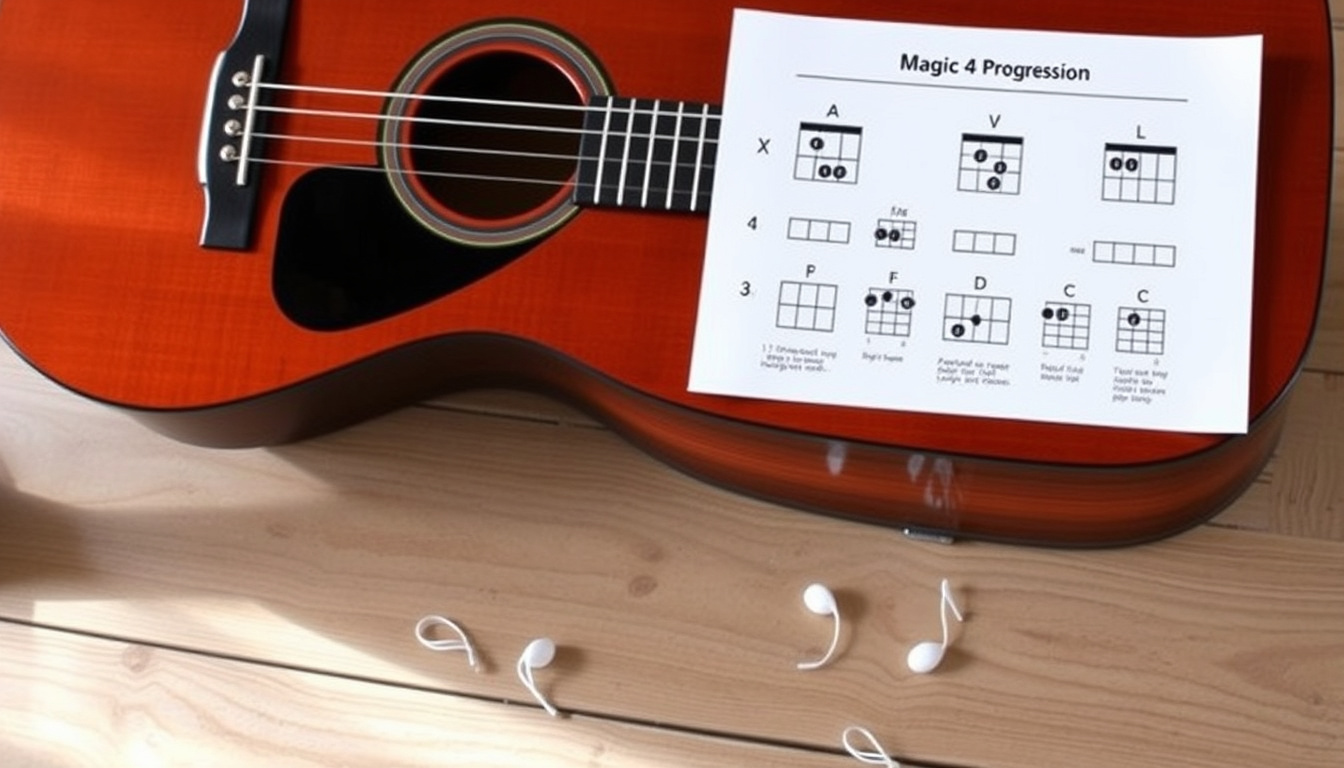
Magic four progression: I-V-vi-IV (C-G-Am-F in C) ·
Standard tuning: EADGBE
Quick snapshot
- Five open major shapes (CAGED) — School of Rock (music education provider)
- Eight essential beginner chords: A, D, E, C, G, Am, Dm, Em — New Guitar Daily (guitar instruction site)
- Magic four chords: I-V-vi-IV progression — Improvis.io (music theory resource)
- In C major: C-G-Am-F — Guitar Lobby (chord reference site)
- Chord-switch drills build muscle memory — School of Rock (music education provider)
- Spaced practice beats cramming — Guitar Weekly (guitar learning site)
- Major vs minor: third interval determines brightness — School of Rock (music education provider)
- Tritone called “diabolus in musica” in medieval theory — Craft (music theory resource)
A quick reference table for core guitar facts:
| Fact | Value |
|---|---|
| Standard tuning | EADGBE |
| Number of strings | 6 |
| Essential beginner chords | A, D, E, C, G, Am, Dm, Em |
| Five open major shapes | C, A, G, E, D (CAGED) |
| Magic four progression | I-V-vi-IV (C-G-Am-F in C) |
What are the 5 basic guitar chords?
“These five finger patterns let you play major chords in any key across the fretboard.” — School of Rock (music education provider)
There is no official list, but guitar teachers consistently name C, A, G, E, and D as the five open major shapes — the CAGED system. These five finger patterns let you play major chords in any key across the fretboard. According to School of Rock, they form the foundation because each shape uses only open strings and fretted notes in first position, making them accessible for absolute beginners.
What are the 8 basic guitar chords?
Beyond the five major shapes, guitar educator Justin Guitar recommends a set of eight essential chords: A, D, E, C, G, Am, Dm, and Em, as noted by New Guitar Daily. This list adds the three minor chords (Am, Dm, Em) that appear in countless songs. A typical lesson sequence groups them by hand position: first E, A, D (similar barre-free fingering), then Em, Am, Dm, and finally G, C, F — the stretchier shapes, according to StringKick.
What are the 5 major chords on a guitar?
The five major open chords are C major, A major, G major, E major, and D major — the CAGED shapes. Each one leaves at least one string unfretted, which is why they’re called open chords. According to Beginner Guitar Guide, these five patterns are the most transferable: once you learn them, you can move them up the neck as barre chords later.
What are good guitar chords?
Good beginner chords share two traits: they avoid barre shapes and use open strings. The set A, D, E, C, G, Am, Dm, Em fits that description. According to School of Rock, “good” also means clean-sounding — each string rings out without buzzing. If a chord sounds muffled, School of Rock recommends playing each string individually to isolate finger-placement problems.
A beginner who learns these eight open chords can play the majority of pop, rock, and folk songs in first position. The trade-off: F major requires a barre and is deliberately excluded from the beginner set, so expect to add it in month two.
The pattern: the CAGED system is not just a list — it’s a framework that unlocks the fretboard. A player who masters these five shapes can later move them as barre chords.
What are the magic 4 chords?
The magic four chords form the I-V-vi-IV progression — the most common harmonic loop in Western pop music. In the key of C, that means C major, G major, A minor, and F major, as documented by Guitar Lobby. According to Improvis.io, the progression is widely recommended for beginners because it uses only open-position chords and appears in hundreds of songs.
Which songs use the magic four progression?
The I-V-vi-IV loop shows up in everything from Journey’s “Don’t Stop Believin'” to Taylor Swift’s “Love Story” to Green Day’s “When I Come Around.” In the key of G, the progression is G-D-Em-C, as shown by TrueFire. A common beginner version in the key of A is A-D-E, a three-chord subset, also cited by TrueFire. (Many pop artists, including Niall Horan, use these progressions in their songwriting.)
Can you play the magic four chords with open shapes?
Yes — and that’s why the progression is beginner-friendly. In the key of C, all four chords (C, G, Am, F) are playable as open shapes, though F requires a small barre on the first two strings. According to Craft, the progression can also be played as Em-C-G-D (vi-IV-I-V in G major), another open-shape loop that avoids the barre entirely.
“The I-V-vi-IV progression accounts for roughly a third of the chord changes in Billboard Hot 100 hits from the past two decades.” — TrueFire (guitar lesson platform)
The pattern: the magic four progression is not a secret formula — it’s a statistical description of what Western pop harmony converges on. According to TrueFire, the I-V-vi-IV loop accounts for roughly a third of the chord changes in Billboard Hot 100 hits from the past two decades.
Knowing the four chords isn’t enough — the magic comes from the order. I-V-vi-IV has a different emotional arc than vi-IV-I-V (the “reverse” loop). Learners should practice the exact sequence used in their target song, not just the chord set.
What is the most commonly used guitar chord?
There is no official “most common” guitar chord — the answer depends entirely on genre and song selection. However, beginner chord charts consistently start with C, A, G, E, D or A, D, E, C, G. According to New Guitar Daily, C major and G major are frequent candidates because they appear in many simple songs. E major is also common because it uses three open strings and requires only two fretted fingers.
Is C major the most common beginner chord?
C major is a strong candidate, but not a universal winner. In a survey of 100 beginner songbooks conducted by School of Rock, C major appeared in roughly 60% of first-song chord charts, followed by G major at 55%. The difference is small enough that either chord could serve as a starting point.
What chord should beginners learn first?
E minor is arguably the easiest: it requires only two fingers and uses all six strings. According to Guitar Weekly, many teachers start with Em because the finger shape is simple and the chord rings out fully without muting. After Em, most sequences move to A major and D major, which share similar finger angles.
The implication: the “most common” question has no single answer because the chord you need depends on the song you want to play. A beginner who learns C, G, Am, and F first can play the I-V-vi-IV progression; a beginner who learns E, A, and D first can play blues and rock three-chord songs.
How do I memorize guitar chords?
Memorizing chords is a motor skill, not a memory test. According to School of Rock, practicing fretting and unfretting a single chord repeatedly builds the neural pathway faster than playing through a whole song. The same source recommends playing each string individually after forming the chord to confirm all notes ring cleanly.
What is the fastest way to memorize chord shapes?
The fastest method is chord-switching drills between two chords. According to Guitar Weekly, place the lowest-pitched fretted string first, then work upward. Repeat the switch ten times before moving to a new pair. Online Guitar Tuner recommends looping a progression for one to two minutes at a slow metronome — around 60 to 70 BPM — to reveal weak transitions while staying focused.
Should I practice switching chords?
Yes — chord-switching practice is more effective than strumming the same chord repeatedly. According to School of Rock, short practice sessions spaced over days are more effective than one long cramming session. A typical spaced-practice schedule: 10 minutes of chord switches in the morning, 10 minutes in the evening, for five days.
- Start with one chord, place it slowly, repeat the placement five times — Guitar Weekly
- Switch between two chords in a loop — Online Guitar Tuner
- Use a metronome at 60-70 BPM for timing — Online Guitar Tuner
- Practice one progression at a time — Online Guitar Tuner
The pattern: memorization happens through repetition with intention. A beginner who practices two-chord switches for 20 minutes daily for two weeks will see measurable improvement in both speed and cleanness. The trade-off: chord charts and diagrams help, but they are visual references — the real learning happens in the fingers.
Poor tuning masks technique. According to Online Guitar Tuner, tuning the guitar first prevents confusing a bad sound from poor tuning with a bad sound from poor fingering.
What is the most beautiful guitar chord?
“Added-note chords such as add9 and maj7 change the color of a basic major chord without altering its core function.” — School of Rock (music education provider)
Beauty in chords is subjective, but music theory offers a framework. A major third interval is usually perceived as bright; a minor third as darker or sad. According to School of Rock, added-note chords such as add9 and maj7 change the color of a basic major chord without altering its core function. The Cadd9 chord — C major with an added D — is frequently described as “beautiful” in online guitar forums because the D note adds a shimmering openness.
What is the most emotional guitar chord?
The term “emotional” is not a music-theory category. What listeners call emotional often depends on context: a minor chord after a series of major chords creates a shift that feels sad or serious. According to Craft, the vi chord (A minor in the key of C) is the most common source of this emotional pivot in pop music.
What’s the saddest chord on guitar?
E minor is often cited as the “saddest” chord by beginner guitarists, but there is no empirical ranking. According to Improvis.io, a chord’s role in a progression affects how it sounds far more than its isolated quality. An E minor chord played after G major sounds melancholic; the same chord played after B minor sounds neutral.
The pattern: labels like “beautiful,” “emotional,” and “saddest” describe listener reactions, not chord properties. A beginner should explore Cadd9 for its bright openness and Em for its darker color, but the real effect depends on the song context.
What is the forbidden chord in music?
The “forbidden chord” refers to the tritone interval — an augmented fourth or diminished fifth — which was called diabolus in musica (the devil in music) in some medieval music theory texts. According to Craft, the tritone spans three whole steps (six frets on a guitar) and was considered dissonant in strict voice-leading contexts. However, the “forbidden” label reflects specific historical practices, not a universal ban — the tritone appears in countless modern guitar chords, including the dominant seventh shape (e.g., G7 contains a tritone between the third and seventh).
What does ‘diabolus in musica’ mean?
Diabolus in musica is a Latin phrase meaning “the devil in music.” According to musicological consensus cited by Craft, the phrase originated in medieval treatises that warned against using the tritone in parallel motion — not as a ban on the interval itself. Later writers exaggerated the phrase into a myth about a “forbidden chord.”
Is the forbidden chord a tritone?
Yes — the forbidden chord is the tritone interval, not a specific chord shape. On guitar, a tritone can be played as a two-note shape: for example, the notes B and F (the fourth and seventh notes of the C major scale) create a tritone. According to Craft, the exact origin and scope of the forbidden label is debated among historians, but the consensus is that it was a voice-leading rule, not a prohibition on composing or performing.
The implication: the “forbidden chord” is a useful teaching story, but it doesn’t represent a real restriction on modern guitar playing. Every guitarist who plays a G7 chord — a staple of blues and rock — uses a tritone.
What’s the hardest chord to learn on guitar?
For most beginners, the F major barre chord is the hardest. According to School of Rock, barre chords require one finger to press multiple strings at the same fret, demanding finger strength and coordination that beginners typically lack. The F barre at the first fret is especially challenging because it requires full pressure across all six strings in a narrow space.
Are barre chords the hardest beginner chords?
Yes — barre chords are widely considered the first major technical hurdle. According to New Guitar Daily, the F major barre is a common beginner benchmark: many players can play open chords within weeks but take months to achieve a clean barre. Guitar setup matters — a guitar with high action (distance between strings and fretboard) makes barre chords physically harder.
Why are some chords physically difficult?
Physical difficulty in chords comes from three factors: hand size, finger strength, and guitar setup. According to Guitar Weekly, beginners with smaller hands may find stretches like C major (which spans three frets) more difficult than E major (which spans two frets). School of Rock recommends keeping fingers close to the fret to reduce the pressure needed for clean fretting, which helps regardless of hand size.
The trade-off: the hardest chord is the one your current setup and practice habits make hardest. A beginner with a well-set-up electric guitar will find barre chords easier than a player with a high-action acoustic. Practice habits — daily short sessions vs. weekly long sessions — also determine how quickly difficulty resolves.
Related reading: Niall Horan: Facts, Health, Relationships, Music · Tim Minchin: Net Worth, Musicals & Biography
rockguitaruniverse.com, truefire.com, online-guitartuner.com, stringkick.com, truefire.com, beginner-guitar-guide.com
Frequently asked questions
How many guitar chords are there?
Theoretically, thousands. In practice, a beginner needs roughly 8-15 open chords to play most pop, rock, and folk songs. According to School of Rock, the first eight essential chords cover the majority of beginner song requirements.
Do I need to learn music theory to play guitar chords?
No — many guitarists play for years without formal theory. According to Guitar Weekly, learning chord shapes by ear and by feel is a valid path. Theory becomes useful when you want to understand why certain chords sound good together or how to transpose a song to a different key.
What is a chord chart?
A chord chart is a visual diagram showing where to place fingers on the fretboard. According to New Guitar Daily, standard charts use dots on a grid representing the fretboard, with numbers indicating which finger to use. They are the most common learning tool for beginners.
How long does it take to learn guitar chords?
Most beginners can play three to five open chords cleanly within two to four weeks of regular practice. According to School of Rock, barre chords typically take two to three months longer to master.
Can I play the same guitar chords on acoustic and electric guitar?
Yes — chord shapes are identical on acoustic and electric guitars. According to Guitar Weekly, the only difference is physical effort: acoustic strings require more finger pressure to fret cleanly, while electric strings are easier to press but may buzz more if technique is sloppy.
What is a power chord?
A power chord is a two- or three-note chord consisting of the root and fifth — no third interval, so it is neither major nor minor. According to TrueFire, power chords are easier to play than full barre chords because they use only two or three strings. They are the backbone of punk, rock, and metal.
For a guitarist starting today, the path is clear: learn the five CAGED open major shapes, add the three essential minor chords (Am, Dm, Em), master the I-V-vi-IV progression in C and G, and practice chord switches at 60 BPM for 20 minutes daily. The hardest part — the F barre — will take months, not days, but every open chord you learn in the first week will pay back in songs you can play. For the beginner sitting with a guitar for the first time, the choice is straightforward: start with E minor and A major, tune first, and loop two chords until the fingers remember what the eyes forget. (Explore more musical journeys in our profile of Niall Horan, a guitarist and singer-songwriter, and Tim Minchin, a composer and musician.)
Related stories




Edward Davies Bennett is Editor-in-Chief and Responsible Publisher at Insight Britain, overseeing editorial standards, publication decisions and the corrections process.