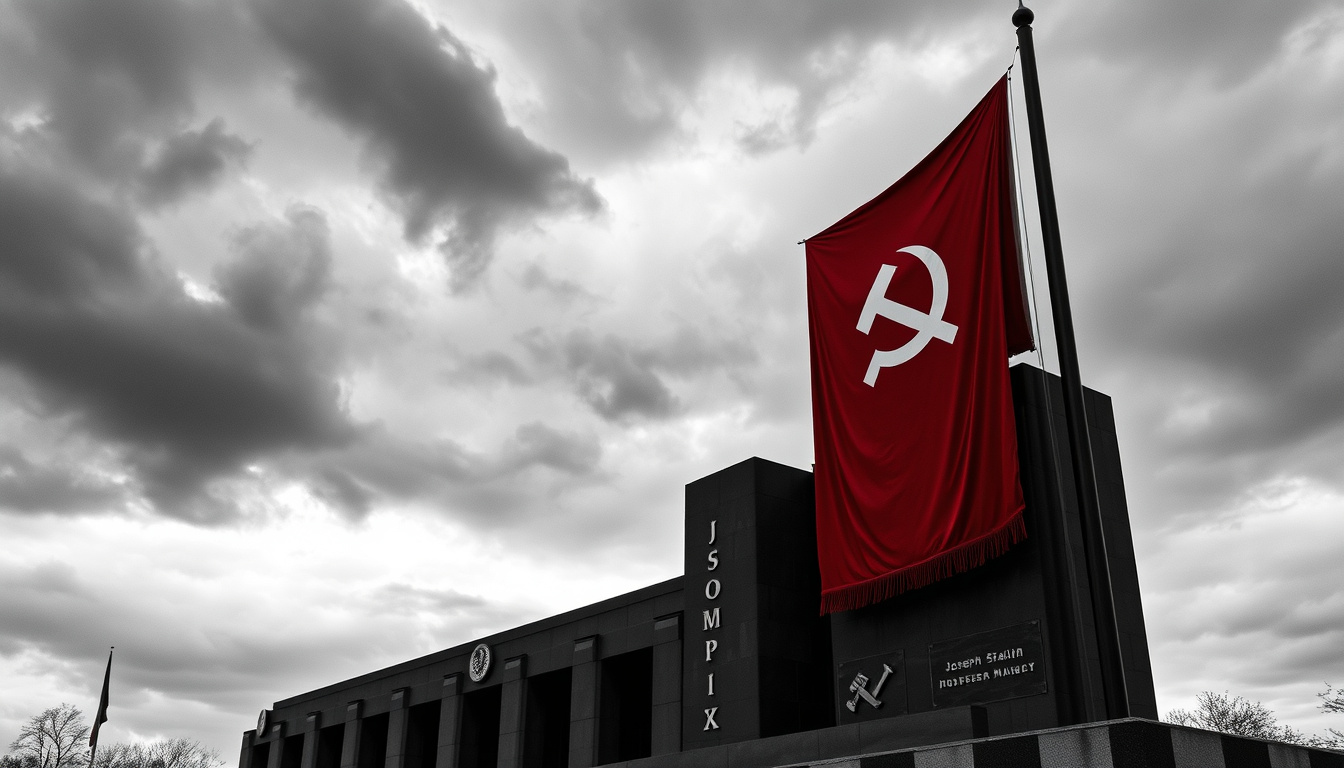
Few names in modern history carry a load as heavy as Stalin’s — part military triumph, part mass terror, part argument that never ends. Eight decades after his death, he still splits opinion in Russia: a 2021 Levada poll found 48% support for putting up Stalin statues. The documented record and the rumor blur together — the purges, the pact with Hitler, the wartime victory, the personal trivia. The point isn’t to settle every argument; it’s to show what’s grounded in archives and what isn’t.
Born: December 18, 1878, Gori, Georgia ·
Died: March 5, 1953, Moscow, USSR ·
Years in power: 1922–1953 ·
Estimated deaths attributed to his regime: 3–20 million (scholarly range) ·
World War II role: Supreme Commander of Soviet forces
Quick snapshot
- Stalin’s rule is tied to mass repression, purges, arrests, and executions documented in Soviet archives (Library of Congress (U.S. national archive)).
- NKVD records point to roughly 700,000 executions from 1935 to 1939, according to a Memorial/NKVD archive project reported by NDTV (international broadcaster).
- He led the USSR to victory over Nazi Germany — the achievement most Russians still credit him for (Heinrich Böll Stiftung (German political foundation)).
- The exact death toll from his policies — scholarly estimates range from roughly 3 million to 20 million, and historians disagree about what should count.
- Whether Stalin wet himself as he lay dying: some accounts report it, others deny it.
- Whether his left arm impairment came from a childhood injury or a birth defect.
- 1922: appointed General Secretary, beginning 31 years in power.
- 1929–1939: forced collectivization, Five-Year Plans, and the Great Purge.
- 1941: Hitler breaks the 1939 pact and invades; 1945: Soviet victory.
- A VTsIOM survey found 62% supported public displays of Stalin’s successes, while 65% opposed memorials to his crimes (Voice of America (U.S. international broadcaster)).
- Approval of Stalin has risen among younger Russians — the generational shift behind the next monument debates. (Voice of America (U.S. international broadcaster))
- Wilson Center analysts warn the numbers are shaped by an authoritarian political climate (Wilson Center (policy research institute)).
Eight biographical facts, one pattern: the certainties are easy to verify, and the controversies begin the moment anyone interprets them.
| Label | Value |
|---|---|
| Full name | Joseph Vissarionovich Stalin (born Ioseb Besarionis dze Jughashvili) |
| Birth date | December 18, 1878 (O.S. December 6) |
| Place of birth | Gori, Georgia, Russian Empire |
| Death date | March 5, 1953 |
| Place of death | Kuntsevo, Moscow, USSR |
| Height | 5 ft 4 in (1.63 m) |
| Religion | Raised Orthodox Christian; later atheist |
| Cause of death | Stroke (official); speculation of poisoning |
Who was Joseph Stalin and what did he do?
Stalin was a Soviet politician who ruled the USSR from 1922 until his death in 1953 — long enough to force-industrialize the country, survive the largest war in history, and rebuild the Soviet state around his own authority. The stages of that rule explain almost everything about his reputation today.
Early life and rise to power
- Born December 18, 1878, in Gori, Georgia, then part of the Russian Empire.
- Trained for the priesthood at the Tiflis Theological Seminary, where he was pulled into revolutionary politics.
- Adopted the alias “Stalin,” built from the Russian word for steel.
- Served several stretches of exile in Siberia before the 1917 revolutions brought the Bolsheviks to power.
Stalin joined the Bolsheviks early and climbed the party ranks as an organizer. In 1922 he became General Secretary — a job designed for paperwork, which he turned into a machine of patronage. After Lenin’s death, he outmaneuvered his rivals, and by the late 1920s he governed alone.
Consolidation of control and the Great Purge
- The Five-Year Plans from the late 1920s pushed rapid industrialization while forcing collectivization of agriculture.
- The Great Purge of the late 1930s fell hardest on Communist Party members, military officers, and ordinary citizens.
- Archive records point to roughly 700,000 executions from 1935 to 1939, according to a Memorial/NKVD archive project reported by NDTV (international broadcaster).
The purge was not a sideshow; it was the system working as designed. The same archive project, as summarized in the NDTV report, tied around 40,000 secret-police personnel to Stalin-era executions.
Stalin’s legacy debate is lopsided in an important way: the achievements live in civic memory, while the repression sits in the archival record. The Library of Congress (U.S. national archive) exhibit on Soviet archives documents purges, arrests, and executions as a structural part of his rule — evidence, not interpretation.
World War II leadership
- Stalin served as Supreme Commander of Soviet forces during World War II.
- The Red Army’s defeat of Nazi Germany in 1945 made the USSR a world power.
Hitler’s June 1941 invasion broke the pact Stalin had signed two years earlier, and the Eastern Front became the deadliest theater of the war. By 1945 the Red Army had driven to Berlin, and Stalin sat at the table that redrew Europe.
That victory is why so many Russians still separate “Stalin the wartime leader” from “Stalin the tyrant” — and why the archives keep pulling the two halves back together.
Why was Stalin so famous?
Part of Stalin’s fame was manufactured — his face was on everything, from portraits to films to birthday editions of every newspaper. But the machine had real material to work with: a Soviet Union that entered the 20th century as an agrarian empire and exited World War II as a superpower.
Defeat of Nazi Germany
- Soviet forces carried the heaviest fighting on the Eastern Front, the decisive theater of World War II.
- Stalin presented the victory as proof of Soviet strength and of his own leadership.
- About two-thirds of Russians in a 2013 survey agreed that the victory in the Great Patriotic War mattered most despite Stalin’s mistakes (Foreign Policy (international affairs magazine)).
A 2018 analysis by the Heinrich Böll Stiftung (German political foundation) found the same split: roughly two-thirds of Russians agreed that Stalin’s leadership had delivered the war victory. The war frames nearly everything Russians still admire about him.
Industrial transformation
- The Five-Year Plans built heavy industry at a pace no agrarian economy had attempted before.
- Collectivization and the Gulag system supplied the coerced labor behind major projects.
- By 1945 that industrial base equipped one of the largest armies in the world.
The growth was real, and so was the cost. The industrial miracle and the terror ran through the same institutions — forced labor, state planning, and surveillance. That is not a paradox; it is a package deal, and modern Russian debates about Stalin are debates about which half to emphasize.
Cult of personality
- Stalin’s image was plastered on propaganda, state media, and monuments.
- Official history credited him personally with every major Soviet achievement.
- Loyalty to Stalin and loyalty to the state became the same thing.
The cult had a practical function: if Stalin was the author of every success, then questioning him meant questioning the system itself. The terror made that equation concrete, and the monuments left behind became the raw material for today’s memory wars.
The implication: manufactured fame sticks only when it has a real achievement to cling to — and the wartime record is real enough to carry the weight.
What was Hitler’s relationship with Stalin?
Hitler and Stalin were ideological enemies who spent nearly two years as formal partners. The pact was a calculation on both sides — and the two leaders never met face to face.
The Molotov–Ribbentrop Pact
- In August 1939, Nazi Germany and the Soviet Union signed a non-aggression pact.
- The pact committed the two powers not to attack each other.
- It bought the USSR nearly two years of preparation before Hitler turned east.
The pact, named for the two foreign ministers who negotiated it, gave Hitler the green light to invade Poland and gave Stalin time to rebuild the Red Army. Both sides knew it was temporary; neither said so publicly.
Operation Barbarossa and betrayal
- On June 22, 1941, Germany invaded the USSR, breaking the 1939 pact.
- Stalin was shocked by the invasion despite intelligence warnings.
- Within months, German armies were deep inside Soviet territory, and the war became existential.
The intelligence failure of 1941 became a trauma in Soviet memory. Stalin reportedly treated the warnings as disinformation and ordered that the border commands not provoke the Germans — a misjudgment that cost the Red Army dearly in the opening months.
Mutual enmity and propaganda
- Soviet propaganda recast the war as the “Great Patriotic War,” a defense of the homeland.
- Nazi propaganda treated the Eastern Front as a racial crusade fought without mercy.
- The two systems defined themselves against each other, leaving no room for negotiation.
Stalin’s eldest son, Yakov, was captured by German forces in 1941. Accounts later claimed Stalin refused a prisoner exchange rather than appear to bargain with Hitler — a story that captures the regime’s logic even if the details are debated.
The pattern: every move in the Stalin–Hitler relationship was provisional. The pact bought time, the invasion ended it, and the war that followed became the defining test of Stalin’s rule — and the main source of his lasting stature.
What did Putin say about Stalin?
Vladimir Putin has spent two decades walking a narrow line on Stalin: acknowledge the crimes, credit the victories. In practice, the emphasis falls on the victories.
Putin’s cautious praise
- Putin has publicly emphasized Stalin’s role in defeating Nazi Germany and making the USSR a great power, according to an NDTV (international broadcaster) report on Russian memory politics.
- He has criticized the repressions in the same breath that honors the wartime victory.
- The Kremlin’s Victory Day ceremonies keep the Red Army’s triumph at the center of official history.
Putin’s standard formula is that Stalin was a “complex figure” — a phrase that acknowledges the crimes without letting them define the legacy.
Stalin as a ‘complex figure’
- The formula allows praise without full rehabilitation.
- Putin has said the Stalin-era repressions cannot be justified.
- But official discourse consistently weights the victory over the terror.
That middle path lets officials celebrate the Soviet war machine while treating the purges as a painful but secondary chapter. Modern Russian polling has repeatedly shown positive or mixed views of Stalin despite awareness of the repression (Carnegie Endowment for International Peace (global affairs think tank)), and a Carnegie analysis carried by The Moscow Times ties improving attitudes toward Stalin to the Putin era and the Kremlin’s use of his image for tighter control.
Polls showing rising Russian approval
- 2013: 42% of Russians named Stalin the most influential historical figure (The Moscow Times).
- 2017: 46% expressed some positive view of Stalin, the highest in that series since 2001 (The Spokesman-Review (regional U.S. newspaper)).
- 2019: 70% called his historical role positive, and 51% expressed respect, admiration, or sympathy (Wilson Center (policy research institute)).
- 2021: a VTsIOM survey found 62% supported public displays of Stalin’s successes, while 65% opposed public signs about his crimes (Voice of America (U.S. international broadcaster)).
A 2013 review of Levada data by Foreign Policy (international affairs magazine) found 28% with a positive opinion, while over half of respondents called Stalin’s repression a political crime that cannot be justified. Approval and condemnation coexist in the same population — sometimes in the same person. The generational shift shows up in the same series: approval of Stalin has risen among younger Russians, even as the wartime generation fades.
Russians can approve of Stalin’s successes and still oppose memorializing his crimes — which is why the 62% and the 65% from the 2021 VTsIOM survey are both true at once. Wilson Center analysts argue the authoritarian climate itself shapes these numbers, making “approval” a noisy signal (Wilson Center).
What did Einstein say about Stalin?
Einstein’s 1946 open letter to Stalin is one of the most-quoted documents in the “even geniuses respected him” genre. The full context is more complicated — and more interesting.
Einstein’s open letter to Stalin (1946)
- Einstein wrote to Stalin in 1946, praising his stance on peace and science.
- The letter lauded Stalin’s “loving care for men of science.”
- It came at the dawn of the nuclear age, when Einstein was urgently pressing for restraint.
The letter was addressed to Stalin as a statesman, not as a personal hero. Einstein praised specific positions — support for research, public commitment to peace — rather than the Soviet system as a whole.
Praise for Soviet science and peace efforts
- Einstein credited Soviet science and Stalin’s declared commitment to peace.
- He framed the exchange as an appeal to reason, not an endorsement of the regime.
- The respectful tone gave Soviet propaganda a rare moment of Western validation.
The distinction matters. Einstein was a lifelong critic of totalitarianism in all its forms, which is why his polite letter carried so much weight in Soviet propaganda: a famous liberal voice sounded respectful, and the state press used it.
Distinction between Stalin and the regime
- Einstein appealed to Stalin personally, but never endorsed the Communist system.
- His later statements continued to attack suppression of free thought.
- The available record suggests he viewed Stalin as a force for stability in the early Cold War.
The irony: Einstein’s courteous letter is sometimes used to make Stalin look reasonable, but the same physicist spent years denouncing the suppression of free thought. The letter praised science and peace — not the purges, and not the cult.
What disability did Stalin have?
Stalin’s image was so controlled that his physical flaws became a quiet obsession — for his propagandists, his contemporaries, and later historians.
Childhood injuries and smallpox scars
- Stalin contracted smallpox as a child, leaving visible scars on his face.
- He stood 5 ft 4 in (1.63 m) tall, a detail his official portraits tended to manage carefully.
- His left arm was slightly shorter and less functional than his right.
The smallpox scars are visible in early photographs; the height was routinely adjusted in retouched images. The fact that his appearance was so heavily managed is itself a fact about the cult of personality.
Shortened left arm (some sources)
- The cause is debated: a childhood injury or a birth defect.
- The impairment was real but never medically documented in detail.
- It was noticeable enough to appear in historical descriptions.
The medical record is thin precisely because Stalin controlled access to his own body as tightly as he controlled the state. The origin of the arm difference will likely never be settled.
Alleged psychological traits
- Observers have speculated about paranoia, cruelty, and personality disorder.
- No independent medical examination ever documented such a diagnosis.
- Psychological speculation about Stalin is not medically confirmed.
The temptation is to explain the Great Purge as the work of a madman. The archival record instead shows organized, systematic policy — planned, signed, and counted. Whatever his private psychology, the terror operated as state policy.
The trade-off: the more a leader controls his image, the more every flaw becomes a rumor. Stalin’s physical record is incomplete, so the fascination with it will continue.
Stalin’s timeline: from Gori to the Kremlin
Six periods, one pattern: every phase pairs a political achievement with a rising human cost.
| Period | What happened |
|---|---|
| 1878–1899 | Birth and early life in Georgia; training as a priest at Tiflis Seminary. |
| 1900–1917 | Joins Bolsheviks; participates in robberies and exiles to Siberia. |
| 1922–1928 | Appointed General Secretary; begins consolidating power after Lenin’s death. |
| 1929–1939 | Forced collectivization, Five-Year Plans, Great Purge. |
| 1941–1945 | Leader of USSR during World War II; victory over Nazi Germany. |
| 1945–1953 | Post-war repression, growing Cold War, death in 1953. |
Thirty-one years in power, two world wars, one empire dismantled and one superpower built — the timeline reads like several lifetimes welded together. The compression is the point: Stalin moved fast, and the cost scaled with the speed.
What’s confirmed and what’s still unclear about Stalin
Two lists, one honest summary: the archival record is solid on the big structures — purges, pact, victory — while the personal details remain stubbornly unverifiable.
Confirmed facts
- Stalin ruled the Soviet Union from 1922 to 1953.
- He signed the Molotov–Ribbentrop Pact with Nazi Germany in 1939.
- Soviet archives document mass repression, purges, arrests, and executions under his rule (Library of Congress (U.S. national archive)).
- He led the USSR to victory over Nazi Germany in 1945 (Foreign Policy (international affairs magazine)).
What’s unclear
- The precise death toll of his policies: estimates span roughly 3 million to 20 million depending on what is counted.
- Whether Stalin wet himself as he died — some accounts report it, others deny it.
- Whether his left arm impairment came from a childhood injury or a birth defect.
- Why nobody assassinated him — secret-police efficiency versus genuine loyalty is still debated.
- Whether his death was a natural stroke or something else — the official cause is stroke, but poisoning suspicions never fully disappeared.
The split between the lists is the finding: the things historians agree on changed the lives of millions, and the things they cannot verify are the human-scale details that keep the curiosity alive.
Stalin in quotes: three verdicts
Three speakers from three different worlds — but together they show how bendable the Stalin image is.
“Stalin took over a Russia with a wooden plough and left it with nuclear weapons.”
Winston Churchill
Churchill dealt with Stalin as a wartime ally and then as a Cold War adversary. His one-line verdict compresses the entire debate: modernization against terror, achievement against cost.
“…loving care for men of science.”
Albert Einstein, open letter to Stalin, 1946
Einstein’s phrase is the most common proof offered that Stalin could look reasonable from a distance. The letter itself was narrow and diplomatic — it never touched the purges.
“A complex figure.”
Vladimir Putin, describing Stalin
Putin’s formula lets Russian officials claim the wartime victory while acknowledging — in three words — that the repressions happened. The ambiguity is the point.
Three speakers, three Stalins: the ally, the patron, the instrument. That slipperiness is the real legacy.
Final thought
Stalin’s historical weight does not come from a single act. It comes from the combination: a dictator who industrialized a backward country in a generation, commanded the Red Army through the most destructive war in history, and ran a machine of arrests, executions, and forced labor that the archives keep exposing. Modern Russian opinion reflects both truths at once — respect for the victory, rejection of the repression — and the Kremlin’s selective memory politics keeps the contradiction unresolved. For younger Russians, the cohort whose approval of Stalin has risen most in recent polling, the choice is clear: keep wrestling with the archive, or let state memory politics decide for them.
stalindigitalarchive.com, foreignpolicy.com, stalindigitalarchive.com
Frequently asked questions
What was Stalin’s real name?
Joseph Vissarionovich Stalin, born Ioseb Besarionis dze Jughashvili in Gori, Georgia. He adopted “Stalin” as a revolutionary alias.
How many people did Stalin kill?
Historians do not agree. Scholarly estimates range from roughly 3 million to 20 million depending on what counts, and Great Terror-era NKVD records reviewed by a Memorial archive project document about 700,000 executions from 1935 to 1939.
Did Stalin have children?
Yes — two sons and a daughter from his two marriages. His eldest son, Yakov, was captured by German forces in 1941; accounts at the time claimed Stalin refused a prisoner exchange rather than appear to bargain with the enemy.
Did Stalin fight in World War I?
No. During World War I he was a revolutionary organizer, not a soldier, and he spent part of that period in Siberian exile. His later military role was as Supreme Commander during World War II.
What countries did Stalin control?
Stalin led the Soviet Union from 1922 to 1953. After 1945, Soviet influence expanded across most of Eastern Europe, creating the bloc that defined the early Cold War.
Did Stalin support LGBTQ rights?
No. In the 1930s, the Stalin-era criminal code criminalized male homosexuality in the USSR, and that legal framework remained in force for decades afterward.
Did Stalin and Hitler ever meet?
No. The two dictators never met face to face. Their only formal agreement was the Molotov–Ribbentrop Pact of 1939, negotiated by their foreign ministers.
What happened to Stalin’s body?
After his death on March 5, 1953, his body was embalmed and placed in Lenin’s Mausoleum on Red Square. In 1961, during the de-Stalinization campaign, it was removed and reburied at the Kremlin Wall Necropolis.
Related stories



Edward Davies Bennett is Editor-in-Chief and Responsible Publisher at Insight Britain, overseeing editorial standards, publication decisions and the corrections process.