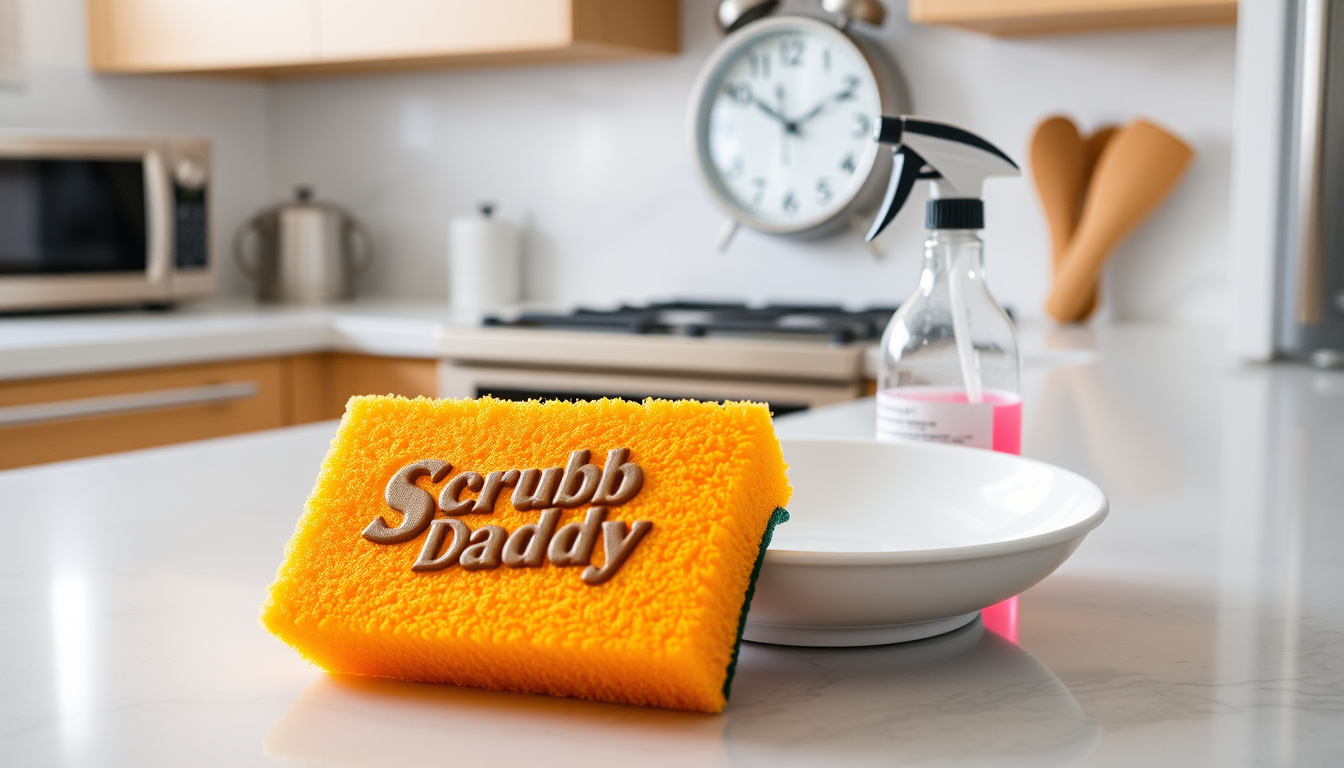
Most of the Scrub Daddy hype is about a Shark Tank deal; the practical case is about a foam that changes texture with water temperature. FlexTexture stays firm in cold water for scrubbing and softens in warm water for gentle cleaning, so the real question is whether that routine fits your surfaces, your sink, and your budget.
Invented by: Aaron Krause (Scrub Daddy official site) ·
Shark Tank investor: Lori Greiner (Scrub Daddy official site) ·
Signature material: FlexTexture foam ·
Texture shift: soft in warm water; firm in cold water ·
UK single-sponge price: £3.49 (Scrub Daddy UK, official store)
Quick snapshot
- FlexTexture is soft in warm water and firm in cold water, per Scrub Daddy EU Support, official brand guide.
- All Scrub Daddy scrubbers are top-rack dishwasher safe except Eraser Daddy and Screen Daddy (Scrub Daddy Support, official care FAQ).
- The official UK store lists a single Scrub Daddy at £3.49 and sells themed variants (Scrub Daddy UK, official store).
- Lori Greiner’s current exact ownership percentage is not established in the reviewed material.
- Aaron Krause’s current net worth is not established in the reviewed material.
- The status and outcome of any lawsuit naming Scrub Daddy are not established in the reviewed material.
- The brand now runs dedicated US, UK, and EU storefronts plus a professional cleaning line, signaling expansion beyond the original dish sponge (Scrub Daddy Professional, commercial line; Scrub Daddy, official US site).
- Use the soft side in warm water for glass and coated surfaces, and rinse grit off the foam before every pass (per the care and surface-safety sources cited above).
- Replace the sponge when it smells or loses its shape, even if the brand’s 8-week odor-resistance window hasn’t closed (per the replacement guidance below).
Eight key specs, one pattern: the material and texture claims come from the brand’s own support pages, while retailers and official storefronts confirm availability, pricing, and care.
| Spec | Detail |
|---|---|
| Inventor | Aaron Krause |
| Shark Tank investor | Lori Greiner |
| Signature material | FlexTexture, described by Target’s listing as “a highly engineered polymer foam” (Target, US retailer) |
| Texture behavior | Soft in warm water; firm in cold water (brand support pages cited above) |
| Dishwasher care | Top-rack safe; Eraser Daddy and Screen Daddy excluded (Scrub Daddy Support, official care FAQ, cited above) |
| Professional care | OG scrubber described as dishwasher- and microwave-safe (Scrub Daddy Professional, commercial line, cited above) |
| UK single-sponge price | £3.49 (Scrub Daddy UK, official store, cited above) |
| Retailer confirmation | Sold at Target; Publix confirms dishwasher sanitizing (Target cited above; Publix, US supermarket chain) |
What is so special about a Scrub Daddy?
The thing that makes Scrub Daddy different from a basic sponge is the foam itself. FlexTexture is a polymer material that turns firm in cold water for scrubbing and softens in warm water for gentle cleaning — a two-texture design the brand says lets you clean without switching sponges.
The texture trick is only valuable if you actually use both temperatures. Buyers who run everything under warm water get a soft sponge; buyers who use cold water get a firm scrubber. The £3.49 price makes sense only when both sides earn their keep.
The value case is straightforward: one sponge, two textures, and a brand-documented care routine. The official UK store prices a single Scrub Daddy at £3.49 as shown above, and US retailers like Target and Publix carry it, so the decision is rarely about availability — it’s about whether the routine fits.
Is Scrub Daddy worth the hype?
- Texture shift: firm side for stuck-on food, soft side for delicate surfaces — one tool instead of two.
- Dishwasher-safe sanitizing: the brand’s care FAQ puts nearly the whole line on the top rack, as covered in the key facts table above.
- Odor resistance: the brand claims 8 weeks, which is the main argument for replacing a basic sponge less often (covered in the replacement section below).
If you already keep a soft sponge and a scouring pad, the Scrub Daddy replaces both. If you only need a basic scrubber for light washing, the per-sponge price is harder to justify.
What is Scrub Daddy material?
- FlexTexture is a highly engineered polymer foam, a description echoed by Target’s product listing (Target, US retailer, cited above).
- The foam is designed to be firm in cold water and soft in warm water, per the brand’s support pages cited above.
- The same material is described as non-toxic, BPA-free, and latex-free on the brand’s official page.
Material-wise, the foam does the pressure work. You change water temperature instead of changing sponges or pressing harder.
Can Scrub Daddy go in the dishwasher?
- Yes for most of the line: top-rack dishwasher sanitizing is confirmed in the brand’s care FAQ, with Eraser Daddy and Screen Daddy as the exceptions.
- The OG scrubber is also described as microwave-safe on the brand’s professional product page (Scrub Daddy Professional, commercial line, cited above).
- Publix’s product listing independently confirms dishwasher sanitizing (Publix, US supermarket chain).
Dishwasher and microwave cycles sanitize the foam, but they don’t rebuild worn texture. A sponge that has gone flat or started smelling needs replacing, not another cycle.
The implication: the brand’s special feature is real and documented, but it pays off only for people who change their technique to match the foam.
What should you not use Scrub Daddy on?
Scrub Daddy’s official support page says independent lab tests show FlexTexture is scratch-free on more than a dozen surfaces, and it lists glass, chrome, ceramic, porcelain, stainless steel, acrylic, and fiberglass among the tested-safe materials (Scrub Daddy EU Support, official brand guide, cited above). That list is the starting point; what matters more is how you use the sponge.
A clean Scrub Daddy is scratch-free; a dirty one is not. Grit, coffee grounds, and soap scum trapped in the foam turn a gentle scrubber into an abrasive that can drag across glossy finishes.
The brand’s tested-safe list doesn’t include every coated or finished surface. High-gloss cookware, non-stick pans, and unsealed wood deserve a cautious approach: test on a small, hidden area first, and avoid heavy pressure.
Can Scrub Daddy clean a bathtub?
- Yes on fiberglass and porcelain, which sit on the brand’s tested-safe list, and on ceramic tile.
- Use warm water so the foam stays soft on glossy tub surfaces.
- Rinse the sponge frequently while scrubbing so soap scum doesn’t redeposit on the finish.
- On coated or enameled tubs, test an inconspicuous spot before going over the whole surface.
The pattern: Scrub Daddy’s risk is not the foam; it’s what gets trapped in it. That’s why the most important step is rinsing, not pressing.
What are the lawsuits against Scrub Daddy?
Scrub Daddy lawsuit questions are common in search queries, but the official and editorial material reviewed for this guide does not document an active product-liability case against the brand. Most legal chatter online mixes trademark and patent disputes with consumer product claims, and those are different legal categories.
If a lawsuit headline about Scrub Daddy appears, check whether the brand is a named defendant and whether a court record exists. Marketing disputes produce press releases; product-liability cases produce filings.
Does Lori still own 20% of Scrub Daddy?
- Lori Greiner is the Shark Tank investor associated with Scrub Daddy, as noted in the stats line above.
- The widely repeated 20% stake is not confirmed in the official material reviewed here.
- Ownership percentages in private brands change over time and are rarely public; treat any exact figure as unverified.
Is Scrub Daddy owner a millionaire?
- Aaron Krause is the founder and inventor named in the brand’s business story.
- His current net worth is not established in the sources reviewed for this guide.
- Net worth estimates circulating online should be traced to a current financial profile or interview before being repeated.
The honest answer: the business story is public at the “who invested” level, but the financial details are private. A number without a court record or financial disclosure is a rumor until proven otherwise.
The implication: lawsuit curiosity is really a question about brand health, and the reviewed material offers no verified evidence of a product-safety crisis.
How often should you throw out a Scrub Daddy?
Scrub Daddy says FlexTexture resists odors for 8 weeks (Scrub Daddy EU Support, official brand guide, cited above). That’s an odor-resistance claim, not a lifespan guarantee, and it depends heavily on how you dry the sponge between uses.
How do you sanitize a Scrub Daddy?
- Top-rack dishwasher: safe for nearly the whole line, with Eraser Daddy and Screen Daddy as exceptions (Scrub Daddy Support, official care FAQ, cited above).
- Microwave: the OG scrubber on the brand’s professional page is described as dishwasher- and microwave-safe for cleaning and reuse, as noted earlier.
- The official UK product page adds a practical tip: sanitize on the top rack and test in a small inconspicuous area if you have concerns.
- Rinse thoroughly and wring out after every use; a wet sponge in a dark sink is where odors return fastest.
A practical replacement schedule: swap the sponge when it still smells after sanitizing, when the firm side no longer holds its shape, or when the soft side stops rinsing clean. Depending on your cooking load, expect that point before or after the 8-week mark, not on a fixed calendar date.
The trade-off: dishwasher and microwave cycles buy time, not immortality. Replacement is driven by performance, not the calendar.
Is showering with a Scrub Daddy a good idea?
Short answer: no. Scrub Daddy is designed and sold as a dish and surface scrubber, not a body sponge, and retail listings position it for cleaning tasks rather than personal care.
The firm cold-water side that powers through stuck-on food will drag across skin if you press. FlexTexture is an engineered abrasive — effective on pans, risky on skin.
Is Scrub Daddy safe on skin?
- Textured foam can feel abrasive on sensitive skin, especially the firm cold-water side.
- Keep it away from eyes, broken skin, and mucous membranes.
- If you test it on skin, use the soft side in warm water, don’t share it, and replace it often.
The catch: a sponge that is safe on glass can still be a bad idea on skin. Keep Scrub Daddy in the kitchen, where its texture is a feature rather than a hazard.
Is Scrub Daddy safe on glass shower doors?
Yes — glass is on the brand’s tested-safe list, as covered in the surface-safety section above, and the soft warm-water side is the right setting for shower glass. But “safe” means the clean foam won’t scratch bare glass; it doesn’t mean a gritty sponge is harmless.
The Home Depot and Lowe’s, home-improvement retailer both warn that abrasive cleaners and scouring pads can scratch or dull glass shower doors (The Home Depot, cited below). PRL Glass (glass-shower specialist) adds that steel wool and harsh abrasives can scratch the glass and that Magic Erasers can remove protective coatings when used aggressively (PRL Glass, cited below). Southern Living (home-care editorial outlet) and The Pioneer Woman, home-lifestyle editorial outlet recommend non-abrasive sponges and mild cleansers for coated glass (Southern Living, cited below). If you’re trying any new scrubber on a coated door, test an inconspicuous area first.
Scrub Daddy fits inside professional glass-care logic: non-abrasive foam, mild detergent, and light pressure. The sponge is a safe tool; technique decides the outcome.
How do hotels keep their shower glass so clean?
- Squeegee the glass after every shower so hard-water minerals never bond to the surface.
- Use a mild detergent or dedicated glass cleaner with a non-abrasive pad.
- Treat stubborn mineral deposits with a hard-water remover on a daily or weekly schedule, depending on use.
That routine is echoed in cleaning guidance from Southern Living, which recommends a squeegee habit and non-abrasive tools for shower doors (Southern Living, cited above).
What do professional cleaners use to clean a shower?
- Microfiber cloths and squeegees are the workhorses; they lift film without scratching.
- Non-abrasive foam pads, the same category as Scrub Daddy’s soft side, handle soap scum.
- Acidic hard-water removers are reserved for mineral deposits and are rinsed off promptly.
The pattern: pros don’t rely on any single sponge. They combine a squeegee habit, a non-abrasive pad, and regular hard-water treatment. Scrub Daddy fits into that system, but it isn’t the system.
The pattern: Scrub Daddy’s soft side is one valid step in a professional-grade glass routine, not the whole routine.
Scrub Daddy specs at a glance
Ten specs, one pattern: the brand documents the material story, and independent retailers keep confirming the care routine. Where a number is a claim, the source is named.
| Spec | Detail |
|---|---|
| Product | Scrub Daddy Original FlexTexture scrubber |
| Material | FlexTexture polymer foam |
| Texture | Firm in cold water; soft in warm water |
| Dishwasher | Top-rack safe; Eraser Daddy and Screen Daddy excluded (per brand care FAQ, cited above) |
| Microwave | OG scrubber is dishwasher- and microwave-safe (per brand professional page, cited above) |
| Odor resistance | Brand claims 8 weeks (source cited above) |
| Material safety | Non-toxic, BPA-free, latex-free per brand |
| Tested-safe surfaces | Glass, chrome, ceramic, porcelain, stainless steel, acrylic, fiberglass |
| Retail availability | Target and Publix in the US; official UK and EU stores |
| Price | £3.49 for a single sponge on the official UK store (cited above) |
The implication: the spec sheet is consistent across official pages and retailer listings; the only unresolved items are business-side claims like ownership stakes and net worth.
The pros and cons of Scrub Daddy
Upsides
- Two textures in one sponge: firm scrubbing in cold water, gentle cleaning in warm water.
- Top-rack dishwasher sanitizing for most of the line, with only Eraser Daddy and Screen Daddy excluded.
- Brand-documented tested-safe list includes glass, fiberglass, porcelain, ceramic, and stainless steel.
- Rinses clean under running water, per the brand’s official site.
Downsides
- Price per sponge is high: £3.49 on the official UK store (already cited above).
- Firm cold-water side can be too aggressive for coated cookware and glossy finishes.
- Trapped grit can scratch glass; the foam has to be rinsed before every glass pass.
- Not a body sponge; the texture is abrasive for sensitive skin and open skin.
- Business-side questions (ownership stake, net worth, lawsuits) remain undocumented in reviewed sources.
The trade-off: Scrub Daddy asks you to pay more per sponge and learn a two-temperature routine; in return, you get a tool that can replace a soft sponge, a scrub pad, and part of a glass-cleaning kit.
How to clean glass shower doors with a Scrub Daddy
- Rinse the Scrub Daddy under warm running water first. Warm water softens the foam, and rinsing removes grit that could scratch glass.
- Apply a mild detergent or glass cleaner to the door. Non-abrasive foam pads are the standard choice for coated glass.
- Use the soft side with light pressure, wiping in straight or circular strokes.
- Rinse the sponge frequently, especially near the bottom track where hard-water grit collects.
- Squeegee the door after every shower to stop mineral spots from bonding.
- Stand the sponge upright to dry, and replace it when it smells or loses its shape.
Why this matters: the sponge is one step in a routine. If you skip the squeegee, no scrubber will keep shower glass truly clear.
Confirmed facts vs what’s unclear
Confirmed facts
- FlexTexture foam is soft in warm water and firm in cold water, per Scrub Daddy EU Support, official brand guide (cited in the snapshot above).
- Lori Greiner is the Shark Tank investor associated with the brand (cited in the stats line above).
- The official UK store lists a single Scrub Daddy at £3.49 and sells themed variants (Scrub Daddy UK, official store, cited above).
What’s unclear
- Lori Greiner’s current exact ownership percentage is not established.
- Aaron Krause’s current net worth is not established.
- The status and outcome of any lawsuit naming Scrub Daddy are not established.
- Whether the online “20% stake” figure reflects today’s cap table is unverified.
The pattern: everything about the foam is documented, and nearly everything about the business owners’ private finances is not.
What the sources say
“Never use abrasive cleaners or scouring pads on glass shower doors — they can scratch the surface.”
“Never use steel wool or harsh abrasive cleaners on shower glass. Magic Erasers can scratch glass or remove protective coatings if used aggressively.”
“Use a non-abrasive sponge or foam cleaning pad on shower doors, and avoid ammonia-based cleansers if the door has a special coating.”
The thread: three independent sources describe the same technique — non-abrasive tools, no harsh scouring, and caution with coated glass. Scrub Daddy’s soft side fits that brief; its firm side doesn’t belong on shower doors.
The takeaway
Scrub Daddy delivers exactly what it promises: a temperature-shifting foam that replaces the soft-sponge-and-scourer combo and sanitizes in the dishwasher. The limits are practical, not technical — a gritty sponge can scratch glass, the firm side is too aggressive for skin and coated finishes, and no sponge survives forever. For the average UK household weighing a £3.49 sponge, the choice is clear: buy it if you’ll use both textures and rinse it before every glass-cleaning pass, or keep a basic sponge and skip the care routine entirely.
Related reading: Scrub Daddy dishwasher safety guidelines · Scrub Daddy FlexTexture material properties
Frequently asked questions
Does Scrub Daddy need warm water to stay soft?
Yes, the soft texture depends on warm water. The brand’s official guide describes FlexTexture as soft in warm water and firm in cold water, so run the sponge under warm water when you need the gentle side.
Can Scrub Daddy be used with bleach?
The official care pages reviewed for this guide do not cover bleach use. Treat bleach as not recommended unless the specific product’s care label says otherwise.
Is Scrub Daddy better than a regular sponge?
It depends on your routine. It offers two textures in one tool, a claimed 8-week odor resistance, and top-rack dishwasher sanitizing — advantages a basic cellulose sponge doesn’t have. If you only want a disposable cheap scrubber, the £3.49 price is hard to justify.
How do you dry Scrub Daddy between uses?
Rinse it thoroughly, wring it out, and store it upright or on a dry holder. A wet sponge left in a dark sink is where odors and bacteria return fastest.
Are Scrub Daddy sponges made in the USA?
The official pages reviewed for this guide do not state a single country of manufacture. Check the product packaging or specific retailer listing if country of origin matters to you.
What is the difference between Scrub Daddy and Scrub Mommy?
Scrub Daddy is the original FlexTexture scrubber with the temperature-shifting texture. Scrub Mommy is a separate product in the same brand family, but the reviewed material does not document its full feature set, so compare product descriptions before buying.
Related stories





Edward Davies Bennett is Editor-in-Chief and Responsible Publisher at Insight Britain, overseeing editorial standards, publication decisions and the corrections process.