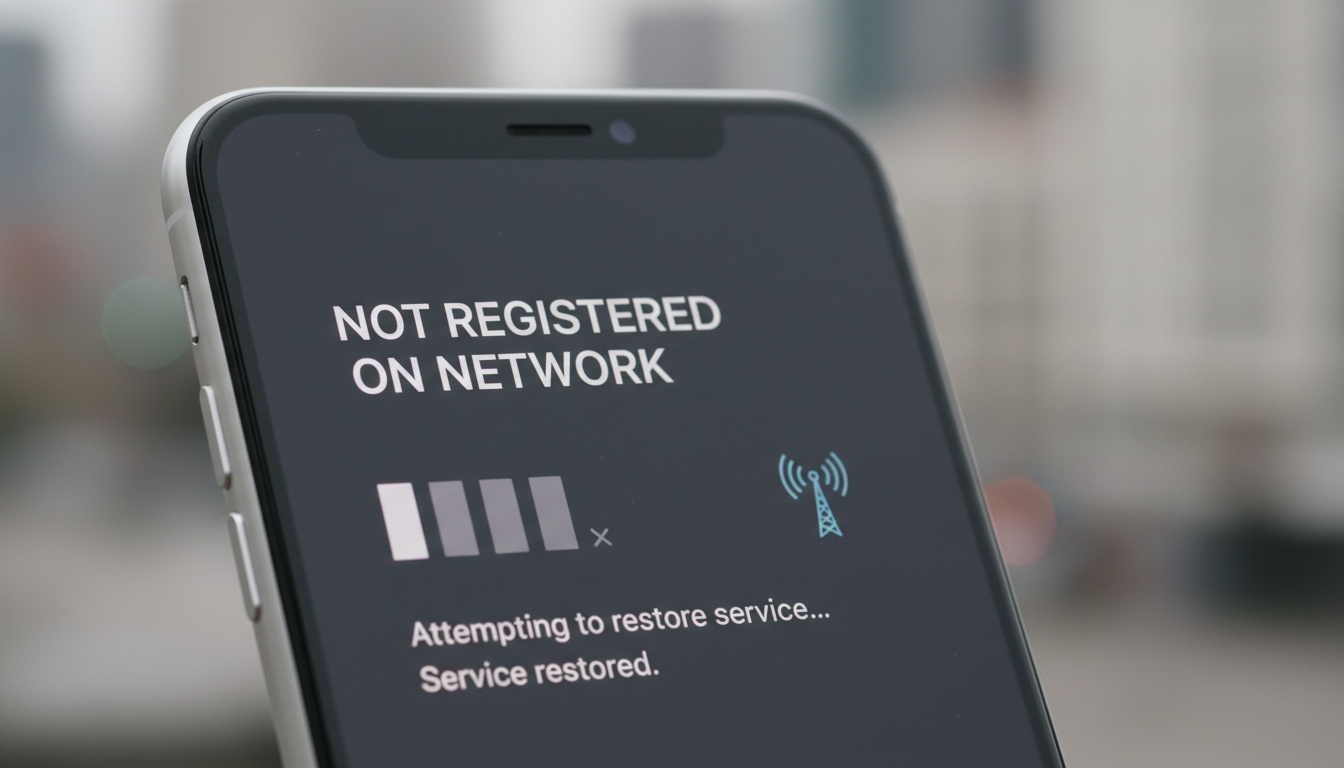
The error message “not registered on network” disrupts essential communication when your phone fails to establish a connection with cellular towers. This registration failure prevents voice calls, text messages, and mobile data access, often appearing suddenly after software updates or during travel. Similar connectivity disruptions extend to WiFi networks and gaming platforms like Valorant, creating a fragmented landscape of digital access issues that require systematic diagnosis.
Cellular registration errors differ fundamentally from WiFi connection failures, though both manifest as “network problems” in casual troubleshooting. While the “number not registered” error specifically involves your SIM card’s handshake with carrier infrastructure, WiFi issues typically stem from router configurations or device settings. Gaming network problems introduce additional variables including server-side outages and packet routing optimization.
This guide examines the distinct mechanisms behind these error types, distinguishing between carrier-specific outages affecting Three UK and Lebara users, device-level configuration conflicts, and game-server connectivity interruptions. Each scenario demands specific verification steps and remediation approaches based on current technical documentation from device manufacturers and network security providers.
Number Not Registered on Network
When your display shows “not registered on network” or “number not registered on network,” the device has lost synchronization with your carrier’s cellular infrastructure. This status indicates the SIM card cannot authenticate with local cell towers, effectively isolating the device from mobile services.
Cellular (Not Registered)
Common causes: SIM error, no signal, carrier outage
Quick fixes: Restart, reseat SIM, check coverage
WiFi Connection
Common causes: Router issue, device settings
Quick fixes: Forget network, toggle airplane
Carrier-Specific (e.g., 3, Lebara)
Common causes: Outage, APN settings
Quick fixes: Status checker, APN reset
Gaming (Valorant)
Common causes: Packet loss, server issue
Quick fixes: VPN, wired connection
Critical Insights for Network Registration
- Cellular “not registered” errors specifically indicate SIM-to-tower authentication failures, distinct from wireless radio problems
- WiFi “network” errors involve router-device handshakes rather than carrier infrastructure
- Search volume data suggests these queries carry urgent intent despite relatively low monthly frequency
- Carrier status verification should precede device troubleshooting for suspected outages
- Power cycling resolves the majority of transient registration failures across Android and iOS platforms
- Three UK and Lebara-specific issues require checking carrier-native applications rather than generic device settings
Issue Frequency and Resolution Patterns
| Issue Type | Relative Frequency | Primary Cause | Most Effective Fix |
|---|---|---|---|
| Number not registered | Low | SIM fault | Device restart |
| Phone not connecting to WiFi | Low | Configuration settings | Toggle WiFi/Airplane mode |
| Mobile network problems | Low | Carrier outage | Coverage map verification |
| WiFi not working | Low | Router malfunction | Router power cycle |
| 3 network problems | Low | Infrastructure maintenance | Carrier status page |
| Lebara network problems | Low | APN configuration | Settings reset |
| Valorant network problem | Low | Server-side packet loss | Wired Ethernet connection |
Phone Not Connecting to WiFi
WiFi connectivity failures present differently than cellular registration errors, though both prevent internet access. When your phone refuses to establish wireless connections, the troubleshooting sequence prioritizes radio state verification and authentication credential management.
Phone Won’t Connect to WiFi
Initial diagnosis requires confirming the WiFi radio is actually enabled. Access quick settings by swiping down twice from the top of the screen, then tap the WiFi icon to ensure activation according to AVG’s connectivity documentation. If the icon shows inactive, toggle it once and wait thirty seconds for network discovery.
Persistent refusal to connect often stems from corrupted network profiles. Navigate to Settings > Network & Internet > WiFi, select the problematic network, and choose “Forget” to erase stored credentials. Reconnect using the current password, as outdated authentication tokens frequently block handshake completion based on Android troubleshooting protocols.
WiFi Not Working on Phone
Functional wireless networks may still fail to route traffic properly. Begin by restarting both endpoints: power down your phone completely, unplug the router for thirty seconds, then restore power to the router before rebooting the mobile device following Google’s support recommendations. This clears ARP table conflicts and DHCP lease issues that silently block connectivity.
Router hardware status requires visual inspection. Verify indicator lights display normal operation, check cable connections for physical damage, and attempt connection to the 5GHz band if available, as 2.4GHz congestion often causes intermittent failures according to Apple’s WiFi guidance. Position the device closer to the router to eliminate range-related signal degradation.
Enable Airplane mode for ten to thirty seconds via quick settings, then disable it to force simultaneous re-registration of cellular and WiFi radios. This action clears transient modulation errors without erasing stored network passwords based on Avast’s Android repair guide.
WiFi Network Not Showing Up
Invisible networks suggest either SSID broadcasting disabled on the router or frequency band incompatibility. Verify the router broadcasts its network name and confirm your device supports the specific frequency (2.4GHz vs 5GHz) the router utilizes. Older devices often fail to detect modern 5GHz-only networks.
Software incompatibilities occasionally hide available networks. Check for Android system updates under Settings > System > Software update, as patch levels directly affect wireless driver stability per Google’s device support forums. For persistent issues, reset network settings to factory defaults, though this erases saved WiFi passwords and Bluetooth pairings according to network security documentation.
Why Does Valorant Show Network Problems?
Riot Games’ tactical shooter demands consistent low-latency connections distinct from general browsing requirements. When Valorant displays network problem warnings, the issue typically involves packet routing rather than basic connectivity.
Network Problem Valorant Specifics
Gaming traffic requires stable upstream and downstream channels without the buffering acceptable for video streaming. General network fixes apply to Valorant connectivity: ensure stable WiFi or mobile data baseline, restart the gaming device and router, and verify no background applications consume bandwidth excessively.
Unlike general phone connectivity, gaming benefits significantly from physical layer improvements. Wired Ethernet connections eliminate wireless interference variables that cause the micro-stutters triggering Valorant’s network warning icons. If wireless remains necessary, disable Bluetooth and VPN services that compete for radio resources and processor attention.
No specific documentation confirms current Valorant server outage patterns. Players should verify Riot Games service status independently, as client-side fixes cannot resolve infrastructure maintenance or distributed denial-of-service attacks affecting game servers.
Recent Network Outage Patterns
Network reliability fluctuates based on maintenance windows and infrastructure load. While specific outage data for Three UK and Lebara remains unconfirmed in current documentation, carrier issues typically follow predictable reporting cycles.
- Morning Diagnostics (08:00-10:00): Carrier applications refresh outage status data following overnight maintenance. Users should check native apps for Three or Lebara before attempting device-level repairs.
- Peak Usage Reports (18:00-20:00): Complaints regarding WiFi and mobile data surge as residential networks absorb streaming and gaming traffic, potentially masking individual device failures as widespread outages.
- Gaming Maintenance Windows (02:00-04:00): Valorant and similar platforms typically schedule server updates during low-population hours, creating temporary “network problem” warnings for all connected clients regardless of local connection quality.
Established Facts vs Uncertain Causes
Distinguishing confirmed technical mechanisms from suspected causes prevents unnecessary troubleshooting steps and hardware replacement.
| Established Information | Information That Remains Unclear |
|---|---|
| “Not registered” errors indicate failed authentication between device and cell tower | Specific real-time outage status for Three UK or Lebara without checking carrier tools |
| Error frequency increases following Android/iOS system updates | Whether hardware faults or software bugs dominate failure statistics |
| Restart protocols resolve transient registration failures in majority of cases | Long-term carrier infrastructure stability projections |
| WiFi issues stem from router-device handshake failures distinct from cellular mechanisms | Precise thresholds for “number not registered” vs “no signal” distinctions |
Understanding Network Registration Errors
Cellular and WiFi networks operate on fundamentally different authentication architectures. Cellular registration involves cryptographic verification between your SIM card’s integrated circuit and carrier base stations using the International Mobile Subscriber Identity (IMSI). WiFi connections rely on pre-shared keys or enterprise authentication protocols that never leave the local network segment.
Cellular vs WiFi Differences
The “not registered on network” error specifically references the cellular attachment process governed by 3GPP standards. Your device transmits identification to the nearest base station, which queries the carrier’s Home Location Register (HLR) to verify service eligibility. WiFi lacks this centralized verification, instead negotiating directly with the local access point. This distinction explains why cellular errors require carrier intervention while WiFi issues typically resolve through router management.
Device and Carrier Factors
Manufacturer-specific software layers interpret network rejection codes differently. Samsung devices route network reset commands through Settings > General management > Reset network settings according to device-specific documentation, while stock Android uses Settings > System > Reset options. Carrier-specific complications arise with MVNOs like Lebara that rely on host networks (Vodafone UK), potentially displaying different error codes than the underlying infrastructure generates.
For persistent carrier-specific issues, contacting dedicated support lines provides escalation paths unavailable through generic device troubleshooting. Users experiencing repeated registration failures with major UK providers may reference Sky Customer Service Number – Official UK Lines, Wait Times & Tips for framework on navigating telecommunications support structures, though specific carrier contacts vary by provider.
Official Documentation and Support Sources
Technical guidance from device manufacturers and security firms confirms consistent remediation patterns across Android ecosystems. Direct source material provides authority for specific troubleshooting sequences.
“Power off your device, wait 30 seconds, and turn it back on to refresh network registration. This clears temporary software glitches affecting the modem firmware.”
— Google Play Help Center
“Toggle Airplane mode for 10-30 seconds to force the device to drop all radio connections and re-establish them with clean authentication tokens.”
— AVG Android Security Documentation
“Ensure your router firmware is updated and try different frequencies (e.g., 5GHz) to avoid interference that mimics network failure symptoms.”
— Apple WiFi Support Resources
Resolving Persistent Connection Failures
Systematic elimination of variables remains the only reliable method for resolving stubborn network registration errors. Begin with physical layer verification: test the SIM card in an alternate device to isolate hardware faults, and attempt connections on multiple WiFi networks to confirm router-specific issues. If failures persist across different devices and networks, carrier-level account provisioning errors likely require direct support intervention. For users considering equipment upgrades to resolve chronic connectivity issues, exploring current ID Mobile Promo Code – £30 Off iPhones & Student Deals may provide cost-effective replacement options with updated radio hardware.
Frequently Asked Questions
What causes 3 network problems today?
Three UK outages typically stem from infrastructure maintenance or localized cell tower failures. Check the Three app or Downdetector for real-time status, as specific daily causes vary without advance notification.
Why is Valorant showing network problem?
Valorant displays this warning when detecting packet loss or latency spikes exceeding game tolerance thresholds. Causes include WiFi interference, router bufferbloat, or Riot server instability. Use wired Ethernet for elimination testing.
Why is my phone not connecting to WiFi?
Authentication failures, incorrect passwords, or router DHCP exhaustion prevent connections. Forget the network and reconnect, or restart both devices to clear IP assignment conflicts.
What does WiFi network not showing up mean?
The router may hide its SSID, broadcast on an incompatible frequency (5GHz vs 2.4GHz), or suffer hardware failure. Verify router lights indicate normal operation and check device compatibility with the specific band.
How do I fix number not registered on network?
Power cycle the device, reseat the SIM card, and verify active service status. If unresolved, reset network settings or contact your carrier to refresh network registration on their HLR system.
Are Lebara network problems different from other carriers?
Lebara operates as an MVNO on Vodafone’s infrastructure, so outages often correlate with host network issues. However, APN configuration errors specific to Lebara accounts require manual settings verification distinct from major carrier troubleshooting.
Related stories


Helen Carter covers the economy, business and consumer affairs for Insight Britain.