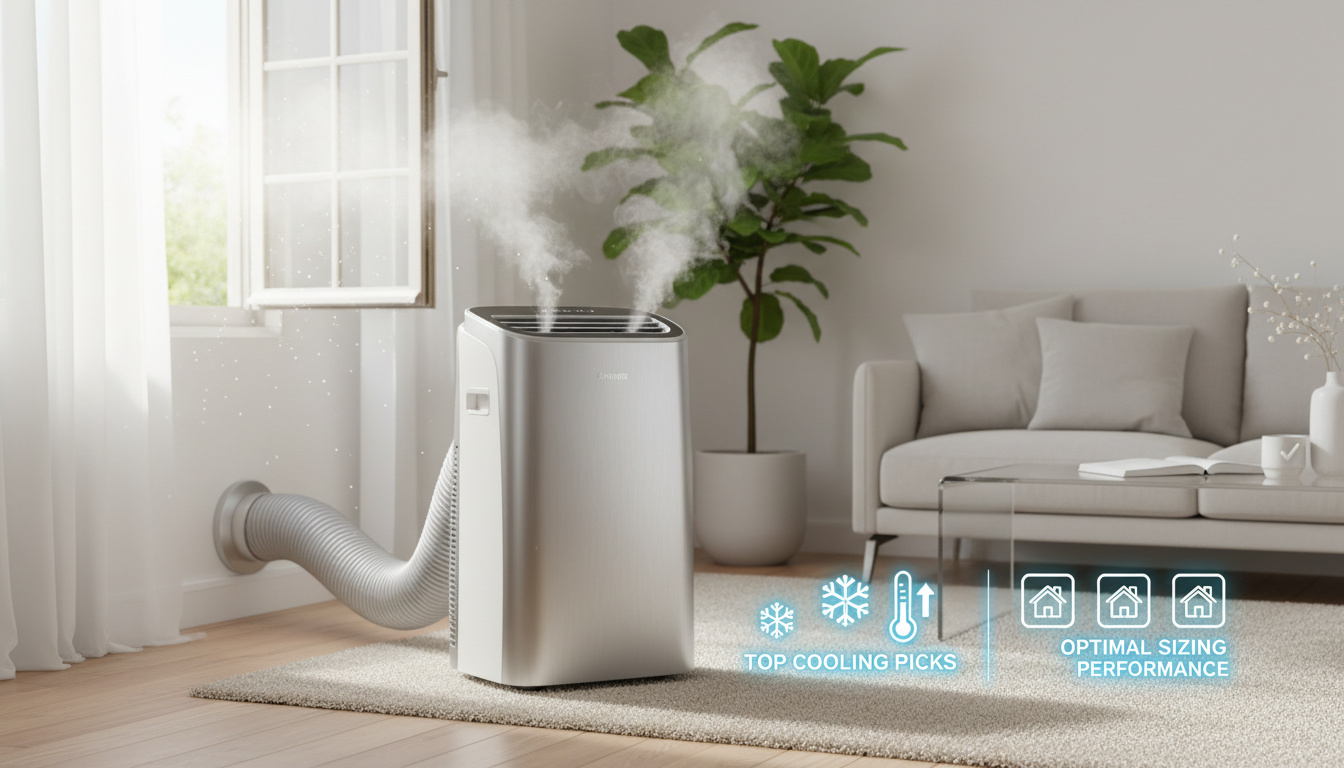
When summer heat becomes unbearable and permanent installation isn’t an option, portable air conditioning units offer a flexible solution for immediate relief. These self-contained cooling systems promise to transform any room into a comfortable retreat without the constraints of window-mounted hardware or central HVAC systems.
Unlike traditional air conditioners that require fixed mounting, portable units roll on casters and connect to windows through flexible exhaust hoses. They target renters, apartment dwellers, and homeowners who need supplemental cooling in specific zones rather than whole-house climate control. Understanding their mechanics, limitations, and proper sizing proves essential before investing in what manufacturers claim is the answer to sweltering indoor temperatures.
This guide examines how portable air conditioning units function, whether they deliver on cooling promises, and how to select the right capacity for your space. Drawing from extensive testing by consumer advocacy groups and technical laboratories, we separate marketing claims from measured performance data to help determine if these mobile coolers justify their cost and energy consumption.
How Does a Portable Air Conditioning Unit Work?
Single-hose, dual-hose, evaporative
8,000–16,000
150–800 sq ft
$200–$800
- Dual-hose systems prevent negative pressure. By using separate intake and exhaust hoses, these units avoid drawing hot outdoor air back into cooled spaces.
- Venting remains mandatory. All refrigerant-based portable ACs require an exhaust hose routed to the outdoors to expel heat and moisture.
- BTU ratings indicate capacity, not efficiency. Higher BTU units cool larger areas faster but don’t necessarily use electricity more efficiently.
- Inverter technology reduces power consumption. Compressors that adjust cooling output based on demand operate more efficiently than standard on/off cycles.
- Single-hose units create pressure imbalances. Drawing return air from the room itself makes them less efficient in larger spaces or high-humidity environments.
- Installation requires 5–15 minutes. Most units include window slider kits, though hose connections may need additional sealing.
- Noise levels vary dramatically by model. Testing reveals ranges from 42 dB on lowest settings to significantly louder operation on budget units.
| Fact | Details |
|---|---|
| Average BTU | 8,000–12,000 for standard rooms |
| Venting Required | Yes, exhaust hose mandatory |
| Energy Use | 900–1,200W typical operation |
| Noise Level | 42–60 dB range |
| Cooling Method | Refrigerant-based heat removal |
| Installation Time | 5–15 minutes with window kit |
| Hose Configuration | Single or dual options |
| Efficiency Leaders | Dual-hose with inverter compressors |
| Maintenance | Filter cleaning, condensate drainage |
| Mobility | Casters for room-to-room movement |
| Smart Features | App control, Wi-Fi connectivity available |
| Heating Capability | Some models offer reverse-cycle heating |
Do Portable Air Conditioners Actually Work?
Performance Under Extreme Conditions
Testing in severe environments confirms operational capability. The Midea Duo Smart Inverter maintained strong, steady cooling during evaluations in Florida conditions reaching 93°F with 80% humidity, dropping room temperatures significantly faster than lower-capacity alternatives according to Bob Vila. This dual-hose model utilizes a “hose-in-hose” design that replaces removed hot air with cool air for maximum efficiency as reported by Business Insider.
Top-Tested Models and Real Results
The Midea Duo Smart Inverter consistently ranks as the best overall portable AC across multiple testing sources including TechGearLab, earning perfect or near-perfect scores for ease of use and performance. For premium features including Wi-Fi connectivity, the Whynter NEX ARC-1230WN receives high marks from RTINGS, while the Whynter ARC-14S serves as a runner-up for strong dual-hose cooling.
The Friedrich ZoneAire operates at extremely low noise levels while delivering 16,000 BTU capacity suitable for 800 square feet according to Business Insider. For budget-conscious buyers, the Amazon Basics Portable Air Conditioner offers strong value, while the Dreo AC319S balances quiet operation with compact design per Bob Vila. The Dreo AC515S specifically addresses noise concerns, earning recognition as a “silent assassin” in contexts where most portable units generate significant operational volume based on video analysis.
Understanding the Limitations
Effectiveness varies by space and climate. Single-hose models create slight negative pressure that draws warm outdoor air back into the room, reducing overall efficiency. These units function best as supplemental cooling rather than central air conditioning replacements. The Midea Duo’s primary drawback involves high power consumption relative to its cooling capacity, though it remains among the most efficient dual-hose options available.
Consumer Reports evaluates portable ACs from over a dozen brands including Emerson, Friedrich, Frigidaire, Honeywell, LG, Midea, Whirlpool, and Whynter, establishing third-party validation of performance claims across consistent criteria: ease of use, performance, noise, portability, and value according to their published testing methodology.
What Size Portable AC Unit Do I Need?
Decoding BTU Ratings and Coverage
British Thermal Units (BTU) indicate cooling capacity, but manufacturer specifications vary regarding coverage area. The LG budget model provides 8,000 BTU for 250 square feet, while the Midea Duo offers 12,000 BTU for 450 square feet. The Whynter ARC-14S delivers 14,000 BTU rated for 500 square feet, whereas the Black+Decker covers 700 square feet with the same BTU rating plus heating capability. The Friedrich ZoneAire reaches 16,000 BTU for 800 square feet based on Business Insider specifications.
Higher BTU units consume more electricity despite cooling larger spaces faster. When planning placement, consider that 30 inches in CM clearance requirements often apply to window venting kits, ensuring proper hose geometry for optimal performance.
The Single-Hose vs Dual-Hose Decision
Dual-hose units utilize one hose to bring in outside air for the condenser and another to exhaust hot air, preventing pressure imbalances. This design proves more efficient in larger spaces and high-humidity environments. Single-hose models draw return air from the room itself, creating negative pressure that allows hot air to leak back inside. While adequate for small rooms under 250 square feet, single-hose configurations struggle in bigger areas or during extreme heat events.
Match 8,000 BTU units to spaces under 300 square feet, 12,000 BTU for 400–450 square feet, and 14,000–16,000 BTU for areas exceeding 500 square feet. Always verify manufacturer specifications, as coverage claims vary significantly between brands for identical BTU ratings.
Portable AC vs Window Unit: Pros and Cons
Where Portable Units Excel
Portable air conditioners move between rooms without permanent installation, functioning in rental properties where window units face restrictions. They store easily during off-seasons and cause no damage to window frames or walls. Installation typically completes within minutes using included slider kits, with smooth-rolling wheels enabling repositioning as needed. Smart controls via apps and remotes reduce manual adjustment frequency according to installation assessments.
These units suit spaces requiring flexible furniture arrangements, similar to how a Pull Out Sofa Bed – Top Picks Sizes and Buying Tips accommodates variable guest needs in multi-purpose rooms.
Efficiency and Cost Considerations
Window units generally operate more efficiently than single-hose portable ACs due to pressure imbalance issues. They typically generate less noise and cost less upfront for equivalent cooling capacity. However, portable units eliminate the need for heavy lifting during installation and removal, protecting window integrity.
Energy consumption varies significantly by design. The Friedrich ZoneAire uses average electricity amounts despite high 16,000 BTU capacity, demonstrating that BTU alone doesn’t determine energy use. Dual-hose and inverter-equipped models demonstrate superior energy efficiency compared to traditional single-hose designs per efficiency testing.
All refrigerant-based portable ACs require venting to the outdoors. Users report that some hose connections fail to clip securely, potentially requiring duct tape for tight seals based on user feedback. Higher-end models feature better-quality hose and venting mounts that secure more reliably according to Bob Vila. For more information on choosing and understanding the efficiency of portable air conditioners, check out our guide at Пошук зображень Google.
How Has Portable Air Conditioning Technology Evolved?
- 1950s: First portable designs emerged, establishing the basic refrigerant-cycle concept for mobile cooling.
- 2000s: Single-hose configurations gained market popularity due to simpler installation and lower manufacturing costs.
- 2020s: Inverter technology and dual-hose efficiency became standard in premium models, reducing energy consumption while improving cooling performance in extreme conditions.
What Are the Facts and Uncertainties About Portable ACs?
| Established Information | Information That Remains Unclear |
|---|---|
| Dual-hose systems prevent negative pressure and improve efficiency in large spaces and high-humidity environments. | Long-term durability statistics across different manufacturers and usage patterns remain unverified. |
| Ventless “portable ACs” provide poor efficiency and effectively reheat the room rather than cooling it. | Precise energy cost comparisons to window units vary significantly by climate zone and electricity rates. |
| Portable units function as supplemental cooling only, not as replacements for central air conditioning systems. | The exact lifespan difference between inverter and standard compressors in portable applications requires more data. |
| Installation typically requires 5–15 minutes with included window kits, though hose sealing quality varies by price tier. | Comprehensive maintenance schedules for optimal longevity across different models lack standardized industry guidance. |
When Does Choosing a Portable Air Conditioning Unit Make Sense?
Renters and apartment dwellers benefit most from portable ACs when lease agreements prohibit window unit installation or when building structures cannot support heavy external hardware. These units serve seasonal needs in regions requiring cooling for only brief periods annually, storing compactly during winter months.
Spaces with multiple uses—such as home offices that convert to guest rooms—match well with portable cooling solutions that relocate as function changes. The technology suits temporary situations where permanent HVAC upgrades prove impractical or cost-prohibitive, though users must accept higher operating costs compared to fixed systems.
What Do Independent Tests Reveal About Portable AC Performance?
The Midea Duo consistently ranks as the best overall portable AC across multiple testing sources, featuring a dual-hose system that delivers powerful cooling with relatively quiet operation.
— Aggregated testing data from Bob Vila, Business Insider, and TechGearLab
Testing methodologies across sources use consistent criteria: ease of use, performance, noise, portability, and value—providing reliable comparative data for purchasing decisions.
— Consumer Reports evaluation of over a dozen brands including Emerson, Friedrich, Frigidaire, Honeywell, LG, Midea, Whirlpool, and Whynter
Are Portable Air Conditioning Units Worth the Investment?
Portable air conditioning units deliver effective supplemental cooling for specific scenarios—rental restrictions, temporary needs, and multi-room flexibility—though they demand acceptance of higher energy costs and noise levels compared to window units. Dual-hose models with inverter technology justify premium pricing for spaces exceeding 400 square feet or high-humidity environments, while budget single-hose units suffice for small bedrooms and occasional use. Success depends entirely on proper sizing, secure venting installation, and realistic expectations regarding efficiency limitations.
Common Questions About Portable Air Conditioning
How do you install a portable AC unit?
Installation involves adjusting a window slider kit to fit the opening, connecting the exhaust hose to the unit and window panel, and ensuring a tight seal to prevent air leaks. Most units install within 5–15 minutes, though some require duct tape for secure hose connections.
Do portable ACs need to be vented?
Yes. All refrigerant-based portable air conditioners require venting to the outdoors through an exhaust hose to expel hot air and moisture. Ventless models function as evaporative coolers, which humidify rather than cool the air effectively.
How loud are portable air conditioners?
Noise levels range from 42 dB on the lowest settings of premium models like the Midea Duo to significantly louder operation on budget units. The Dreo AC515S and Friedrich ZoneAire specifically target low-noise operation.
How do you calculate the right BTU for your room?
Match 8,000 BTU to rooms under 300 square feet, 12,000 BTU for 400–450 square feet, and 14,000–16,000 BTU for spaces up to 800 square feet. Consider dual-hose models for areas over 500 square feet or high ceilings.
Can portable ACs cool large rooms effectively?
Units rated at 14,000–16,000 BTU can cool spaces up to 800 square feet, though effectiveness decreases with single-hose designs. Dual-hose models maintain better efficiency in large spaces by preventing negative pressure.
How much electricity does a portable AC use?
Typical units consume 900–1,200 watts during operation. Inverter-equipped models like the Midea Duo adjust capacity based on demand, reducing consumption compared to standard compressors, though dual-hose systems generally draw more power than single-hose alternatives.
What maintenance do portable ACs require?
Regular filter cleaning maintains airflow and efficiency. High-humidity environments require monitoring condensate drainage. Inspect hose connections periodically for air leaks that reduce cooling performance.
Related stories


Rachel Dunn covers culture, lifestyle and society stories across the UK.