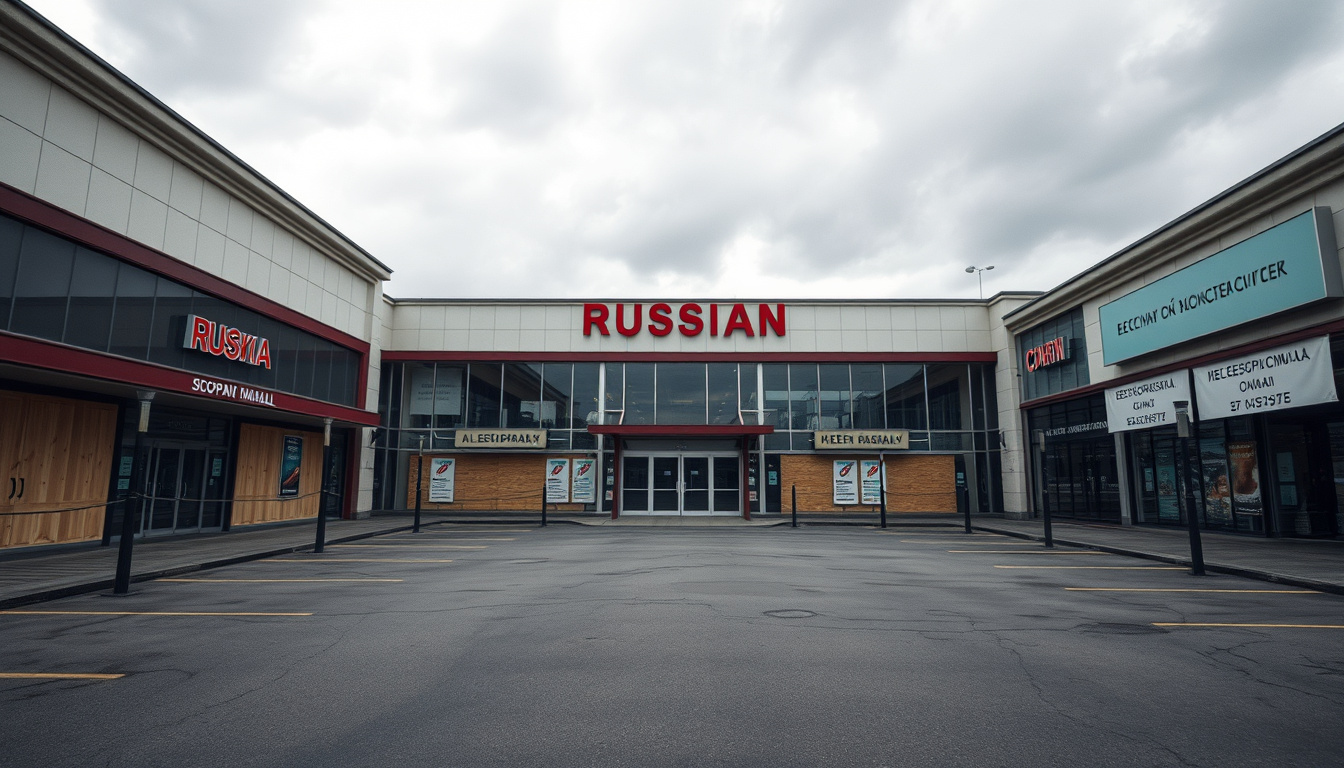
Russia’s shopping mall sector is facing its most severe test in decades, with roughly a quarter of the country’s retail centers now operating in pre-bankruptcy conditions. The crisis, documented by the Russian Council of Shopping Centers in late 2024, reflects the cumulative weight of soaring borrowing costs, dramatic tax increases, and the prolonged fallout from international sanctions.
Industry leaders have warned that hundreds of malls could close their doors in 2025 if current economic pressures persist. The situation extends beyond individual property operators, affecting an entire retail ecosystem that employs millions and serves as a cornerstone of urban commerce across Russia’s major cities.
This report examines the scale of the emergency, the factors driving it, and the broader implications for Russia’s retail landscape and economy at large.
How Many Russian Shopping Malls Are at Risk of Closure?
The Russian Council of Shopping Centers (RCSC) placed approximately 25 percent of the country’s retail properties in pre-bankruptcy territory as of December 2024. With around 1,000 shopping centers operating nationwide, that percentage translates to roughly 250 facilities facing serious financial distress. Industry experts have cited figures ranging from 25 to 40 percent depending on how risk is measured and which properties are included in the assessment.
Key Facts Driving the Assessment
Several interconnected developments have converged to produce the current crisis environment. Understanding these factors requires examining both the financial pressures on property owners and the operational challenges facing tenants.
- Central Bank interest rates reached 21 percent in October 2024, up from 19 percent, making loan refinancing prohibitively expensive for many mall operators
- Property taxes surged sharply due to recalculated cadastral values, with some owners facing increases of up to ten times previous levels within two years
- Foreign retailers departed Russia following the 2022 invasion of Ukraine, creating vacancies that remain difficult to fill and accelerating the shift toward online shopping
- New construction financing dropped between 30 and 50 percent as lenders grew wary of exposure to the retail sector
- Consumer demand has weakened considerably, with retail turnover declining across multiple categories and market segments
- RCSC vice president Pavel Lyulin noted that in some regions, more than one in five shopping centers reported turnover drops exceeding 20 percent
- Maintenance and capital improvement programs have been scaled back as owners struggle to meet basic financial obligations
| Metric | Detail | Source |
|---|---|---|
| Total Shopping Centers | Approximately 1,000 nationwide | RCSC estimates, December 2024 |
| Malls at Pre-Bankruptcy Risk | 25–40% of total inventory | Kyiv Independent, December 2024 |
| Central Bank Rate | 21% (October 2024) | Multiple industry reports |
| Property Tax Increases | Up to 10× over two years | RCSC via Kyiv Independent |
| Foreign Exit Losses | Over $107 billion since 2022 | Industry analysis |
| New Financing Decline | 30–50% reduction in loan availability | Market reports |
| VkusVill Store Closures (2025) | 286 stores closed | Moscow Times, April 2026 |
| Svetofor Store Closures (2025) | 321 stores closed | Moscow Times, April 2026 |
Why Are Russian Shopping Malls Facing Bankruptcy?
The financial structure of shopping center operations has fundamentally shifted in recent years. Mall owners typically rely on a combination of rental income, asset appreciation, and the ability to refinance debt as properties mature. Each of these pillars has come under severe pressure simultaneously.
The Weight of High Interest Rates
Russia’s Central Bank implemented an aggressive monetary tightening campaign to combat inflation, which hovered near 9.5 percent. The benchmark rate climbed from 19 to 21 percent between late 2024 assessments and October 2024, with further increases remaining under consideration by Central Bank chief Elvira Nabiullina. For mall operators carrying substantial debt loads, this translates directly into ballooning interest expenses that cannot be offset through refinancing.
Property owners who financed acquisitions or expansions through bank loans found themselves locked into arrangements that became economically unviable almost overnight. The cost of servicing existing debt consumed an ever-larger share of rental income, while new financing for essential maintenance or upgrades became essentially inaccessible.
Property Tax Escalation
Alongside borrowing costs, property taxes have risen dramatically. Cadastral value reassessments drove increases of up to tenfold over a two-year period, according to figures cited by RCSC vice president Pavel Lyulin. In some cases, tax obligations now claim approximately half of a mall’s total income, leaving owners with minimal operational flexibility.
Additional increases were anticipated for 2025 at the time of the December 2024 reports, adding uncertainty to an already strained planning environment. Unlike interest rate pressures that might ease if the Central Bank shifts course, tax obligations are contractual and immediate.
According to industry data, tax obligations and debt service now jointly consume the majority of rental income for many mall operators, leaving little margin for unexpected expenses or market fluctuations.
How Has the War in Ukraine Affected Russian Retail?
The conflict that began in February 2022 reshaped the retail landscape in ways that continue to reverberate through shopping centers today. The departure of Western brands created both immediate vacancies and longer-term shifts in consumer behavior that have proven difficult to reverse.
Foreign Retailer Exodus
Hundreds of international chains suspended operations or withdrew from Russia in the months following the invasion. The cumulative financial impact exceeded $107 billion in losses across affected sectors, according to industry analyses. Shopping centers that had built their tenant mix around recognizable Western brands suddenly faced prolonged vacancies.
Filling these spaces proved challenging for multiple reasons. Domestic retailers lacked the scale or brand recognition to absorb premium locations. Russian subsidiaries of foreign companies often faced legal and logistical obstacles to continued operation. The uncertainty surrounding future sanctions deterred potential new entrants.
The Online Competition Acceleration
The departure of physical retailers coincided with rapid growth in e-commerce, a trend amplified by logistics improvements and changing consumer habits. Shopping centers that once served as anchors for retail districts found themselves competing against digital platforms that offered broader selection and home delivery.
This dynamic accelerated a vacancy cycle that proved particularly damaging to smaller and mid-sized properties. Without anchor tenants to drive foot traffic, surrounding shops faced declining sales, creating pressure for rent concessions that further reduced owner revenues.
The retail meltdown extends to standalone chains. VkusVill closed 286 stores in 2025 as part of optimization efforts, shifting focus to online sales, which now represent approximately 50 percent of its revenue. Discount chain Svetofor shut 321 stores over the same period due to regulatory violations.
Timeline of the Crisis
The current situation reflects developments that have unfolded over several years, with key milestones marking the intensification of pressure on Russia’s retail property sector.
- 2022: Western sanctions and corporate withdrawals begin, creating initial vacancies and revenue losses exceeding $107 billion
- Late 2023: Central Bank interest rates climb above 15 percent as inflation persists, beginning to constrain refinancing options
- 2024: Property tax increases based on revised cadastral values take effect, with some owners reporting multi-fold increases
- October 2024: Central Bank rate reaches 21 percent, marking a new peak that effectively blocks loan refinancing for many property owners
- December 2024: RCSC releases pre-bankruptcy assessment covering approximately 25 percent of Russian shopping centers
- Early 2025: Industry reports corroborate findings, with additional coverage of retail chain closures and broader economic strain
- 2025: Major retail chains including VkusVill and Svetofor announce significant store closure programs as demand remains weak
What We Know and What Remains Unclear
Reporting on the Russian retail crisis has come primarily from industry sources and independent news organizations, given that official government statistics on mall bankruptcies are limited. Several aspects of the situation are well-documented, while others require careful interpretation.
| Established Information | Information Requiring Caution |
|---|---|
| Central Bank rate reached 21% in October 2024 | Precise number of malls that will ultimately close |
| Property taxes increased up to tenfold in some cases | Whether 25% or 40% is the more accurate risk figure |
| Foreign retailer losses exceeded $107 billion since 2022 | Regional distribution of closures and distress |
| RCSC documented pre-bankruptcy conditions in December 2024 | Full financial details of individual mall operators |
| Retail chains have announced hundreds of store closures in 2025 | Timeline for any government policy responses |
| Financing for new retail construction dropped 30–50% | Medium-term impact on employment in the sector |
The Broader Economic Context
The shopping mall crisis exists within a larger pattern of economic strain affecting multiple sectors of the Russian economy. Alongside retail real estate, industries including coal mining, airlines, and information technology have reported mounting financial pressures that analysts attribute in part to continued international sanctions. The broader challenges facing Russia’s economy have created a particularly difficult environment for capital-intensive sectors like commercial real estate, and readers seeking to understand how different industries navigate economic reporting may find it useful to explore how financial journalism covers economic developments.
Coal producers recorded losses totaling tens of billions of rubles as export routes faced disruptions. Approximately 30 airlines were identified by industry observers as being at risk of insolvency, reflecting the combined impact of aircraft maintenance challenges and reduced travel demand. These sector-specific difficulties compound the broader retail malaise documented by the RCSC.
The Central Bank’s inflation-fighting mandate has created a difficult trade-off between currency stability and business viability. While higher rates have supported the ruble and moderated price growth, they have simultaneously increased debt servicing costs across the economy, placing particular strain on capital-intensive industries like commercial real estate.
The situation is critical. Russia faces the prospect of widespread retail closures unless interest rate pressures ease or government intervention provides relief.
— Industry commentary as reported across multiple platforms, December 2024
Sources and Expert Statements
Reporting on the shopping center crisis has drawn from industry associations, independent analysts, and journalists covering the Russian economy. Several key figures have provided direct commentary on conditions facing retail property operators.
RCSC managing director Oleg Voytsekhovsky and vice president Pavel Lyulin have been among the most prominent voices highlighting the scale of financial distress. Their December 2024 reports formed the basis for subsequent coverage by international news organizations.
— Russian Council of Shopping Centers, December 2024
Central Bank chief Elvira Nabiullina has articulated the rationale behind continued monetary tightening, emphasizing the bank’s commitment to bringing inflation closer to its 4 percent target despite the economic costs of higher borrowing rates. For those interested in the broader implications of these economic pressures across different regions, comparative analysis of European economic challenges can provide useful context on how various markets respond to similar pressures.
- Kyiv Independent report on pre-bankruptcy conditions
- The Express coverage of retail sector strain
- Moscow Times reporting on store closure programs
Summary and Outlook
Russia’s shopping mall sector entered 2025 under conditions of significant financial stress, with roughly a quarter of all properties operating in or near pre-bankruptcy status according to industry assessments. The convergence of high interest rates, soaring property taxes, reduced financing availability, and the lasting impact of foreign retailer departures has created an environment where maintaining operations has become increasingly difficult for many property owners.
The crisis reflects broader economic dynamics affecting multiple sectors of the Russian economy, from coal mining to aviation. Whether conditions improve depends substantially on monetary policy decisions, government intervention, and the evolution of international sanctions. For now, the retail property sector faces a challenging outlook with limited near-term relief in sight.
Frequently Asked Questions
What percentage of Russian malls may close in 2025?
Industry reports indicate that approximately 25 percent of Russian shopping centers face pre-bankruptcy conditions, with some assessments citing risk figures as high as 40 percent depending on criteria used.
What is causing the crisis in Russian shopping centers?
The crisis stems from multiple factors including Central Bank interest rates reaching 21 percent, property tax increases of up to tenfold, reduced financing availability, and the continued impact of foreign retailer departures since 2022.
How has the Ukraine war affected Russian retail?
The conflict triggered the departure of hundreds of Western brands, creating vacancies worth over $107 billion in losses and accelerating the shift to online shopping, which has weakened demand for physical retail spaces.
What role do high interest rates play in Russian mall closures?
Interest rates at 21 percent make refinancing existing loans prohibitively expensive and block access to new financing, leaving property owners unable to service debt or fund essential maintenance.
How much has retail turnover declined in shopping centers?
Industry figures indicate significant turnover declines across the sector, with reports noting that more than one in five shopping centers experienced drops exceeding 20 percent in certain regions.
Who are the key experts warning about the crisis?
RCSC managing director Oleg Voytsekhovsky and vice president Pavel Lyulin have provided the most detailed public commentary, with their December 2024 reports forming the basis for broader coverage.
Are there examples of retail chains also facing closures?
Yes. Supermarket chain VkusVill closed 286 stores in 2025 as part of optimization, while discount chain Svetofor shut 321 stores over the same period due to regulatory violations.
Related stories


Rachel Dunn covers culture, lifestyle and society stories across the UK.