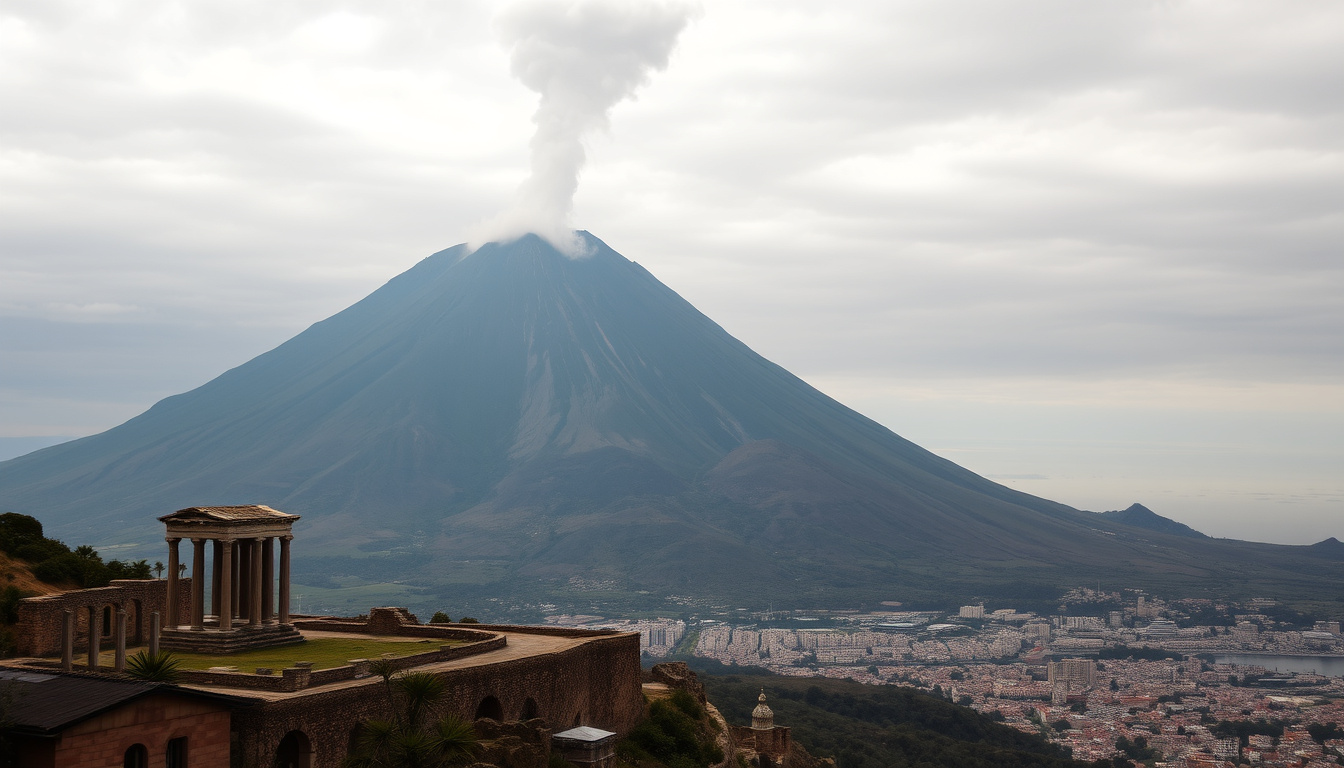
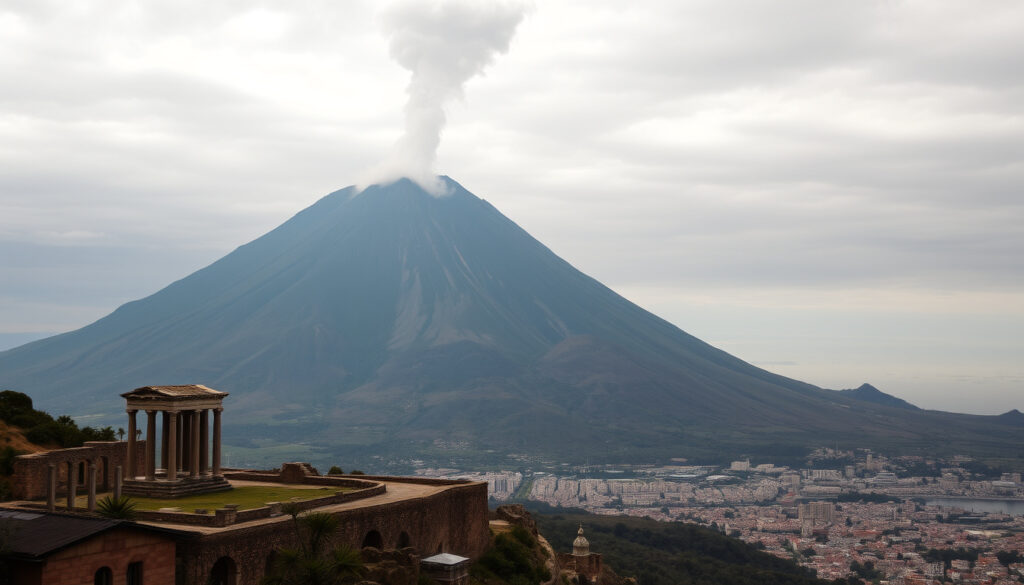
Few places on Earth blend beauty and danger quite like the Bay of Naples, where nearly 3 million people live in the shadow of Mount Vesuvius. That proximity isn’t just scenic — it’s one of the highest volcanic risks on the planet, according to research published in Natural Hazards and Earth System Sciences (Copernicus publications (peer-reviewed geoscience journal)).
Last major eruption: 1944 ·
Type of volcano: Stratovolcano ·
Height: 1,281 m (4,203 ft) ·
Deaths in 79 AD eruption: ~2,000 (Pompeii and Herculaneum)
Quick snapshot
- Vesuvius is an active volcano; last eruption 1944 (Italian Civil Protection Department (national volcanic risk authority))
- Red zone covers 25 municipalities + parts of Naples; ~600,000 people would need evacuation (Italian Civil Protection Department (official hazard mapping agency))
- Naples area described as highest volcanic risk globally due to 3 explosive volcanoes + urban density (Natural Hazards and Earth System Sciences (peer-reviewed journal))
- Exact timing of next eruption is unknown — current data shows no anomalous phenomena (Italian Civil Protection Department)
- Whether the next eruption will be VEI 4-5 (subplinian/Plinian) or smaller (95% probability of subplinian or lower) (European Commission Civil Protection report (EU hazard assessment))
- Real-world effectiveness of evacuation plans under pressure — never tested at scale (Italian Civil Protection Department)
- 79 AD: Catastrophic Plinian eruption buries Pompeii and Herculaneum (Oregon State University Volcano World (educational volcano resource))
- 1631: ~3,500 killed in a violent subplinian eruption (Oregon State University Volcano World)
- 1944: Last eruption — 26 deaths, destroys villages of San Sebastiano and Massa (Italian Civil Protection Department)
- Continuous monitoring by Vesuvius Observatory (INGV) — seismic, gas, ground deformation data collected 24/7 (Italian Civil Protection Department)
- Evacuation plan for 600,000 red-zone residents — preventive evacuation is the only measure (Italian Civil Protection Department)
- No imminent eruption expected; official line from observatory confirms no unusual activity (BBC Future (international science journalism))
The key facts below pull together official data from Italian civil protection, the European Commission, and peer-reviewed research into a single reference table.
| Attribute | Value |
|---|---|
| Coordinates | 40°49′N 14°26′E |
| Elevation | 1,281 m (4,203 ft) |
| Last eruption | March 1944 |
| Volcanic arc | Campanian volcanic arc |
| Population at risk (within 20 km of possible vent) | ~3 million (Natural Hazards and Earth System Sciences) |
| Population in red zone (evacuation area) | ~600,000 (Italian Civil Protection Department) |
| Alert level | Basic green — no anomalous phenomena (Italian Civil Protection Department) |
| Probable eruption intensity (planning basis) | Subplinian (95% probability) (European Commission Civil Protection report) |
| Volcano type | Stratovolcano (composite) — part of Campanian volcanic arc |
Is Vesuvius volcano still active?
Yes — Vesuvius is classified as an active volcano by the Italian Civil Protection Department (Italy’s national volcanic risk authority). The last eruption occurred in March 1944, and the volcano is currently in a dormant phase. Scientists at the Vesuvius Observatory (part of INGV) maintain continuous monitoring of seismic activity, gas emissions, and ground deformation. As of the latest official statements, no anomalous phenomena indicate an imminent return to eruptive activity.
“The monitoring network gives us a window into the volcano’s internal state — we see no precursors that would signal an imminent eruption,” said a scientist from the Vesuvius Observatory (INGV), commenting on the current data stream. (Italian Civil Protection Department)
Is Vesuvius ready to erupt?
Not according to current data. The Italian Civil Protection Department states that “no phenomena currently suggest a resumption of eruptive activity soon” (Italian Civil Protection Department (official public preparedness guide)). The volcano’s alert level remains at basic green, the lowest on the scale. This does not mean Vesuvius is “safe” — only that there are no detectable precursors right now.
Is Vesuvius likely to erupt again?
Yes — the geological record makes clear that Vesuvius will erupt again. The question is when and at what intensity. Emergency planning is calibrated to a subplinian eruption, with the European Commission Civil Protection report noting a 95% probability that the next eruption will be of that intensity or lower. A larger Plinian eruption (similar to 79 AD) remains possible but less probable.
Vesuvius is not about to erupt tomorrow — but the combination of an active volcano and 3 million nearby residents makes it the highest-stakes geological waiting game in Europe.
Could Vesuvius go off again?
Yes. Every volcanologist who studies the Campanian arc agrees on this point. A BBC Future report confirms the official line from the Vesuvius observatory: while an eruption is not imminent, the volcano is active and will eventually resume activity. The history of Vesuvius shows a pattern of eruptions occurring after dormant periods of varying lengths.
How many people died in the 1944 Mount Vesuvius eruption?
The 1944 eruption — the most recent — killed 26 people (Italian Civil Protection Department). The eruption produced lava flows and heavy ash fall that destroyed the villages of San Sebastiano and Massa di Somma. While modest compared to earlier disasters, the death toll underscores that even a moderate eruption in a populated area can be lethal. The eruption also marked the end of a cycle of activity that had produced frequent eruptions through the 19th and early 20th centuries.
Why this matters: For residents in the red zone today, the 1944 eruption is a reminder that a relatively small event — not only a giant Plinian blast — can cause significant loss of life and property.
Why did Vesuvius destroy Pompeii?
The 79 AD eruption was a Plinian event — the most violent type of stratovolcano eruption — named after Pliny the Younger, who documented the disaster from across the Bay of Naples. In his surviving letters (Pompeii Archaeological Park (official site of the UNESCO ruins)), Pliny described a massive column of ash that rose high into the stratosphere before collapsing in pyroclastic surges.
“A cloud of unusual size and appearance — like an umbrella pine — rose from the mountain, so that the very earth seemed to tremble,” wrote Pliny the Younger in his account of the 79 AD eruption. (Pompeii Archaeological Park)
What happened to Pompeii when Vesuvius erupted?
Pompeii was buried under approximately 4 to 6 meters of pumice and ash. The initial phase dropped pumice lapilli on the city, collapsing roofs. Then came the pyroclastic flows — superheated avalanches of gas, ash, and rock that surged through the streets at hundreds of kilometers per hour, killing those who had survived the first phase of the eruption. Excavations have revealed casts of victims preserved in volcanic ash, showing they died of thermal shock and asphyxiation (Pompeii Archaeological Park).
The same volcanic violence that destroyed Pompeii also preserved it for 1,900 years — making Vesuvius simultaneously a destroyer and an archaeologist’s gift.
The trade-off: Vesuvius’s explosiveness is precisely what makes it so dangerous for modern Naples. The 79 AD eruption was not an anomaly — it was the volcano’s signature behavior, and could repeat.
Will Naples be destroyed if Vesuvius erupts?
It depends on the eruption size and wind direction. The red zone — where pyroclastic flows are possible — covers 25 municipalities plus parts of the city of Naples itself (Italian Civil Protection Department official hazard map). A large subplinian or Plinian eruption would be catastrophic for any area directly in the path of pyroclastic flows. However, much of Naples lies outside the red zone and would face ash fall rather than incineration.
A 2013 study published by the European Geosciences Union (scientific paper on volcanic risk modeling) shows that the worst-case scenario for Naples requires a wind direction from the east-southeast — which occurs only about 15% of the time. Under the more common westerly winds, the ash plume would drift out over the Adriatic.
What volcano is most likely to erupt in 2026?
No scientist can name a specific volcano with certainty for a specific year. However, among Italy’s active volcanoes, Campi Flegrei — west of Naples — has shown increased ground deformation and seismic activity in recent years, drawing more short-term attention from INGV monitors than Vesuvius at present (BBC Future). Vesuvius remains a long-term threat; Campi Flegrei is the one scientists are watching more nervously right now.
The implication: Naples sits between two highly explosive volcanoes — both of which are active, both of which are monitored, and both of which could significantly disrupt life in the city with little warning.
What type of volcano is Mount Vesuvius?
Vesuvius is a stratovolcano (also called a composite volcano). It is part of the Campanian volcanic arc, formed by the subduction of the African tectonic plate beneath the Eurasian plate (Oregon State University Volcano World (educational volcano resource)). Stratovolcanoes are characterized by their steep profiles, layered composition of lava, ash, and pumice, and their tendency to produce highly explosive eruptions. Vesuvius’s magma is silica-rich and gas-charged, which drives its Plinian and subplinian behavior.
How do you pronounce Vesuvius?
In English: vih-SOO-vee-us. In Italian: Vesuvio (veh-ZOO-vee-oh). The stress falls on the second syllable in both languages.
Vesuvius is an active stratovolcano that will erupt again, though not imminently. Residents in the red zone should understand the evacuation plan and know their zone. Visitors can hike the crater safely while the alert level is green. For the roughly 600,000 people living in the danger zone, the question is not if — but when — the evacuation plan will be put to the test.
The catch: Vesuvius’s structure as a stratovolcano is what makes it capable of the explosive eruptions that threaten Naples — and that same geology ensures it will remain a threat for generations.
en.wikipedia.org, discovertheworldeducation.com, the-independent.com, nhess.copernicus.org, rischi.protezionecivile.gov.it, suomilife.org
The ongoing threat Vesuvius poses to Naples is explored in depth in this detailed overview of Vesuvius.
Frequently asked questions
Is it safe to visit Vesuvius?
Yes — while the alert level is green (no anomalous phenomena), the crater trail is open to visitors. The Italian Civil Protection Department confirms no current eruption risk. The trail is steep but well-maintained, and guided tours operate daily.
How often does Vesuvius erupt?
Over the past 2,000 years, Vesuvius has erupted more than 50 times, ranging from small effusive events to massive Plinian eruptions. The average repose period between major eruptions is roughly 200–300 years. The current dormant period (since 1944) is within the normal range of quiescence (Oregon State University Volcano World).
What is the most dangerous volcano in Europe?
By population at risk, Vesuvius and Campi Flegrei share the title. A Natural Hazards and Earth System Sciences review describes the Naples area as having the highest volcanic risk in the world due to multiple explosive volcanoes and extreme urban density.
Can Vesuvius cause a tsunami?
Potentially — a large pyroclastic flow entering the Bay of Naples could generate a local tsunami. Historical accounts of the 79 AD eruption mention waves affecting boats and coastal areas.
How is Vesuvius monitored?
The Vesuvius Observatory (INGV) operates a dense network of seismometers, gas sensors, GPS stations, and thermal cameras. Data streams are analyzed 24/7 for changes in activity. The observatory issues regular updates to the Italian Civil Protection Department (Italian Civil Protection Department).
What should I do if Vesuvius erupts?
Follow official instructions from the Italian Civil Protection Department. Know if you are in the red zone (pyroclastic flow risk) or yellow zone (ash fall risk). The national plan calls for preventive evacuation of the red zone before an eruption begins (Italian Civil Protection Department).
Are there any warning signs before an eruption?
Yes — volcanoes typically show measurable precursors before an eruption: increased seismic activity, ground deformation (swelling), changes in gas composition (especially sulfur dioxide and carbon dioxide), and thermal anomalies. The INGV monitoring network is designed to detect these signals early (BBC Future).
Related stories





Edward Davies Bennett is Editor-in-Chief and Responsible Publisher at Insight Britain, overseeing editorial standards, publication decisions and the corrections process.