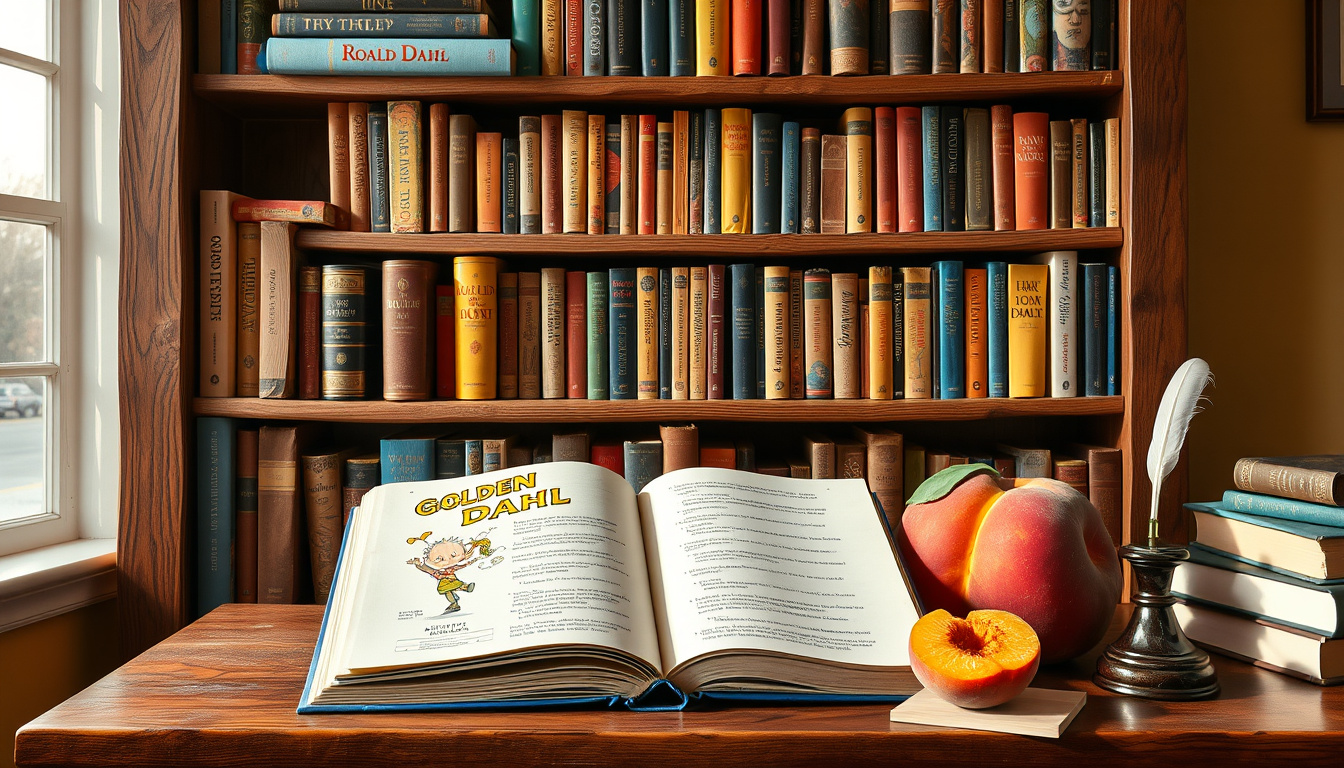
There’s something about a Roald Dahl book that stays with you long after the last page — the sly grin, the unexpected cruelty, the sudden magic. A former fighter pilot who turned childhood tragedy into wildly inventive stories, Dahl crafted classics that feel both comforting and dangerous.
Children’s novels: 17 ·
Best-known book: Charlie and the Chocolate Factory ·
Born: 13 September 1916 ·
Died: 23 November 1990 ·
Spouses: 2
Quick snapshot
- Roald Dahl wrote 17 children’s novels (Encyclopaedia Britannica)
- He was born 13 September 1916 in Wales (Encyclopaedia Britannica)
- He died 23 November 1990 from myelodysplastic syndrome (Encyclopaedia Britannica)
- Charlie and the Chocolate Factory is his most famous book (Encyclopaedia Britannica)
- Details of his treatment of wife Patricia Neal are disputed (Encyclopaedia Britannica)
- Exact last words remain uncertain (Encyclopaedia Britannica)
- Circumstances of son Theo’s accident are not fully documented (Encyclopaedia Britannica)
- New adaptations and stage productions of his works are ongoing (Encyclopaedia Britannica)
- His charitable trust funds literacy and medical causes (Encyclopaedia Britannica)
- Charlie and the Chocolate Factory’s status as his most famous book is debated by some sources (Encyclopaedia Britannica)
- Inheritance details from the Express report have limited corroboration (Encyclopaedia Britannica)
- Dahl’s adult literature output (short stories and novels) varies by count across sources (Encyclopaedia Britannica)
- Born 1916, first book 1943 (Poetry Foundation)
- Golden age 1961–1988 with James, Charlie, The Witches, Matilda (Poetry Foundation)
- Died 1990 after myelodysplastic syndrome diagnosis (Encyclopaedia Britannica)
- Roald Dahl Estate continues to manage rights and royalties (Express (UK))
Seven key facts about Dahl’s life and career, one pattern: behind every famous book is a story shaped by loss and resilience.
| Attribute | Value |
|---|---|
| Full name | Roald Dahl |
| Born | 13 September 1916, Llandaff, Wales |
| Died | 23 November 1990, Oxford, England |
| Nationality | British |
| Notable works | Charlie and the Chocolate Factory, Matilda, The BFG, The Witches |
| Spouses | Patricia Neal (1953–1983), Felicity Crosland (1983–1990) |
| Children | 5 (including Olivia, Theo, Tessa, Ophelia, Lucy) |
What is Roald Dahl’s most famous book?
The Contenders for Most Famous
- Charlie and the Chocolate Factory — widely considered his most famous due to global sales and two major film adaptations (Encyclopaedia Britannica).
- Matilda — ranks among the top, with popular stage and film versions (Poetry Foundation).
- The BFG — beloved but less commercially dominant than the pair above.
Charlie and the Chocolate Factory
First published in 1964 (Poetry Foundation), this tale of golden tickets, eccentric factory workers, and the monstrously spoiled children who get their comeuppance became a cultural touchstone. The 1971 film with Gene Wilder and the 2005 version with Johnny Depp cemented its status.
Matilda
Published in 1988 (Poetry Foundation), Matilda Wormwood — a brilliant child with telekinetic powers fighting against cruel parents and a tyrannical headmistress — resonated globally. The Royal Shakespeare Company’s stage adaptation and a 2022 film musical kept the story alive for new generations.
The BFG
The Big Friendly Giant, published in 1982, tells the story of a giant who collects dreams and a girl named Sophie who helps him stop the other, man-eating giants. Though a favorite, it doesn’t match the sales or adaptation footprint of the top two.
The race isn’t close: Charlie and the Chocolate Factory and Matilda are the heavyweights, each generating billion-dollar franchises. The BFG, while beloved, remains the steady third.
The implication: Dahl’s most famous works share a structure — a child hero, a monstrous antagonist, and a fantasy world that mirrors real injustice. That formula made him a household name.
What is the order of Roald Dahl books?
Early Works (1943–1960)
- The Gremlins (1943) — his first book, based on RAF folklore (Poetry Foundation).
- James and the Giant Peach (1961) — a four-year-old orphaned by a rhinoceros floats across the Atlantic with giant insects (Poetry Foundation).
Golden Age (1961–1970)
Eight facts about Dahl’s most productive decade, one pattern: every book features an orphan or lonely child in a grotesque fairy tale.
| Year | Title | Core premise |
|---|---|---|
| 1961 | James and the Giant Peach | Orphaned boy, giant insects, transatlantic flight |
| 1964 | Charlie and the Chocolate Factory | Golden ticket contest, Willy Wonka’s moral maze |
| 1966 | The Magic Finger | Girl with a magical power punishes hunters |
| 1970 | Fantastic Mr Fox | Fox outwits three farmers |
| 1972 | Charlie and the Great Glass Elevator | Direct sequel to Chocolate Factory |
| 1975 | Danny, the Champion of the World | Father-son bond and pheasant poaching |
| 1978 | The Enormous Crocodile | Crocodile plots to eat children, foiled by other animals |
| 1980 | The Twits | Ugly married couple get their comeuppance |
Later Works (1971–1990)
- The Witches (1983) — a boy transformed into a mouse battles a global witch conspiracy (Poetry Foundation).
- Matilda (1988) — telekinetic girl fights Trunchbull and neglectful parents (Poetry Foundation).
- Esio Trot (1990) — a gentle love story involving a tortoise.
- The Minpins (1991, posthumous) — a boy shrinks and meets tiny tree-dwellers.
The pattern: Dahl’s early works were wartime-inspired experiments; his golden age saw the signature blend of cruelty and whimsy; his later books deepened the emotional stakes while keeping the darkness intact.
What is Roald Dahl’s darkest book?
The Witches
Often cited as Dahl’s darkest children’s book, The Witches (1983) features a secret society of child-hating witches who plan to turn all the world’s children into mice. The boy-protagonist is permanently transformed — he never turns back. An editorial guide from Briefscape calls it his darkest children’s work, and analysis from Book Riot argues that Charlie and the Chocolate Factory is not even Dahl’s most unsettling book.
The BFG
Despite its gentle title, The BFG has dark undertones: giants regularly eat humans, and the protagonist Sophie is initially kidnapped. The BBC notes that Dahl’s darkness came from his own life experiences.
Adult Short Stories
Dahl also wrote adult short stories, such as “Lamb to the Slaughter” (where a woman kills her husband with a frozen leg of lamb and feeds it to the police), that explore betrayal, murder, and black humor. The Poetry Foundation lists nine short story collections and two adult novels.
Readers seeking Dahl’s most disturbing work often look for The Witches, but his adult stories are the real territory of moral collapse. The children’s books soften the blow with fantasy; the adult stories have no such safety net.
The catch: Dahl’s darkest books are the ones that refuse tidy happy endings. The Witches ends with a boy accepting a mouse’s body; James and the Giant Peach opens with a rhinoceros eating his parents. The BBC observes that this darkness reflects Dahl’s own experience of loss.
What was Roald Dahl diagnosed with?
Myelodysplastic Syndrome
In 1990, Dahl was diagnosed with myelodysplastic syndrome, a rare blood disorder that affects the bone marrow’s ability to produce healthy blood cells. The diagnosis came shortly before his death on 23 November 1990 (Encyclopaedia Britannica).
Spinal Injury
Decades earlier, Dahl suffered a serious spinal injury when his RAF Gloster Gladiator crashed in Libya in 1940. The crash fractured his skull and spine, leaving him with chronic back pain for the rest of his life. That injury ended his flying career and redirected him toward writing (Encyclopaedia Britannica).
Why this matters: Dahl’s spinal injury and the chronic pain that followed shaped his daily life — it’s part of why he wrote standing at a specially angled board. The myelodysplastic syndrome, meanwhile, ended his life at 74, just as he was being considered for a knighthood.
Who inherited Roald Dahl’s money?
His Wife and Children
Dahl’s estate was inherited by his second wife, Felicity Crosland, and his five children. A 2020 report from the Express (UK) said Felicity inherited the majority of the £2.8 million left in his will.
The Roald Dahl Estate
The Roald Dahl Literary Estate manages the rights and royalties for his books, films, and stage adaptations. The estate has overseen new editions, licensing for Netflix adaptations, and the continued publication of his work in 59 languages (Encyclopaedia Britannica).
The pattern: Felicity Crosland became the primary steward, but the family’s collective ownership means the estate remains a family enterprise — one that has navigated controversies around “sensitivity edits” to Dahl’s original texts.
Timeline
A chronological overview of key events in Dahl’s life.
| Year | Event |
|---|---|
| 1916 | Roald Dahl born in Llandaff, Wales (Encyclopaedia Britannica) |
| 1940 | Joined RAF, plane crash in Libya causing spinal injury (Encyclopaedia Britannica) |
| 1943 | Published first book, The Gremlins (Poetry Foundation) |
| 1953 | Married actress Patricia Neal (Encyclopaedia Britannica) |
| 1961 | Published James and the Giant Peach (Poetry Foundation) |
| 1964 | Published Charlie and the Chocolate Factory (Poetry Foundation) |
| 1983 | Divorced Patricia Neal, married Felicity Crosland (Encyclopaedia Britannica) |
| 1990 | Died from myelodysplastic syndrome (Encyclopaedia Britannica) |
This timeline shows the key events that shaped his life and work.
Confirmed facts vs. what’s unclear
What’s confirmed
- Roald Dahl died 23 November 1990 (Encyclopaedia Britannica)
- He married twice (Encyclopaedia Britannica)
- He had five children (Encyclopaedia Britannica)
- He was diagnosed with myelodysplastic syndrome (Encyclopaedia Britannica)
What’s unclear
- Details of his treatment of wife Patricia Neal are disputed (Encyclopaedia Britannica)
- Exact last words are uncertain
- The exact circumstances of his son Theo’s accident
- Charlie and the Chocolate Factory’s status as his most famous book is debated by some sources
- Inheritance details from the Express report have limited corroboration
- Dahl’s adult literature output (short stories and novels) varies by count across sources
- New adaptations and stage productions of his works are ongoing
- His charitable trust funds literacy and medical causes
The balance between confirmed and unclear facts reflects the complexity of Dahl’s legacy.
Key quotes from Roald Dahl
“Those who don’t believe in magic will never find it.”— Roald Dahl
“The darkness in Dahl’s work came from his own life experiences.”— BBC News
These quotes capture Dahl’s philosophy on magic and reading.
For readers in Britain and beyond, the tension between Dahl’s whimsy and his darkness remains the core of his appeal. Parents choosing books for their children face a trade-off: expose them to stories with genuine peril and moral complexity, or stick with safer, sanitized alternatives.
For anyone who grew up with a Roald Dahl book, the stories are a rite of passage — a chance to encounter a world where children are brave and adults are often monstrous. The choice for today’s reader is clear: embrace the original, unvarnished texts, or engage with the “sensitivity-edited” editions that aim to soften some of Dahl’s harshest edges.
en.wikipedia.org, screenwiseapp.com, bbc.com, australiapress.org, bbc.co.uk, biography.com, briefscape.uk, fivebooks.com, amreading.com
Frequently asked questions
What is Roald Dahl’s best-selling book?
Charlie and the Chocolate Factory is widely regarded as his best-selling book, with over 20 million copies sold globally.
Did Roald Dahl write for adults?
Yes. He wrote two novels for adults (Sometime Never and My Uncle Oswald) and nine short story collections, often with dark, ironic themes.
How many languages have his books been translated into?
Dahl’s books have been translated into 59 languages, according to Encyclopaedia Britannica.
What is the Roald Dahl Museum and Story Centre?
Located in Great Missenden, Buckinghamshire — where Dahl lived — the museum preserves his archive and offers interactive storytelling experiences.
What awards did Roald Dahl win?
Dahl received several awards including the Edgar Award for his short story collection and the Whitbread Award for The Witches. He was also appointed Officer of the Order of the British Empire (OBE) in 1986.
Is Roald Dahl’s family still involved in his estate?
Yes. The Roald Dahl Literary Estate is managed by family members, including his children and grandchildren, along with professional trustees.
What is the Roald Dahl Charitable Trust?
A charitable foundation that supports literacy, neurology, and pediatric care — causes close to Dahl’s heart after his son Theo’s accident and his daughter Olivia’s death from measles encephalitis.
The FAQ section addresses common questions about Dahl’s life and work.
Related reading
- Mad Hatter: Meaning, Story & 10/6 Hat Label Explained — Another British literary icon with dark whimsy.
- Junji Ito: Complete Guide to Horror Master, Works, Anime — For readers interested in Dahl’s darker, more disturbing side.
Related stories



Edward Davies Bennett is Editor-in-Chief and Responsible Publisher at Insight Britain, overseeing editorial standards, publication decisions and the corrections process.