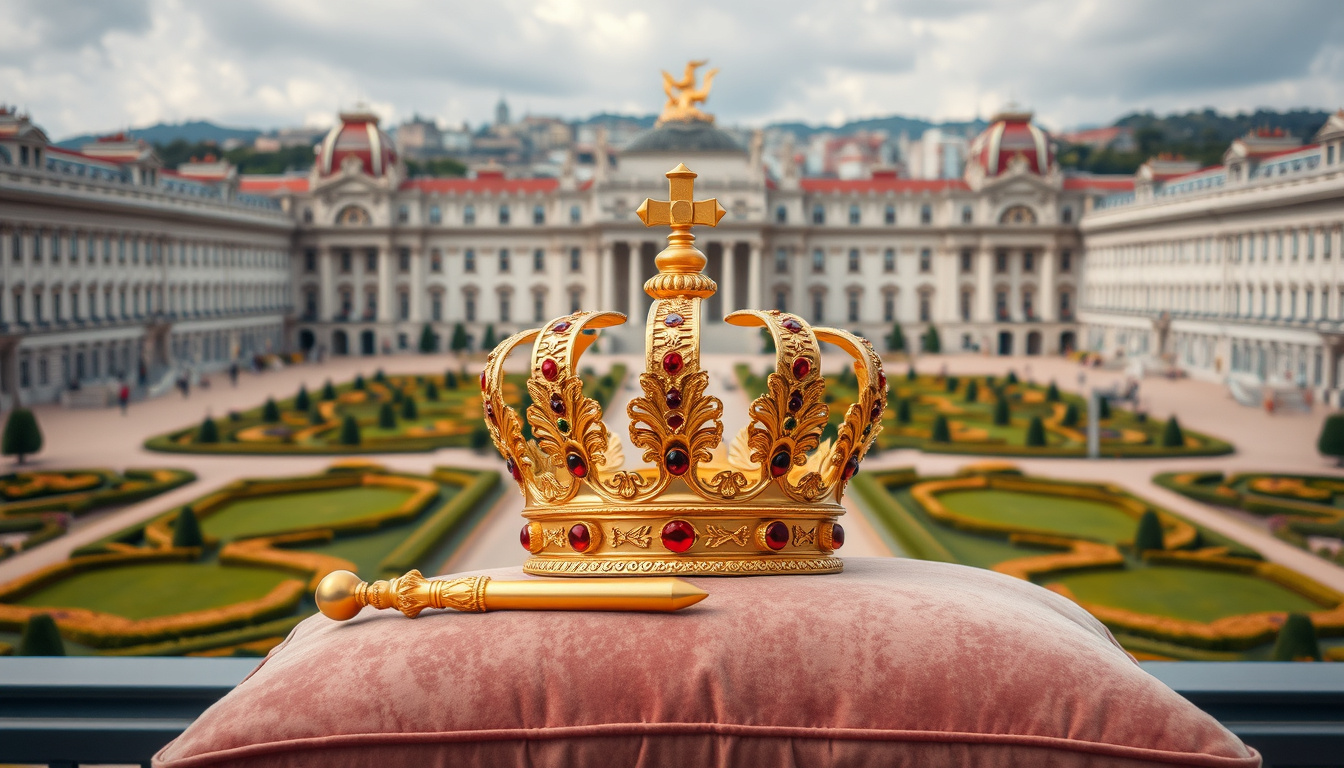
Walk into a Spanish classroom and you’ll spot his portrait next to the flag: King Felipe VI, the living symbol of an institution the 1978 Constitution defines as the embodiment of unity and permanence (the Spanish Senate’s official constitutional text), in a role that is more constitutional machinery than fairy-tale monarchy. This is how Spain’s king actually works — his powers, his family, and the succession line that will decide who follows him.
Current king of Spain: Felipe VI ·
Ascended throne: 19 June 2014 ·
Children: 2 (Leonor and Sofía) ·
Heir presumptive: Princess Leonor (born 31 October 2005) ·
Age of King Felipe VI: 57 (born 30 January 1968)
Quick snapshot
- Felipe VI was born in Madrid on 30 January 1968 and proclaimed King on 19 June 2014 (BBC News).
- Queen Letizia is his wife and queen consort (Casa de S.M. el Rey, the official biography of the Queen).
- Princess Leonor, born 31 October 2005, is the heir presumptive (Casa de S.M. el Rey, the official succession page).
- The exact nature and current status of Queen Letizia’s health issues.
- Why Queen Letizia does not wear a wedding ring in public.
- Any official timeline for Princess Leonor’s marriage.
- 2014: Juan Carlos I abdicates; Felipe VI takes the throne (BBC News).
- 2023: Princess Leonor turns 18 and begins formal military training (Wikipedia’s Felipe VI biography).
- Leonor continues the long preparation path toward a future reign.
- Spain’s public debate over the monarchy’s role is not going away.
Six basics, one pattern: the biographical record published by Casa de S.M. el Rey, the royal household’s official biography, is stable — names, dates, palaces — while the political debate around the role keeps moving.
| Detail | Value |
|---|---|
| Full name of King | Felipe Juan Pablo Alfonso de Todos los Santos de Borbón y Grecia |
| Birth date | |
| Reign start | |
| Marriage | to Letizia Ortiz Rocasolano |
| Children | Leonor (2005), Sofía (2007) |
| Residence | Zarzuela Palace, Madrid |
How is the King of Spain related to Queen Elizabeth?
The short answer: distant cousins. The British royal household’s own page on Spain’s royals (The Royal Household, the British royal family’s official site) keeps the connection on record: King Felipe VI and Queen Elizabeth II both descend from Queen Victoria and Prince Albert, through different branches of a very large family tree. Felipe’s line runs through Victoria’s daughter Princess Beatrice, whose own daughter Victoria Eugenie married King Alfonso XIII of Spain in 1906 — the marriage that permanently linked the two houses.
- Felipe VI’s line: Victoria → Princess Beatrice → Victoria Eugenie → Infante Juan → King Juan Carlos I → Felipe VI.
- Elizabeth II’s line: Victoria → Edward VII → George V → George VI → Elizabeth II.
That places Felipe VI a generation below Elizabeth II’s third cousins — technically, her third cousin once removed.
The implication: this is a family tie, not a political one. The two monarchies share a family tree and ceremonial occasions, but the constitutional relationship between Spain and Britain runs through governments, not kings.
Does Spain’s king have any power?
Yes — formal powers, and no personal discretion. The 1978 Constitution makes the King head of state and “the symbol of its unity and permanence,” and it says he arbitrates and moderates the regular functioning of Spain’s institutions. The key word is “moderates”: he is part of the machinery, not the driver.
What does the king of Spain do?
Nearly everything the King signs happens at the government’s initiative. His constitutional acts are formal acts, and the Constitution attaches each one to a procedure that ends with ministers or Parliament — which is why observers describe the modern Spanish monarchy as symbolic rather than executive.
- Sanction and promulgate laws passed by the Cortes Generales.
- Summon and dissolve the Cortes Generales, and call elections, under the Constitution’s terms.
- Propose a candidate for President of the Government, and appoint or dismiss the President following constitutional procedures.
- Appoint and dismiss ministers on the proposal of the President of the Government.
- Issue decrees approved by the Council of Ministers, and confer civil and military positions and honors under the law.
- Represent Spain in international relations, particularly with the countries of its historical community.
- Be informed of state affairs, and preside over Council of Ministers meetings when the Prime Minister requests it (La Moncloa, Spain’s government portal).
All of the above are set out in Articles 56 and 62 of the Spanish Constitution (BOE’s official English text of the Constitution), the same text that defines the Crown as hereditary and subject to the law.
The implication: the king of Spain is a constitutional safety mechanism. He keeps the machinery running through transitions and elections, but the strategic decisions rest with the elected government.
Who will be the next King of Spain?
At the top, the order is settled: Princess Leonor, born 31 October 2005, is first in line; her sister Princess Sofía, born in 2007, is second. The rules come from Article 57 of the Constitution: the throne passes by primogeniture and representation, earlier lines before later ones — with the old caveat that males precede females within the same line and degree. Leonor would become queen if the King died or abdicated; if she had children, they would enter the line ahead of Sofía.
She is being prepared for that outcome in stages. The most visible step so far: after turning 18 in 2023, Leonor began the military training that the palace announced as the first stage of her future duties.
Has Princess Leonor married?
No — as of June 2025, the royal house has announced no engagement, no wedding date, and no public timeline for Princess Leonor’s marriage.
The palace treats her personal life as private; the royal house’s official channels have made no announcement in any direction. Her public focus is the military training that began in 2023, and a wedding of this scale would, when it happens, arrive through official channels rather than leaks.
King of Spain daughters
- Princess Leonor — born 31 October 2005; heir presumptive.
- Princess Sofía — born in 2007; second in line.
Sofía’s role is legally defined but deliberately quiet: she attends the events the family calendar puts in front of her, while Leonor carries the preparation expected of a future head of state.
Why this matters: the succession is not a mystery — it is a schedule. Leonor is being trained in public, step by step, and that visibility is the monarchy’s way of making the transition to a new generation feel normal before it happens.
Do king Felipe and Queen Letizia live together?
They do — and the household looks more conventional than the palace setting suggests. Felipe VI and Letizia Ortiz Rocasolano married on 22 May 2004, and the family — King, Queen and two daughters — lives together at the Zarzuela Palace complex on the edge of Madrid, the residence listed in the palace’s own biography above.
The Zarzuela is a working family home, not a showpiece — and for a monarchy whose legitimacy comes from the 1978 Constitution, the less palace glamour, the better.
The Royal Palace in central Madrid is where state ceremonies take place; it belongs to the state, not to the family. Moving between the two is one of the small ways the king’s life marks the line between the person and the institution.
What this means: the private arrangement of the royal family is deliberately unglamorous. The monarchy’s long-term bet is that a small, stable family home projects the civic, constitutional image Spain expects.
Do Spaniards generally like Queen Letizia?
Broadly, yes — though opinion splits along predictable lines, and the sharpest criticism tends to live online. Letizia arrived from a career in broadcast journalism, and that background still shapes how Spaniards argue about her: praised for professionalism and composure, dissected for every public appearance.
What does Queen Letizia suffer from?
- Documented: a history of foot problems — pain around the metatarsophalangeal joint — that media reports said required surgery.
- Not documented: any current diagnosis or official health statement from the palace.
The royal house treats medical matters as private, so the speculation about “what Queen Letizia suffers from” runs far ahead of what an official source has confirmed. The honest answer: a foot condition that at one point needed surgery, and a public record that is otherwise nearly empty.
Why doesn’t Queen Letizia wear a wedding ring?
No official explanation exists. The palace has never commented on her ring, and every offered theory is speculation.
It is one of the persistent search queries about Spain’s royal family, and the royal-watching press has produced exactly zero official confirmation. Whatever the reason — practicality, preference, personal meaning — it remains private. The ring is a personal choice, not a constitutional issue.
Who paid for Queen Letizia’s wedding dress?
The Spanish state paid for the gown, as is customary for royal weddings — though the palace never released an itemized bill, so the exact figure survives only as press estimates.
The dress was part of a state wedding in May 2004, and the monarchy’s annual budget is public money — which is why the cost of the gown became a topic at all. The precise number has never been matched by an official receipt; the safest summary is that the state covered it, and the details stayed vague.
The pattern: Letizia carries a double standard — praised as the queen who modernized the image of the palace, criticized as the woman who does everything in front of a camera. None of it has changed her position; all of it explains why the monarchy feels personal to Spaniards.
Confirmed facts vs. lingering questions
The record is settled on these points, all of them grounded in the Spanish Senate’s official text of the Constitution and the palace’s own pages:
Confirmed facts
- Felipe VI is the current King of Spain (Casa de S.M. el Rey, the royal household’s official biography).
- Queen Letizia is his wife and queen consort (Casa de S.M. el Rey, the official biography of the Queen).
- Princess Leonor is the heir presumptive (Casa de S.M. el Rey, the official succession page).
- The King’s functions are set out in the 1978 Constitution (La Moncloa, Spain’s government portal).
What’s unclear
- The exact nature and current status of Queen Letizia’s health issues.
- Why Queen Letizia does not wear a wedding ring in public.
- Any timeline for Princess Leonor’s marriage.
- Whether Spain will revisit the constitutional preference for male heirs within the same line.
The pattern: what gets debated about the royal family is personal, not constitutional. The institutional chain — King, Cortes, Constitution, succession — is settled; the conversations about health and rings are what keep the tabloid cycle going.
In their own words
“The King is Head of State, the symbol of its unity and permanence. He arbitrates and moderates the regular functioning of the institutions.”
— Article 56.1, Spanish Constitution (La Moncloa, Spain’s government portal)
“A Spain that is one and diverse, within the framework of the 1978 Constitution.”
— King Felipe VI, proclamation address, 19 June 2014, as reported by BBC News
The consistent thread: every official framing of Spain’s monarchy lands on the same idea — unity. The king’s job is to embody the country’s continuity, not to push a policy; the quotes make that duty clear in two sentences.
Where the monarchy stands
As the 2014 transition fades into institutional routine, the royal family’s horizon is now Leonor’s. She is being trained publicly and methodically to inherit a role whose powers are ceremonial, whose limits are written into the 1978 Constitution, and whose value Spain will keep testing in public debate. For the Spanish public, the implication is concrete: the monarchy now lives or dies by its usefulness as a symbol of unity. Either the Crown keeps earning that role as Leonor steps up — or the constitutional settlement will face questions it has not answered in half a century.
Related reading: Egyptian Gods: List, Powers, Hierarchy & History Guide
Frequently asked questions
How old is King Felipe VI?
King Felipe VI was born on 30 January 1968. He is 57 years old as of June 2025.
Where does the Spanish royal family live?
The royal family lives at the Zarzuela Palace complex on the outskirts of Madrid. The Royal Palace in central Madrid is used for official ceremonies.
What is the constitutional role of the Spanish monarchy?
Under the 1978 Constitution, the King of Spain is head of state, the symbol of national unity, and the moderator of the regular functioning of the institutions. The King’s formal acts require government backing.
Does Queen Letizia have any health issues?
Queen Letizia has a documented history of foot problems that media reports said required surgery. The palace has never published clinical details, so the current picture is not publicly confirmed.
Who was the previous King of Spain?
King Juan Carlos I was the previous King of Spain. He abdicated in June 2014, and Felipe VI was proclaimed king on 19 June 2014.
What is the line of succession to the Spanish throne?
Princess Leonor is first in line to the Spanish throne, followed by her sister Princess Sofía. After that, the order follows the constitutional rules of primogeniture and representation.
Related stories




Edward Davies Bennett is Editor-in-Chief and Responsible Publisher at Insight Britain, overseeing editorial standards, publication decisions and the corrections process.