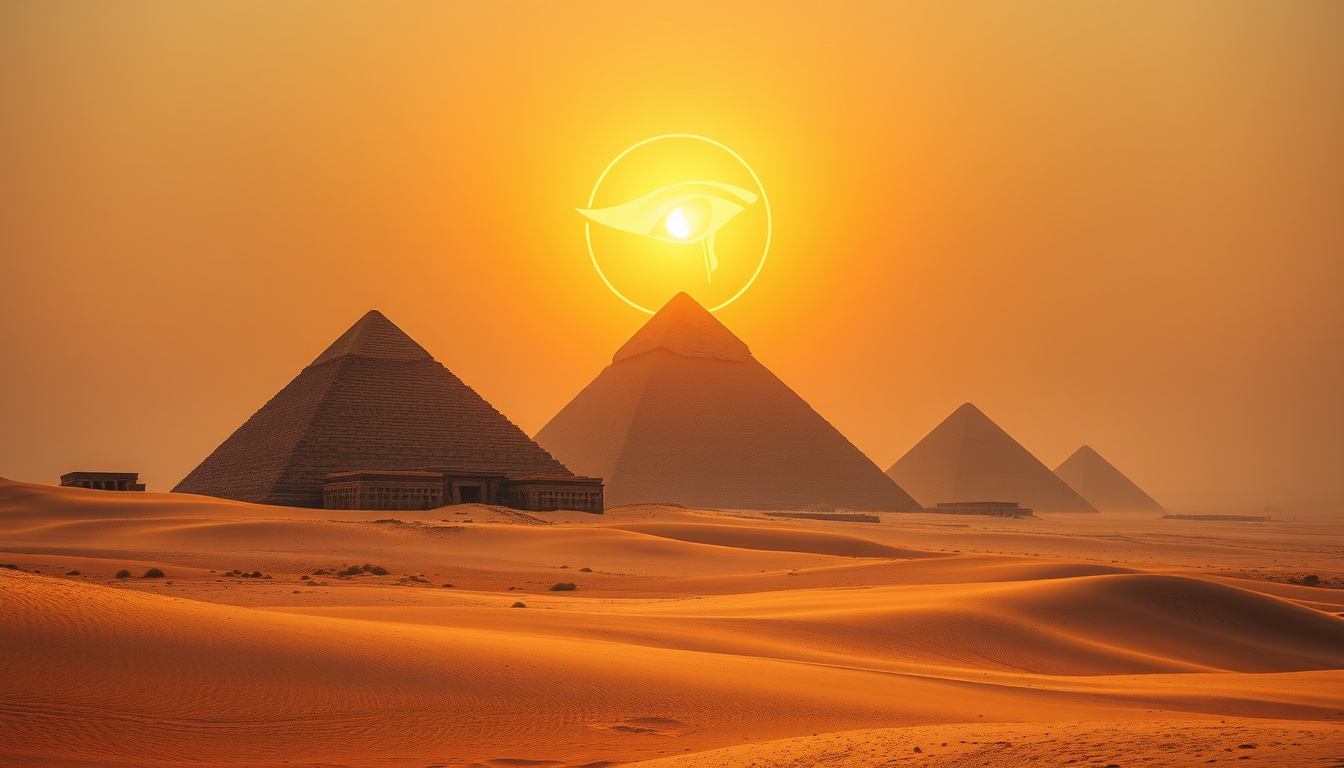
Stroll through any major Egyptology collection and you’ll notice something odd: the gods multiply the longer you look. Ancient Egyptian religion included more than 1,500 named deities (The Metropolitan Museum of Art (museum exhibition archive)) with overlapping forms and traits, and none fit neatly into a single hierarchy, pulled between local cults, state temples, and shifting political alliances.
Number of major gods in the Ennead: 9 · Duration of ancient Egyptian religion: over 3,000 years · Most prominent god: Ra (or Amun-Ra) · God of mummification: Anubis
Quick snapshot
- Atum was the first god and creator in Heliopolitan theology, and the Ennead was the group of nine gods linked to him (British Museum (national museum education resource)).
- Anubis was the earliest known deity, with a cult that pre-dated dynastic Egypt (Egyptian Museum (Egyptology museum collection)). (British Museum (national museum education resource))
- Ra was conceptualized as the supreme god and ruler of all (The Metropolitan Museum of Art (Divine Egypt exhibition)).
- The exact origins of several major gods are debated by Egyptologists (various Egyptological sources). (Australian Museum (natural history museum))
- The balance between local cults and state temples shifted by region and period (Australian Museum (natural history museum)).
- Whether one “true” hierarchy ever existed is doubtful — thousands of gods resisted a single genealogy. (Australian Museum (natural history museum))
- Egyptian religion emerged in prehistory (Egyptian Museum (Egyptology museum collection)).
- Amun became king of the gods in the New Kingdom, according to the Bradshaw Foundation (anthropology research foundation).
- When a city rose in importance, its local gods rose with it — so the pantheon kept shifting (Australian Museum (natural history museum)).
- The practical next step is learning the cult center behind each major god.
Six rows, one pattern: every ‘official’ count in Egyptian religion depended on which city was winning.
| Label | Value |
|---|---|
| Total documented deities | More than 1,500 (The Metropolitan Museum of Art (museum exhibition archive)) |
| Period of worship | c. 3150 BC – 642 AD, more than 3,000 years (Australian Museum (natural history museum)) |
| Organization of deities | Family groups, triads (god, wife, child), and combined forms (Museu Egipci (Egyptian museum collection)) |
| Nature of deities | Powerful but not all-powerful; present in multiple places at once (Encyclopaedia Britannica (scholarly encyclopedia)) |
| Chief creator in Heliopolis | Atum, believed to be the first god and creator |
| Principal gods of Heliopolis | The Ennead — a group of nine gods linked to Atum (British Museum (national museum education resource)) |
What religion was ancient Egypt?
Ancient Egyptian religion was a polytheistic system of beliefs and rituals in which every god and goddess had a role in keeping the land in balance (British Museum (national museum education resource)). It was also more flexible than a modern catechism: the gods were not considered all-powerful or all-knowing, and their power, while far beyond a human’s, had limits (Encyclopaedia Britannica (scholarly encyclopedia)). A deity could be in more than one place at once, visible and invisible, and could merge with other gods into combined forms.
That flexibility explains how the religion survived for more than three thousand years. Rather than one fixed theology, it grew as a network of local cults — and every city shaped its gods to fit its own needs.
What was the role of the pharaoh in Egyptian religion?
- The pharaoh was treated as a divine king — the living Horus on earth.
- Pharaohs often called themselves the son of Amun, tying their rule to the god’s authority (Bradshaw Foundation (anthropology research foundation)).
- The king led the rituals and temple offerings that kept the gods’ forces running on behalf of the whole country.
The divine status of the king was not decoration. If the pharaoh was Horus, then loyalty to the state and loyalty to the gods were the same thing — which made rebellion a religious offense as much as a political one.
The pharaoh was the hinge between heaven and Egypt: when the king fell, the gods’ order on earth fell with him.
How did Egyptian religious beliefs evolve?
- The religion’s roots reach into prehistory (Egyptian Museum (Egyptology museum collection)).
- Local gods rose when their cities rose, and the pantheon was reshaped as power moved between regions.
- The New Kingdom brought Amun to the top of the hierarchy — a political shift as much as a theological one.
For most of its history, the religion grew by addition. A conquered city’s gods were not destroyed; they were absorbed, renamed, or paired with existing deities. That is why the pantheon looks crowded: it was designed to include everyone. The pattern is clear in the rise of Amun: when Thebes became the New Kingdom’s capital, its local god became a national one, and Egypt’s theology followed the army and the treasury.
What was the hierarchy of gods in ancient Egypt?
Egyptologists warn against drawing one clean org chart. Thousands of gods were worshipped under the pharaohs, and no single all-encompassing genealogy can structure them (Museu Egipci (Egyptian museum collection)). What existed instead was a web of family ties, loose groups, local pantheons, and combined forms — organized differently in every temple city.
Who were the Ennead of Heliopolis?
- Atum, the creator who began the line.
- Shu and Tefnut, air and moisture.
- Their children Geb and Nut, earth and sky.
- Then the four children of Geb and Nut: Osiris, Isis, Set, and Nephthys.
The Ennead was Heliopolis’s answer to the creation question: a family tree of nine gods, starting with Atum, that explained how the world came to be. This is the standard Heliopolitan grouping noted in the key facts table.
The pattern: in Heliopolis, hierarchy meant generations — the older the god, the closer to creation.
What is the Ogdoad?
- The Ogdoad of Hermopolis grouped eight primordial forces in four male–female pairs.
- The pairs represented water, infinity, darkness, and hiddenness.
- Triads — a main god, his wife, and their child — were the more common local pattern (Museu Egipci (Egyptian museum collection)).
Each temple city organized its gods slightly differently. Hermopolis counted eight; Heliopolis counted nine; most cities built their theology around a triad. None of these arrangements was considered wrong, because all of them described the same forces from a different local angle.
The pattern: there was no single pyramid of gods — there were dozens, and they co-existed.
Who are the top 10 powerful Egyptian gods?
Ask who was most powerful, and an ancient Egyptian would answer: it depends on the century. Ra was often regarded as the king of the gods in many periods (Bradshaw Foundation (anthropology research foundation)). Amun took the title in the New Kingdom, when Thebes became the empire’s religious center — the timeline signal flagged in the snapshot above.
Amun’s clergy grew rich enough to rival the king, meaning theology doubled as the wealthiest political lobby in Egypt (World History Encyclopedia (history reference)).
Who is the most powerful Egyptian god?
- Old Kingdom: Ra — the sun god of order and kingship.
- New Kingdom: Amun — the hidden state god of Thebes.
- Merged form: Amun-Ra — the supreme solar creator of the imperial age.
The answer changed with the capital. Ra ruled from Heliopolis’s theology in the Old Kingdom; Amun rose when Thebes won political supremacy; and the empire eventually fused them into Amun-Ra so that no temple city would be left out.
Who are the 9 major Egyptian gods in order?
- Atum, the creator.
- Shu (air) and Tefnut (moisture).
- Geb (earth) and Nut (sky).
- Osiris, Isis, Set, and Nephthys.
‘In order’ only works for Heliopolis, where the sequence reads like a family tree: one god creates a couple, that couple creates the next level, and the fourth generation produces the great mythic figures of Osiris and Isis.
Who are the big three Egyptian gods?
- Osiris — god of the underworld and resurrection, judge of the dead (World History Encyclopedia (history reference)).
- Isis — goddess of magic and motherhood, wife of Osiris and mother of Horus.
- Horus — god of kingship, sky, and war, the living pharaoh’s divine counterpart.
The Osiris family was the most famous triad in Egyptian religion because it explained the two things every Egyptian cared about: who rules the land, and what happens after death.
The standard shortlist of the ten most powerful gods runs roughly as follows:
- Ra / Amun-Ra — sun god, king of the gods.
- Amun — air and kingship; state god of Thebes.
- Osiris — underworld, resurrection, judgment.
- Isis — magic, motherhood, protection.
- Horus — kingship, sky, war.
- Set — chaos, desert, storms.
- Anubis — mummification and the afterlife.
- Thoth — writing, wisdom, and the moon (World History Encyclopedia (history reference)).
- Ptah — creator god of Memphis.
- Bastet — cat goddess of home and protection.
The trade-off: a god’s rank was real but temporary — theology followed military and economic power, not the other way around.
What powers did Anubis have?
Anubis, the jackal-headed god of mummification and the afterlife, was the deity Egyptians expected to meet first after death (Egyptian Museum (Egyptology museum collection)). His cult is among the oldest attested in Egypt, pre-dating the dynastic era.
What is the symbolism of Anubis?
- He is depicted as a jackal or as a man with a jackal head, standing near mummies and judgment scenes.
- The jackal form linked him to cemeteries and the desert’s edge, where the dead were buried.
- His black coloring was associated with the fertile Nile soil and with rebirth.
Anubis was not a distant state god. He was the access point to the afterlife — the figure who decided whether a soul passed into the field of reeds or was devoured.
What rituals involved Anubis?
- The weighing of the heart ceremony: Anubis stood at the scales, testing the deceased’s heart against the feather of maat.
- Mummification: as the patron of embalming, Anubis was invoked by priests during the wrapping of the body.
- Burial magic: amulets and images of Anubis guarded tombs and guided the dead through the underworld.
That judgment was deeply personal: the heart on the scales was the moment belief stopped being theology and became biography.
Anubis’s popularity tells you what Egyptians feared most — not death itself, but a bad verdict after it.
The implication: Anubis’s role underscored the personal stakes in the afterlife.
Which Egyptian gods start with the letter S?
The S-group includes some of the most important gods in the pantheon, from crocodile deities to chaos gods.
What are the Egyptian gods starting with S? (list)
- Sobek — the crocodile god of the Nile.
- Set (Seth) — god of chaos and the desert.
- Sekhmet — the lioness-headed warrior goddess.
- Shu — god of air, a second-generation member of the Ennead.
- Satis — goddess of the Nile flood and the southern border.
- Selkis (Serqet) — scorpion goddess who guarded the dead.
Sobek and Set were the heavyweights. Sobek’s crocodile cult was a national force in the Fayoum, and Set was powerful enough to fight Horus for the throne of Egypt.
Are there any major Egyptian gods beginning with S?
- Yes — Set was one of the nine gods of the Heliopolitan Ennead.
- Sobek was a major state god with temples across Upper Egypt.
- Sekhmet was a state goddess tied to war, plague, and healing.
Set’s reputation as the villain of the Osiris myth obscures a more complex role: in daily cult, he was a protective god of the desert and a royal patron.
The pattern: the S-list mixes national heavyweights with local specialists — a reminder that importance depended on where you lived.
Egyptian gods compared: powers, symbols, and status
Eight major deities, one pattern: every god’s power was tied to a city, a symbol, and a political moment.
| Deity | Main domain | Typical image | Status peak |
|---|---|---|---|
| Ra | Sun, light, order | Falcon head with sun disk | King of the gods in many periods |
| Amun | Air and kingship | Ram-headed or human with double crown | King of the gods in the New Kingdom |
| Osiris | Underworld, resurrection | Mummified king with crook and flail | Judge of the dead |
| Isis | Magic, motherhood | Throne on her head | Widely worshipped across Egypt |
| Horus | Kingship, sky, war | Falcon head with double crown | Living pharaoh on earth |
| Anubis | Mummification, afterlife | Jackal head | Weighing of the heart |
| Thoth | Writing, wisdom, moon | Ibis head | Scribe of the gods |
| Set | Chaos, desert, storms | Unidentifiable animal head | Ennead member, rival of Horus |
What this means: the ‘most powerful’ slot was a rotating title. When Thebes won, Amun won; when Heliopolis’s theology set the tone, Ra was supreme. The gods’ powers stayed constant — their rank did not.
What’s confirmed — and what’s still debated
Separating settled Egyptology from open debate makes the rest of the picture clearer.
Confirmed facts
- Ra was treated as the supreme god and ruler of all.
- Anubis was associated with mummification and the afterlife.
- Local gods rose when their cities rose to prominence.
What’s unclear
- The exact origins of several major gods remain debated.
- The full balance between local cults and state temples is hard to reconstruct.
- Whether Amun’s clergy directed New Kingdom policy is still argued.
- The local variants of major gods resist simple classification.
This distinction underscores the dynamic nature of the pantheon.
Voices on the Egyptian pantheon
Gods were not considered all-powerful or all-knowing, but their power greatly exceeded that of humans.
Deities represented natural forces and phenomena, and worshippers supported them with offerings and rituals so those forces would continue to function according to maat.
The thread: Egyptologists keep stressing limits — gods were strong, not omnipotent; ranks shifted; local meanings came first.
The takeaway
Ancient Egyptian religion was less a fixed pantheon than a living map of political power — every god had a local cult first and a national claim later. For travelers walking into Karnak or students facing a wall of animal-headed figures, the implication is clear: learn the cult centers first, or you’ll read the temples as a jumble of symbols instead of the political argument they were built to make.
Frequently asked questions
What does the Eye of Horus represent?
The Eye of Horus represents healing, protection, and wholeness. In the Osiris myth, Horus lost his eye in the fight with Set and it was restored, so the symbol became a sign of renewal and royal power.
How did Egyptian gods influence daily life?
Gods governed the forces that mattered most — the flood, the harvest, childbirth, and judgment after death — and households from the palace to the village kept shrines and amulets to stay on their good side.
What is the difference between a god and a goddess in Egyptian mythology?
In Egyptian mythology, gender shaped a deity’s domain but not its status. Isis was one of the most widely worshipped deities in the entire pantheon, and goddesses like Sekhmet served as state powers in their own right.
Which Egyptian god is associated with writing?
Thoth — the god of writing, wisdom, and the moon — was the scribe of the gods. He appears in the top-10 list above and was credited with inventing hieroglyphs.
Did the ancient Egyptians believe in one supreme god?
At different periods, yes. Ra was supreme in the Old Kingdom, Amun took the title in the New Kingdom, and the two were eventually fused as Amun-Ra. The blockquote from the Metropolitan Museum above captures Ra’s claim to that title.
What happened to the Egyptian gods after Christianity?
The old cults gradually lost state support as Christianity spread across Egypt. By about 642 AD — the end of the worship period tracked in the key facts table — the public cults of the ancient gods had effectively ended.
Related stories





Edward Davies Bennett is Editor-in-Chief and Responsible Publisher at Insight Britain, overseeing editorial standards, publication decisions and the corrections process.