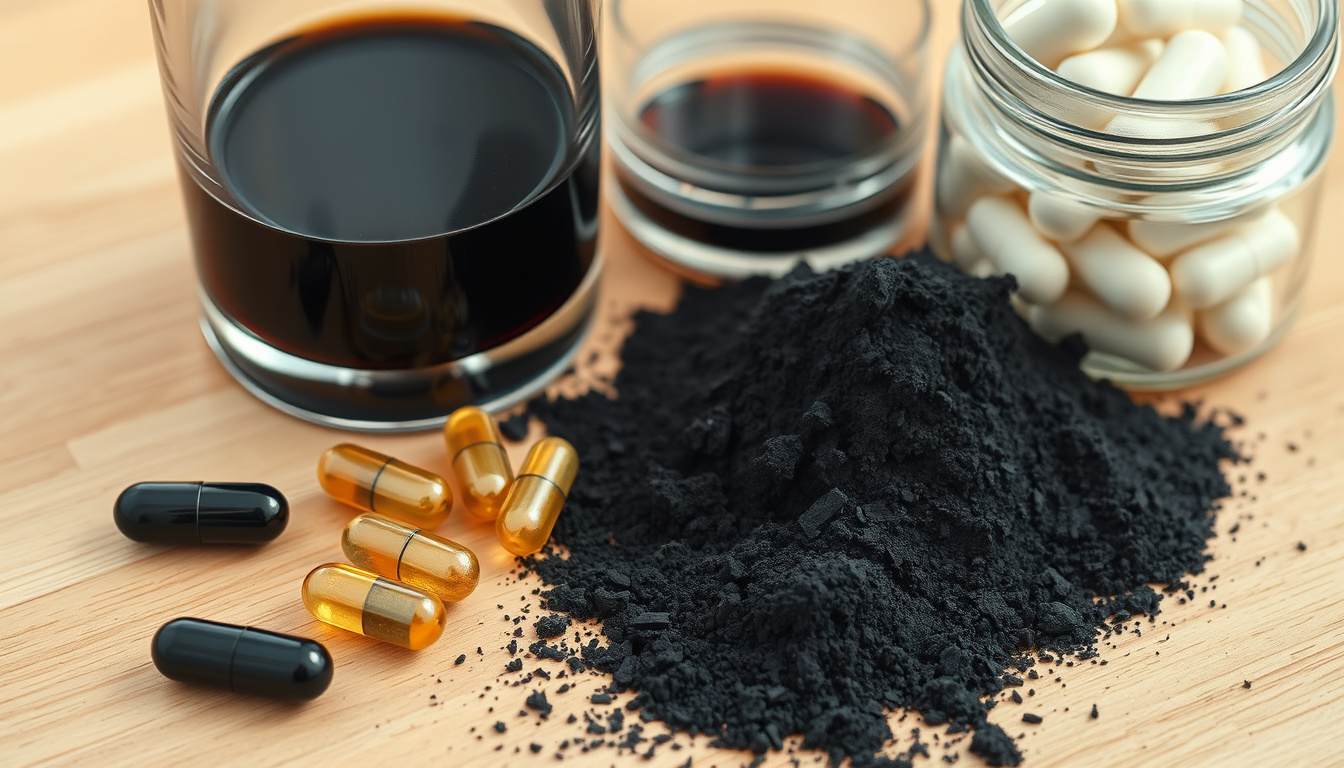
Activated charcoal serves two radically different roles: a proven hospital antidote for specific poisonings, cited by the Australian Prescriber journal, or a wellness market offering promising detox with far thinner evidence. The gap between the two is wider than most product labels suggest.
Common single dose (acute poisoning): 1 g/kg body weight (Australian Prescriber) ·
Common visible effect: black stools (WebMD (health reference)) ·
Not effective against: alcohols, strong acids, alkalis (Mayo Clinic (health system))
Quick snapshot
- Most effective when given within about 1 hour of ingestion (PMC/NIH research review)
- Timing, not dose, is the whole game — see the Critical timing row in the quick-facts table below (PMC/NIH research review). (PMC/NIH research review)
- Everyday “detox” and wellness benefits lack conclusive, large-scale research (MedicalNewsToday (health media))
- Cosmetic oral-health claims for charcoal toothpaste aren’t established by strong evidence (Drugs.com (pharmacology reference))
- For timed-release or extended-release products, benefit may extend up to 6 hours after ingestion (PMC/NIH research review).
- Suspected poisoning is an emergency — the next step is professional medical care, not a home supplement dose (University of Utah Health (academic medical center))
Six rows, one pattern: the only place activated charcoal behaves like a reliable medicine is the narrow window of emergency poisoning care.
| Fact | What the evidence says | Source |
|---|---|---|
| Medical status | Antidote for certain acute poisonings | Drugs.com (pharmacology reference) |
| Mechanism | Adsorbs drugs and toxins in the GI tract | StatPearls (clinical toxicology reference) |
| Typical dose (acute) | 1 g/kg body weight | Australian Prescriber |
| Critical timing | Best within about 1 hour of ingestion | PMC/NIH research review |
| Common side effect | Black stools, vomiting, constipation | WebMD (health reference) |
| Not effective against | Alcohols, strong acids, alkalis | Mayo Clinic (health system) |
What are the benefits of taking activated charcoal?
In emergency medicine, the benefit list is short and specific: activated charcoal reduces how much of certain poisons and drug overdoses the body absorbs. In the wellness aisle, the list gets longer, louder, and far less evidence-based.
The same powder that works as an antidote inside a hospital is sold as a daily “cleanse” next to the vitamins. The molecule didn’t change — the evidence did.
What toxins does activated charcoal remove from the body?
- Many organic drugs and toxins still sitting in the stomach or intestines — the adsorption mechanism shown in the quick-facts table above (StatPearls).
- Not alcohols, and not strong acids or alkalis — the limits shown in the same table (Mayo Clinic).
The practical translation: the “removes toxins” claim is true for a narrow list of substances in a narrow window. Everything else is extrapolation.
Does charcoal cleanse your stomach?
- No — the mechanism is adsorption, not a rinse. Charcoal holds molecules on its surface; it doesn’t flush the gut or “reset” digestion.
If “cleanse” means “bind whatever is in there,” then yes. If it means a system-wide detox, that’s a marketing phrase, not a clinical one.
Can activated charcoal get rid of parasites?
- No recognized evidence supports parasite removal — the claim belongs in the same evidence gap flagged in the “What’s unclear” panel at the top.
Parasite infections call for specific treatments; charcoal doesn’t appear in the evidence for that job.
What are the side effects of taking activated charcoal?
Most side effects are cosmetic and temporary. The serious ones are all about the powder going somewhere it shouldn’t.
- Black stools and a black tongue — common, harmless, and worth expecting (WebMD, quick-facts table above).
- Vomiting, bowel obstruction, and aspiration into the lungs — the recognized adverse effects that clinicians watch for (StatPearls (clinical toxicology reference)).
Aspiration is the risk behind the biggest safety rule: charcoal should only be given to someone who can protect their airway. That’s why emergency teams, not home users, are the ones administering it.
A powder that is easy to swallow can turn dangerous in the wrong lungs. Airway protection comes before the dose — always.
Why do I feel better after taking activated charcoal?
- Plausible explanations: relief from gas or bloating, plus the placebo effect. A system-wide “detox” has no mechanism behind it.
Feeling better is real, but “I feel better” isn’t a clinical endpoint. The gap between feeling and proven effect is where much of the supplement market operates.
Does activated charcoal destroy good gut bacteria?
- Unknown — long-term effects on gut bacteria aren’t well studied, and no large-scale research exists to justify confident claims either way (the same evidence gap MedicalNewsToday flags in the snapshot above).
If charcoal binds indiscriminately, it’s fair to ask what else it binds. The honest answer: nobody has done the large-scale work needed to tell you.
What happens if I take activated charcoal every day?
Nothing dramatic, probably — and that’s exactly the problem. Daily “detox” doses aren’t a medical protocol; they’re a consumer experiment.
- Hospital use is a one-time emergency intervention, given under supervision — not a daily routine (University of Utah Health (academic medical center)).
What happens when you take activated charcoal on an empty stomach?
- An empty gut means less competition: whatever is in there — including medications — is more likely to be bound. That cuts both ways.
This is the same adsorption mechanism from the quick-facts table, applied to a daily routine. For someone on prescription meds, that’s not a cleanse; it’s a timing hazard.
How long does it take for activated charcoal to remove toxins?
- In poisoning treatment, the benchmark is about one hour — the critical timing row in the quick-facts table above.
For general “toxin removal,” there is no validated timeline, for the same reason there’s no validated detox effect: the research isn’t there.
The implication: daily use turns a targeted medical tool into an unregulated experiment on your own digestion.
Who should not use activated charcoal?
Contraindications are where casual supplement use and emergency medicine sharply diverge.
- Anyone with reduced consciousness or an unprotected airway — the risk of inhaling charcoal is too high (Drugs.com (pharmacology reference)).
- Anyone who swallowed a corrosive substance, an alcohol, or a hydrocarbon such as gasoline — charcoal doesn’t bind them, as the Mayo Clinic limits in the quick-facts table make clear.
- Anyone at risk of bowel obstruction — the concern noted in the side-effects section above.
Pregnancy and breastfeeding are “ask a doctor first” territory: there’s no solid safety data for daily supplement use in these groups.
The catch: the people most drawn to charcoal — the ones chasing a “detox” — are also the least likely to have a medical reason for it.
What should you not mix with activated charcoal?
Two mixing rules matter more than the supplement label suggests: medications and alcohol.
- Oral medications: the same adsorption that traps poisons can trap your prescriptions. That’s why hospital protocols emphasize timing — and why daily supplement use alongside medication is a bad idea (binding mechanism documented by StatPearls in the quick-facts table).
- Alcohol: charcoal doesn’t bind ethanol, methanol, or ethylene glycol — so “charcoal before a night out” is folklore, not toxicology (see the Mayo Clinic limits in the quick-facts table).
- Syrup of ipecac and other “make yourself vomit” remedies — modern protocols don’t pair these with charcoal, and self-induced vomiting adds its own risks.
If you take any medication on a schedule, the safest move is to separate charcoal from your doses by hours — and to ask a pharmacist before starting it at all.
The trade-off: a product that grabs everything in your gut is useful exactly once, in an emergency, when a specific poison is the target. In daily life, “grabs everything” is the side effect.
Pros and cons of activated charcoal
Upsides
- Proven antidote for certain acute poisonings
- Hospital protocol is well documented and time-tested
- Visible side effects such as black stools are harmless
Downsides
- No solid evidence for daily “detox” use
- Can bind oral medications and reduce their absorption
- Aspiration and bowel obstruction are serious risks
- Useless against alcohols, corrosives, and hydrocarbons
Confirmed facts vs. what’s still unclear
Confirmed facts
- Activated charcoal adsorbs many organic drugs and toxins in the GI tract (StatPearls (clinical toxicology reference)).
- Black stools and a black tongue are common, harmless visible effects (WebMD (health reference)).
- It is not effective against alcohols, strong acids, or alkalis (Mayo Clinic (health system)).
What’s unclear
- Everyday “detox” benefits lack conclusive, large-scale research (MedicalNewsToday (health media)).
- What daily use does to gut bacteria over months: no large study has answered it.
- Whether charcoal removes parasites: no recognized evidence says yes.
- Whether long-term use changes nutrient absorption: a real concern, but not yet a precisely measured effect.
What the sources actually say
There is not sufficient conclusive, large-scale research to establish many claimed benefits of activated charcoal outside poisoning treatment.
— MedicalNewsToday (health media)
Activated charcoal should only be given in health care facilities for poisonings and should not be used at home.
— University of Utah Health (academic medical center)
The practical verdict
Activated charcoal is two different products wearing the same name. In an emergency room, it’s an evidence-based antidote with a narrow window and real risks. On a supplement shelf, it’s a detox promise with no clinical ledger behind it. For UK supplement shoppers, the decision is clear: keep charcoal for medical emergencies and skip the daily cleanse — or apply the same skepticism you’d bring to any product whose benefit starts with the word “detox.”
ams.usda.gov, healthline.com, pmc.ncbi.nlm.nih.gov, aafp.org
Frequently asked questions
Can activated charcoal help with hangovers?
No evidence supports it. Charcoal doesn’t bind alcohols such as ethanol, which is why the limits in the quick-facts table list alcohol outside its reach.
How much activated charcoal should I take for gas?
There is no proven dose for gas relief. The only validated dosing in the sources reviewed is the emergency protocol of 1 g/kg body weight, and that’s a hospital setting.
Does activated charcoal expire?
Supplement makers usually print an expiry date, but the medical sources reviewed here don’t set a standardized shelf life. If the package has an expiry date, respect it.
Can I take activated charcoal with other supplements?
Not at the same time. The same adsorption that catches toxins can catch the supplement you just swallowed, which means less of it reaches your system. Space doses out, or ask a pharmacist first.
Is it safe to give activated charcoal to children?
Only under medical supervision. Emergency guidance cited in this article is clear that charcoal for poisoning belongs in a health care facility, not the kitchen.
Does activated charcoal affect birth control pills?
Potentially. Since charcoal binds whatever is in the gut, oral medications — including hormonal contraceptives — can be affected if taken at the same time. Keep doses apart and check with a pharmacist.
Can activated charcoal cause dehydration?
There’s no strong evidence of direct dehydration. The more commonly documented digestive effects are black stools, vomiting, and constipation.
Related stories





Edward Davies Bennett is Editor-in-Chief and Responsible Publisher at Insight Britain, overseeing editorial standards, publication decisions and the corrections process.