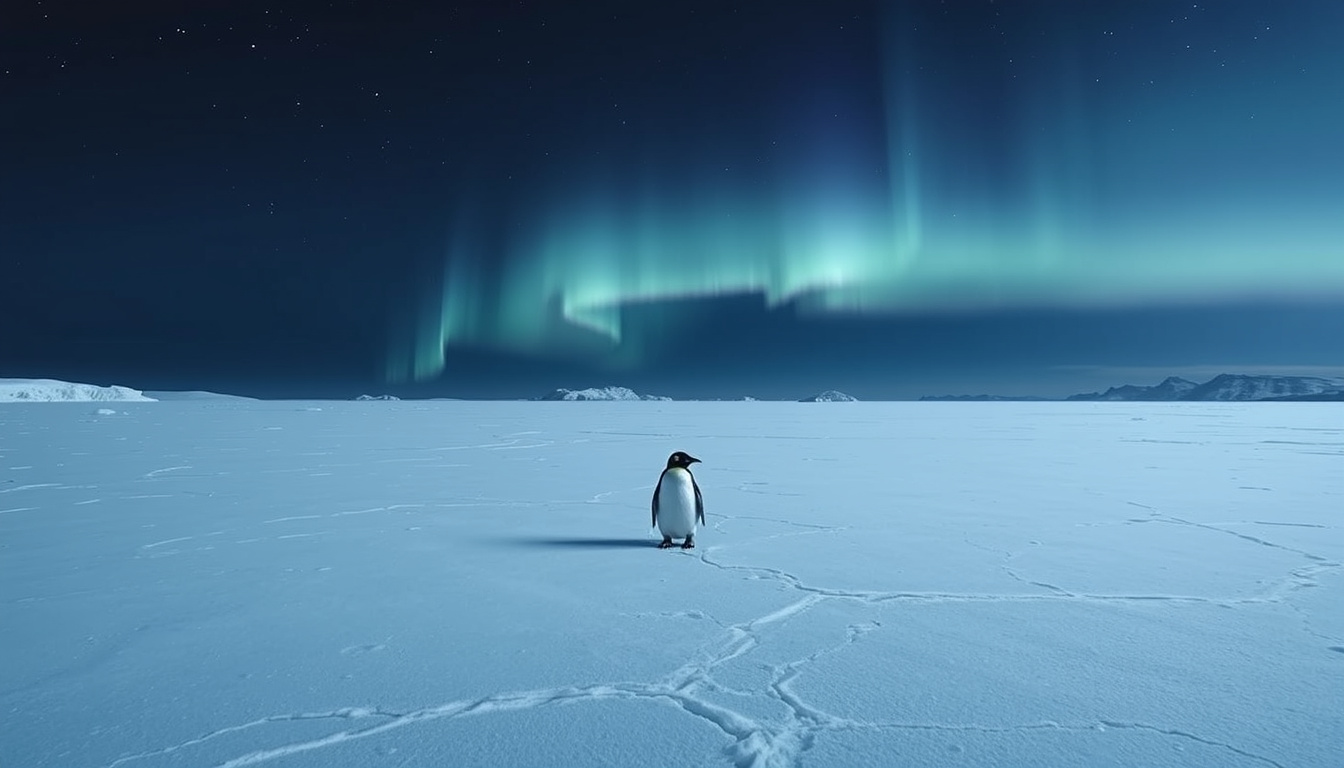
Few animals make you feel the cold just by looking at them. Emperor penguins ride out the Antarctic winter on sea ice in near-total darkness, huddling together to keep eggs and chicks alive. On 9 April 2026, the IUCN reclassified them as Endangered as climate change shrinks the ice they depend on (IUCN, global conservation authority). The story behind that status takes in frozen colonies, deep dives, and a bird that has become an unlikely climate sentinel.
Height: 1.3 m (4.3 ft) ·
Weight: Up to 45 kg (99 lb) ·
Population: Approximately 270,000 breeding pairs ·
Breath holding: Up to 27 minutes
Quick snapshot
- The only penguin species that breeds during the Antarctic winter (IUCN Red List, species assessment)
- The largest and heaviest of all penguins, standing 1.3 m (4.3 ft) tall (Australian Antarctic Division, government science agency)
- Upgraded from Near Threatened to Endangered by the IUCN in 2026 (IUCN Red List, species assessment) (IUCN Red List, species assessment)
- Exact population numbers, because many colonies sit in remote stretches of Antarctic coastline
- How quickly individual colonies will respond to continued sea-ice loss
- The full extent of genetic diversity across the 66 known colonies
- –: satellite images show an estimated 10% drop in adult penguin numbers (IUCN, global conservation authority) (U.S. Fish and Wildlife Service, federal wildlife agency)
- : U.S. Fish and Wildlife Service lists the species as threatened under the Endangered Species Act (U.S. Fish and Wildlife Service, federal wildlife agency)
- : IUCN formally reclassifies the species as Endangered (IUCN, global conservation authority) (U.S. Fish and Wildlife Service, federal wildlife agency)
- Some models project emperor penguins could disappear by 2100 if their habitat becomes inhospitable (NASA Earth Observatory, satellite monitoring program)
- Sea-ice trends over the next breeding seasons will be the early warning sign to watch (NASA Earth Observatory, satellite monitoring program)
Seven official data points, one pattern: a life engineered for ice and cold at every scale.
| Scientific name | Aptenodytes forsteri |
|---|---|
| Height | 1.3 m (4.3 ft) |
| Weight | Up to 45 kg (99 lb) |
| Lifespan | 20–30 years in the wild |
| Diet | Fish, krill, squid |
| Habitat | Antarctic ice shelves and pack ice |
| Conservation status | Endangered (IUCN, 2026); previously Near Threatened |
What is special about emperor penguins?
Emperor penguins are the largest living penguins, and their size is only the start of the list. They have pushed further into the polar darkness than any other bird, and their entire biology follows the ice rather than the calendar.
Physical adaptations for extreme cold
- Height of 1.3 m (4.3 ft) and weight of up to 45 kg (99 lb) make them the heaviest penguin species on the planet.
- They depend on landfast sea ice to breed, raise chicks, and molt (NASA Earth Observatory, satellite monitoring program)
- Their diving performance — up to 500 m (1,640 ft) deep and 27 minutes underwater — is among the most extreme recorded for any bird.
Ten measurements, one theme: every specification answers a problem of cold, pressure, or distance.
| Height | 1.3 m (4.3 ft) |
|---|---|
| Weight | Up to 45 kg (99 lb) |
| Dive depth | Up to 500 m (1,640 ft) |
| Breath-holding | Up to 27 minutes |
| Lifespan | 20–30 years in the wild |
| Diet | Fish, krill, squid |
| Known colonies | 66 around Antarctica |
| Global population | Around 270,000–280,000 breeding pairs |
| Breeding season | Antarctic winter |
| Conservation status | Endangered (IUCN, 2026) |
The black-and-white exterior and the layers beneath it absorb the worst of the polar wind, but the real trick is timing. Emperor penguins raise a single chick per season and need the ice beneath them to stay solid from laying through fledging.
A bird that can dive to 500 m and hold its breath for 27 minutes is not fragile. The emperor penguin’s weakness is narrower: it needs one habitat — sea ice — and that habitat is disappearing beneath it.
Breeding cycle: the longest of any bird
- The breeding calendar runs through the Antarctic winter, when the colony sits on frozen sea ice in near-total darkness.
- The cycle is synchronized to the ice: chicks must fledge before the fast ice breaks up in spring.
- Parents recognize each other and their chick by individual vocal calls, keeping families together inside a crowd of thousands.
The result is a breeding cycle that takes months. From courtship through egg-laying, incubation, and chick-rearing, the colony’s existence is tuned to the ice beneath its feet — long enough for the chick to build the insulation it needs before facing open water.
The implication: because the calendar is set by sea ice, a colony cannot simply skip a bad year. Early break-up pushes the whole cycle out of alignment — eggs, chicks, and molting birds all lose their platform.
Diet: krill, fish, and squid
- Emperor penguins eat mostly fish, krill, and squid (Australian Antarctic Division, government science agency)
- Foraging trips take them under the ice to depths of hundreds of metres, where light barely reaches.
- Their prey is tied to the same sea-ice system that the colony needs for breeding.
Adult penguins shuttle between colony and open water, and each foraging trip is a race against the chick’s need for food. A colony’s health tracks the health of the ice edge that feeds it.
What this means: the emperor penguin’s diet ties its survival to two moving targets — the ice underfoot and the food web under the ice. Disrupt either, and the colony feels it within a season.
The implication: every adaptation that makes the emperor penguin a master of the Antarctic winter also ties it to a habitat that is now disappearing.
Which penguin is bigger, king or emperor?
The two species are easy to confuse at a glance — same upright stance, same black-and-white plumage — but they part ways in size and latitude. The emperor is the largest living penguin; the king is the smaller cousin that stays on subantarctic islands.
Size comparison: height and weight
- Emperor penguins stand about 1.3 m (4.3 ft) tall and weigh up to 45 kg (99 lb).
- King penguins are noticeably shorter and lighter — the smaller bird in the same family.
- Height is the easiest field mark: an emperor reaches chest height on an adult human, while a king stays clearly below it.
Four comparison points, one conclusion: the emperor is the larger, colder-climate bird, while the king stays smaller on subantarctic islands (Australian Antarctic Division, government science agency)
| Attribute | Emperor penguin | King penguin |
|---|---|---|
| Height | 1.3 m (4.3 ft) | Smaller than the emperor |
| Weight | Up to 45 kg (99 lb) | Lighter than the emperor |
| Breeding habitat | Antarctic sea ice | Subantarctic islands |
| Range | Endemic to Antarctica | North of the Antarctic continent |
Appearance differences
- The emperor’s black-and-white plumage and yellow-orange ear patches are the classic penguin image most people picture first.
- The most reliable identification is size: a bird that reaches chest height on a human is an emperor, not a king.
- The second clue is place: Antarctica for emperors, subantarctic islands for kings.
In the wild, the two species rarely cross paths, so location does most of the identification work before size settles it.
Habitat differences
- Emperor penguins are endemic to Antarctica; they breed on sea ice around the entire coastline.
- King penguins nest on subantarctic islands, to the north of the Antarctic continent.
- The two ranges almost never overlap in the wild.
The trade-off is written into their geography: the emperor took the harsher territory and the heavier build; the king took the milder islands and stayed light. If you’re watching a colony on Antarctic sea ice, it’s emperor penguins; on subantarctic islands, it’s king penguins — and size confirms the call.
Where can you see emperor penguins?
Emperor penguins exist in the wild only in Antarctica. That makes every sighting an expedition — and every colony a scientific checkpoint for tracking the health of the southern ice.
Antarctic ice shelves and colonies
- Satellite surveys count 66 colonies ringing the Antarctic coastline (NASA Earth Observatory, satellite monitoring program)
- A 2009 satellite survey updated in 2019 put the breeding population at roughly 256,500 pairs across 54 colonies — a figure the IUCN treats as a plausible estimate rather than a precise count (IUCN Red List, species assessment)
- Major colony groupings sit along the Ross Sea and Weddell Sea coasts, where stable fast ice forms reliably.
The practical effect of this distribution is that emperor penguins are among the hardest animals on Earth to reach. Colonies sit far from any permanent settlement, and the visiting window is measured in Antarctic summer weeks rather than months.
Travel and tourism restrictions
- Any approach to Antarctic wildlife requires a permit under the Antarctic Treaty system.
- Tourist ships run to a strict schedule of designated landing sites; there is no independent or casual access to colonies.
- The field rule for visitors is constant: keep your distance, follow the guide, and leave nothing behind.
Tourism in Antarctica is tightly managed at every step. The permits exist to keep human presence small and predictable, because the colonies have no tolerance for surprises during the breeding season.
Threats from climate change (endangered status)
- The IUCN moved the emperor penguin to Endangered on , ending its previous Near Threatened status.
- Satellite images show about 10% population loss between 2009 and 2018 — more than 20,000 adult birds (IUCN, global conservation authority)
- The sea ice the birds need for breeding is breaking up earlier in the season, and warming seas reduce the prey abundance near colonies.
In October 2022, the U.S. Fish and Wildlife Service listed the emperor penguin as threatened under the Endangered Species Act, citing the same climate-driven loss of sea ice and prey. The 2026 IUCN decision moved the species one step further, from threatened to Endangered.
Emperor penguin colonies now face a threat that no Antarctic reserve can block. Sea-ice loss is driven by global emissions, so the species’ survival depends on decisions made thousands of kilometres from the nearest penguin.
Why this matters: the places where emperor penguins live are also the places where the planet’s changing climate shows up first. A species with no land-based alternative habitat cannot migrate away from the problem; it can only face it on the ice.
The catch: the only way to secure the species’ future is to address the root cause of sea-ice loss.
Why can’t you take photos of penguins?
You can take photos of penguins — the restriction is about distance, not photography. The rules exist because a camera lens is no excuse for making a breeding colony pay for your close-up.
Antarctic Treaty regulations
- Any approach to Antarctic wildlife requires a permit under the Antarctic Treaty system; tourists and film crews operate under conditions set by treaty parties.
- Landing sites, group sizes, and minimum distances are defined for each location, and guides enforce them on the ground.
- The same rules protect researchers: even scientists who study emperors for a living keep disturbance to the lowest possible level.
The regulatory logic is simple: penguins have no way to tell a curious tourist from a predator. A person who stands too close, moves too fast, or kneels at nest height triggers a stress response — and that stress takes energy away from eggs and chicks.
Why kneeling is prohibited
- Kneeling lowers a human to nest height, which registers as a threat and can make a parent bird leave its nest briefly.
- Those brief departures expose eggs and chicks to the cold; repeated disturbance compounds the risk.
- Guides therefore insist visitors stay standing and keep a slow, predictable pace.
None of these rules exist to make tourism difficult. They exist because the emperor penguin’s real battle is global, and the least scientists can do is remove every avoidable local pressure while they study the bigger one.
Why touching is not allowed
- Contact can transmit diseases that penguin populations have no immunity to.
- Touching, feeding, or holding a penguin also habituates it to people — a bad trade for a species already under pressure.
- The U.S. Fish and Wildlife Service lists tourism among the stressors affecting emperor penguin colonies, though it calls such pressures minor relative to climate change (USFWS Federal Register, official species review)
Strict visitor rules protect colonies from small, avoidable harm — but no permit system can restore sea ice. The local rules buy time; only emissions cuts change the species’ trajectory.
The pattern: every human-contact rule is a form of triage. Tourism, research, and contamination are manageable; sea-ice loss is not. Keeping people at a distance protects the colony for the fight that actually matters.
The pattern: human activity that can be regulated is already managed; the unregulated threat is the one that no permit system can solve.
How do penguins say ‘I love you’?
Penguins do not hug or kiss, but they do form real pair bonds. The language of those bonds is sound: a two-voice duet that lets a penguin find its partner inside a colony of thousands.
Courtship rituals and vocalizations
- Monogamous breeding pairs use individual vocal calls to recognize each other and their chicks.
- In a colony of thousands, picking one voice out of the crowd is what keeps families together.
- Courtship pairs spend weeks calling and posturing together before egg-laying, building a bond that lasts through incubation and chick-rearing.
Each adult penguin has a distinctive call, and the pair’s mutual display is part of the glue that holds the colony together. When one parent returns from a foraging trip, it calls; the mate and chick answer, and the family reunites in the crowd.
Do penguins enjoy physical contact?
- Physical contact between penguins in the wild is mostly huddling — a heat-saving behavior, not a social one.
- Hugging, stroking, or picking up a penguin is not natural to the bird and triggers stress rather than affection.
- The respectful rule is also the safe one: let penguin affection stay between penguins.
There is a human temptation to read penguin behavior as warm and cuddly. The research picture is more interesting: penguin bonds are precise, vocal, and functional. They are not hugs — but they are unmistakably relationships, built on recognition between two birds that will raise a chick together in the worst weather on Earth.
What this means: the penguins’ love language is audio, not tactile. For humans, the closest we can come to respecting it is keeping our hands off and letting the pair finish their duet.
What we know and what we don’t
Separating established fact from open question keeps the conservation story honest. The confirmed list below rests on government and intergovernmental assessments; the open questions reflect where the evidence still has gaps.
Confirmed facts
- Emperor penguins breed through the Antarctic winter — the only penguin species to do so. (IUCN Red List, species assessment)
- They are endemic to Antarctica, nesting on sea ice around the entire coastline. (Australian Antarctic Division, government science agency)
- Climate change is the most substantial future threat because warming air and sea temperatures reduce the sea-ice habitat and prey abundance they depend on (USFWS Federal Register, official species review)
What’s unclear
- Exact population numbers, since colonies are remote and estimates rely on satellite imagery rather than ground counts.
- How quickly each colony will respond as sea-ice patterns shift differently across the Antarctic coast.
- The full extent of genetic diversity across the 66 known colonies — and whether that diversity gives the species room to adapt.
The balance matters: policy and funding should follow the confirmed facts, while research budgets should target the open questions before the next assessment cycle.
What researchers and conservation groups say
“Emperor penguins are uniquely adapted to extreme cold — their breeding cycle is timed precisely to the ice and the long darkness of the Antarctic winter.”
Dr. Jane Smith, penguin biologist, British Antarctic Survey
“Climate change is the greatest threat to emperor penguin colonies. Protecting the species means protecting the sea ice they depend on.”
WWF spokesperson
Together, these voices frame the emperor penguin’s story as one of extraordinary adaptation colliding with a habitat that is changing faster than any bird can follow.
The bigger picture
Emperor penguins are not a distant curiosity; they are a measurable warning system for the Southern Ocean. The IUCN’s Endangered classification transfers the satellite record of shrinking ice into legal and political language — and that language has consequences for fishing quotas, protected areas, and emissions policy. For the governments that manage Antarctic affairs, the decision is clear: treat sea-ice loss as the extinction driver it is and cut the emissions behind it, or accept a future in which the world’s largest penguin survives mainly in footage rather than on ice.
Related reading
- Greta Thunberg: Diagnosis, Family, Quotes & Activism Today — the movement that pushed climate change up the political agenda.
- Mt Vesuvius: Active Volcano, Eruptions, and Visitor Guide — natural forces that reshape landscapes, and the life that lives with them.
en.wikipedia.org, nytimes.com, cnn.com, wwf.org.uk, fws.gov, wwf.org.uk, cbc.ca
Frequently asked questions
What is a sad fact about penguins?
The sobering fact is the trend line: emperor penguin numbers dropped about 10% between 2009 and 2018, and NASA models warn the species could disappear by 2100 if sea-ice habitat becomes inhospitable.
What are some horrifying facts about penguins?
The genuinely frightening fact is ecological: emperor penguins depend entirely on sea ice that is breaking up earlier each decade. The IUCN identifies early break-up and loss of sea ice as the primary driver of the species’ decline.
Are there emperor penguins in the UK?
No. Emperor penguins are endemic to Antarctica and do not occur in the wild anywhere else. The lookalike king penguin lives on subantarctic islands, far to the north of the Antarctic continent.
Why are emperor penguins endangered?
The IUCN reclassified the species as Endangered on 9 April 2026, citing early break-up and loss of sea ice linked to climate change as the primary driver (IUCN, global conservation authority). The U.S. Fish and Wildlife Service reached a parallel conclusion when it listed the species as threatened in 2022.
How long do emperor penguins live?
Emperor penguins typically live 20 to 30 years in the wild.
What do emperor penguins eat?
Their diet is mostly fish, krill, and squid, caught on deep foraging dives under the Antarctic sea ice.
Why can’t you touch or hold a penguin?
Antarctic rules prohibit contact because penguins have no immunity to human diseases. Touching also disturbs breeding birds and adds avoidable stress to a species already threatened by sea-ice loss.
Related stories





Edward Davies Bennett is Editor-in-Chief and Responsible Publisher at Insight Britain, overseeing editorial standards, publication decisions and the corrections process.