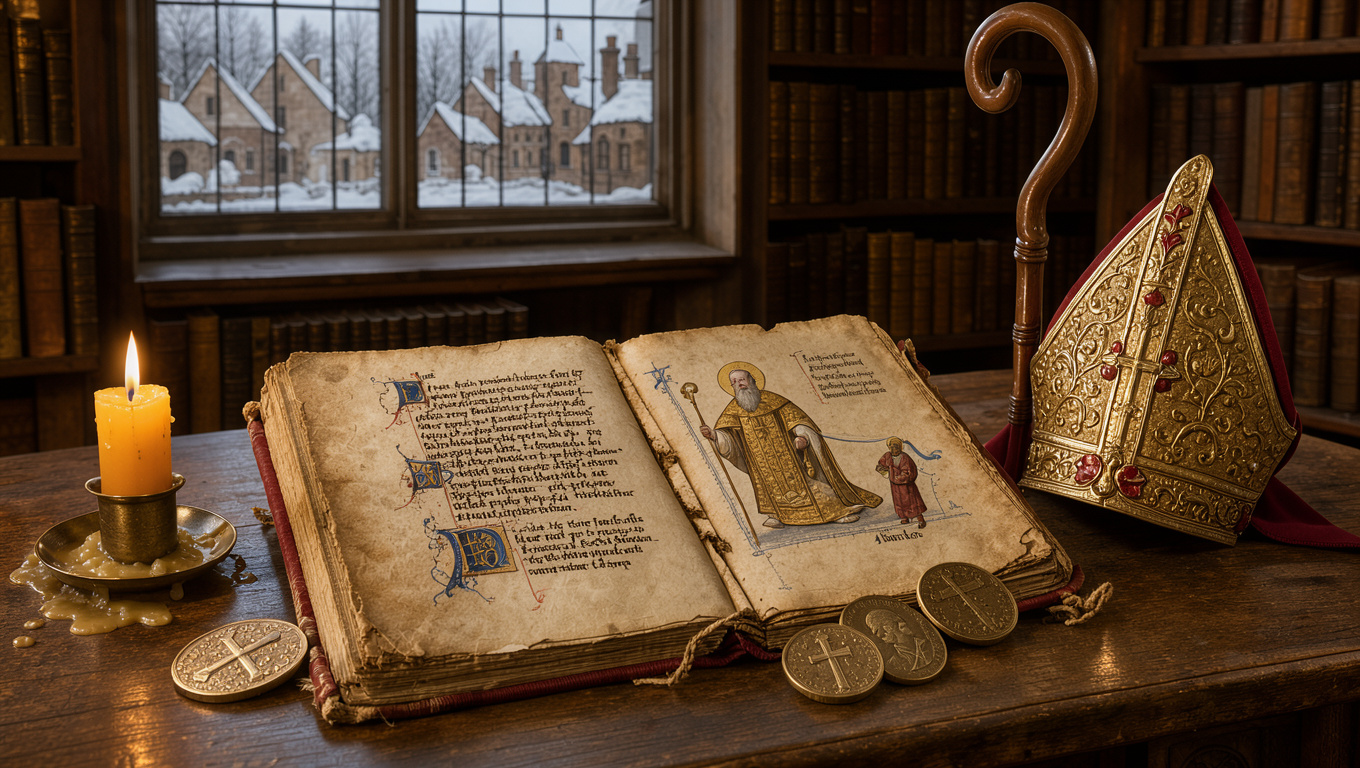
Nearly everyone can picture Santa Claus, yet few people know where the red suit and reindeer sleigh actually came from. The story starts with a real person, and Britannica (encyclopedic reference) ties the popular image to traditions around Saint Nicholas, a 4th-century Christian saint, while this article marks where the evidence runs out.
Historical root: Saint Nicholas, a 4th-century bishop (National Geographic (popular history magazine)) ·
Feast day linked to Saint Nicholas: 6 December (Britannica) ·
Traditional gift night: Christmas Eve (according to UC Davis Health (university health newsletter)) ·
Alternate name: Father Christmas (St. Nicholas Center (scholarly research on Saint Nicholas))
Quick snapshot
- Saint Nicholas, a 4th-century Christian saint, is the historical basis of the popular image (Britannica).
- Saint Nicholas was born around 280 A.D. and became bishop of Myra, in modern Turkey (National Geographic).
- Santa Claus is described as a legendary figure, and whether he is real is a matter of belief (Wikipedia (collaborative encyclopedia)).
- The research gathered for this piece does not establish Santa’s family, age or diet. (Wikipedia (collaborative encyclopedia))
- 1823: “A Visit from St. Nicholas” was first published anonymously (National Geographic).
- 1863: Thomas Nast began drawing Santa for Harper’s Weekly, and 1931 brought Coca-Cola advertisements (Britannica).
- The earliest attestation of Father Christmas remains disputed between a 15th-century carol (St. Nicholas Center) and 16th-century England (Wikipedia). (Fun and Games (family activity info sheet))
- A 1927 Lapland claim rests on a single low-confidence source (Fun and Games (family activity info sheet)).
Ten dated or named anchors, one pattern: the documented dates cluster in two windows, the late Roman era and the 19th century, with almost nothing recorded between them.
| Label | Value |
|---|---|
| Historical root | Saint Nicholas, a 4th-century bishop (National Geographic) |
| Birth period | c. 280 A.D. (National Geographic) |
| Death date | December 6, mid-fourth century (c. 343) (National Geographic) |
| See | Bishop of Myra, Lycia, modern Turkey (Britannica) |
| Feast day linked to Saint Nicholas | 6 December (Britannica) |
| Traditional gift night | Christmas Eve (according to UC Davis Health) |
| Alternate name | Father Christmas (St. Nicholas Center) |
| Knickerbocker’s History of New York publication | 1809 (National Geographic) |
| A Visit from St. Nicholas, first publication | 1823, published anonymously (National Geographic) |
| Thomas Nast, first Santa drawings for Harper’s Weekly | 1863 (Britannica) |
Who is Santa Claus in real life?
Butler Eagle (regional US newspaper) reports that modern Santa grew from several traditions that came together in the United States in the late 19th century. National Geographic dates the historical saint’s birth to around 280 A.D. and his death to December 6 in the mid-fourth century, around 343.
Is Santa Claus real?
- Santa Claus is described as a legendary secular gift-bringer, according to Wikipedia.
- Whether he is real is a matter of belief, not something the documented sources settle.
Is Santa real or is it just our parents?
- The documented record shows how the figure was built, which is a different question from who delivers the gifts.
- Washington Irving’s 1809 book first portrayed a pipe-smoking Nicholas flying over rooftops (National Geographic).
- Clement Clarke Moore wrote his poem for his six children in 1822, and it was published anonymously in 1823 (National Geographic).
The implication: the documented record explains how the figure was assembled, while the question of belief is left to each household.
Where is Father Christmas now?
Father Christmas is the English name for the same gift-giver, and the sources treat the two names as one figure. History Hit (popular history publisher) notes a “Sir Christëmas” personification in a 15th-century carol, and Ben Jonson’s 1616 masque “Christmas, His Masque” featured Old Christmas.
How do you spell Claus?
- The sources reviewed use the spelling Claus in the name Santa Claus and say nothing about other spellings.
- In 1927, Finnish radio host Markus Rautio declared that Father Xmas lives on Lapland’s Korvatunturi Mountain, according to Fun and Games, a single low-confidence claim.
The sources disagree on the century. The St. Nicholas Center places the name in a 15th-century carol, while Wikipedia places Father Christmas in 16th-century England under Henry VIII.
The implication: both the Lapland claim and the century dispute show that answers about origin and location depend on which source a reader trusts.
What is Santa’s wife’s name?
No single name for Santa’s wife appears in the sources reviewed. Family details vary across traditions, so any name quoted with confidence needs a citation this research does not provide.
Does Santa have a baby?
- No source in the research describes children of Santa.
- Family details differ across traditions, so the answer depends on which version a family follows.
How old will Santa be in 2026?
- The sources date Saint Nicholas, the historical bishop, not the modern figure, so no age for Santa in 2026 can be derived from them.
- Santa’s age is not established in the sources reviewed.
The catch: the family and age questions have no sourced answer, so any name or birthday quoted online is folklore rather than documented fact.
Is 7 too old for Santa?
The research does not measure when children stop believing. It does show that the gift night itself moved: according to UC Davis Health, some clergy urged gift-giving on Christmas Eve rather than St. Nicholas Day during the Protestant Reformation.
Can you explain Santa Claus to kids?
- Children’s material presents Santa as a gift-giving figure tied to Christmas Eve.
- The age when belief ends varies by child, and the sources do not measure it.
The legend rests on a bishop’s generosity, yet no source gives an age when belief ends. Parents are left to judge that moment themselves.
The trade-off: a Christmas Eve frame suits young children, but the research offers no threshold for when to retire the story.
What does Santa eat?
No diet for Santa appears in the sources reviewed. What exists is cultural tradition, and the research does not verify it.
- No dietary detail for Santa is documented in the provided sources.
- Popular depictions of Santa’s diet are cultural tradition, not verified fact.
- Sinterklaas is shown with a long white beard and red cape over a bishop’s garment, and carries a book of children’s behavior, according to UC Davis Health.
The diet question exposes the legend’s gap: the figure is defined by gifts and appearance, not by documented habits. Readers who want facts should separate the costume from the character.
The implication: food questions are answered by tradition, so treat any specific menu as folklore rather than history.
Confirmed versus unverified claims
Confirmed
- Saint Nicholas was a 4th-century Christian saint and bishop of Myra (Britannica).
- Thomas Nast’s Santa drawings for Harper’s Weekly began in 1863 (Britannica).
- “A Visit from St. Nicholas” was first published anonymously in 1823 (National Geographic).
- Coca-Cola advertisements from 1931 helped standardize the American image (Britannica).
- Father Christmas is an alternate name for the same figure (St. Nicholas Center).
Unverified
- Whether Santa Claus is real is a matter of belief.
- No canonical name for Santa’s wife appears in the research.
- Santa’s age in 2026 is not established.
- Santa’s diet beyond cultural depiction is not verified.
- The age at which children stop believing is not measured.
- The 1927 Korvatunturi claim rests on one low-confidence source (Fun and Games).
- A legend of three impoverished daughters receiving gold is attributed to Saint Nicholas by Crosswalk (Christian faith publisher), with no primary source in the research.
- Odin’s influence on Santa’s beard is a low-confidence theory (Wikipedia).
The pattern: the confirmed column rests on encyclopedic and scholarly references, while the unverified column holds the legends that lack a primary source.
In their own words
“Here we finally have the appearance of a Santa Claus.”
Gerry Bowler, University of Manitoba historian and author of Santa Claus: A Biography, quoted in National Geographic
“Father Christmas was never a Christian religious figure, but symbolized rather the arrival of those [seasonal] secular pleasures that came from elsewhere than the Christian tradition.”
A scholarly quotation carried in the St. Nicholas Center article
Both voices point the same way: the figure was assembled from separate traditions, not handed down as one finished character.
Where the legend lands
Saint Nicholas is the part of this legend that the documented record can carry. The figure children meet today took shape through print and illustration over the following century, as the Britannica entry on Nast’s drawings shows. The sources stop short of Santa’s family, age and diet. For parents and teachers planning the season, the choice is clear: present the bishop as history and the rest as tradition, or let folklore pass as fact.
Related reading: Teddy bears guide to history and types · Michael Rosen’s books and legacy
history.co.uk, stnicholascenter.org, africa.thegospelcoalition.org, praxis-psychologie-berlin.de, randomtrivia.co, throughouthistory.com, study.com
Frequently asked questions
Is Santa coming, yes or no?
The sources cannot confirm a visit. Whether Santa is real is a matter of belief, and the documented record covers Saint Nicholas instead.
What are the origins of Santa Claus?
The documented root is Saint Nicholas, a 4th-century Christian saint whose popular image draws on his tradition (Britannica). The figure then grew through Dutch, English and American traditions over several centuries.
How did Saint Nicholas become Santa Claus?
Washington Irving’s 1809 book pictured a flying, pipe-smoking Nicholas (National Geographic), and Thomas Nast’s drawings from 1863 fixed the look (Britannica).
What is the definition of Santa Claus?
Santa Claus is a legendary secular gift-bringer shaped by centuries of folklore, poetry and illustration, according to Wikipedia (collaborative encyclopedia).
Did the Dutch bring Santa to New York?
Britannica credits the Dutch with carrying the Saint Nicholas legend, and the custom of gifts and sweets on his feast day, to New Amsterdam, now New York City. The research notes that evidence for this link is thin, according to the St. Nicholas Center.
Related stories



Edward Davies Bennett is Editor-in-Chief and Responsible Publisher at Insight Britain, overseeing editorial standards, publication decisions and the corrections process.