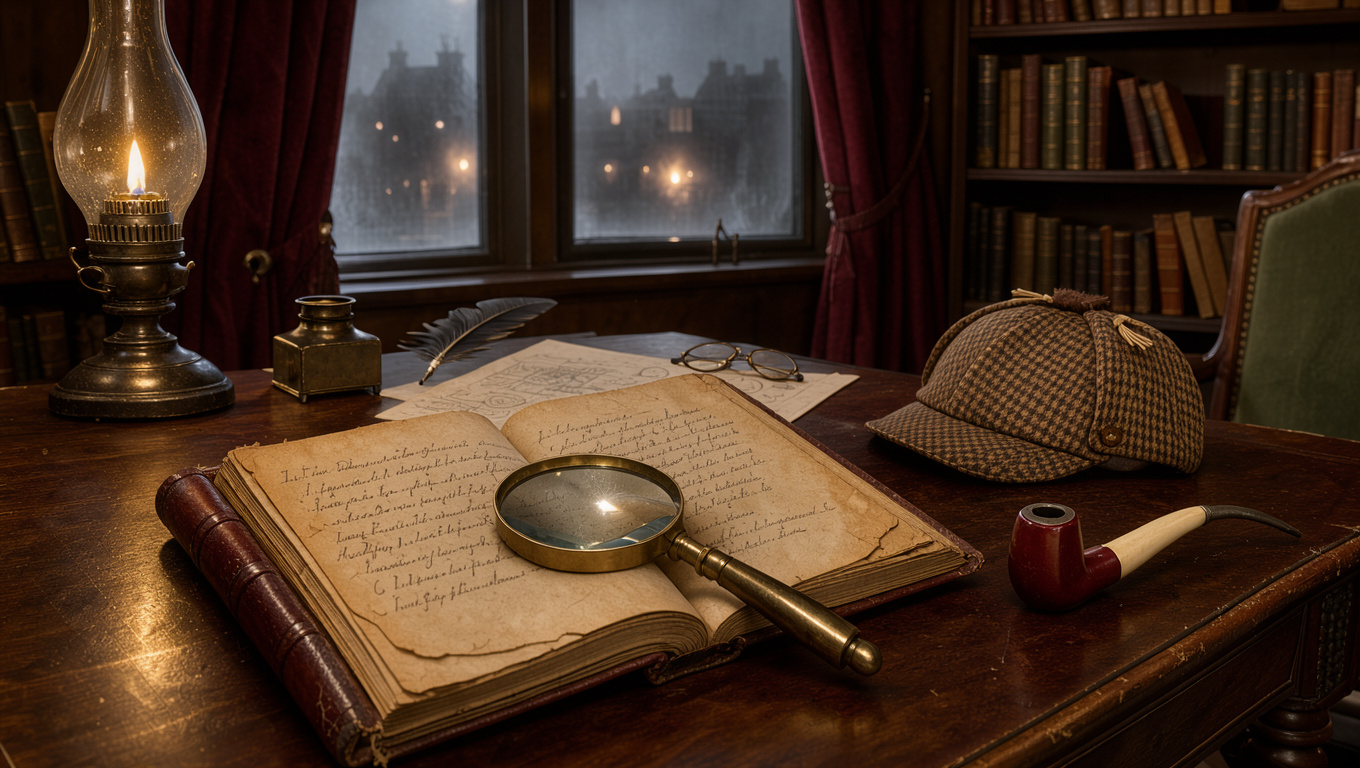
The line most people tie to Sherlock Holmes, “Elementary, my dear Watson,” never appears in Arthur Conan Doyle’s stories. Doyle’s Holmes does use the two words in the same passages, and the joined phrase turns up in print from 1908 and on screen from 1929.
Creator: Arthur Conan Doyle | First appearance: A Study in Scarlet, 1887 | Address: 221B Baker Street | Companion: Dr John Watson
Who the character is
- Fictional consulting detective created by Arthur Conan Doyle (Mental Floss book facts)
- First appeared in A Study in Scarlet, published 1887 (Mental Floss book facts)
Earliest exact phrase in print
- Exact match in The Globe (London), 1908 (Quote Investigator citation history)
Film milestone
- The Return of Sherlock Holmes, US release on 26 October 1929 (This Day in Quotes film chronology)
The table below gives the core reference points. Each row is tied to a dated source in the research notes.
| Fact | Detail |
|---|---|
| Creator | Arthur Conan Doyle |
| First story | A Study in Scarlet (1887) |
| Canon size | Four novels and 56 short stories |
| Phrase first in print | The Globe (London), 1908 |
| Earliest fiction use | P. G. Wodehouse, Psmith, Journalist (1915; date disputed) |
| First sound film with the phrase | The Return of Sherlock Holmes (1929) |
Those six rows give a timeline from Doyle’s pages to the screen. The gap between the canon and the catchphrase is the story’s central fact.
Who was Sherlock Holmes?
Holmes is a consulting detective created by Arthur Conan Doyle. The first story, A Study in Scarlet, appeared in 1887. Doyle went on to write four novels and 56 short stories about him.
Dr John Watson narrates most of those stories. He shares rooms with Holmes at 221B Baker Street and records the cases as they unfold.
Doyle, not the screen, created Holmes. Readers who treat the stars of later adaptations as the source will misread what the books actually say.
The distinction matters because most public quotes about Holmes come from adaptations, not from the stories themselves.
Is Sherlock Holmes real?
Holmes is fictional. Doyle invented him, and no real person is documented as the detective of the stories.
- Confirmed: Holmes is a fictional character created by Arthur Conan Doyle (Encyclopaedia Britannica reference entry).
- Confirmed: The first Holmes story is A Study in Scarlet, published in 1887 (Mental Floss book facts).
- Unclear: The claim that Dr Joseph Bell, an Edinburgh surgeon, shaped Holmes’s observational method has no source in the research notes.
- Unclear: The research notes do not document how Doyle described the influence of any real person on the character.
Treat the Joseph Bell link as an open question until a dated source confirms it. Doubt is the right default for claims without a citation.
The real-life question stays open, but the fiction question does not. Holmes exists only in Doyle’s pages and in the adaptations built on them.
What are some famous quotes by Sherlock Holmes?
Holmes’s most recognizable lines come from the stories, but the best-known phrase does not. Two canonical lines are documented with exact wording.
“How often have I said to you that when you have eliminated the impossible, whatever remains, however improbable, must be the truth?” Sherlock Holmes, The Sign of the Four (1890), per Yale Alumni Magazine, Fred Shapiro
“That was the curious incident.” Sherlock Holmes, Silver Blaze, per Yale Alumni Magazine, Fred Shapiro
Did Doyle write “Elementary, my dear Watson”?
No exact match appears in the canon. Holmes says “my dear Watson” and “elementary” separately. In The Adventure of the Crooked Man (1893), the two words sit a few sentences apart (Mental Floss book facts). An Interesting Facts estimate puts them about 52 words apart, but that figure rests on a tier 3 source.
The joined phrase appears in print outside the canon first. A 1909 Richmond Times-Dispatch passage uses it as “Sherlock Holmes was wont to say,” a date Fred Shapiro identified. The research notes rest that date on a single secondary source.
“Elementary, my dear Watson,” as Sherlock Holmes was wont to say. Richmond Times-Dispatch, 24 August 1909, as identified by Yale Alumni Magazine, Fred Shapiro
The comparison below separates the canon from the later print and screen uses.
| Item | Canon (Doyle’s text) | Adaptation or print myth |
|---|---|---|
| Holmes’s two words | “my dear Watson” and “elementary” separated in The Adventure of the Crooked Man (1893) | Joined as “Elementary, my dear Watson” in print from 1908 |
| Earliest exact print match | None in the canon | The Globe (London), 1908; Richmond Times-Dispatch, 1909 |
| Earliest fiction use | “Interesting, though elementary” in The Hound of the Baskervilles (1901) | P. G. Wodehouse, Psmith, Journalist (1915) |
The table shows the phrase grew by accumulation, not by Doyle’s pen.
Do not cite the Wodehouse date as settled. Sources give 1910 for a serial installment and 1915 for the book, and the research notes do not resolve the gap.
The catchphrase counts as a myth about Doyle’s text. The canon supplies the separated words, and later print and film supply the joined line.
Editors who attribute the joined phrase to Doyle will be contradicted by the canon itself, which contains no exact match.
Who is smarter, Mycroft or Sherlock?
The research notes do not include a verified passage that compares the brothers. The content plan names two stories, The Adventure of the Bruce-Partington Plans and The Greek Interpreter, but neither passage is checked against the text in the supplied evidence.
- Unverified: Mycroft is seven years older than Sherlock.
- Unverified: Holmes credits Mycroft with stronger powers of observation.
Without the passages, the ranking cannot be settled. Any answer that names a winner goes beyond the evidence.
What kind of addict was Sherlock Holmes?
The research notes include no verified passage on Holmes’s drug use. The content plan states that cocaine appears in The Sign of the Four, but the supplied sources do not confirm the scene or the dosage.
Avoid labeling Holmes an addict in print until the exact passages are checked against a primary text.
A claim this specific needs the chapter and wording. Without them, the question stays open.
supanova.com.au, quotegeek.com, nofilmschool.com, interestingfacts.com, susannahfullerton.com.au, collider.com, tpl.ca, brokensecrets.com, usingtherightwords.wordpress.com, quoteinvestigator.com, scribd.com
Frequently asked questions
Who created Sherlock Holmes?
Arthur Conan Doyle created Holmes. The first story, A Study in Scarlet, was published in 1887.
How many Holmes stories did Doyle write?
Doyle wrote four novels and 56 short stories, according to Yale Alumni Magazine, Fred Shapiro.
When did the joined phrase first appear in print?
An exact match appeared in The Globe (London) in 1908, according to Quote Investigator citation history. A 1909 Richmond Times-Dispatch passage is also cited.
Which film made the phrase famous?
The Return of Sherlock Holmes (1929) is widely credited as the first film with the full phrase. The 1939 film The Adventures of Sherlock Holmes did more to popularize it for American audiences.
Did Doyle write the exact phrase?
No. The canon separates “my dear Watson” and “elementary” and never joins them into the catchphrase.
Related on this site: Lord Farquaad’s famous lines and Shrek voice actor covers another fictional character’s quotes. Santa Claus origins and Saint Nicholas history separates documented history from popular myth.
Related stories





Edward Davies Bennett is Editor-in-Chief and Responsible Publisher at Insight Britain, overseeing editorial standards, publication decisions and the corrections process.