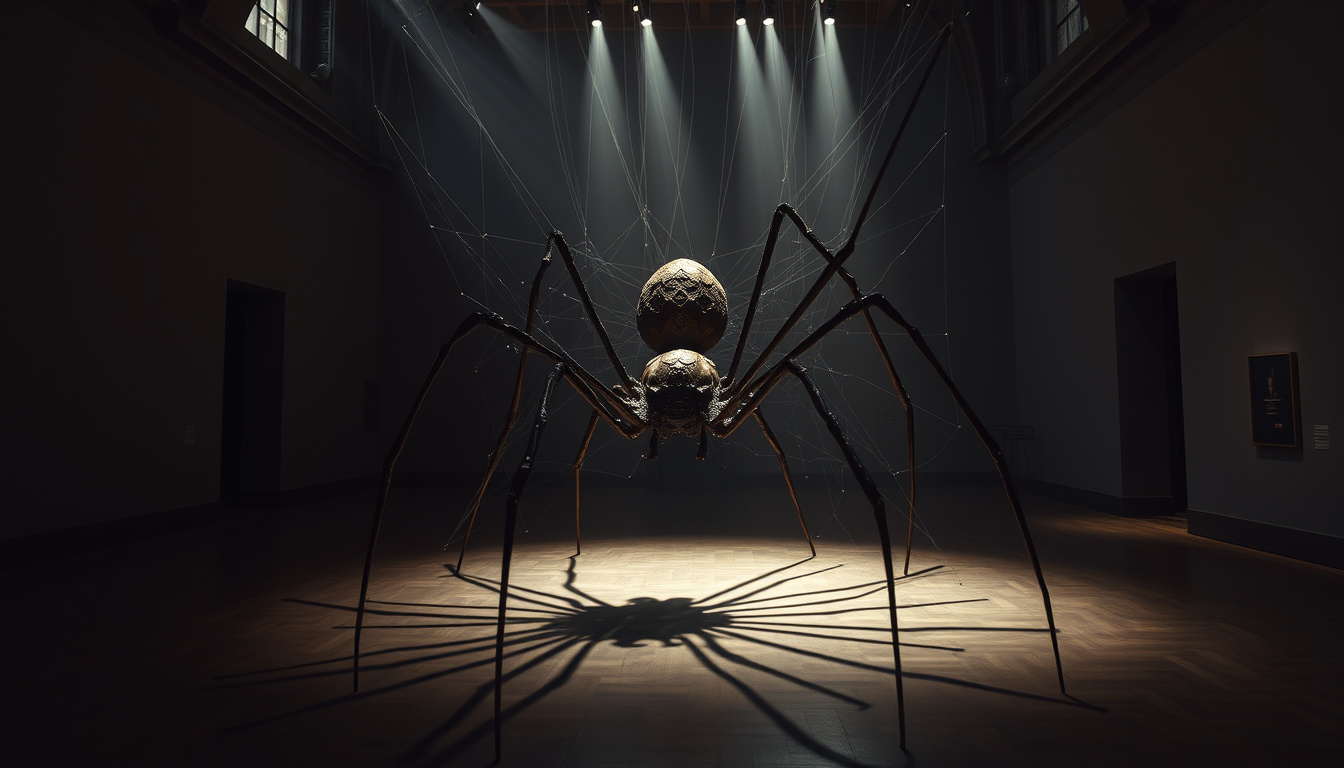
Louise Bourgeois was a woman who knew fear, yet she is the artist who changed how we look at trauma. For over seven decades, she worked through childhood wounds using materials like wood, metal, and fabric, but it was her colossal bronze spiders that made her a household name.
Born: 1911, Paris, France ·
Died: 2010, New York, USA ·
Known for: Large-scale sculpture and installation art ·
Most famous work: Maman (1999)
Quick snapshot
- Maman was created in 1999 (Guggenheim Museum Bilbao)
- The spider motif first appeared in her drawings in the 1940s (Guggenheim Museum Bilbao)
- Her mother’s death triggered her artistic exploration (PubMed Central)
- The exact number of spider sculptures she created varies by estimate
- The precise market value of Maman remains uncertain as auction prices fluctuate
- Whether she ever fully resolved her childhood trauma is a matter of debate
- The spider motif became central to her work during the 1990s (Guggenheim Museum Bilbao)
- Her father’s affair caused a lifelong trauma (PubMed Central)
- Bourgeois’s work continues to be exhibited globally, with Maman appearing in major retrospectives
- Her home in New York is not open to the public, but her works remain accessible
Louise Bourgeois (1911–2010) was a French-American artist whose work transcends simple categorization, but a central theme remains constant: the transformation of personal pain into universal art. Her legacy is dominated by the spider, a motif that has both terrified and fascinated audiences for decades.
| Detail | Information |
|---|---|
| Full name | Louise Joséphine Bourgeois |
| Born | December 25, 1911, Paris, France |
| Died | May 31, 2010, New York, USA |
| Nationality | French-American |
| Movement | Modern art, feminist art |
| Notable works | Maman, The Destruction of the Father, Cells |
| Gender | Female |
| Children | 3 (Michel, Jean-Louis, Alain) |
The pattern here is biographical consistency: every major institution records the same core details about her birth, death, and family structure.
Why is Louise Bourgeois so famous?
Louise Bourgeois’s reputation rests on creating a body of work that is both deeply personal and universally accessible. Unlike many artists who pursued abstraction, she remained committed to figurative and symbolic forms, using them as vessels for intense emotional states. Her fame was not instantaneous; it built over decades as she produced drawings, prints, and sculptures that plumbed the depths of memory and the unconscious. A key part of her fame stems from her refusal to be categorized, moving fluidly between surrealism and minimalism while maintaining a distinct voice.
Tate asserts that her spider sculptures were among her “most successful subject” and that she described the spider as a symbol that can be both predator and protector (Tate). This duality—embracing both danger and vulnerability—is why her work resonates so powerfully.
What are Louise Bourgeois’s most famous works?
Beyond the spider, Bourgeois’s oeuvre includes several iconic pieces. The massive spider Maman (1999) is perhaps her most recognized. Bourgeois’s Maman (1999) is part of a series of spider sculptures, created for her inaugural commission at the Tate Modern (Tate). Her Cells series, which began in the 1990s, is another hallmark; these immersive installations function as architectural spaces for psychological states. For example, The Destruction of the Father (1974) offers a violent, physical rendering of family conflict. These works, alongside her fabric pieces and hanging sculptures, establish her as an artist who could handle emotional weight in any material.
How did her trauma influence her art?
Louise Bourgeois’s art was driven by working through troubled childhood memories, according to Tate (Tate). Bourgeois’s childhood was fractured by the arrival of Sadie Gordon Richmond, the tutor who became her father’s mistress (SNFCC). This event happened against the backdrop of the First World War and her mother’s death. She reportedly began making art to exorcise these demons, treating the studio as a “safe space.” Bourgeois’s spider sculptures directly reference her childhood; the spider’s web is a metaphor for her mother’s weaving and restoration work, linking memory to material.
What is her impact on feminist art?
Louise Bourgeois is often cited as a foremother of feminist art because she centered female subjectivity and sexuality at a time when the art world was overtly patriarchal. Her spider is described as an ode to her mother, positioning her as a powerful, protective figure. Bourgeois’s work opened doors for many female artists to explore personal abuse and identity politics without shame. She normalized the idea that the personal is artistic material. After winning the National Endowment for the Arts Fellowship and achieving global recognition later in life, she proved that artistic genius was not gender-bound.
Bourgeois’s fame rests on a double-edged sword. On one hand, the accessibility of the spider narrative allows novices to connect with the work; on the other, the artist’s own biography becomes a lens that can obscure the formal qualities of the work itself.
What was the trauma in Louise Bourgeois’ life?
Louise Bourgeois’s biography is a case study in how early experiences can shape an entire career. The central trauma was her father’s affair with her English tutor, Sadie, who moved into the family home when Bourgeois was a teenager. Tate documents that Bourgeois’s mother was often ill, and the betrayal contributed to Bourgeois’s lifelong struggles with abandonment (Tate). A similarly significant trauma was the death of her mother in 1932 when Bourgeois was 21. National Galleries of Scotland links Bourgeois’s childhood trauma to her mother’s illness and death, her father’s philandering, and the First World War (National Galleries of Scotland). This loss caused a profound period of depression and led her to switch from mathematics to art.
How did her mother’s death specifically affect her artistic production?
Louise Bourgeois’s mother’s death, which deeply affected her, was a catalyst. She had a close relationship with her mother, who worked as a weaver and restorer. When her mother died, Bourgeois lost not just a parent but a connection to the craft of repair. She channeled that grief into making art, creating works that aimed to “repair” the emotional damage. The spider sculpture Maman is an ode to her mother, whom she called “my best friend.” Her mother’s illness and the imagery of illness started appearing in her work, often as distorted, lump-like forms. The Destruction of the Father (1974) was created after her mother’s death, which shows her need to confront the source of her family’s pain.
What role did her father play in her psychological damage?
Louise Bourgeois’s father was a paranoid, possessive man who ruthlessly dominated the household. Tate notes her father’s affair with the governess instilled a deep sense of betrayal in Bourgeois that she described as a “double betrayal” because her mother accepted it (Tate). The father is often depicted in her work as a perpetrator, but he is also a source of ambition. This relationship directly fueled her exploration of the “web” — the tangled dynamics of family. She was “always worried” about her father’s mood, which kept her in a state of hypervigilance, a state she then transformed into her art.
What specific challenges did she face as a female artist?
Louise Bourgeois faced significant discrimination early in her career, being largely excluded from male-dominated galleries. Despite exhibiting in the 1940s, she was often relegated to a status of being an “apprentice” to her husband, the art historian Robert Goldwater. She also contended with the pressure of motherhood and domestic life while maintaining a studio practice. She represented a defiant alternative to the male “genius” archetype. Her large-scale pieces, like the Cells, require immense physical labor and technical skill—a challenge to the stereotype of the delicate female artist. She was elected to the American Academy of Arts and Letters, signaling a shift, but she was nearly 60 when she achieved major commercial success.
Why did Louise Bourgeois make spiders?
Louise Bourgeois made spiders because they became the perfect, engineered symbol for her mother. She had to find an object that could convey the physical and emotional weight of her relationship with her mother. The spider’s anatomy—disproportionate legs, bulky body—mirrored the disproportionate weight of maternal responsibility. She used materials like bronze and steel to make them permanent, challenging the transient nature of life. The spider was her way of dealing with her fear of abandonment by making the protector permanent. She made them to “seduce, protect, and promote” the idea of the mother.
What is the story behind the “Maman” spider?
Maman was created in 1999 for the Tate Modern, and it is an ode to the artist’s mother. The spider was created for the controversial opening of the Tate Modern’s Turbine Hall. It was not her first spider, but it was the largest, standing over 30 feet high. The story goes that Louise Bourgeois used the spider to reclaim the anxiety of her childhood home. According to the Guggenheim, Maman was born from childhood memories of the father’s mistress (Guggenheim Museum Bilbao). The spider at Bilbao is a version of this, but it is her most famous. It represents the maternal complex, with the egg sac carrying the precious weight of the family.
How does the spider relate to her childhood trauma?
Louise Bourgeois’s childhood trauma is literally attached to the spider because of the family structure. The spider’s web is a representation of her childhood home, where her father’s affair with the governess created a net of secrecy. The spider itself is the “weaver” of this trauma, showing how a delicate thread can become a trap. The spider’s legs are aggressive, yet they cradle the egg sacs, showing a sign of care. By scaling up the spider to the size of a building, she shows that trauma is a massive structure you can walk through but not fully escape.
Is she a feminist artist?
Yes, Louise Bourgeois is unquestionably a feminist artist, though she often resisted the label because it felt limiting. Her creation of Maman is considered a centerpiece of feminist art because it turns the mother into a monument. She rejected the idea that male artists like Constantin Brancusi had a monopoly on sculptural innovation. Bourgeois’s work is a feminist critique of the male gaze, using the female form to express female rage. SNFCC frames Bourgeois’s work as a feminist reading that extends personal rage at the father figure into an attack on patriarchy (SNFCC). She fought for the recognition of women’s artistic production, leading by example.
While many celebrate Bourgeois as a feminist, her work is more nuanced than simple empowerment. It is a journey through the dark side of motherhood, which can challenge viewers who expect to see a wholesome female archetype.
What is the most famous sculpture by Louise Bourgeois?
Louise Bourgeois’s most famous sculpture is undoubtedly Maman, the giant spider. It is known worldwide and is a key attraction at the Guggenheim Museum Bilbao. The work is less a single object and more a series of sculptures made in 1999. Maman is often the centerpiece of public art displays, traveling the globe. The statue has a monumental scale, making it impossible to ignore.
Who owns the most famous Bourgeois spider?
The ownership of Louise Bourgeois’s spider is split among a few major institutions. The original Maman is owned by the Guggenheim Museum Bilbao, where it stands outside the museum. Other versions of the spider are owned by the Museum of Modern Art (MoMA) in New York, another leading authority on her work. The publication via institutions like MoMA confirms their place in the canon. The value of these pieces is immense, with insurance valuations in the tens of millions.
What is the symbolism of the spider?
The symbolism of the spider in Louise Bourgeois’s work is largely tied to the artist’s mother. The spider symbolizes the mother’s protective nature and her ability to weave and repair. In Bourgeois’s twisted history, the spider subverts the father who was a predator. The spider’s translucent body and fragile legs represent the delicate balance of the family. The spider is not just a mother; she is a protector who can be ruthless for the safety of her children. Hauser & Wirth says Bourgeois used spider imagery to explore motherhood as both predator and protector (Hauser & Wirth). It symbolizes the omnipotent mother, a source of both comfort and fear.
How many spider sculptures did she create?
Louise Bourgeois created a significant number of spider sculptures, though the exact count is debated. A common estimate suggests she made over 100 spider sculptures in various sizes and materials. The Tate lists a few in its collection, but there are many in private hands. Art historians categorize her spiders in a series, with early versions in steel and later versions in bronze. Each iteration varied slightly, affecting the piece’s overall meaning.
Where is the Louise Bourgeois spider now?
The permanent home for the most famous version of Maman is the Guggenheim Museum Bilbao. This spider, a monumental work of art, is a signature piece for the museum. However, the spider has had a life beyond Bilbao, traveling internationally for major exhibitions. When it leaves Bilbao, it moves to places like the Tate Modern, where it was first installed. There are also versions of the spider sculpture that are placed in major museum collections, such as in Doha, Qatar, and Ohio.
Is “Maman” only in Bilbao?
No, Maman is not only in Bilbao. There are multiple castings of the original spider. The first Maman installed at the Guggenheim Bilbao is the most famous, but other versions exist. For example, a version of Maman is located at the Mori Art Museum in Tokyo. Public museums and private collections own different editions of the work. The version seen at the Tate Modern in 1999 is now on permanent view in Bilbao.
How much is the spider sculpture worth?
The value of a work by Louise Bourgeois is high, though a specific figure depends on the work’s provenance and size. Estimates for Maman are often quoted in the tens of millions of dollars. While the spider specifically is not routinely sold, its value is pegged to her status as one of the leading modern artists. Insurance companies likely cover it for $10 million USD or more, reflecting the fact that it is an iconic piece of modern art.
The placement of Maman is strategic. Museums use it as a way to pull in tourist crowds, but they also use it as a symbol of their own stability and commitment to important cultural artifacts.
How does Louise Bourgeois’s work relate to childhood trauma?
Louise Bourgeois’s trauma is a foundational part of how she processed the world. She was born in 1911 into a family with a mother who was ill and a father who was unfaithful. Her mother died in 1932, which destabilized her completely. This triad of events—mother’s suffering, father’s cruelty, and eventual abandonment—is the engine of her work. She didn’t just have memories; she used her art to “re-experience” the trauma. Her work “The Destruction of the Father” is a direct response to her feelings of paternal oppression.
How did her father and mother influence her art and psyche?
Louise Bourgeois’s relationship with her parents is the central dynamic in her work. Her mother, Josephine, was a tender but weak figure, which led Bourgeois to see her as someone who needed to be fixed. Her father, a brutal man, is often perceived as a lodger. Bourgeois represents her mother’s passivity through the soft materials she uses, like clothing and fabric. Her father’s dominance is challenged by the hard, aggressive forms like the spider. The spider itself is a symbol that bridges the two. It is as fragile as her mother’s mental health, yet it has a powerful, angry bite like her father’s narcissism.
Are there other spiders in mythology that influenced her?
While Bourgeois’s spiders are unique, they are rooted in myth. The story of Arachne, the weaver transformed into a spider, is a powerful parallel for an artist. That myth involves a challenge to a father (Athena). Bourgeois’s spider is the anti-Arachne: Arachne is punished for her art, while Bourgeois’s spider is rewarded. By making the spider an “ode to her mother,” she recalibrates a myth of female punishment into one of female power. The Tate’s analysis suggests a more psychological exploration of her own femininity (Tate). Unlike the evil mother in fairy tales, she presents a mother’s duality as a strength, not a weakness.
What are the key facts about Louise Bourgeois?
Louise Bourgeois was born in Paris, France, in December 1911, and left Europe in 1938 after marrying art historian Robert Goldwater. She studied at the Sorbonne and various art schools, initially training in mathematics, but later pivoting to art after her mother’s death. Her career took off late; she only gained widespread fame in the 1980s, after a major retrospective at the MoMA. She is known for her grand, ambitious sculpture, but she also created a vast body of drawings and prints. Here are a few key facts:
- Maman is a monumental spider sculpture made in 1999.
- She was the subject of a major exhibition at the Tate and the Guggenheim in the 1990s.
- Her father ran a gallery that dealt in antique tapestries, where she learned early about art.
- She created art for nearly seven decades, from the 1930s until her death in 2010.
- She has been linked to the feminist art movement, though she denied it.
What was unique about her approach to materials?
Louise Bourgeois used a wide array of materials in her work, from household objects to standard art materials like wood and steel. Her decision to use salvaged clothing in her later Cells was a key move, as it inserted a personal intimacy into the sculpture. Humor and pain were often found in the same breath, as she juxtaposed soft fabrics with hard metal. The spider was often made in bronze or steel, but she also wove fabric. She was a master who believed the material carried the message. Each material was selected to convey a specific emotional state, whether it was the warmth of fabric or the permanence of metal.
How did she transform personal pain into art?
Louise Bourgeois transformed personal pain into art through a process of constant exorcism. She used the spider to confront the fear of abandonment. She stated that the spider was a “secret, sheltered” place for her. Hauser & Wirth quotes Bourgeois as saying, “Art is the experience, the re-experience of a trauma” (Hauser & Wirth). She used the “spider” to represent her mother’s protective nature. Her work is a form of narrative, but rather than telling a story, she created an environment where the viewer can feel the dread. A trip to the gallery is a journey into her psyche rather than merely a viewing of objects.
Why is she considered the “Grande Dame of Modern Art”?
She is considered the “Grande Dame” because of her unflinching authority in a male-dominated field. Unlike many of her famous male artist counterparts who were more reclusive, Bourgeois used performance and installation to command the stage. She knew how to speak with a powerful voice, which forced art critics to take her seriously. Her iconic status is cemented by her presence at institutions like MoMA and the Centre Pompidou. She bucked the trend of women fading from view after a certain age. She remained conceptually and culturally relevant until the very end.
en.wikipedia.org, en.wikipedia.org, txtilezine.com, shapersofthe80s.com, hero-magazine.com, historyrise.com
Frequently Asked Questions
Why is Louise Bourgeois so famous?
Louise Bourgeois is famous for her large-scale sculptures and installation art, particularly her spider series. Her fame stems from her ability to turn her personal psychological trauma, especially from her childhood, into universally resonant art. She became a central figure in the feminist art movement, challenging the male-dominated art world late in her career.
What is the meaning behind Louise Bourgeois’s spiders?
The spider is widely interpreted as a symbol of her mother, representing a protector and weaver. Bourgeois used the spider to explore complex maternal themes, such as nurturing, weaving, and the threat of the predator. It embodies the duality of the mother as both a source of safety and a potential danger.
What was the relationship between Louise Bourgeois and her trauma?
Louise Bourgeois’s trauma stemmed from her childhood, notably her father’s affair with her tutor and her mother’s subsequent illness and death. She used her art as a form of therapy to process this trauma. Her work often dealt with fear, abandonment, and the complexity of family relationships.
Where can I see the Maman spider?
The most famous version of Maman is located at the Guggenheim Museum in Bilbao, Spain, where it stands as a permanent installation. Other large versions of her spider sculptures have been installed temporarily in various cities around the world.
What materials did Louise Bourgeois use?
Louise Bourgeois used a wide range of materials throughout her career, including bronze, steel, fabric, wood, and glass. She worked with these materials to create both large-scale, hard-edged sculptures and softer, more intimate fabric works. This versatility allowed her to express a wide range of emotional and psychological states.
How does Louise Bourgeois’s childhood trauma appear in her art?
Her childhood trauma, especially her father’s betrayal and her mother’s frailty, is a recurring theme in her work. It appears through motifs like the spider (her mother), figures that feel both protective and menacing, and the general theme of feeling trapped. Her art is often seen as a way to revisit and control these past events.
Why did Louise Bourgeois make spiders?
Bourgeois made spiders to symbolize her mother, representing her as a patient, clever, and protective weaver. The spider embodied the complexity of the maternal figure, being both a source of safety and potential menace. This motif allowed her to process her feelings of abandonment and her mother’s illness.
How many spider sculptures did Louise Bourgeois create?
Louise Bourgeois is believed to have created over 100 spider sculptures. They were made in various sizes and materials, such as bronze, steel, and marble, demonstrating the importance of the motif to her overall body of work.
Where is the most famous Louise Bourgeois spider located?
The most famous version of the spider, Maman, is located at the Guggenheim Museum in Bilbao, Spain. Other versions of her spider sculptures are also present in major museum collections like the Tate Modern and MoMA.
Can you visit Louise Bourgeois’ house?
Her former home in New York is not open to the public. However, visitors can see her major works at institutions like the Guggenheim Bilbao, Tate Modern, and MoMA.
The implication: Bourgeois’s spiders are best experienced in person, where their scale creates an emotional response that reproductions cannot capture. Her legacy continues to draw visitors to major museums worldwide.
For further reading, explore Marlene Dietrich: Life, Controversies, and Daughter or Enid Blyton: Books, Controversy, and Her Lasting Legacy.
Related stories





Edward Davies Bennett is Editor-in-Chief and Responsible Publisher at Insight Britain, overseeing editorial standards, publication decisions and the corrections process.