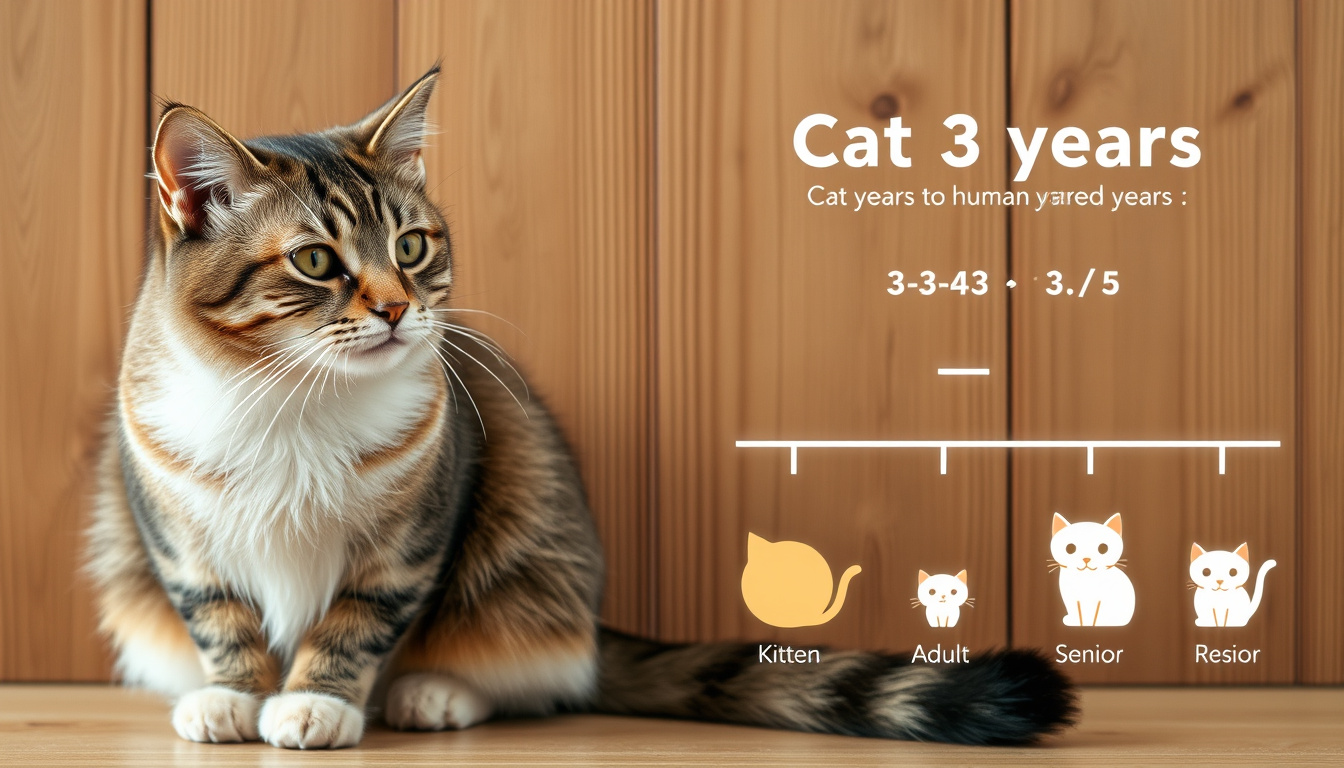
You’ve probably heard the shortcut: one cat year equals seven human years. The conversion veterinarians actually use is more gradual: 15 human years for the first cat year, 9 more for the second, then about 4 per year after.
First year: 15 human years · Second year: adds 9 (24 total) · Each year after: about 4 human years · Indoor cat lifespan: 15–18 years · Oldest verified cat: 38 years (Creme Puff) · 1 cat year = 7 human years: myth
Twelve rows, one pattern: after the first two years, each calendar year adds roughly four human years — the conversion curve that takes a 10-year-old cat to 56 human years.
| Cat years | Human years |
|---|---|
| 0–1 | 15 |
| 2 | 24 |
| 3 | 28 |
| 4 | 32 |
| 5 | 36 |
| 6 | 40 |
| 7 | 44 |
| 8 | 48 |
| 9 | 52 |
| 10 | 56 |
| 15 | 76 |
| 20 | 96 |
Quick snapshot
- The standard model: 15 human years for year one, 24 by year two, then about 4 per year after (Purina (pet nutrition experts))
- A 10-year-old cat lands near 56 human years (PetMD (veterinary health publisher))
- The oldest verified cat, Creme Puff, lived to 38 years (Guinness World Records)
- Whether purebred and mixed-breed cats age at the same rate — the formula is an average, not a per-cat number
- How closely cat emotions map to human emotions — the research is still young
- Whether the 1:7 rule is pure myth or a rough folk average — veterinarians don’t use it either way
- Kittenhood ends at 1 year; young adulthood runs 1–6; mature adulthood 7–10; senior starts after 10 (AAHA/AAFP guidelines (veterinary medical associations))
- Indoor cats commonly reach 15–18 years; outdoor cats far fewer (ASPCA)
- The end-of-life stage can begin at any age, not only at the top of the chart (AAHA/AAFP)
- Switch to six-month checkups once your cat passes 10 (ASPCA senior cat care)
- Watch behavior changes — hiding, litter-box misses, new vocalizing — as possible disease signals (PetMD cat behavior)
- Adjust food, exercise, and home setup to the life stage your cat is in (Purina life-stage nutrition)
How old is a 10 year old cat in human years?
The short answer: about 56 human years. That places a 10-year-old cat in mature adulthood — past the midpoint of the average indoor lifespan, but not nearly as old as the 7-year myth makes it seem.
PetMD (veterinary health publisher) traces this 15/24/+4 model to the American Veterinary Medical Association, which gives it far more authority than a viral chart. The same framework underpins the conversion curve in the table above.
Understanding the Cat-to-Human Age Formula
- First year: 15 human years
- Second year: +9, for a total of 24
- Every year after: +4 — 28, 32, 36, 40, and so on
The arithmetic is simple, but the logic matters: kittens develop fast, then adult cats age slowly and steadily. That’s why a 2-year-old cat can be a calm adult while a 10-year-old cat is only just entering its senior window.
The implication: cat-to-human age is a curve, not a straight line — and the chart above shows exactly where your cat sits on it.
Cat Years to Human Years at a Glance
- 3 cat years = 28 human years
- 5 cat years = 36 human years
- 7 cat years = 44 human years — the start of mature adulthood
- 10 cat years = 56 human years — senior screening territory
- 15 cat years = 76 human years
- 20 cat years = 96 human years
If you want a quick mental shortcut, skip the 7-year rule: subtract 2 from the cat’s age, multiply by 4, and add 24. For a 10-year-old cat: 10 − 2 = 8; 8 × 4 = 32; 32 + 24 = 56.
Why this matters: the formula doubles as a health checklist. A cat at 44 human years (7 cat years) needs dental monitoring, and a cat at 56 (10 cat years) needs senior bloodwork.
How the 7-Year Myth Started
The 7-year shortcut flatters kittens and shortchanges seniors: it would make a 2-year-old cat a 14-year-old human, while the veterinary model says 24 — and it would make a 15-year-old cat 105, while the model says 76.
The 1:7 rule doesn’t appear in any major veterinary life-stage framework. The AAHA/AAFP guidelines instead group cats into kitten, young adult, mature adult, senior, and end-of-life — and they note that age groupings are not absolutes, because individual cats vary.
The pattern: the myth survives because it’s easy, but it misleads in both directions — underestimating how quickly kittens mature and overestimating how frail senior cats are.
The implication: the conversion curve is more accurate than the 7-year rule for assessing health risks at each age.
What is the 3-3-3 rule for cats?
The 3-3-3 rule is the adjustment timeline that rescue and adoption groups commonly use for a cat settling into a new home: 3 days to decompress, 3 weeks to explore, 3 months to build a routine.
It exists because moving home is one of the most stressful events in a cat’s life — and a stressed cat hides, stops eating, and can miss the litter box. The rule gives owners a map for what normal looks like at each stage.
The rule’s failure point isn’t the cat — it’s the owner’s expectations. An 8-week-old kitten may bond in days, while a 14-year-old senior adjusting to a new home may need months; both are normal, and the timeline should flex with life stage.
The First 3 Days: Decompression
- Expect hiding, a quiet appetite, and little social contact
- Put food, water, litter, and a bed in one calm room
- Don’t force handling — let the cat choose when to emerge
Age matters here: a kitten may decompress in hours, while a senior cat that lost a familiar home may need the full 3 days — or longer.
The Next 3 Weeks: Exploration
- Appetite returns and the cat begins exploring wider territory
- Play behavior and grooming signal growing comfort
- Fixed feeding times help build predictability
This is where the rule does its real work: the cat learns the new home is safe, and the owner learns the cat’s personality.
The First 3 Months: Routine
- The cat settles into a sleep/wake rhythm that matches the household
- Trust signals — slow blinks, head bumps, lap time — become consistent
- Problems that persist past 3 months usually need a vet or behaviorist
Are cats happier if they sleep with you?
A cat that chooses your bed is usually a cat that feels safe — and safety is the foundation of feline happiness. Sharing sleep space is one of the strongest trust signals a cat can send.
Behavior experts generally read the choice as comfort-seeking: your warmth, smell, and heartbeat make the bed a secure, predictable place.
Signs Your Cat Trusts You
- Slow blinking — the feline equivalent of a relaxed smile
- Sleeping on or next to you, especially belly-up
- Kneading, head bumps, and grooming you in return
- Following you from room to room without asking for food
These signals grow more meaningful with age: a senior cat that has chosen your bed for years is showing long-term trust, not just warmth-seeking.
The Science of Cat Sleep
- Cats cycle between light dozing and deep sleep
- They’re most active at dawn and dusk, which shapes when they want to cuddle
- Sharing a bed can deepen a cat’s sense of security — or interrupt yours
The trade-off is real: a cat on your chest can be calming, but a cat that stirs at 5 a.m. can erode your sleep — and an exhausted owner is a worse caretaker.
Should You Let Your Cat Sleep in Your Bed?
- Yes for bonding: shared sleep strengthens the human-animal bond
- Yes for older cats: easy warmth and comfort reassure a senior cat
- No if your sleep suffers or allergies flare — a cat bed next to yours is a fair compromise
The trade-off: a cat in your bed is a compliment, but a cat that prefers its own space isn’t rejecting you — it’s showing a different, equally healthy comfort style.
What hurts a cat’s feelings?
Cats don’t hold grudges the way people do, but they track how they’re treated — and they remember. Most of what owners call “hurt feelings” is actually stress, confusion, or a broken expectation.
Signs Your Cat Is Stressed or Upset
- Hiding more than usual, especially in a normally social cat
- Litter-box misses — a classic stress and age-related warning sign
- Overgrooming, fur pulling, or sudden aggression
- Ears pinned flat, tail thrashing, or dilated pupils
A senior cat showing these signs deserves a vet visit first: pain and disease cause many behavior changes that look like moodiness.
Common Mistakes Owners Make
- Yelling or punishing — cats link the punishment to you, not to the behavior
- Sudden routine changes without a gradual transition
- Forced handling or petting in sensitive spots
- Ignoring attention bids, then wondering why the cat acts out
The pattern: nearly every “hurt feeling” traces back to the cat feeling unsafe, unsteady, or unheard — not to a feline grudge.
How to Apologize to a Cat
- Use a soft voice and slow blinks — the feline “I mean no harm” signal
- Offer a favorite treat or a short play session
- Give the cat space and let it reinitiate contact
- Keep the routine stable for the next few days
The implication: apologizing to a cat is really about restoring predictability — and age makes predictability more important, not less.
Can a cat live 30 years?
Yes — but it’s exceptional. The oldest verified cat on record, Creme Puff, lived to 38 years, a Guinness World Records record that still stands. A 30-year-old cat is rare but possible with excellent care and a measure of luck.
How Long Do Indoor vs Outdoor Cats Live?
- Indoor cats commonly live 15 to 18 years, per animal-welfare groups such as the ASPCA
- Outdoor cats average far fewer — estimates often land around 2 to 5 years
- The indoor/outdoor gap is one of the largest single factors in how long a cat lives
That gap is also why age conversion matters: a 10-year-old indoor cat may have many healthy years left, while a 10-year-old outdoor cat has already beaten the odds.
The Oldest Cats in History
- Creme Puff: 38 years, verified by Guinness World Records
- Cats reaching 30 are documented but rare — and most record claims are hard to verify
- Well-cared-for indoor cats most often land between 15 and 18
Note the pattern: the verified record-holders were indoor cats with attentive owners — longevity is managed, not accidental.
Tips for Helping Your Cat Live Longer
- Keep the cat indoors or in a safe outdoor enclosure
- Schedule veterinary visits every 6 months after age 10
- Feed a life-stage-appropriate diet and manage weight
- Watch for early disease signals — kidney, thyroid, and dental issues top the list
The AAHA/AAFP senior care guidance (veterinary medical associations) emphasizes early detection of age-related disease, appropriate nutrition, tailored exercise, and frequent veterinary checks — the care pattern that separates a 15-year-old cat from a 30-year-old outlier.
The biggest senior-cat risk is silent disease: kidney and thyroid problems build for months before symptoms appear, which is why twice-yearly checkups beat waiting for something to look wrong.
The catch: longevity is mostly a management problem, not a genetic lottery — and the management has to start before the cat looks old.
The implication: regular veterinary care and indoor living give the best chance for a long life.
A cat’s life in human years, stage by stage
The timeline below applies the conversion to the full arc of a cat’s life, using the same life-stage signals veterinarians use to plan care.
- Birth – 6 months: human infancy and early childhood (0–10 human years). Rapid growth, weaning, litter-box learning, and socialization. (AVMA kitten care)
- 6 months – 2 years: adolescence through young adulthood (10–24 human years). Social and sexual maturity; hierarchy and routine take shape. (Cornell cat health)
- 3 – 6 years: the prime adult years (28–40 human years). Peak physical condition and a settled personality. (AVMA adult cat care)
- 7 – 10 years: mature adulthood (44–56 human years). The start of age-related risks — kidney, thyroid, and dental. (Cornell senior cat health)
- 11 – 14 years: the senior years (60–72 human years). Slower movement, senior wellness exams, adjusted diet. (AVMA senior cat care)
- 15+ years: geriatric (76+ human years). Comfort care; easy access to food, water, and litter. (PetMD geriatric cat care)
The implication: the transition points matter more than the numbers — the 7-year mark is when screening should start, and the 10-year mark is when senior care becomes the default.
What’s confirmed, what’s not
Separating solid facts from fuzzy ones keeps the conversion honest — and stops owners from overreacting to either extreme.
Confirmed facts
- The 15/24/+4 conversion is the standard veterinary model (Purina (pet nutrition experts))
- Indoor cats average 15–18 years; outdoor cats far fewer (ASPCA)
- Creme Puff lived to 38 — the oldest verified cat on record (Guinness World Records)
- The AAHA/AAFP define senior as older than 10 years (AAHA/AAFP guidelines (veterinary medical associations))
What’s unclear
- Whether the 1:7 rule is pure myth or a rough folk average — no veterinary body uses it
- Whether purebred cats age faster than mixed breeds — the data is thin
- How closely cat emotions map to human emotions — the research is still developing
- What the true lifespan ceiling is for most cats — records exist, but they’re outliers
- Whether senior “grumpiness” is behavior or pain — usually both, and untangling them takes a vet
The distinction matters: the confirmed list tells you when to change care, and the unclear list tells you why the conversion is a guide, not a law.
What the experts say
“The standard conversion assigns approximately 15 human years to a cat’s first year, 24 human years by the second year, and about four human years for every additional cat year.”
Purina Cat Care Team — Purina (pet nutrition and care experts)
“This is the model the American Veterinary Medical Association backs: 15 years at one, 24 at two, then roughly four per year after.”
PetMD — PetMD (veterinary health resource)
“Age groupings are not absolutes; individual cats can vary substantially. The goal of life-stage care is to keep attention on changing physical, behavioral, and medical needs.”
AAHA/AAFP Feline Life Stage Guidelines — AAHA (veterinary association)
Three different voices, one consistent message: the conversion is a planning tool, and the care plan should change with the life stage — not with the meme.
The takeaway
The cat-years-to-human-years conversion was never meant to be a party trick — it’s a reminder that a 10-year-old cat is 56, not 70, and that a 7-year-old cat is 44, not 49. Those numbers change what owners should watch: dental checks at 7, senior bloodwork at 10, comfort care after 15. For anyone with a cat approaching double digits, the decision is clear: stop asking how old your cat is in human years and start asking what that age needs — because a cat living at 56 human years deserves a senior-focused checkup rhythm, not a birthday-party formula.
Frequently asked questions
How do you calculate cat years to human years accurately?
The most widely used veterinary calculation: 15 human years for the first cat year, 9 more for the second (24 total), then about 4 per year after. PetMD attributes the model to the American Veterinary Medical Association.
What is the oldest age a cat has ever reached?
The oldest verified cat on record is Creme Puff, who lived to 38 years — a record recognized by Guinness World Records.
At what age is a cat considered a senior?
The AAHA/AAFP feline life-stage guidelines define senior as older than 10 years, with mature adulthood running from 7 to 10. Age groupings are guides, not absolutes.
Is the 1 cat year to 7 human years rule accurate?
No veterinary body uses it. The standard model starts at 15 human years for year one and reaches 24 by year two — the 7-year rule understates early aging and overstates old age.
Do different cat breeds age differently in human years?
The conversion is a general average. The AAHA/AAFP guidelines note that individual cats vary substantially, and breed-specific aging curves are not precisely mapped.
How can I tell how old my cat is in human years without a chart?
Use the life-stage milestones: kittens are under 1 year, young adults run 1 to 6, mature adults run 7 to 10, and seniors are older than 10. Then apply the conversion: 15 for year one, 24 by year two, then 4 per year after.
What age do most indoor cats live to?
Indoor cats commonly live 15 to 18 years, according to animal-welfare organizations such as the ASPCA — several years longer than outdoor cats on average.
These answers provide a quick reference for the most common questions about cat aging and care.
Related stories





Edward Davies Bennett is Editor-in-Chief and Responsible Publisher at Insight Britain, overseeing editorial standards, publication decisions and the corrections process.