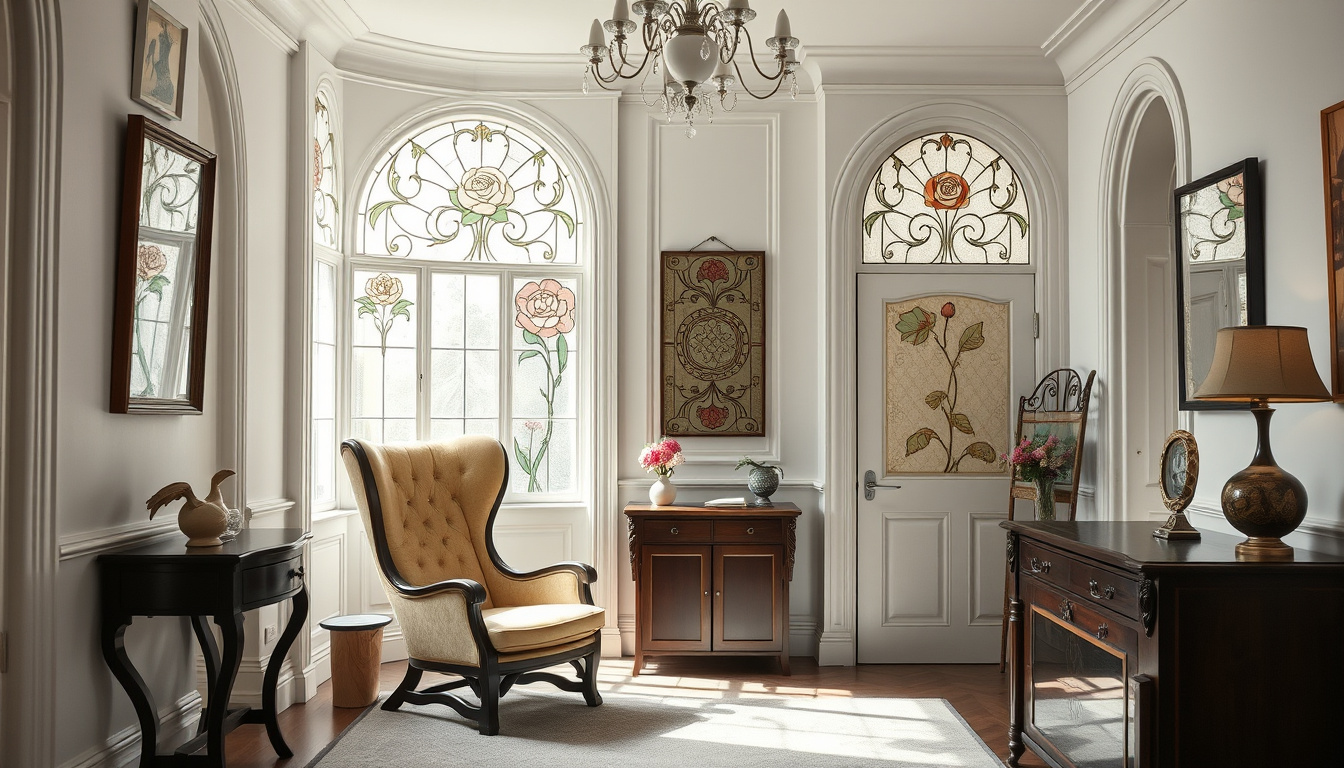
Glasgow keeps its heroes close: nearly a century after his death, Charles Rennie Mackintosh’s chairs, tearooms, and buildings remain part of the city’s everyday life. Few designers have shaped one city’s identity so completely across architecture, interiors, and furniture — and his Glasgow School of Art still sets the benchmark for integrated design.
Born: 7 June 1868 ·
Died: 10 December 1928 ·
Nationality: Scottish ·
Known for: Architecture, Design ·
Key movement: Art Nouveau ·
Major work: Glasgow School of Art
Quick snapshot
- Born in Glasgow on 7 June 1868 (National Galleries of Scotland (national collection))
- Designed the Glasgow School of Art (Glasgow School of Art Archives (institutional archive))
- His rooms, furniture, and ornament form one continuous design system (Design Museum (design museum archive))
- Exact wording of some private letters is disputed by scholars
- Attribution of some lesser-known furniture pieces is contested
- Construction dates of the Glasgow School of Art vary by source
- 1883: enrolled at Glasgow School of Art at age 15 (Glasgow School of Art Archives (institutional archive)) (Encyclopaedia Britannica (reference publisher))
- 1900–1904: married Margaret Macdonald; became partner at Honeyman and Keppie (Encyclopaedia Britannica (reference publisher))
- 1928: died in London on 10 December (National Galleries of Scotland (national collection)) (Encyclopaedia Britannica (reference publisher))
- His integrated interiors anticipate the modern idea of total design
- His Glasgow buildings are the most direct way to experience his design system
The life dates below rest on the artist record kept by the National Galleries of Scotland: a Glasgow-born designer whose working life spanned the rise of Art Nouveau and ended in London in 1928.
| Field | Record |
|---|---|
| Full name | Charles Rennie Mackintosh |
| Born | 7 June 1868, Glasgow, Scotland |
| Died | 10 December 1928, London, England |
| Occupation | Architect, Designer, Watercolourist |
| Spouse | Margaret Macdonald (married 1900) |
| Children | None |
| Movement | Art Nouveau / Glasgow Style |
What is Charles Rennie Mackintosh most famous for?
What is Charles Rennie Mackintosh’s most famous piece?
Mackintosh’s fame narrows to one building — the Glasgow School of Art — but the building’s own history, an assistant’s design submitted under his employer’s name, is the reason attribution still matters today.
The building was designed in two principal phases. Glasgow Architecture broadly dates the work to 1897–1899 and 1907–1909 (Glasgow Architecture (architecture record)); ArchDaily puts the completion points at around 1899 and 1909 (ArchDaily (architecture publication)). The project grew out of a competition in 1896 among twelve local architects — the winning entry came from the office where Mackintosh was still an assistant, so his authorship was not publicly acknowledged at first — and it has since become widely regarded as his most celebrated architectural work, according to the Design Museum (design museum archive).
Charles Rennie Mackintosh famous designs
- Glasgow School of Art — his most celebrated commission
- Willow Tea Rooms, Glasgow — interiors designed as one composition
- Hill House, Helensburgh — designed around 1902–1904 (Glasgow Architecture (architecture record))
The Glasgow School of Art matters because it survives as a complete argument. From the library’s pierced timber gallery to the ironwork and light fittings, every surface was resolved by the same hand or the same studio. That completeness is rare: most architects hand the interior over; Mackintosh treated it as one design problem.
The pattern: one building made his name, but the reason it made his name is that he treated the whole building — structure, furniture, fittings — as a single design problem. That is the Mackintosh move.
Is Charles Rennie Mackintosh art deco or Art Nouveau?
What is the difference between Art Nouveau and Art Deco?
Three movements, one shared confusion: Art Nouveau arrived first, Art Deco answered it later, and Mackintosh’s Glasgow Style grew up inside the earlier wave while looking unlike anything else in it.
| Dimension | Art Nouveau | Art Deco | Mackintosh’s Glasgow Style |
|---|---|---|---|
| Peak period | 1890s–1910s | 1920s–1930s | 1890s–1910s |
| Signature look | Whiplash curves, organic flow | Geometric symmetry, bold contrast | Tall vertical lines, restrained ornament |
| Favourite motifs | Vines, flowers, insect forms | Sunbursts, chevrons, fans | Stylised roses, plant forms |
| Key figures | Horta, Guimard, Mucha | Ruhlmann, Lalique | Mackintosh and Margaret Macdonald |
| Mackintosh’s link | Inside Art Nouveau, but with a distinct British variant: the Glasgow Style | ||
Mackintosh’s own place is well documented. He became a leading figure of the Glasgow Style in Britain — the country’s local expression of Art Nouveau, according to Encyclopaedia Britannica (reference publisher). His work was also shaped by European Symbolism and fed directly into Art Nouveau and Secessionist design (National Galleries of Scotland, national collection).
How does Mackintosh’s work relate to Art Nouveau?
- Vertical, elongated forms instead of whiplash curves
- Restrained ornament rather than dense surface pattern
- Architecture and interiors designed as one continuous system
In short, Mackintosh belonged to Art Nouveau’s generation but not to its decorative excess. The Design Museum summarises the approach as a combination of geometric structure, elongated vertical forms, restrained ornament, and carefully integrated interiors and furniture (Design Museum, design museum archive). That description separates him cleanly from Art Deco, which came later and leaned on machine-age geometry rather than organic design language.
The label that fits: Mackintosh is Art Nouveau, but the useful word is the one Britannica uses — Glasgow Style. It keeps the movement, adds the geography, and stops people from flattening him into a generic “Art Nouveau designer.”
What was Charles Rennie Mackintosh inspired by?
Japanese art influence on Mackintosh
Japanese print composition shows up in Mackintosh’s buildings as structure, not decoration — tall proportions, flat planes, and negative space doing the heavy lifting.
Japanese design principles run through his work: vertical emphasis, plain surfaces, and quiet intervals between objects. He did not reproduce Japanese forms so much as absorb their compositional logic into Scottish architecture.
The result reads as “Japanese” without being Japanese — a point that matters when people try to file him as an imitator. He took principles, not patterns.
Celtic revival and nature in Mackintosh’s work
- Arts and Crafts honesty of materials and unity of design
- Celtic revival interest in stylised, interlaced ornament
- Natural forms — above all the rose — as recurring motifs
The Arts and Crafts movement gave Mackintosh his working ethic: materials should be honest, and the designer should control the whole environment. Nature gave him the vocabulary. The Design Museum specifically notes the organic motifs in his work; the best known is the stylised rose, the recurring emblem that became shorthand for the Glasgow Style. The rose appears across the studio’s decorative panels, many of them made with Margaret Macdonald.
The trade-off: Mackintosh’s influences were so thoroughly blended that they became a private language. That is why “Glasgow Style” stuck — it was easier to name the place than the ingredients.
What did Charles Rennie Mackintosh say about his wife?
Who was Margaret Macdonald?
- Artist trained at the Glasgow School of Art
- Member of The Four, with Mackintosh, her sister Frances, and Herbert MacNair
- Co-designer of decorative panels and interior schemes credited to the Mackintosh studio
Margaret Macdonald was not Mackintosh’s muse in the passive sense. She was an exhibiting artist, a collaborative designer, and the person he credited in his letters as “the other half of the apple” — a phrase preserved in the Glasgow School of Art Archives (institutional archive).
Did Charles Rennie Mackintosh have any children?
- Married in 1900 (Encyclopaedia Britannica (reference publisher))
- No children recorded
- Professional collaboration continued through their decades in Glasgow, France, and London
The couple had no children, and their studio output was genuinely joint: decorative panels, gesso work, and interior schemes were made together. That is why attribution debates surface — when a piece is marked “Mackintosh,” the hand is not always his alone.
The implication: “the other half of the apple” was not just affection. It was an accurate description of a working partnership that no single-attribution catalogue can easily undo.
What is a famous quote by Charles Rennie Mackintosh?
What did Mackintosh say about art?
Mackintosh’s best-known statement is not about architecture at all — it is a warning against stylish pretending.
The quote that follows him everywhere comes from his writing on art and design:
“There is hope in honest error; none in the icy perfections of the mere stylist.”
Charles Rennie Mackintosh, on art
Other notable quotes from Mackintosh
- “The architect must be a prophet… a prophet in the true sense of the term.”
- His private letters contain the most candid lines — especially the letters to Margaret
- His public lectures stress foresight and integrity over fashion
On architecture, Mackintosh set the bar high, and the fragment most often quoted runs:
“The architect must be a prophet… a prophet in the true sense of the term.”
Charles Rennie Mackintosh, on architecture
Assessment from outside the studio carries the same conviction. Britannica’s verdict on the Glasgow School of Art is the line most often cited when the building comes up:
“The first original example of Art Nouveau architecture in Great Britain.”
Encyclopaedia Britannica, on the Glasgow School of Art
Why it matters: Mackintosh’s quotes are not museum pieces. The line about honest error is exactly the argument working designers make against derivative style — and it explains why his reputation keeps growing while many of his contemporaries stay filed under “period.”
Art Nouveau vs Art Deco vs the Glasgow Style
Three design languages, one useful boundary. Art Nouveau, Art Deco, and the Glasgow Style each have a different centre of gravity — and Mackintosh only ever occupied one of them.
| Dimension | Art Nouveau | Art Deco | Mackintosh’s Glasgow Style |
|---|---|---|---|
| Peak period | 1890s–1910s | 1920s–1930s | 1890s–1910s |
| Signature look | Whiplash curves, organic flow | Geometric symmetry, bold contrast | Tall vertical lines, restrained ornament |
| Favourite motifs | Vines, flowers, insect forms | Sunbursts, chevrons, fans | Stylised roses, plant forms |
| Key figures | Horta, Guimard, Mucha | Ruhlmann, Lalique | Mackintosh and Margaret Macdonald |
| Mackintosh’s link | Inside Art Nouveau, but with a distinct British variant: the Glasgow Style | ||
What the table does not show is the attitude difference. Art Nouveau wanted to be lavish; Art Deco wanted to be modern; Mackintosh wanted to be honest — which is why his rooms look spare a century later while many of his contemporaries look dated.
The composition-first logic carries directly into modern kitchen and interior work: decide the room as a system before choosing parts. The UK-specific sequence — cabinet style, fit order, lighting, final detailing — is laid out in the kitchen cabinet styles guide.
The pattern: Mackintosh’s designs sit inside Art Nouveau’s dates but use none of its excess. The Glasgow Style is best read as a third column — a local synthesis that outlived the movement it came from.
What’s confirmed — and what’s still unclear
The solid record and the soft spots matter equally here.
Confirmed facts
- Born in Glasgow on 7 June 1868 — artist record, National Galleries of Scotland
- Married Margaret Macdonald in 1900 — Encyclopaedia Britannica
- No children — biographical record (Encyclopaedia Britannica)
- Designed the Glasgow School of Art — institutional archive, Glasgow School of Art
- Died in London on 10 December 1928 — National Galleries of Scotland
What’s unclear
- Exact wording of some private letters is debated by scholars
- Attribution of some lesser-known furniture pieces is contested
- Construction dates on the Glasgow School of Art vary by source
- The “first Art Nouveau building in Britain” label is Britannica’s description, not a universal consensus
- Credit for some collaborative decorative panels is hard to assign to one hand
Any “Mackintosh” piece offered without provenance is a risk. Attribution debates are concentrated exactly where the money is — chairs, decorative panels, and unsigned studio work.
The takeaway: use the confirmed list for decisions and the unclear list for caution. When a fact wobbles between sources — the dates, the attributions, the labels — the wobble is part of the historical record.
Why Mackintosh still matters
Mackintosh’s interiors are not relics; they are working arguments — walls, chairs, and light fittings all saying the same thing: design the whole, not the parts. For anyone planning a renovation, that is a direct instruction: settle the room’s full composition before choosing a single cabinet, or you will assemble a space that fights itself. Mackintosh’s reputation took decades to catch up with the work — a familiar shape to anyone who has read the legacy of Lord Byron. For Glasgow, the choice is concrete: keep funding the conservation of Mackintosh’s surviving buildings, or let the city’s most original designer live on mainly as reproductions and souvenir patterns.
Frequently asked questions
Quick, source-aware answers to the questions readers ask most about the architect.
What is the difference between Charles Rennie Mackintosh and Charles Macintosh?
Charles Rennie Mackintosh (1868–1928) was the Glasgow architect and designer. Charles Macintosh was a different figure — a Scottish chemist associated with waterproof fabric, which is why the raincoat is nicknamed a “mac.” The names sit one letter apart, so the mix-up is common.
What materials did Charles Rennie Mackintosh use in his furniture?
The historical record emphasises design integration over a single material: Mackintosh designed furniture for specific rooms, alongside the building itself. The signature look is tall, vertical, and restrained, with the same organic motifs used across the interior.
Where can I see Charles Rennie Mackintosh’s work in Glasgow?
Start with the Glasgow School of Art and the Willow Tea Rooms — his two most famous Glasgow commissions. Hill House sits in Helensburgh, a short journey from Glasgow. Check current access arrangements before visiting, because several sites manage entry carefully.
Is the Glasgow School of Art still standing?
Yes — the building Mackintosh designed in two phases, completed around 1899 and 1909, still stands (ArchDaily, architecture publication). Its long-term condition remains a live conservation story, so check the Glasgow School of Art’s own updates for the current restoration status.
How did Charles Rennie Mackintosh’s style influence modern design?
The biggest influence is his integrated approach: interiors, furniture, and architecture designed as one system. That idea flows directly into contemporary “total design” practice, and his visual language — tall, simple, ornament used sparingly — still shows up in modern furniture and fit-out design.
What is the ‘Mackintosh Rose’?
The Mackintosh Rose is the stylised rose motif that recurs across his work — in panels, textiles, and interior details. It is the most recognisable element of the Glasgow Style’s organic vocabulary, often produced with Margaret Macdonald.
Are there any reproductions of Mackintosh furniture available?
Yes — reproductions range from simple chair silhouettes to full room interiors. Because Mackintosh designed furniture for specific rooms, the most convincing reproductions treat the piece as part of a larger composition. For a claimed antique, provenance is everything: documented early pieces sit mainly in institutions, while lesser-known attributions remain debated.
The thread through all of these answers: verify the label, then the date, then the hand. Mackintosh’s name carries weight — exactly why it attracts loose attributions.
Related stories




Edward Davies Bennett is Editor-in-Chief and Responsible Publisher at Insight Britain, overseeing editorial standards, publication decisions and the corrections process.