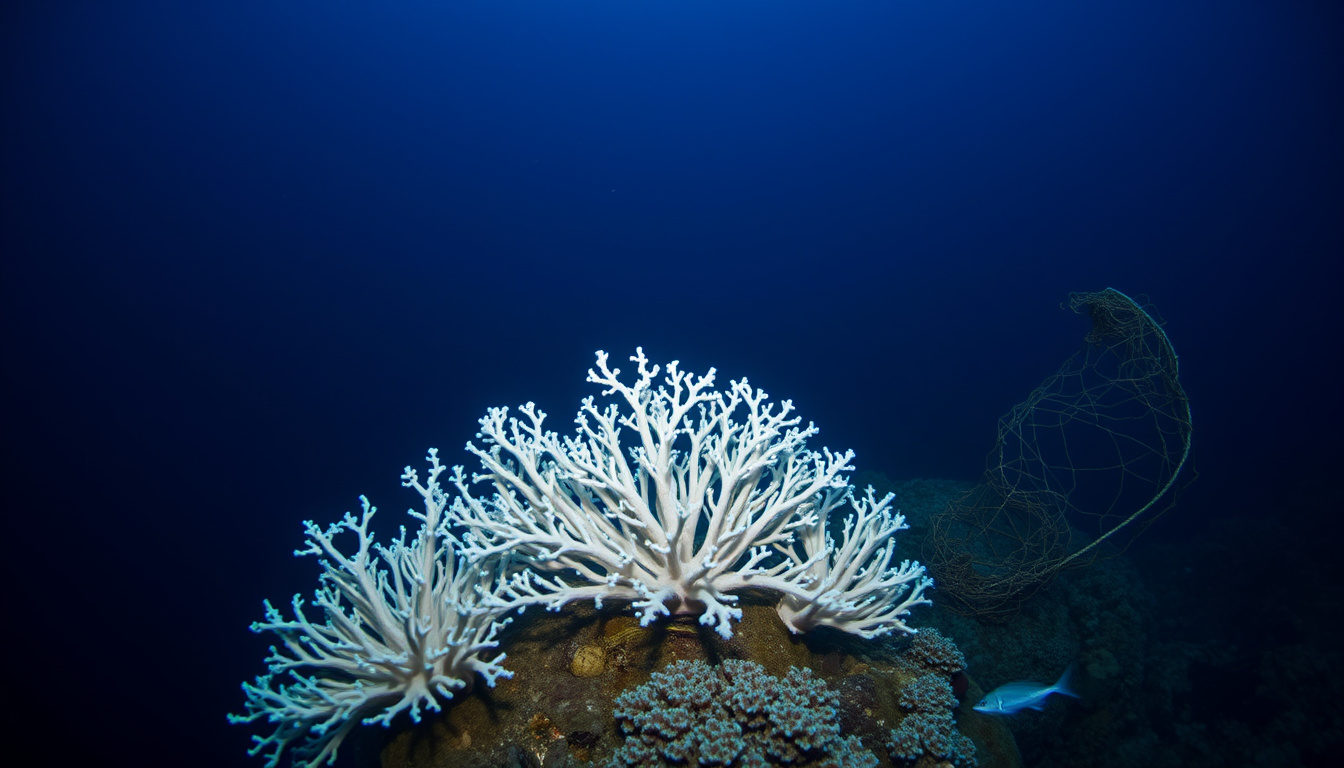
When you picture a coral reef, you’re probably imagining warm, sunlit waters off the coast of Australia or the Caribbean. But not all reefs are tropical — some thrive in the cold, dark depths of the Atlantic, right off the coast of Ireland.
Coral reefs cover: less than 1% of the ocean floor ·
Support at least: 25% of all marine species ·
Annual economic value estimated at: $375 billion ·
One Irish deep-water reef changing at: approximately 20% over four years
Quick snapshot
- Underwater ecosystem built by coral polyps
- Two main types: warm-water and cold-water
- Cold-water reefs on carbonate mounds (National Parks & Wildlife Service Ireland)
- Changing at approximately 20% over four years (National Parks & Wildlife Service Ireland)
- Climate change is the biggest killer
- Also: pollution, overfishing, ocean acidification
- Do not touch coral
- Swim with caution to avoid damage
A few key numbers that paint the picture of what coral reefs are and why they matter:
| Attribute | Value |
|---|---|
| Global coverage | Less than 1% of ocean floor |
| Marine species supported | 25% of all marine species |
| Economic value | Approximately $375 billion per year |
| Irish reef depth | 300–500 meters |
| Rate of change (Irish reef) | About 20% over four years |
What exactly is a coral reef?
A coral reef is an underwater ecosystem built by colonies of coral polyps that secrete calcium carbonate skeletons, creating the hard, rocky structures we call reefs (Coast Pulse, marine education resource). These polyps are tiny animals related to sea anemones and jellyfish, and each one lives inside a cup-shaped skeleton it builds around itself. Over generations, millions of these skeletons accumulate into massive structures.
A coral reef is not a single organism — it’s a city of tiny animals building a shared calcium-carbonate foundation that supports entire marine ecosystems. — Coast Pulse
Definition and structure
- Reefs form when coral polyps extract calcium carbonate from seawater and deposit it as a hard skeleton beneath their bodies.
- The structure is defined in European habitat guidance as “hard compact substrates on solid and soft bottoms that rise from the seabed in the littoral and sublittoral zones” (NPWS Reef Habitat in Irish Offshore Waters, government habitat report).
- Warm-water reefs thrive in sunlit, shallow tropical waters where symbiotic algae (zooxanthellae) provide the coral with energy through photosynthesis.
- Cold-water corals do not need sunlight and instead feed by trapping plankton and organic particles in passing currents (Raghunathpur College, coral reef classification paper).
Difference between warm-water and cold-water reefs
A deep difference separates these two worlds — it goes far beyond water temperature.
- Warm-water reefs grow in shallow, sunlit zones (typically 0–100 meters) at temperatures of 20–30°C.
- Cold-water reefs exist in dark, deep waters from 200–2000 meters at temperatures between 4–8°C (National Parks & Wildlife Service, Irish reef habitats).
- Cold-water corals grow much slower — often only a few millimeters per year — making them particularly vulnerable to disturbance (Ask About Ireland, educational resource).
- In the northeast Atlantic, the dominant cold-water coral species is Lophelia pertusa, a stony coral that builds complex reef structures (European Environment Agency EUNIS, habitat classification system).
The implication: these two reef types share the name “coral,” but they operate on radically different timescales, depth ranges, and ecological rules. What threatens one may not threaten the other the same way.
Are there any coral reefs in Ireland?
Yes — and they’re nothing like the postcards. Ireland hosts significant cold-water coral reefs, some of which sit on massive carbonate mounds rising hundreds of meters above the seafloor. These deep-water reefs are some of the least understood, yet most ecologically important habitats in European waters.
Ireland’s coral reefs are invisible to the naked eye — hidden 300 meters deep in cold, dark water — yet they are changing at a measurable rate that scientists are only now beginning to track. — NPWS
Cold-water coral reefs off the Irish coast
- Ireland’s cold-water coral reefs are generally found at depths of 200–1600 meters in water temperatures of about 4–8°C (National Parks & Wildlife Service, Irish reef habitat description).
- These reefs are associated with carbonate mounds that can rise 300–500 meters above the sea floor, providing hard substrate for coral settlement.
- The dominant habitat-forming coral is Lophelia pertusa, which creates a three-dimensional structure that offers shelter for fish, crustaceans, and other marine life.
- Biogenic cold-water coral reefs are defined as “three-dimensional structures that create microhabitats and shelter for other species” (Scottish Government, Priority Marine Features review).
Deep-water coral mounds and carbonate mounds
- Carbonate mounds are large geological features formed by the accumulation of carbonate sediment, dead coral skeletons, and other biological material over thousands of years.
- In Irish waters, these mounds provide the foundation for cold-water coral growth, creating “reefs” in a habitat sense rather than the continuous fringing reefs seen in the tropics.
- Research in 2020 revealed that one Irish deep-water reef changed at approximately 20% over four years — a rate much faster than previously assumed for slow-growing cold-water systems.
- Cold-water coral reef structures in UK and Irish waters are found in “cold, largely aphotic waters, generally along the shelf edge and in offshore waters down to 2000 m” (European Environment Agency EUNIS, habitat classification).
What is the biggest killer of coral reefs?
Climate change, specifically rising sea temperatures that cause coral bleaching, is the leading cause of coral reef degradation worldwide. But the threat profile differs substantially between warm-water and cold-water systems.
For warm-water reefs, bleaching is the acute threat. For cold-water reefs off Ireland, the main immediate threat is physical destruction from bottom-trawling fishing gear (Academia.edu, Irish Coral Task Force research paper) — a very different kind of killer. — Irish Coral Task Force
Climate change and ocean warming
- When water temperatures rise just 1–2°C above normal, coral polyps expel the symbiotic algae living in their tissues — a process called coral bleaching. Without these algae, the coral starves and often dies.
- Mass bleaching events have become more frequent since the late 20th century, with some of the most severe events occurring on Australia’s Great Barrier Reef and throughout the Caribbean.
- Cold-water corals do not host symbiotic algae, so they are not directly threatened by bleaching — but they are affected by ocean acidification and changes in water chemistry.
- Ocean acidification, caused by increased CO₂ absorption, reduces the availability of carbonate ions that corals need to build their skeletons.
Other major threats: pollution, overfishing, ocean acidification
- The main immediate threat identified for deep-water coral habitats in Europe is demersal trawling — dragging heavy fishing nets across the seafloor (Academia.edu, Irish Coral Task Force research).
- These nets can crush centuries-old coral structures in a single pass, and cold-water coral reefs are “slower growing than shallow tropical reefs, which makes them vulnerable to disturbance” (Ask About Ireland, educational comparison).
- Nutrient runoff from agriculture and coastal development causes algal blooms that smother warm-water reefs by blocking sunlight.
- Plastic pollution and microplastics are an emerging area of research — their full impact on cold-water coral health is still being studied.
Can you touch or swim in a coral reef?
If you’re snorkeling in warm tropical waters, it’s tempting to reach out and touch the colorful coral. But touching, kicking, or standing on coral can cause serious damage — and the same caution applies to any reef ecosystem, shallow or deep.
Why touching coral is harmful
- Corals are living animals with fragile polyps. Even a light touch can damage their protective mucus layer, leaving them vulnerable to infection and disease.
- Oils and chemicals from human skin can harm coral tissues, and physical contact can break coral skeletons that took years to grow.
- For cold-water corals, the damage risk is even higher because of their extremely slow growth rates — a single broken branch may take decades or centuries to regrow.
Swimming and diving guidelines
- When swimming near a coral reef, maintain a safe distance and avoid fin kicks that stir up sediment, which can smother corals.
- Use reef-safe sunscreen, as common chemical sunscreens (oxybenzone, octinoxate) are toxic to coral larvae and can contribute to bleaching.
- In Irish waters and other cold-water reef sites, SCUBA diving near deep coral habitats requires special training and permits — these are not casual swim stops.
- Best practice: look without touching, keep your fins away from the reef, and never anchor boats directly on coral structures.
The implication: every human-coral interaction — whether in tropical shallows or deep Irish waters — carries a consequence. Responsible visitation isn’t just polite; it’s essential for reef survival.
How clean is the Irish Sea?
The Irish Sea, where many of Ireland’s deep-water coral ecosystems sit, faces a complex set of water quality challenges. Clean water is not optional for these reefs — it’s a baseline requirement for their continued existence.
For cold-water corals that spend their entire lives filtering organic particles from passing currents, water quality directly determines whether they thrive or starve. — Marine Institute
Water quality around Irish coral reefs
- The Irish Sea experiences nutrient runoff from agricultural land, which can lead to eutrophication — excessive algal growth that depletes oxygen from the water column.
- Plastic debris and microplastics are present in Irish Sea waters, though research into their impact on deep-water coral health is still in early stages.
- Sediment from bottom-trawling and coastal development can smother coral polyps and reduce water clarity, affecting food availability for filter-feeding cold-water corals.
Human impacts on the Irish Sea
- Shipping traffic, fishing activity, and offshore energy infrastructure all contribute to pollution and physical disturbance in areas where cold-water corals grow.
- Efforts to monitor and improve water quality in Irish waters are coordinated through agencies like the National Parks & Wildlife Service (Irish government body for habitat protection) and the Marine Institute.
- Marine protected areas (MPAs) have been designated in some Irish reef sites, but enforcement and monitoring remain ongoing challenges.
The catch: clean water is a prerequisite for coral health, but in a shared sea with shipping lanes and fisheries, maintaining that quality requires active trade-offs between economic activity and ecosystem protection.
Related reading: Ireland’s cold-water coral reefs · coral reef definition, types, and threats
torontoedition.com, southernpulse.org, assets.wwf.org.uk, universitytimes.ie, facebook.com
Frequently asked questions
What is the difference between warm-water and cold-water coral reefs?
Warm-water reefs thrive in shallow, sunlit tropical waters (typically 0–100 meters, 20–30°C) and depend on symbiotic algae for energy. Cold-water reefs exist in dark, deep waters (200–2000 meters, 4–8°C) and feed by trapping plankton and organic particles. Cold-water corals grow much slower and do not host symbiotic algae (National Parks & Wildlife Service Ireland).
How are coral reefs formed?
Coral reefs form over thousands of years as coral polyps secrete calcium carbonate skeletons. Generations of polyps build on top of previous skeletons, creating the hard, rocky structures that define reefs. The process requires clean, clear water and a hard substrate for initial settlement (Coast Pulse, marine education resource).
Why are coral reefs important?
Despite covering less than 1% of the ocean floor, coral reefs support at least 25% of all marine species. They provide coastal protection from storms, generate approximately $375 billion annually in economic value through tourism and fisheries, and are a source of potentially valuable biochemical compounds.
Can coral reefs recover from damage?
Some warm-water reefs can recover from bleaching events if water temperatures return to normal quickly and stress is not prolonged. However, cold-water reefs grow extremely slowly, making recovery from physical damage (like trawling) a process that can take centuries or may be impossible within human timescales (Ask About Ireland).
How can I help protect coral reefs?
Use reef-safe sunscreen, avoid touching coral when swimming or diving, reduce your carbon footprint to help limit ocean warming, and choose sustainably caught seafood to reduce demand for destructive fishing practices. Support marine protected areas and follow local guidelines when visiting reef ecosystems.
For Ireland’s deep-water coral reefs, the choice is becoming more visible with each passing year. These slow-growing, centuries-old ecosystems are measurable signals of how human activity — from fishing to carbon emissions — reaches even the deepest, darkest parts of our ocean. The rate of change on one Irish reef, approximately 20% over four years, is not an abstract number: it’s a baseline for what we might lose, and a timeline for what can still be protected.
Related stories





Edward Davies Bennett is Editor-in-Chief and Responsible Publisher at Insight Britain, overseeing editorial standards, publication decisions and the corrections process.