
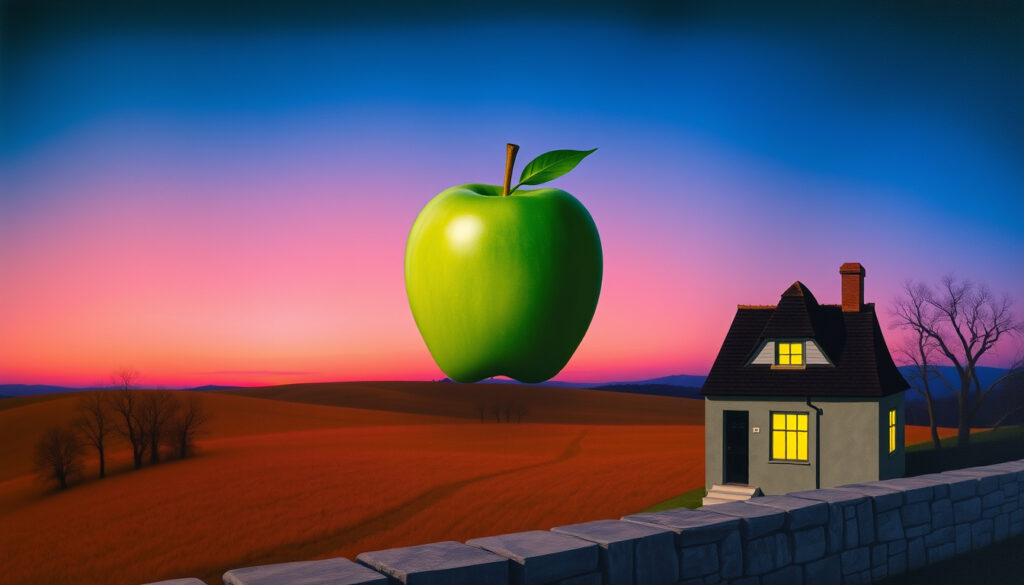
Few paintings spark the same quiet puzzlement as a Magritte. A bowler-hatted man with an apple hiding his face, a pipe labeled “Ceci n’est pas une pipe” — these images have become cultural shortcuts for the surreal.
Born: November 21, 1898, Lessines, Belgium · Died: August 15, 1967, Brussels, Belgium · Known for: Surrealist paintings of ordinary objects in unexpected contexts · Most expensive work: L’empire des lumières (1954) — $79.4 million (Christie’s, 2022) · Style period: 1920s–1960s, Surrealism
Quick snapshot
- Objects in odd contexts (Encyclopaedia Britannica)
- Bowler hats, apples, pipes (Encyclopaedia Britannica)
- Blurred reality and representation (Guggenheim Museum)
- The Treachery of Images (1929) (MoMA)
- The Son of Man (1964) (René Magritte.org)
- The Empire of Lights (1954) (René Magritte.org)
- Record: $79.4 million (René Magritte.org)
- Primary: Christie’s, Sotheby’s (René Magritte.org)
- Prices rose 300% in 2010s (René Magritte.org)
- Married to Georgette Berger (Masterworks Fine Art)
- Worked as a wallpaper designer (Magritte Museum)
- Died in 1967, buried in Brussels (Encyclopaedia Britannica)
Six facts about the man, one pattern: Magritte built a career on turning the familiar into the unsettling.
| Attribute | Value |
|---|---|
| Full name | René François Ghislain Magritte |
| Nationality | Belgian |
| Born | 21 November 1898, Lessines, Belgium (Encyclopaedia Britannica) |
| Died | 15 August 1967, Brussels, Belgium (Encyclopaedia Britannica) |
| Art movement | Surrealism (Guggenheim Museum) |
| Famous quote | This is not a pipe (Ceci n’est pas une pipe) (MoMA) |
What was René Magritte best known for?
His signature motifs and style
- Magritte is best known for his surrealist paintings that place familiar objects in strange, illogical contexts (Encyclopaedia Britannica).
- He sought to make viewers question their assumptions about reality (Guggenheim Museum).
- A recurring feature is the use of ordinary objects in unusual or unsettling situations (Encyclopaedia Britannica).
Magritte turned everyday items—bowler hats, apples, windows—into psychological triggers. His work forces the viewer to ask: what is real, and what is representation? That tension is his true signature.
Key works that define his reputation
- Iconic works include The Treachery of Images (1929), The Son of Man (1964), and The Empire of Lights (1954) (MoMA; René Magritte.org).
- The Treachery of Images famously combines a painted pipe with the text “Ceci n’est pas une pipe” (MoMA).
- The Son of Man shows a man in a bowler hat with an apple floating in front of his face (René Magritte.org).
The pattern: each painting dismantles a mental category. A pipe that isn’t a pipe. A face that can’t be seen. An ordinary street bathed in impossible light. For Magritte, painting was a philosophical tool, not a mirror.
Why did Magritte hide faces?
The meaning of obscured faces
- Magritte often obscured faces with objects like apples, doves, or cloth to challenge identity and perception (Encyclopaedia Britannica).
- He said the hidden face represents the mystery of the unseen and the limits of human knowledge (Magritte Museum).
- Whether his mother’s suicide by drowning in 1912 directly inspired this motif is debated among art historians (EBSCO Research Starters).
By hiding faces, Magritte made us more aware of the person behind the concealment. The apple doesn’t erase the man—it forces us to imagine what we can’t see.
Examples of concealed faces in his work
- Paintings like The Son of Man and The Lovers use concealment to create psychological tension (Encyclopaedia Britannica).
- In The Lovers, two figures kiss through cloth, their features muffled, creating a sense of isolation even in intimacy (René Magritte.org).
- Magritte also used a floating apple to block the face of a bowler-hatted man in The Son of Man (René Magritte.org).
The implication: concealment is not evasion. It’s an invitation. Magritte once wrote, “Everything we see hides another thing, we always want to see what is hidden by what we see.” That line could serve as his artistic manifesto (Magritte Museum).
This fascination with hidden identity resonates beyond art. Musicians and writers have borrowed the motif—for example, the anonymous band covered in the Sleep Token Controversy uses obscured identity to shift focus from person to music. Magritte’s apple and Sleep Token’s masks serve the same purpose: make the audience fill in the blanks.
What was René Magritte’s famous quote?
His most cited statements on art and reality
- His most famous quote is: “Ceci n’est pas une pipe” (This is not a pipe), written on The Treachery of Images (MoMA).
- He also said: “Everything we see hides another thing, we always want to see what is hidden by what we see” (Magritte Museum).
- Another often-quoted line: “I love subversive humour, freckles, knees, the long hair of women, the dreams of young children at liberty, a young girl running in the street” (Magritte Museum).
Context of the quotes
- “Ceci n’est pas une pipe” appears directly on the canvas of The Treachery of Images (1929) (MoMA).
- Magritte used words and images to question representation itself (Guggenheim Museum).
- The quote about hidden things comes from an interview later in his life, reflecting his consistent philosophy (Magritte Museum).
What this means: Magritte’s words are not captions—they are part of the painting’s argument. The contradiction between language and image forces the viewer to decide which reality to trust. That tension is the essence of his art.
What is René Magritte’s most expensive painting?
Record auction prices
- The most expensive Magritte sold at auction is L’empire des lumières (1954) for $79.4 million in 2022 at Christie’s (René Magritte.org).
- Other top sales include Le principe du plaisir at $31.8 million and La cour d’amour at $30.9 million (René Magritte.org).
- His market has grown significantly since the 2010s, with auction totals rising sharply (Masterworks Fine Art).
The $79.4 million record is tied to a single version of L’empire des lumières. Other versions exist and sell for less. The market treats Magritte’s scarcity and signature motif as premium drivers, but the price gap between his top and mid-tier works is wide.
Why his works are valued so highly
- Surrealist masterpieces by Magritte are rare on the market; many key works are held by museums (MoMA).
- His iconic imagery has global recognition, which attracts ultra-high-net-worth collectors (EBSCO Research Starters).
- The growing prestige of surrealism in the art market since 2010 has lifted all major names (Artsper Magazine).
The pattern: Magritte’s market is driven by the same tension that defines his art—familiar yet elusive. Collectors pay for the puzzle as much as the paint.
Was René Magritte a good person?
His personal character and behavior
- Biographies depict Magritte as reserved, disciplined, and devoted to his wife Georgette (Masterworks Fine Art).
- He avoided the bohemian lifestyle of many artists and lived a middle-class life (Magritte Museum).
- He was known for his wit and intellectual rigor (Encyclopaedia Britannica).
Reputation among contemporaries
- He maintained long friendships with other surrealists like André Breton, though they occasionally clashed (Artsper Magazine).
- Unlike many artists, he worked steadily as a commercial wallpaper designer to support himself (Magritte Museum).
- No major scandals or unethical behavior are recorded in his biography (EBSCO Research Starters).
Magritte’s personal stability is a contrast to the turmoil in his paintings. The man who made the world look strange lived a remarkably conventional life. That gap between creator and creation is part of his mystique.
Which painter had schizophrenia?
Artists with mental illness
- Notable painters with schizophrenia include Vincent van Gogh (possibly), Edvard Munch, and Yayoi Kusama (who voluntarily hospitalized herself) (EBSCO Research Starters).
- Magritte himself did not have schizophrenia; he was considered mentally stable (Encyclopaedia Britannica).
- The myth may confuse Magritte with the subject of obscured faces or with other artists who used similar motifs (René Magritte.org).
Magritte’s mental health
- The only documented trauma in his life was his mother’s suicide in 1912, which he witnessed as a teenager (EBSCO Research Starters).
- He did not suffer from diagnosed mental illness and lived a stable, disciplined life (Masterworks Fine Art).
- His art’s unsettling quality came from deliberate intellectual choice, not psychological disturbance (Guggenheim Museum).
Timeline signal
- 1898: Born in Lessines, Belgium (Encyclopaedia Britannica)
- 1912: Mother died by suicide; Magritte was present when her body was recovered (EBSCO Research Starters)
- 1916: Enrolled at Académie Royale des Beaux-Arts in Brussels (Guggenheim Museum)
- 1926: Created his first surrealist painting, The Lost Jockey (MoMA)
- 1927: Moved to Paris and joined surrealist circle with André Breton (Artsper Magazine)
- 1929: Painted The Treachery of Images (MoMA)
- 1930s–1940s: Returned to Brussels; produced most of his famous works (Magritte Museum)
- 1954: Painted The Empire of Lights series; later sold for record $79.4 million (René Magritte.org)
- 1964: Painted The Son of Man (René Magritte.org)
- 1967: Died of pancreatic cancer in Brussels (Encyclopaedia Britannica)
What this timeline shows: Magritte’s most influential works came in bursts—1926-1929 and the 1950s-1960s—always after periods of commercial work. The pattern suggests a man who needed financial stability to produce his most radical ideas.
Confirmed facts
- Magritte was a Belgian surrealist painter born in 1898 (Encyclopaedia Britannica).
- He hid faces to evoke mystery and challenge viewer perception (Encyclopaedia Britannica).
- His most expensive painting sold for $79.4 million (René Magritte.org).
- He famously wrote “This is not a pipe” on The Treachery of Images (MoMA).
- He married Georgette Berger in 1922 (Masterworks Fine Art).
- He died of pancreatic cancer in 1967 (Magritte Museum).
What’s unclear
- Exact cause of his wife Georgette’s death is not widely documented beyond natural causes (Masterworks Fine Art).
- Whether Magritte’s mother’s suicide directly inspired his obscured-face motif is debated among art historians (EBSCO Research Starters).
Quotes that capture Magritte’s mind
“Everything we see hides another thing, we always want to see what is hidden by what we see.”
— René Magritte, quoted by the Magritte Museum (official biography)
“Magritte is a Belgian Surrealist painter known for images that destabilize ordinary reality.”
— Guggenheim Museum (curatorial statement)
“Ceci n’est pas une pipe.”
— René Magritte, The Treachery of Images (1929), as documented by MoMA (collection record)
These three quotes together encapsulate Magritte’s method: make the familiar strange, state the contradiction plainly, and leave the viewer to resolve the tension.
Magritte spent a career making the ordinary mysterious. He didn’t invent surrealism, but he gave it some of its most enduring images. For anyone trying to understand why a painted apple in front of a face can feel more revealing than a portrait, the answer is in his own words: “Everything we see hides another thing.” That is Magritte’s gift—he reminds us that seeing is never enough. For the art market, the implication is clear: his works will continue to draw top prices because they sell a question, not a picture.
His exploration of identity and concealment is powerfully captured in Magrittes ikoniska målning Människosonen, where a floating green apple obscures a man’s face in broad daylight.
Frequently asked questions
What is René Magritte’s nationality?
Belgian. He was born in Lessines, Belgium in 1898 and remained a Belgian citizen throughout his life (Encyclopaedia Britannica).
How do you pronounce René Magritte?
In French, it is roughly “ruh-NAY mah-GREET.” The ‘g’ is hard, the final ‘e’ is pronounced lightly (René Magritte.org).
What is the René Magritte Museum?
The Magritte Museum is located in Brussels, Belgium, dedicated to the life and work of the artist. It is part of the Royal Museums of Fine Arts of Belgium and holds the world’s largest collection of his paintings (Magritte Museum).
What is the meaning of the eye in Magritte’s paintings?
Magritte used the eye as a symbol of perception and the limits of vision. In works like The False Mirror (1928), a giant eye fills the canvas with a cloudy sky in the iris, suggesting that what we see is not objective reality but a reflection of our own mind (MoMA).
Did Magritte have schizophrenia?
No. Magritte did not suffer from schizophrenia or any diagnosed mental illness. He lived a stable, disciplined life and his art’s strangeness was a deliberate intellectual choice (Encyclopaedia Britannica).
What was Magritte’s relationship with the Surrealist movement?
He was a central figure. In 1927 he moved to Paris and joined the circle of André Breton. Though he later returned to Belgium, he remained a key surrealist, known for his philosophical approach to visual paradox (Artsper Magazine).
What is the most expensive Magritte painting?
L’empire des lumières (1954) sold for $79.4 million at Christie’s in 2022 (René Magritte.org).
Related stories





Rachel Dunn covers culture, lifestyle and society stories across the UK.