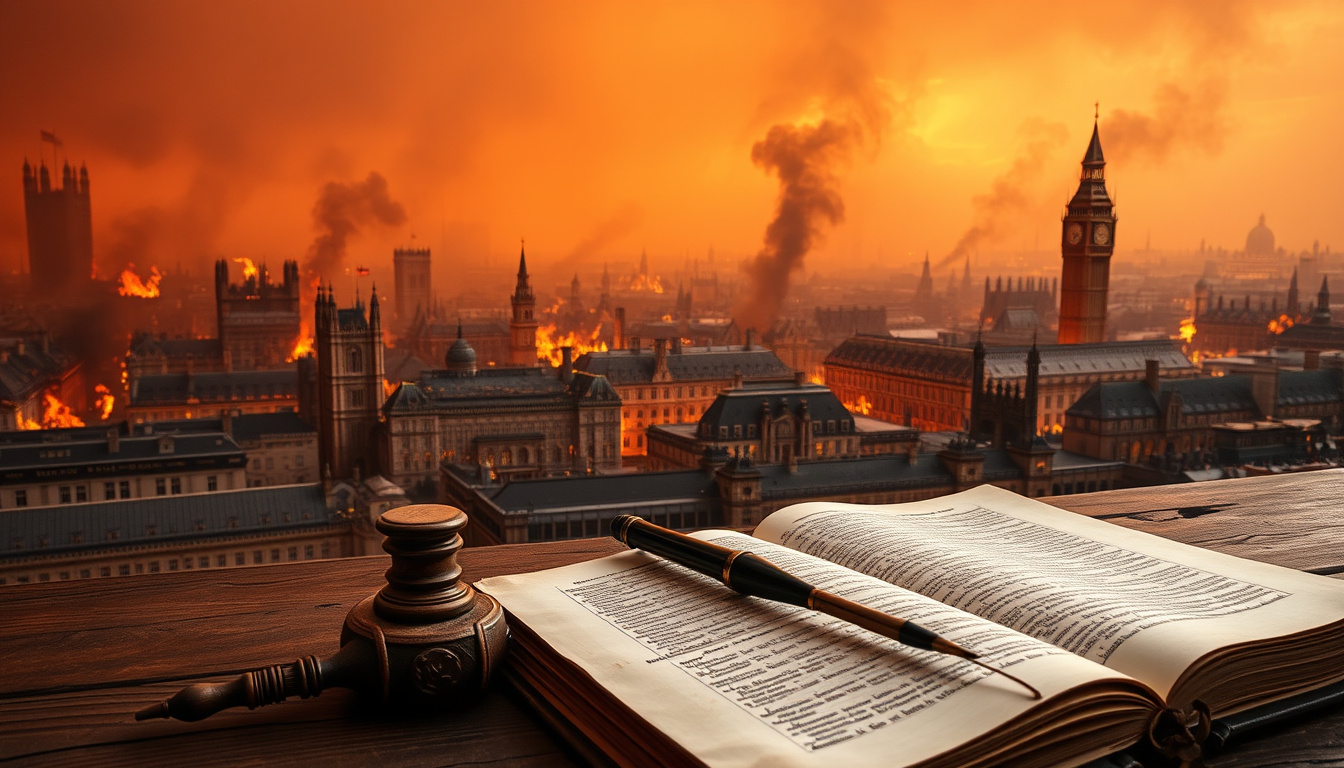
There are moments in history where one person’s private notes become the public record; for the Great Fire of London, that person is Samuel Pepys, whose diary entries from September 1666 remain the most cited first-hand account of the disaster. His blend of personal panic and official duty gives us a view of the fire that no official report could match.
Born: 23 February 1633 ·
Died: 26 May 1703 ·
Famous for: His detailed diary (1660–1669) ·
Role in 1666: Witness and chronicler of the Great Fire ·
Diary first published: 1825
Quick snapshot
- Pepys wrote a diary from 1660 to 1669 (The Diary of Samuel Pepys)
- He was an eyewitness to the Great Fire of London (London Fire Brigade)
- Exact cause of death (believed kidney stones or failure)
- Whether the Great Fire definitely ended the Great Plague
- Exact details of his imprisonment in the Tower of London in 1679 (lack of contemporary corroboration)
- Verification of the kiss with Queen Catherine of Braganza (relies solely on his diary)
- Diary begins 1 January 1660 (The Diary of Samuel Pepys)
- Great Fire: 2–6 September 1666 (London Fire Brigade)
- Pepys’ legacy lives on at the Pepys Library, Magdalene College
- Continued scholarly interest in the diary as a primary source
The table below summarises essential details about Samuel Pepys.
| Attribute | Detail |
|---|---|
| Full name | Samuel Pepys |
| Born | 23 February 1633, London |
| Died | 26 May 1703, Clapham |
| Occupation | Naval administrator, diarist, MP |
| Diary period | 1660–1669 |
| Cause of death | Kidney failure (probable) |
What is Samuel Pepys most famous for?
His diary as a historical record
Pepys is most famous for his diary covering 1660–1669, a decade that includes the Great Fire of London, the Restoration of Charles II, and the Great Plague. The diary is a primary source for the Restoration and the Great Fire — it captures daily life alongside national crisis. The The Diary of Samuel Pepys notes that his entries from 1666 alone cover his movements, conversations, and decisions during each day of the fire.
Pepys’ diary is not just a personal record; it is the most vivid piece of journalism from 17th-century London. For historians, it bridges the gap between official documents and lived experience.
Naval administration and politics
Beyond the diary, Pepys served as Chief Secretary to the Admiralty under both Charles II and James II. He was a key reformer of the Royal Navy, improving its logistics and administration. He also served as a Member of Parliament and President of the Royal Society. Royal Museums Greenwich describe his dual role as a civil servant and chronicler as unique for the period.
Pepys wasn’t a passive observer. His post at the Navy Board gave him access to the highest levels of government — and his diary gave posterity a seat at the same table.
What did Samuel Pepys do during the Great Fire of London?
Pepys’ actions on 2–6 September 1666
On 2 September 1666, Pepys was awakened by a servant who reported a fire in the distance, according to Historic UK. He went to the Tower of London to observe the fire and took a boat on the Thames to get a better view. His diary entry for that day describes “a lamentable fire” and people removing goods into boats on the river, as recorded by BBC Bitesize.
“We saw the fire as one entire arch of fire from this to the other side of the bridge, and in a bow up the hill for an arch of above a mile long — a most horrid, malicious, bloody flame.”
— Samuel Pepys, diary entry 4 September 1666
Pepys buried his wine and Parmesan cheese in his garden to save them from the flames. He also reported to the King and Duke of York at Whitehall, bringing a firsthand report that prompted the King to order the creation of firebreaks — though the order came too late to save much of the city. By 3 September, Pepys noted that “above 300 houses have been burned down,” and the fire was threatening London Bridge (The Diary of Samuel Pepys, 2 September 1666).
Pepys didn’t just watch. He took his eyewitness account directly to the monarchy — a direct line from a burning street to the King’s ear.
Pepys combined personal observation with direct access to the King, making his account uniquely authoritative.
His report to King Charles II
Pepys brought details of the fire to Whitehall, presenting his account to the King and the Duke of York. According to The Diary of Samuel Pepys, the King told Pepys to bring the Lord Mayor a command to spare no houses — a firebreak tactic — but the order was of little practical effect as the fire had already spread too far. The King’s reliance on an eyewitness shows how few sources of real-time information existed in 1666.
The pattern: Pepys was the fire’s most credible chronicler because he combined physical proximity with institutional access. No other figure in London that week could do both.
What did Samuel Pepys think of the Great Fire?
Diary entries from September 1666
Pepys described the fire as “a most horrid, malicious, bloody flame” in his diary entry of 4 September 1666 (The Diary of Samuel Pepys). He expressed deep concern for the displaced population, noting that poor people stayed in their houses until the fire touched them, then ran to the river or moved between riverside stairs (BBC Culture).
“Having stayed, and in an hour’s time seen the fire rage every way, and nobody, to my sight, endeavoring to quench it.”
— Samuel Pepys, diary entry 2 September 1666
Personal distress and administrative concern
Pepys’ diary mixes personal anxiety — securing his own possessions — with an administrative worry about the city’s fate. He noted the wind direction, the spread of the fire, and the lack of coordinated response. By 6 September, he wrote that Westminster Hall was full of people’s goods and that Exchequer money had been put into vessels to carry to Nonsuch for safety (The Diary of Samuel Pepys, 6 September 1666).
“By seeing the city from the river, I saw the miserable sight of the whole city in flames, the fire having taken hold of all the churches and houses.”
— John Evelyn, contemporary diarist
The trade-off: Pepys’ diary is intensely personal, which gives it emotional power but also limits its objectivity. He records what he saw and feared, not necessarily the full scope of the fire’s spread or the official response.
Pepys’ emotional honesty makes his diary vivid, but his personal focus means it is not an objective report.
Why was Samuel Pepys imprisoned in the Tower of London?
Imprisonment in 1679
Pepys was imprisoned in the Tower of London on suspicion of treason in 1679 during the Popish Plot, a period of anti-Catholic hysteria fanned by allegations from Titus Oates. Pepys was accused of being a Catholic sympathizer — a dangerous charge in Restoration England. He was released after about six weeks when the accusations failed to hold up under scrutiny.
Popish Plot allegations
The Popish Plot alleged a Catholic conspiracy to assassinate Charles II and replace him with his Catholic brother James. Pepys, despite his Protestantism, was swept up in the wave of arrests. The Tower imprisonment damaged his reputation but did not end his career — he would later serve again as Secretary to the Admiralty and as a Member of Parliament.
What this means: Even a loyal civil servant with Pepys’ record of service was not safe from the paranoia of the time. His imprisonment shows how fragile political security was in 1670s England.
Which queen did Samuel Pepys kiss?
Catherine of Braganza
Pepys recorded kissing Queen Catherine of Braganza, the wife of Charles II, in 1664. His diary entry describes the event with characteristic detail: he was an admirer of the Queen and noted the occasion with obvious pleasure. It remains one of the more charming and somewhat audacious entries in his diary — a courtier who recorded his own access to royalty.
Courtly behavior in the diary
The kiss was not a romantic scandal but a standard courtly gesture — a greeting or mark of favor. Still, Pepys’ willingness to write about it reflects the diary’s unfiltered nature: he records his own vanities, ambitions, and personal encounters with the same honesty he applies to national events.
The catch: Pepys was a chronicler of his own ego as much as of history. That mix is what makes his diary so readable — and so historically valuable.
How long did the Great Fire of London last?
Start and end dates
The Great Fire burned from 2 September to 6 September 1666 — approximately five days. According to The Diary of Samuel Pepys, the fire was officially extinguished on 5 September, though some smoldering continued into the 6th. The fire destroyed 13,200 houses and 87 churches (Royal Museums Greenwich).
Duration and containment
The fire destroyed four-fifths of the City of London, including St Paul’s Cathedral, the Guildhall, and the Royal Exchange (Royal Museums Greenwich). The fire was eventually stopped by a combination of firebreaks — buildings deliberately demolished — and a shift in the wind that pushed the flames away from the city’s remaining areas.
Why this matters: The duration of the fire — just five days — is remarkably short for the damage it caused. The speed of the destruction reflects the density of wooden buildings and the lack of an organized firefighting force.
Did the Great Fire of London stop the plague?
Relationship between fire and plague
The Great Fire is sometimes credited with ending the Great Plague of 1665, which had killed an estimated 100,000 people in London. The theory holds that the fire destroyed the infested buildings and rats that spread the disease. However, plague cases had already declined significantly before the fire began — the epidemic was in its late stages by summer 1666.
Sanitation improvements
The fire did destroy many of the unsanitary, overcrowded areas where plague thrived, and the rebuilding that followed included wider streets and brick construction. But Historic UK notes that the plague’s decline was already underway before September 1666. The fire may have accelerated the end, but it was not the decisive factor.
The pattern: The plague-fire link is a persistent piece of popular history that is only partially true. It’s a reminder that even well-known historical connections can be more correlation than causation.
Timeline of Samuel Pepys’ life
- 1 January 1660 — Pepys begins writing his diary (The Diary of Samuel Pepys)
- 2–6 September 1666 — Great Fire of London; Pepys documents events (London Fire Brigade)
- 31 May 1669 — Last diary entry (due to failing eyesight) (The Diary of Samuel Pepys)
- 1825 — Pepys’ diary first published (The Diary of Samuel Pepys)
The pattern: The diary’s publication history mirrors its journey from private notes to public record.
Confirmed facts vs what remains unclear
Confirmed facts
- Pepys wrote a diary from 1660 to 1669 (The Diary of Samuel Pepys)
- He was an eyewitness to the Great Fire of London (London Fire Brigade)
What remains unclear
- Exact cause of death (believed kidney stones or kidney failure)
- Whether the Great Fire definitively ended the Great Plague
- Exact details of his 1679 imprisonment (lack of contemporary corroboration)
- Verification of the kiss with Queen Catherine of Braganza (relies solely on his diary)
The implication: Most of what we know about Pepys is solid — his diary, his career, his movements during the fire. The uncertainties are small but meaningful: the plague question, in particular, shows how easily a plausible story becomes accepted as fact.
pepysdiary.com, pepysdiary.com, en.wikipedia.org, pepysdiary.com, pepysdiary.com, gutenberg.org
Frequently asked questions
Where is Samuel Pepys buried?
Samuel Pepys is buried in St Olave’s Church, Hart Street, London, in the same church where he worshipped while working at the Navy Office.
How many volumes are in Pepys’ diary?
Pepys’ diary consists of six volumes, covering nearly 1.25 million words written between 1660 and 1669.
Did Samuel Pepys have children?
Pepys and his wife Elisabeth had no children. Pepys did have an illegitimate daughter, named Samuel (remarkably), with a maidservant — the child died as an infant.
What language did Pepys write his diary in?
Pepys wrote his diary in shorthand, using a system called Shelton’s shorthand, with occasional passages in longhand, Latin, French, or Spanish for sensitive or private matters.
Why did Pepys stop writing his diary?
Pepys stopped writing his diary on 31 May 1669 because his eyesight was failing and he feared going blind. He never resumed it, even though his eyesight eventually recovered.
What is the Samuel Pepys cheese story?
During the Great Fire of London on 4 September 1666, Pepys buried his wine and a wheel of Parmesan cheese in his garden to save them from the flames — a moment that has become one of the most famous anecdotes from the fire.
How many books did Samuel Pepys own?
Pepys owned over 3,000 books, which he bequeathed to Magdalene College, Cambridge — his alma mater — along with the library case that keeps them in the same order he arranged them.
What is the Pepys Library?
The Pepys Library at Magdalene College, Cambridge, houses Samuel Pepys’ personal collection of books, manuscripts, and his original diary volumes. It remains exactly as he arranged it, and the diary is still kept in his original bookcases.
Related reading
For anyone reading about Restoration London, the choice is clear: trust Pepys’ diary as the most human source, but remember that one man’s view — however sharp — is not the whole story. The fire burned through 13,200 households, each with its own story. Pepys gave us one version, and it happens to be the best we’ve got.
Related stories


Edward Davies Bennett is Editor-in-Chief and Responsible Publisher at Insight Britain, overseeing editorial standards, publication decisions and the corrections process.