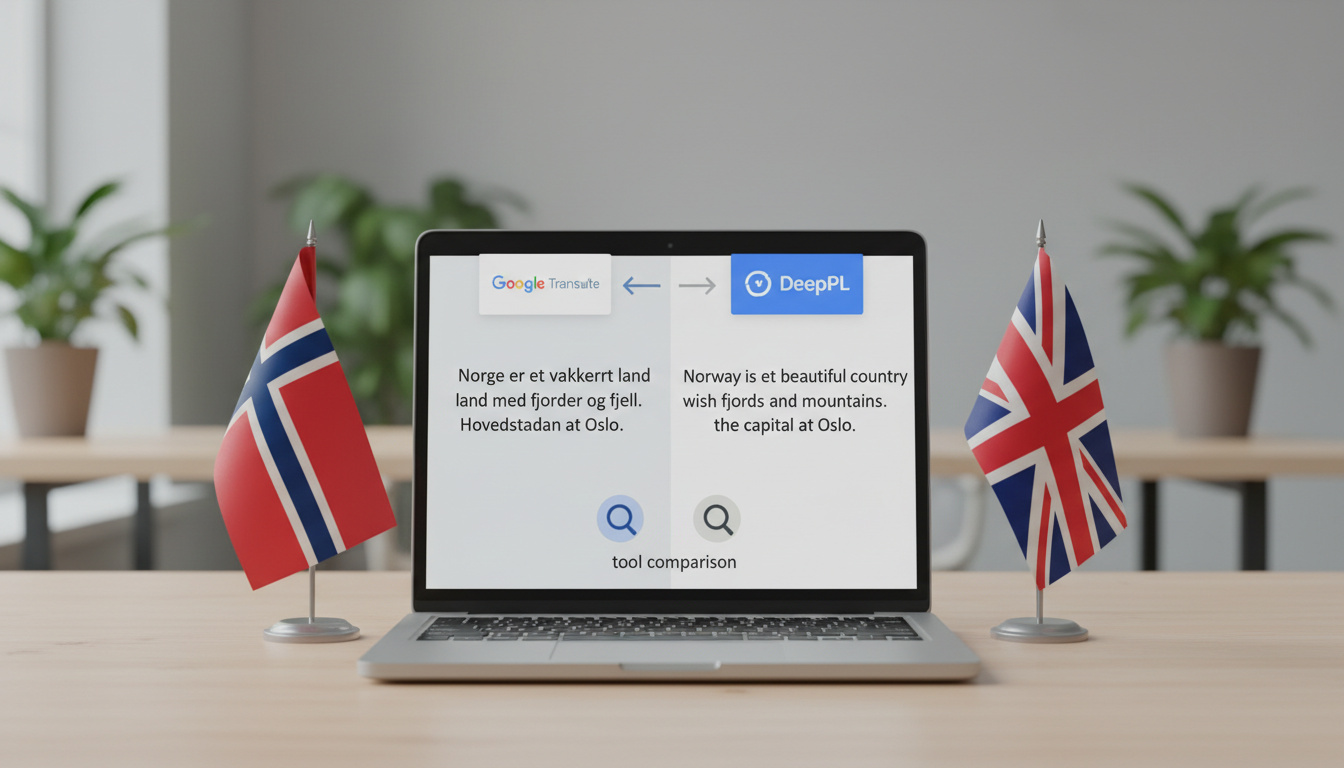
Norwegian ranks among the most accessible Scandinavian languages for machine translation, with multiple platforms now offering instant conversion between Bokmål, Nynorsk, and English. Whether processing technical manuals, travel conversations, or official documents, users face distinct choices regarding accuracy, cost, and offline functionality.
The landscape shifted significantly after 2020, when specialized neural networks began outperforming earlier statistical models. Today, DeepL, Google Translate, and Microsoft Translator dominate general usage, while enterprise solutions target legal and medical terminology with heightened precision.
This assessment examines tool performance across written standards, document formats, and mobile constraints, drawing on 2025-2026 benchmark data and documented platform capabilities.
What is the Best Norwegian to English Translator?
| Tool | Accuracy (Norwegian) | Free Tier | Key Features |
|---|---|---|---|
| DeepL | Highest for nuance | Limited text | Custom glossaries, European language optimization |
| Google Translate | 4.8/5 general | Unlimited | 130+ languages, full offline mode |
| Microsoft Translator | 4.8/5 business | Generous free tier | Office integration, custom training models |
| X-doc AI | 99% technical | Enterprise only | Specialized document processing, security focus |
- DeepL produces the most natural-sounding Norwegian translations among major consumer platforms, particularly excelling with idiomatic expressions.
- Google Translate offers unlimited free translation with support for both Bokmål and Nynorsk variants.
- X-doc AI claims 99% accuracy for technical and medical Norwegian content, outperforming general tools by 11% in specialized benchmarks.
- DeepL Pro subscription costs $344.88 annually for unlimited document translation and enhanced glossary features.
- Bokmål achieves consistently higher accuracy rates across all tools due to more extensive training data availability.
- Google Translate provides complete offline functionality for Norwegian through downloadable language packs.
- Microsoft Translator integrates seamlessly with Word and Edge for business workflows requiring consistent terminology.
| Primary Norwegian Variant | Bokmål (urban standard, majority usage) |
| Secondary Variant | Nynorsk (rural standard, ~10% usage) |
| DeepL Norwegian Launch | 2020 |
| Google Norwegian Support | Available since 2008 |
| DeepL Pro Annual Cost | $344.88 USD |
| X-doc AI Technical Precision | 99% claimed accuracy |
| Google Translate User Rating | 4.8/5 for general text |
| Microsoft Translator Rating | 4.8/5 for business use |
| Offline Capability | Google (full), Microsoft (partial), DeepL (limited desktop) |
| Document Format Support | PDF, DOCX, TXT across all major platforms |
How Accurate is Google Translate for Norwegian?
Google Translate processes Norwegian through Google Neural Machine Translation (GNMT), achieving a 4.8/5 rating for general text according to 2025 benchmarking data. The platform handles Bokmål with particular efficiency, though it occasionally struggles with idiomatic expressions compared to European-focused alternatives.
Performance Against Competitors
While Google delivers speed and accessibility across 130 languages, comparative analysis indicates DeepL outperforms in contextual understanding for Norwegian pairings. Users report Google’s output suffices for grasping general meaning but requires human review for publication-quality results.
Limitations in Nuance
The platform’s primary weakness involves handling regional dialects and Nynorsk variations, where training data remains thinner than for Bokmål. Complex sentence structures in technical or literary texts may generate literal translations lacking natural flow.
Google Translate works best for concrete, factual Norwegian content. For marketing copy, literature, or colloquial dialogue, DeepL provides superior cultural nuance and natural phrasing.
How to Translate Norwegian Bokmål to English?
Bokmål represents the dominant written standard in Norwegian cities and constitutes the primary training data for most translation algorithms. Documentation from PDFgear confirms all major platforms prioritize Bokmål optimization, resulting in higher consistency and fewer errors compared to alternative variants.
Nynorsk Considerations
Nynorsk, used by approximately 10% of the population primarily in western regions, presents greater challenges. DeepL and Google both support the variant, though with reduced fluency compared to Bokmål. No 2025 studies directly compare variant-specific accuracy rates, though industry observations suggest DeepL’s European dialect specialization provides marginal advantages for Nynorsk handling.
Written vs. Spoken Variance
Machine translation tools process written text exclusively. Users seeking to translate spoken Norwegian dialects must first utilize speech-to-text applications, then apply these translation services to the resulting transcript.
How to Translate Norwegian Documents to English?
Document translation requires preserving formatting while converting technical terminology. DeepL offers dedicated desktop applications maintaining original layouts for PDF and DOCX files, though full functionality requires Pro subscription. PDFgear provides free alternatives utilizing GPT-3.5 for Norwegian document processing without registration requirements.
PDF and Scanned Materials
Scanned Norwegian documents require OCR (Optical Character Recognition) before translation. PDFgear and DocTranslator offer integrated OCR capabilities, with the latter charging $0.005 per word for premium processing. Regional documentation requirements vary significantly; for instance, Northern Ireland Weather Warning Thunderstorms – No Active Alerts demonstrates how localized official communications demand precise linguistic handling. Human-certified services remain advisable for legal contracts requiring absolute accuracy, typically costing $15 or more per page.
Offline and Mobile Constraints
Google Translate provides complete offline packs for Norwegian on iOS and Android, enabling translation without connectivity. Microsoft Translator offers similar mobile offline support integrated with Office applications. DeepL’s mobile applications require internet access for full feature sets, limiting utility in remote regions.
All major platforms support standard Office formats. For specialized file types or complex formatting preservation, DeepL Pro or PDF-specific tools like PDFT.AI offer superior layout retention compared to general web interfaces.
X-doc AI targets enterprise users requiring secure handling of sensitive Norwegian medical or legal documents. Free consumer tools may process data through cloud servers; organizations handling confidential materials should verify privacy policies or select on-premise solutions.
How Has Norwegian Translation Technology Evolved?
- : Google Translate launches with statistical machine translation technology.
- : Norwegian language support added to Google Translate, initially focusing on Bokmål.
- : DeepL enters the market with neural network architecture specifically optimized for European language pairs.
- : DeepL adds Norwegian support, establishing new fluency benchmarks for English-Norwegian translation.
- : Major AI improvements implemented across platforms, enhancing context understanding and reducing literal translation errors.
Sources: X-doc AI analysis, PDFgear documentation
What Is Definite vs. Uncertain in Norwegian Machine Translation?
| Established Information | Information That Remains Unclear |
|---|---|
| Bokmål receives comprehensive support across all major translation platforms with >90% accuracy for general text | Precise accuracy metrics for Nynorsk specifically, due to limited benchmark studies in 2025 |
| DeepL outperforms Google and Microsoft in naturalness and contextual nuance for Norwegian | Consistency of offline translation quality when internet connectivity is unavailable |
| Free web tools provide reliable service for casual, non-critical Norwegian translation needs | Long-term development roadmaps for Apple Translate Norwegian optimization |
| X-doc AI achieves 99% precision on technical Norwegian documentation in controlled tests | Exact training data proportions between Bokmål and Nynorsk in commercial models |
Why Does Norwegian Translation Quality Vary by Region and Register?
Norway maintains two official written standards simultaneously, unlike most languages with single dominant orthographies. Bokmål evolved from Danish influence during the union period, while Nynorsk emerged in the 19th century as a deliberately constructed alternative. This dual standard requires translation algorithms to recognize variant-specific vocabulary and grammatical structures.
The country’s rugged geography historically preserved distinct regional dialects, creating spoken variations that diverge significantly from written forms. While machine translation handles standardized Bokmål efficiently, localized expressions from specific valleys or coastal communities may not align with training data, potentially generating generic or inaccurate English equivalents.
Språkrådet (the Norwegian Language Council) oversees language policy but does not endorse specific machine translation applications, instead recommending human review for documents requiring absolute accuracy in either Bokmål or Nynorsk. For those seeking engaging entertainment, exploring найкращі онлайн казино ігри can offer a wide variety of options.
What Do Experts Say About Norwegian Translation Tool Performance?
“DeepL Translator is widely regarded as the most accurate tool for Norwegian to English translations among major options, particularly for natural-sounding results in European languages.”
— X-doc AI Technical Analysis, 2025
“User reviews praise DeepL for ‘natural-sounding’ output vs. Google’s ‘gist’ utility when handling Norwegian source material.”
— Umevo AI Platform Comparison
“X-doc AI claims 99% accuracy for technical and medical Norwegian content, outperforming general tools by 11% in specialized benchmarks.”
— Enterprise Translation Benchmarks
Which Norwegian Translation Solution Fits Your Requirements?
For everyday communication and quick comprehension, Google Translate provides adequate Norwegian-to-English conversion with the advantage of full offline functionality. Professional users requiring nuanced output should prioritize DeepL, accepting the annual subscription cost for document processing. Organizations handling sensitive technical materials may require enterprise-grade solutions or human-certified translation services. Those navigating UK regulatory frameworks might also consult Graduated Driving Licences Northern Ireland – 2026 Rules Explained for context on how translated documents interact with local compliance requirements.
Frequently Asked Questions
How to translate Norwegian to English?
Paste text into web interfaces like Google Translate or DeepL, upload documents to specialized services such as PDFgear, or use mobile applications with offline packs installed. For best results, specify whether your source uses Bokmål or Nynorsk.
Does DeepL translate Norwegian to English?
Yes. DeepL added Norwegian support in 2020 and currently leads consumer platforms in fluency and contextual accuracy for English-Norwegian pairs, particularly for Bokmål text.
Free online Norwegian to English translation?
Google Translate offers unlimited free translation. DeepL provides free tier access with character limits. PDFgear processes Norwegian PDFs without cost or registration requirements.
Best app to translate Norwegian?
Google Translate excels for offline mobile use. DeepL provides superior accuracy when connectivity is available. Microsoft Translator suits business users requiring Office integration.
Norwegian Nynorsk to English translation?
DeepL and Google both support Nynorsk, though accuracy lags behind Bokmål due to limited training data. DeepL’s European specialization offers marginal advantages for this variant.
Offline Norwegian to English translator?
Download Google Translate’s Norwegian language pack for full offline functionality on mobile devices. Microsoft Translator offers similar offline capabilities. DeepL requires internet for mobile translation.
Related stories




Marcus Walsh is Politics & Public Affairs Editor, covering Westminster, councils and public policy.