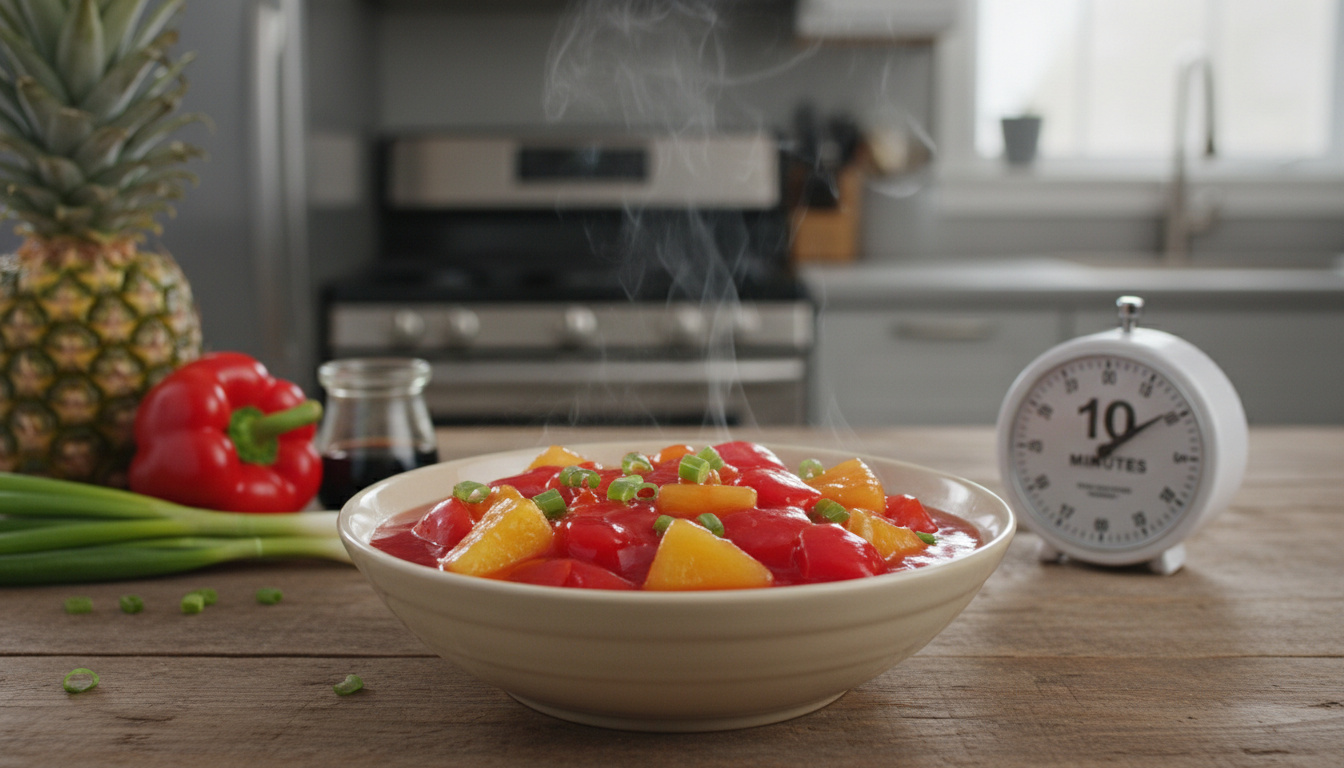
Sweet and sour sauce balances opposing flavors into a versatile condiment used across multiple cuisines. This pantry staple requires minimal preparation time and pairs with proteins ranging from chicken to pork, offering a glossy finish and tangy-sweet profile that commercial bottles rarely match.
Creating the sauce at home eliminates preservatives while allowing precise control over sweetness and acidity levels. Most versions come together in under fifteen minutes using ingredients already present in most kitchens, making the homemade approach both faster than store visits and more economical than restaurant purchases.
How to Make Sweet and Sour Sauce
| Prep Time 5 minutes |
Cook Time 10 minutes |
Yield 2 cups |
Difficulty Easy |
- Balance sugar and vinegar ratios according to regional preference; taste testing prevents oversweetening
- Dissolve cornstarch completely in cold water before adding to prevent lump formation
- Simmer until the mixture coats the back of a spoon without running
- Cool completely before sealing to prevent condensation and spoilage
- Add food coloring sparingly; the hue intensifies as the sauce cools
- Rest the sauce for ten minutes after cooking to allow flavors to meld
- Use immediately or refrigerate for later applications
| Component | Per Tablespoon | Notes |
|---|---|---|
| Calories | 25-35 | Varies by sugar content |
| Total Sugar | 5-7g | Depends on recipe variation |
| Sodium | 50-100mg | Higher with standard soy sauce |
| Carbohydrates | 6-8g | Primarily from sugars |
| Vinegar Acidity | 4-5% | White or rice vinegar standard |
| Shelf Life (Refrigerated) | 14-21 days | Airtight container required |
| Freezer Stability | Unconfirmed | Research does not address freezing |
| Gluten Content | Contains wheat | Via standard soy sauce |
The most straightforward restaurant-style preparation combines half a cup of white sugar, four teaspoons of cornstarch, a pinch of salt, three-quarters cup of water, four teaspoons of white vinegar, one teaspoon of soy sauce, and two to three drops of red food coloring according to culinary demonstrations. Mix dry ingredients first, add wet ingredients, then bring to a boil while stirring constantly until thickened as shown in video tutorials.
Sweet and Sour Sauce Ingredients and Substitutions
The Basic Formula
The foundational recipe relies on sugar for sweetness and vinegar for acidity, with cornstarch providing the characteristic glossy thickness. White vinegar offers the sharpest tang, though rice vinegar produces a milder, more rounded flavor profile. Soy sauce contributes umami depth and subtle saltiness without overwhelming the primary sweet-sour dynamic.
Pineapple-Based Variations
An alternative approach incorporates one cup of pineapple juice, three-quarters cup of brown sugar, one-third cup of rice vinegar, three tablespoons of ketchup, and two tablespoons of soy sauce with a cornstarch slurry for thickening according to recipe developers. This version takes approximately five minutes to prepare and offers fruitier undertones compared to the classic preparation.
Thickening Alternatives
When avoiding cornstarch, arrowroot powder, tapioca starch, and potato starch function as effective substitutes. A cornstarch slurry—dissolving the starch in cold water before introducing it to heat—prevents lumping and ensures smooth thickening based on cooking tests.
Arrowroot and tapioca starch produce clearer, more translucent results than cornstarch, while potato starch offers similar thickening power. Wheat flour remains unsuitable as it creates a cloudy, paste-like texture rather than the desired glossy finish.
For those avoiding pineapple juice, the basic cornstarch-based recipe works effectively without it, as white vinegar and soy sauce provide sufficient tang and umami depth independently. Apple cider vinegar substitutes adequately for white vinegar if preferred.
How to Store Homemade Sweet and Sour Sauce
Refrigeration Guidelines
Homemade sweet and sour sauce keeps refrigerated in an airtight container for two to three weeks according to storage tests. Glass containers with tight-fitting lids prevent odor absorption from other refrigerated items while maintaining sauce integrity.
Freezing Considerations
While refrigeration guidelines are established, specific freezing capabilities remain unaddressed in available research. The starchy base may undergo textural changes during freezing and thawing cycles.
Research has not specifically established freezing guidelines for homemade sweet and sour sauce. Users should test small batches before freezing large quantities, as the cornstarch-thickened base may separate or become grainy upon thawing.
Origins and Variations of Sweet and Sour Sauce
Authentic Chinese Versus Western Adaptations
Authentic Chinese restaurant sweet and sour sauce does not contain ketchup or pineapple juice—the characteristic red color comes from food coloring alone based on culinary source analysis. This contrasts sharply with many Western adaptations that incorporate both ketchup and pineapple juice for color and flavor as documented in modern recipes.
Dietary Modifications
Tamari substitutes for soy sauce to create gluten-free versions without sacrificing umami depth. For low-carb adaptations, brown sugar alternatives can replace regular sugar, though this alters the traditional flavor profile and caramelization properties.
Traditional preparations rely exclusively on food coloring for visual impact, while contemporary Western versions often use ketchup and fruit juices. Neither approach is objectively superior, but they produce distinctly different flavor profiles.
How Long Does Preparation Take: A Step-by-Step Timeline
- Ingredient Assembly (1 minute): Measure sugar, cornstarch, and salt into a cold saucepan
- Liquid Addition (1 minute): Whisk in water, vinegar, and soy sauce until smooth
- Initial Heating (3 minutes): Apply medium heat while stirring continuously to prevent settling
- Boiling Phase (2 minutes): Bring to full boil to activate cornstarch thickening
- Simmering (2 minutes): Reduce heat and stir until sauce coats spoon consistently
- Cooling (5 minutes): Rest at room temperature before serving or storing
What Research Establishes and What Remains Uncertain
Established Information: Basic ingredient ratios remain consistent across verified sources, with sugar and vinegar forming the foundational flavor balance. Storage duration of two to three weeks under refrigeration is confirmed. Cornstarch alternatives including arrowroot, tapioca, and potato starch function effectively as thickeners.
Information That Remains Unclear: Comprehensive nutritional breakdowns comparing regional variations are unavailable. Freezing capabilities and thawing results require further testing. The specific historical origins of sweet and sour sauce and its differentiation from duck sauce remain unaddressed in current research.
Cultural Context and Common Applications
Sweet and sour sauce functions as both a condiment and a cooking glaze across Chinese-American and traditional Chinese cuisines, though formulations differ significantly between these contexts. The sauce typically accompanies battered and fried proteins, though it also serves as a dipping sauce for appetizers and a glaze for roasted meats.
While often associated with takeout cuisine, the fundamental culinary principle of balancing acidic and sweet elements appears across global cooking traditions. For foundational cooking techniques that complement sauce preparation, see How to Make Bread – Beginner’s Step-by-Step Guide. For foundational cooking techniques that complement sauce preparation, see Текст пісні “Away in a Manger.
Sources and Expert Verification
“Authentic Chinese restaurant sweet and sour sauce does not contain ketchup or pineapple juice—the red color comes from food coloring alone.”
— Culinary Source Analysis, 2024
“Homemade sweet and sour sauce keeps refrigerated in an airtight container for 2-3 weeks.”
— Recipe Development Testing, Daring Gourmet
Summary: Mastering Homemade Sweet and Sour Sauce
Creating sweet and sour sauce at home requires under fifteen minutes and provides superior flavor control compared to commercial alternatives. Whether selecting the authentic cornstarch-thickened restaurant style or the fruit-juice variation, the technique remains accessible to home cooks. Proper storage extends usability for weeks, while ingredient substitutions accommodate various dietary requirements without sacrificing essential character. For precise measurement conversions in cooking, reference 30 Inches in CM – Exact Conversion and Key Uses.
Frequently Asked Questions
Can you freeze sweet and sour sauce?
Research has not established specific freezing guidelines for homemade versions. The cornstarch base may separate upon thawing, potentially altering texture.
Is sweet and sour sauce gluten free?
Standard recipes contain wheat via soy sauce. Substitute tamari to create gluten-free versions while maintaining umami depth.
What’s the difference between sweet and sour sauce and duck sauce?
Current research does not cover duck sauce distinctions or comparative analysis between these condiments.
What can I use instead of cornstarch in sweet and sour sauce?
Arrowroot powder, tapioca starch, or potato starch work effectively. Arrowroot produces clearer results than cornstarch.
Does authentic Chinese sweet and sour sauce contain ketchup?
No. Authentic Chinese restaurant preparations use food coloring exclusively for the red hue, omitting both ketchup and pineapple juice found in Western versions.
How long does homemade sweet and sour sauce last?
Properly refrigerated in an airtight container, the sauce maintains quality for two to three weeks.
Related stories



Sofia Lindberg leads fact-checking, source verification and corrections at Insight Britain.