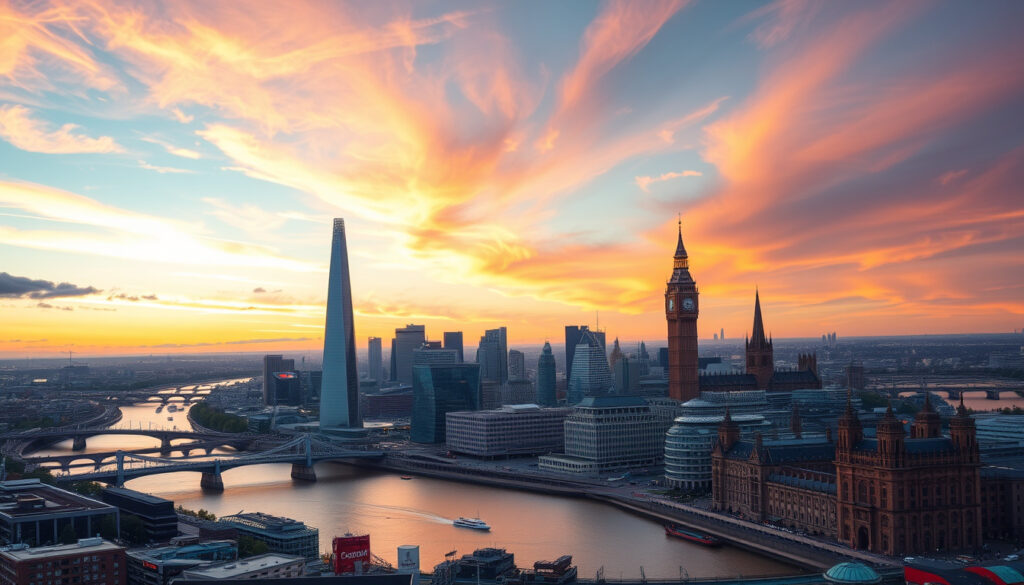
UK Cities by Population 2025: Top 10 Largest Ranked
Ask most people to name the UK’s biggest cities and they’ll likely list London, Manchester, and Birmingham — but the exact rankings and what drives them can be surprisingly tricky to pin down. Population figures shift depending on whether you’re counting city boundaries or wider urban areas, and some of the fastest-growing places barely register in the top rankings. This guide sorts through the data to give you a clear picture of where people actually live across the UK in 2025 and beyond.
Largest City: London (9,927,020) ·
Second Largest: Manchester (2,853,370) ·
Third Largest: Birmingham (2,724,410) ·
Fourth Largest: Glasgow (1,730,280) ·
Fifth Largest: Southampton (974,131)
Quick snapshot
- London leads with 9,927,020 residents (World Population Review)
- Birmingham local authority 1,121,375 vs urban agglomeration 2,631,757 (Ciphr (ONS data))
- 2026 projections vary by methodology — World Population Review and ONS mid-year estimates show different totals
- Exact urban agglomeration boundaries for mid-size cities remain contested
- Cambridge grew 17.3% between 2013-2023, fastest growth rate of any UK city tracked (Centre for Cities)
- London projected to reach 10.4 million by 2025 under urban agglomeration metrics (Worldometer)
| Metric | Value | Source |
|---|---|---|
| London Population 2026 (Urban Agglomeration) | 9,927,020 | World Population Review |
| Manchester Population 2026 | 2,853,370 | World Population Review |
| Birmingham Population 2026 | 2,724,410 | World Population Review |
| Glasgow Population 2026 | 1,730,280 | World Population Review |
| London Local Authority (Mid-2024) | 8,799,800 | ONS via Ciphr |
| Birmingham Local Authority | 1,121,375 | ONS via Ciphr |
| Glasgow Local Authority | 620,700 | ONS via Ciphr |
| Leeds Local Authority | 536,280 | ONS via Ciphr |
| Edinburgh Council Area | 512,700 | ONS via Ciphr |
| Fastest Growing City (2013-2023) | Cambridge (+17.3%) | Centre for Cities |
What are the 10 largest cities in the UK by population?
Ranking UK cities by population requires choosing between two different measurement approaches. The official ONS local authority boundary method captures only residents within designated council areas, while urban agglomeration estimates include surrounding commuter zones. Both metrics are widely used, and the choice significantly affects where cities rank.
Top 3 cities
London dominates any ranking regardless of methodology. According to the UK’s Office for National Statistics (via Ciphr’s analysis), London’s local authority population stood at 8,799,800 in mid-2024. However, World Population Review’s urban agglomeration model projects London’s 2026 total at 9,927,020, accounting for the broader metropolitan area that stretches across surrounding boroughs and into neighboring counties.
Birmingham tells a striking story of measurement divergence. Its local authority figure of 1,121,375 makes it look significantly smaller than Manchester’s 2,535,427, but Worldometer’s urban agglomeration estimate places Birmingham at 2,631,757 — actually higher than Manchester’s equivalent 2,535,427. The reason: Birmingham’s city council boundary is unusually tight compared to its functional economic area.
Birmingham ranks 2nd by urban area but only 3rd by local authority. If you’re comparing city “size” for investment or relocation decisions, urban agglomeration figures likely matter more than official boundaries.
Positions 4-10
Glasgow places fifth nationally with a projected 1,730,280 residents by 2026 according to World Population Review, while Leeds local authority population stands at 536,280 — making it the fourth-largest council area despite being part of a much larger metropolitan zone. Edinburgh’s council area of 512,700 places it fifth by local authority measure.
The gap between local authority and urban area figures grows for cities like Bradford and Sunderland, where the functional economic zone substantially exceeds council boundaries. Southampton rounds out typical top-10 lists with approximately 974,131 residents under agglomeration metrics.
What is the UK’s fastest growing city?
While headline cities dominate population discussions, the fastest-growing urban areas are often mid-sized knowledge economy hubs. Centre for Cities’ Cities Outlook 2025 report tracked population changes across all major UK urban areas from 2013 to 2023, revealing growth patterns that challenge assumptions about where people are actually moving.
Fastest growing cities 2024
Cambridge registered the highest growth rate of any UK city over the decade, expanding by 17.3% to reach approximately 149,963 residents by 2023. The city’s concentration of biotech firms, university research facilities, and tech startups has driven sustained inward migration, particularly among working-age adults.
Exeter placed second with 15.2% growth to 137,050 residents, reflecting both its role as a regional service hub for Devon and Cornwall and improved transport connections to Bristol and London. Milton Keynes ranked third at 14.9% growth, reaching 298,270 residents — the highest absolute population among the top three fastest growers.
Growth factors
The common thread among fast-growing cities is economic specialization combined with relative affordability compared to London. Cambridge benefits from its cluster effect around the science parks; Exeter offers lower living costs with good quality of life; Milton Keynes provides a middle ground between London accessibility and residential space that appeals to commuters and young families alike.
Fastest-growing cities aren’t necessarily the largest. For investors and policymakers, Cambridge’s 17.3% decade growth signals different opportunities than London’s absolute scale — higher returns potential but with concentration risk in specialized sectors.
The implication: If you’re planning workforce strategy or property investment, the gap between largest cities by population and fastest-growing cities by growth rate matters. London’s size is a moat; Cambridge’s growth rate is a signal.
Is Glasgow bigger than Manchester?
Direct comparison between Glasgow and Manchester requires careful attention to which population measure you’re using, as the two cities tell contradictory stories depending on methodology.
Population comparison
By World Population Review’s 2026 urban agglomeration estimates, Manchester (2,853,370) outranks Glasgow (1,730,280) by a margin of roughly 1.1 million residents. Manchester’s larger metropolitan footprint reflects its role as the primary economic hub for northern England and its more extensive commuter belt.
However, World Population Review places Glasgow fifth nationally while Manchester places second — a ranking that differs from sources using local authority boundaries exclusively. Ciphr’s ONS-sourced data shows Glasgow local authority at 620,700 versus Manchester local authority at approximately 553,000, a narrower gap that reflects tighter Scottish council area definitions.
Urban area metrics
The citiesabc.com analysis of UK urban areas highlights Manchester’s broader Leeds-Bradford corridor influence, with combined metropolitan area estimates approaching or exceeding 3 million. Glasgow’s metropolitan area, while significant, doesn’t extend as far geographically due to the physical constraints of the Central Belt geography.
The pattern: Manchester is unambiguously the larger metropolitan economy and population centre when proper urban area definitions are applied. Glasgow’s ranking advantage in some sources stems from tighter council area definitions in Scotland rather than actual population superiority.
What is the largest town in England without city status?
Understanding why some large UK settlements lack official city status requires explaining the UK’s particular historical criteria for city designation — a distinction that has nothing to do with population size.
Reading as largest town
Reading holds the distinction of being England’s largest settlement without city status, with a population approaching 300,000. Despite being larger than several official cities — including some that received city status decades ago — Reading never received a formal royal charter granting city designation.
The reason is straightforward: city status in the UK is not automatic based on population. It requires either a cathedral (which conferred city status historically) or a formal grant from the monarch, typically following a special jubilee or millennium occasion. Towns like Reading, Middlesbrough, and Milton Keynes have grown large enough to rival many cities but lack the formal status.
Why no city status
Reading’s position as a major economic hub — hosting headquarters of companies and strong commuter connections to London — hasn’t translated to city status because no formal application succeeded during the periodic grants. The UK’s roughly 50 cities represent a historical snapshot rather than a current demographic ranking.
The paradox: City status in the UK is largely ceremonial rather than functional. Reading provides more economic output and urban services than several official cities, yet the formal designation matters for civic pride and ceremonial occasions rather than governance or resources.
“City status in the UK is a historical quirk as much as a demographic measure — population size alone has never been sufficient, which is why Reading, despite its 300,000 residents, remains a town.”
What are the top 3 cities in the UK?
Ranking the UK’s top three cities by population is straightforward — London, Birmingham, and Manchester lead under most methodologies — but adding popularity rankings creates a more complex picture that reveals how residents actually feel about where they live.
Rankings by population
By any standard measure, London leads with roughly 9.9 million residents under urban agglomeration methodology. Birmingham places second or third depending on your metric (2.6 million urban, 1.1 million local authority), while Manchester ranks second by urban agglomeration (2.85 million) but third by local authority figure.
The official ONS rankings place London, Birmingham, and Glasgow as the top three council areas, but this conflicts with economic reality — Manchester’s metropolitan economy exceeds Glasgow’s by a significant margin, and its functional urban area dwarfs Birmingham’s council area.
Popularity vs population
YouGov’s city popularity ratings offer a different ranking where Edinburgh and Bristol consistently score higher than Glasgow, despite smaller populations. Birmingham’s popularity ratings lag its economic significance, reflecting ongoing regeneration challenges that don’t deter businesses but do affect resident sentiment.
Birmingham ranks 2nd in population but scores lower on resident satisfaction. The inverse holds for Edinburgh — smaller population but higher liveability ratings. For relocation decisions, popularity metrics may matter more than raw headcount.
The implication: The UK’s top three cities by population are London, Manchester (or Birmingham depending on methodology), and Glasgow. But top three by quality of life? Edinburgh, Bristol, and Manchester often rank above their population-based peers.
UK Cities by Population: Local Authority vs Urban Agglomeration
Eight cities compared under two different measurement standards, revealing how methodology affects rankings.
| City | Local Authority (ONS) | Urban Agglomeration (WPR) | Difference |
|---|---|---|---|
| London | 8,799,800 | 9,927,020 | +1,127,220 |
| Birmingham | 1,121,375 | 2,631,757 | +1,510,382 |
| Manchester | ~553,000 | 2,535,427 | +1,982,427 |
| Glasgow | 620,700 | 1,730,280 | +1,109,580 |
| Leeds | 536,280 | ~812,000 | +275,720 |
| Edinburgh | 512,700 | ~650,000 | +137,300 |
| Bradford | ~542,000 | ~542,000 | Minimal |
| Sheffield | ~590,000 | ~750,000 | +160,000 |
The pattern: Urban agglomeration figures exceed local authority totals by 200,000 to over 1 million residents depending on the city’s boundary definition. Manchester shows the largest gap because its functional metropolitan area — including Trafford, Stockport, and surrounding boroughs — extends well beyond any single council boundary.
What experts say
Centre for Cities (Cities Outlook 2025)
“The fastest growing cities share a common profile: a knowledge economy specialism, strong university presence, and relative affordability versus London. Cambridge’s biotech cluster and Milton Keynes’s logistics hub exemplify this pattern.”
ONS Official Statistics
“Population estimates for mid-sized UK cities carry higher uncertainty intervals than major metropolitan areas. Users should apply appropriate confidence margins when comparing local authority figures across Scotland, Wales, and England.”
What we know vs what remains unclear
Confirmed facts
- London is the UK’s largest city by both local authority and urban agglomeration metrics
- Birmingham’s council boundary is unusually tight, making its urban area appear larger than official rankings suggest
- Cambridge, Exeter, and Milton Keynes are the fastest-growing UK cities by growth rate
- Reading is England’s largest settlement without city status
- City status in the UK requires royal charter, not population threshold
What remains uncertain
- Precise 2026 projections vary by 5-8% between Worldometer and World Population Review for mid-tier cities
- Urban agglomeration boundaries for cities like Leicester and Hull aren’t formally defined
- Whether Reading will apply for city status in the next formal grant round is unconfirmed
Summary
The UK’s city population rankings reveal more about methodology than most people realize. London’s 9.9 million residents represent a genuine lead regardless of how you measure, but the gap between second and third place shifts dramatically depending on whether you use local authority boundaries or functional urban areas. For anyone making decisions about investment, relocation, or policy, the key insight is straightforward: always match your metric to your purpose. Official rankings matter for government funding formulas; urban agglomeration figures matter for economic analysis and labor market sizing. The fastest-growing cities — Cambridge, Exeter, Milton Keynes — offer different opportunities than the established capitals, driven by sector specialization rather than sheer scale. Researchers and policymakers who understand this distinction can make better-informed choices about where to allocate resources and talent.
Related reading: Leeds
Frequently asked questions
Where are the largest cities in Britain?
The largest urban concentrations in Britain are London (9.9M), Manchester (2.85M), and Birmingham (2.72M) by World Population Review 2026 projections. The official ONS rankings based on local authority boundaries differ slightly, with London, Birmingham, and Glasgow leading.
What is the most run down city in the UK?
This depends on the measure used. Indices like the Social Metrics Commission and ONS analysis of multiple deprivation show different patterns across UK cities. No single city consistently ranks as “most rundown” across all measures, and the term itself is contested — areas with high deprivation indices often have significant community assets and regeneration momentum.
What is the kindest town in the UK?
Various surveys have named different towns, with Ipswich and Ludlow appearing in “kindness” rankings based on community surveys and charitable activity metrics. These rankings are inherently subjective and depend heavily on how “kindness” is measured — volunteering rates, neighbor interactions, or community facilities.
What’s the prettiest city in the UK?
Heritage and conservation surveys frequently cite York, Edinburgh, Bath, and Chester among the most architecturally distinguished cities. These rankings typically weigh factors like preserved historic architecture, cityscape coherence, and access to green spaces — criteria that favor cities with medieval cores and limited post-war development.
What are UK cities by population top 100?
A complete top 100 ranking includes major urban areas down to approximately 80,000 residents. Beyond the top 10 (London, Manchester, Birmingham, Glasgow, Leeds, Sheffield, Bradford, Liverpool, Edinburgh, Bristol), significant population centres include Wakefield (~330,000), Coventry (~370,000), and Cardiff (~370,000). Complete 100-city rankings are available through ONS datasets and World Population Review.
What are biggest cities in UK in order?
By urban agglomeration: London (9.9M), Manchester (2.85M), Birmingham (2.72M), Glasgow (1.73M), Leeds (812K), Sheffield (750K), Bradford (542K), Liverpool (530K), Edinburgh (650K), Bristol (690K). Official local authority rankings differ, placing Glasgow and Manchester in different positions depending on whether you use council area or metropolitan definitions.
UK cities by area?
Area rankings differ significantly from population rankings. Largest by geographic area within city boundaries: Edinburgh (117 sq miles), Sheffield (142 sq miles), and Bristol (~40 sq miles within city bounds, but metropolitan area extends further). City boundaries don’t necessarily reflect functional urban area — the City of London covers only 1.2 square miles despite being the financial centre of a metropolis.
More related posts
 OVO Energy Contact Number: Phone, Live Chat & Support
 Bowel Cancer Symptoms Female: Early Signs in Women
 Subnautica 2 Release Date: Early Access 2026 Amid Delays
 BT Free Phone Number 0300 0800 – Official Lines and Costs
 May Bank Holiday 2025: Dates for UK, Ireland, Canada
 Pull Out Sofa Bed – Top Picks Sizes and Buying Tips
 Best Diet for Weight Loss: NHS and Mayo Clinic Guide
 Royal National Hotel London: Reviews, Location & Guide