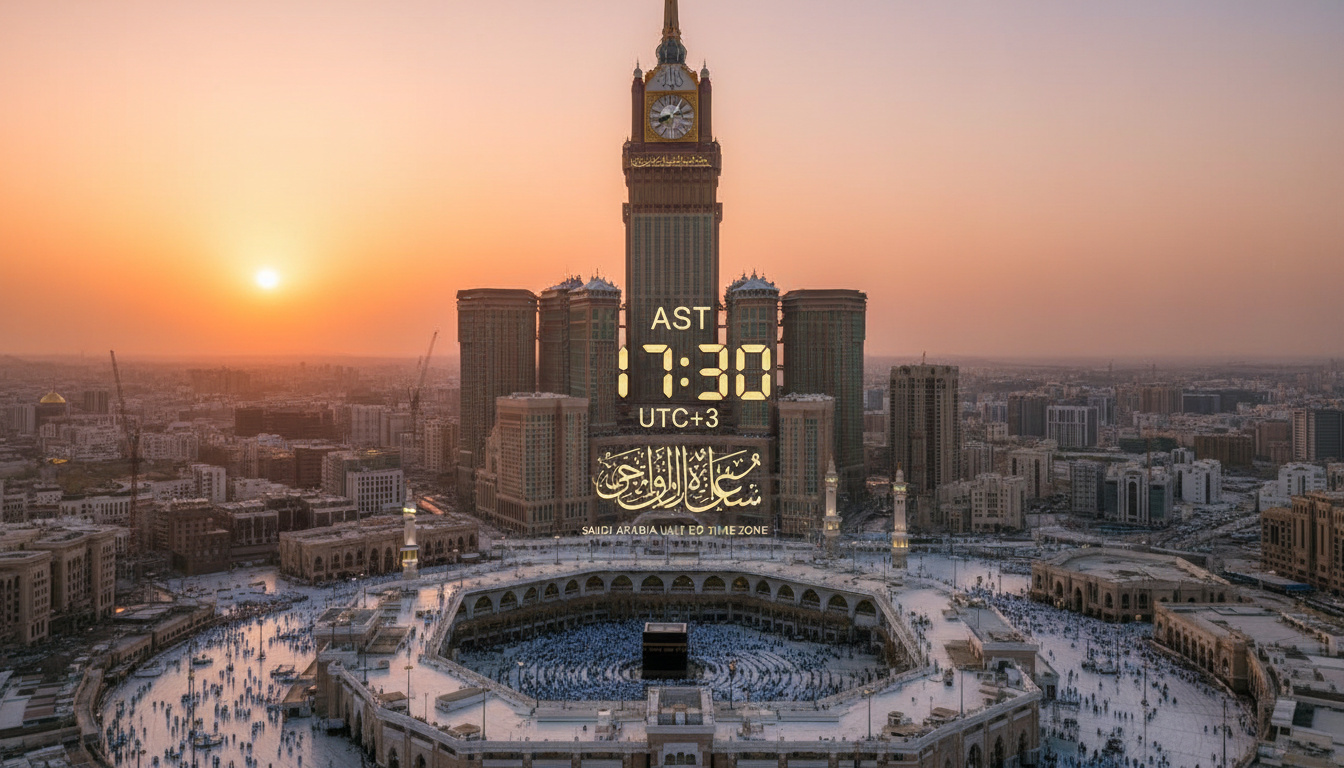

Saudi Arabia maintains a single, unified time zone across its entire territory. The kingdom operates exclusively under Arabia Standard Time (AST), fixed at three hours ahead of Coordinated Universal Time (UTC+3). This standard applies uniformly from the capital Riyadh to the holy cities of Makkah and Madina, ensuring synchronized clocks nationwide regardless of longitudinal differences.
Unlike many countries that adjust clocks seasonally, Saudi Arabia follows Arabia Standard Time year-round without daylight saving time modifications. This consistency simplifies international business coordination, religious observance scheduling, and domestic travel planning. Whether calculating prayer times in Makkah or scheduling video conferences with Jeddah, understanding this fixed UTC+3 standard is essential for accurate timekeeping.
What Is the Current Time in Saudi Arabia?
- Saudi Arabia uses one time zone nationwide: AST at UTC+3
- No daylight saving time adjustments occur in 2026 or any current year
- The kingdom remains three hours ahead of UTC and 2.5 hours ahead of India Standard Time
- All major cities including Riyadh, Makkah, Jeddah, and Madina share identical local times
- The IANA time zone database identifies Saudi Arabia exclusively as Asia/Riyadh
- Historical “Arabic time” systems were replaced by standardized UTC-based measurement in 1968
- Prayer schedules align with solar events calculated within this fixed time framework
| Attribute | Specification |
|---|---|
| Official Time Zone | Arabia Standard Time (AST) |
| UTC Offset | UTC+3 (GMT+3) |
| Daylight Saving Status | No DST observed |
| IANA Identifier | Asia/Riyadh |
| Geographic Basis | 45th Meridian East |
| Time Format Usage | 12-hour AM/PM and 24-hour formats |
| Nationwide Uniformity | Single zone applies to all provinces |
| Current Example | When UTC is 1:13 AM, AST is 4:13 AM |
What Time Zone Does Saudi Arabia Use?
Saudi Arabia operates under Arabia Standard Time (AST), commonly abbreviated as SAST (Saudi Arabia Standard Time). This designation represents a fixed offset of three hours ahead of Coordinated Universal Time, expressed as UTC+3 or GMT+3. The standard is defined by the 45th Meridian East and applies to all regions of the kingdom without exception.
The time zone is listed in the IANA Time Zone Database under the identifier “Asia/Riyadh.” This technical designation appears in computer systems, smartphones, and international scheduling software when selecting Saudi Arabia’s local time. Unlike neighboring regions that may observe daylight saving time, Saudi Arabia maintains this offset consistently throughout the calendar year.
Saudi Arabia does not advance clocks during summer months. The kingdom abandoned daylight saving time trials in 2013, reverting to permanent UTC+3 year-round to avoid the disruption of seasonal time changes.
Historically, the kingdom followed a traditional Islamic timekeeping method known as “Arabic time,” where clocks reset to midnight at sunset to align with prayer schedules. This system prevailed until 1968, when the government adopted the modern standardized system based on the 45th Meridian to facilitate international coordination and modernization efforts.
Current Time in Major Saudi Cities Like Riyadh, Makkah, and Jeddah
All major Saudi cities observe identical local times despite spanning significant longitudinal distances. Riyadh, located in the central region, shares the exact clock time with Makkah and Jeddah on the western coast, as well as with Madina and eastern coastal cities.
Time in Riyadh
The capital city of Riyadh follows Asia/Riyadh time exclusively. As the political and administrative center, Riyadh’s local time sets the standard for government operations, financial markets, and international business headquarters operating within the kingdom. World Time Buddy confirms Riyadh maintains UTC+3 without deviation.
Time in Makkah (Mecca)
Makkah, the holiest city in Islam, operates under the same UTC+3 standard. Despite its religious significance and distinct solar noon timing compared to eastern regions, the city follows Arabia Standard Time uniformly. Time.is verifies that Makkah shares the kingdom’s single time zone with no separate local variation.
Time in Jeddah
Saudi Arabia’s primary commercial port and gateway for international pilgrims, Jeddah follows the identical AST standard. Located on the Red Sea coast, the city synchronizes precisely with Riyadh despite the approximately 850-kilometer distance between them.
Time in Madina (Medina)
The Prophet’s City of Madina aligns with the national standard UTC+3. Worldometers records Madina under Arabian Standard Time, confirming the unified approach extends to this second holy city.
Saudi Arabia Time Converter to India and Other Locations
Converting Saudi Arabian time to international zones requires adding or subtracting hours based on the fixed UTC+3 reference. For travelers and businesses coordinating between the kingdom and other regions, precise calculation prevents scheduling errors.
India Standard Time (IST) operates at UTC+5:30. To convert from Saudi Arabia to India, add two hours and thirty minutes. For example, when the time in Riyadh is 4:13 AM AST, the equivalent in Mumbai or Delhi is 6:43 AM IST.
The kingdom’s time conversion tools, including Zeitverschiebung and 24TimeZones, provide visual comparisons showing Saudi Arabia seven hours ahead of New York during Eastern Daylight Time and consistent offsets with European and Asian trading partners.
Saudi Arabia utilizes both 12-hour AM/PM notation and 24-hour military format depending on context. Official government and airline schedules typically employ 24-hour notation, while casual conversation and some digital displays may use the 12-hour cycle with Arabic or English AM/PM indicators.
For those managing social media content across time zones, understanding these offsets is crucial. The Best Time to Post on Instagram UK differs significantly from optimal posting windows in Saudi Arabia, requiring careful calculation of the five-hour difference during Greenwich Mean Time periods.
Namaz (Prayer) Times in Saudi Arabia
Islamic prayer times in Saudi Arabia follow the Arabia Standard Time framework while calculating specific moments based on solar position. The five daily prayers—Fajr, Dhuhr, Asr, Maghrib, and Isha—are determined by astronomical calculations tied to sunrise, sunset, and shadow length rather than arbitrary clock times.
In Makkah, solar noon typically occurs at approximately 12:24 PM AST, slightly offset from the clock’s midday due to the city’s position within the time zone. Sunrise on April 3, 2026, occurs at 6:12 AM AST, with sunset at 6:36 PM AST, creating a day length of 12 hours and 24 minutes. These solar events anchor the prayer schedule, with Fajr beginning before dawn and Maghrib commencing immediately at sunset.
Pilgrims performing Hajj or Umrah should consult official Islamic applications or mosque schedules for precise prayer times, as these vary by specific location within the kingdom and shift gradually throughout the year due to seasonal changes in daylight duration.
Historical Development of Saudi Time Standards
- Pre-1968: Saudi Arabia observed traditional “Arabic time,” resetting clocks to midnight at sunset to align with Islamic prayer cycles, creating variable time standards based on seasonal daylight changes.
- 1968: The kingdom formally abandoned Arabic time in favor of standardized timekeeping based on the 45th Meridian East to facilitate modernization and international coordination.
- 1972: Arabia Standard Time (UTC+3) received formal government codification as the exclusive national standard, eliminating local time variations.
- 2009-2013: Experimental daylight saving time trials occurred, advancing clocks seasonally to reduce energy consumption, though the practice created disruption for religious scheduling.
- 2013-Present: Saudi Arabia permanently discontinued DST, reverting to year-round UTC+3 to maintain consistency with prayer times and reduce confusion in commercial and religious contexts.
Time Zone Certainty and Geographic Consistency
Established Facts
- Saudi Arabia maintains a single time zone: AST (UTC+3) nationwide
- No daylight saving time adjustments occur in any region or season
- All major cities—Riyadh, Makkah, Jeddah, Madina—share identical local times
- IANA database registers the kingdom exclusively under Asia/Riyadh
Variable Elements
- Exact prayer times shift daily based on solar calculations at specific locations
- Sunrise and sunset times vary by city longitude within the unified zone
- Seasonal day length changes affect prayer scheduling but not clock time
Practical Context for International Coordination
Understanding Saudi Arabia’s fixed UTC+3 standard proves essential for international business operations, religious travel, and personal communications. The kingdom’s position three hours ahead of Greenwich Mean Time places it conveniently between European and Asian markets, facilitating same-day communication with both London and Tokyo during standard business hours.
For families scheduling calls between Saudi Arabia and the United Kingdom, the time difference varies seasonally: five hours during GMT (winter) and two hours during British Summer Time. Those planning When Is Mother’s Day 2025 UK celebrations should note that Saudi Arabia does not observe this specific UK holiday, though commercial floral and gift services in Riyadh and Jeddah may accommodate international clientele according to British calendar dates.
Travelers arriving for Umrah or Hajj should configure devices to Asia/Riyadh immediately upon arrival. Despite Makkah and Madina’s western locations suggesting potential time differences with Riyadh, the unified zone ensures pilgrims need not adjust watches when traveling between holy sites and the capital.
Sources and Expert Verification
Saudi Arabia uses a single time zone, Arabia Standard Time (AST or SAST), which is UTC+3 with no Daylight Saving Time (DST). This applies uniformly to major cities including Riyadh, Makkah (Mecca), Jeddah, and Madina (Medina).
— World Time Buddy, Zeitverschiebung, Wikipedia
Prior to 1968, Saudi Arabia followed ‘Arabic time’ (clocks set to midnight at sunset for Islamic prayer alignment), but now uses standardized SAST defined by the 45th Meridian East.
— IANA Time Zone Database
Current time data and sunrise/sunset calculations for Makkah are verified by Time.is, while regional time confirmation for Madina is provided by Worldometers. Technical time zone boundaries and UTC offset standards are maintained by the IANA Time Zone Database under the Asia/Riyadh identifier.
Summary
Saudi Arabia operates under Arabia Standard Time (AST) at UTC+3 nationwide without daylight saving time adjustments. This unified standard applies equally to Riyadh, Makkah, Jeddah, and Madina, simplifying domestic travel and international coordination. The fixed offset remains three hours ahead of UTC and 2.5 hours behind India Standard Time, with prayer times calculated within this framework based on solar position rather than arbitrary clock changes.
Is the time in Saudi Arabia AM or PM?
Saudi Arabia uses both 12-hour AM/PM notation and 24-hour formats. Official documents and airlines typically use 24-hour time, while casual contexts may use AM/PM indicators.
What is the time in the Kingdom of Saudi Arabia right now?
The Kingdom observes Arabia Standard Time (AST) at UTC+3 year-round. To determine the current time, add three hours to Coordinated Universal Time (UTC).
Does Saudi Arabia change clocks for daylight saving time?
No. Saudi Arabia discontinued daylight saving time in 2013 after experimental trials between 2009 and 2013. The kingdom maintains permanent UTC+3.
Is Mecca time different from Riyadh time?
No. Makkah (Mecca) and Riyadh share the identical local time under the single Asia/Riyadh time zone, despite their geographic separation.
How do I convert Saudi Arabia time to India time?
Add two hours and thirty minutes to Saudi Arabia time. When it is 12:00 PM AST in Riyadh, it is 2:30 PM IST in India.
Related stories


Freddie Carter is Senior Reporter at Insight Britain, covering breaking news and long-form explainers.