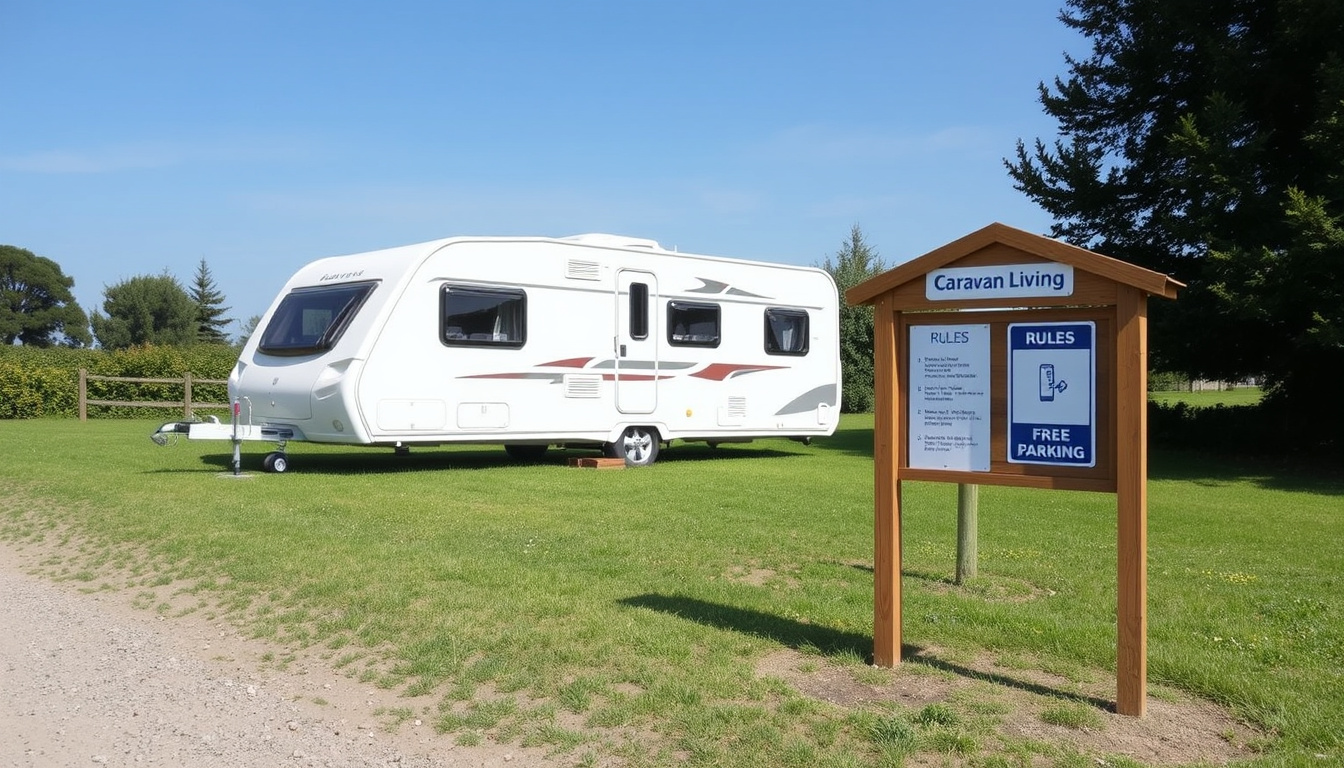
Anyone who’s dreamed of waking up to a different view every morning—or just wants a simpler weekend escape—knows that finding the right place to park your caravan can feel like a puzzle. Between public land stays, retailer lots, and seasonal parks, the rules vary more than you’d think. This guide walks through the key limits, free overnight options, and what it really takes to live in a caravan full‑time in the U.S.
14‑day limit (public lands): Most BLM and National Forest areas cap stays at 14 days within a 28‑day period ·
Overnight parking: Walmart and Cracker Barrel allow it at many locations, but it’s location‑specific ·
Full‑time living: Requires a residential park or private land with proper permits and utilities ·
Static caravan lifespan: 20–30 years with maintenance
Quick snapshot
- Dispersed camping on BLM land is limited to 14 days within a 28‑day period in many areas (U.S. Bureau of Land Management – camping guidance)
- National Forests allow dispersed camping with stay limits set by local ranger districts (USDA Forest Service – Know Before You Go)
- Walmart permits overnight RV parking at many stores, but the policy is set by local management (Walmart Corporate – Ask Walmart)
- Cracker Barrel allows RV parking at most locations when space is available, pending store‑manager approval (Cracker Barrel – RV Parking)
- Exact enforcement of the 28‑day rule (UK) varies by local authority; in the U.S. the 14‑day rule is common but not universal
- Whether a long‑term seasonal pitch can be used as a primary residence depends on local zoning and park rules
- Retailer policies (Walmart, Costco) are not uniform and can change without notice
- 14‑day stay limit on BLM and National Forest lands – after that you must move at least a certain distance
- State parks and Army Corps of Engineers sites typically have reservation caps (often 14–21 days)
- Monthly RV parks offer longer stays but require payment and adherence to park rules
- Research specific park or land agency rules before you go – use tools like The Dyrt’s public‑lands guide or Campendium
- Contact the store manager before overnight parking at retailers (The Dyrt’s public‑lands guide)
- If planning full‑time living, check local zoning laws and permit requirements (The Dyrt’s public‑lands guide)
Five key figures, one pattern: the most common stay limits across U.S. public and private land all cluster around two weeks, but the path to permanent living is much more complex.
| Rule / limit | Value | Source |
|---|---|---|
| BLM dispersed camping limit | 14 days within a 28‑day period in most areas | BLM Camping |
| National Forest stay limit | Set by local ranger district; typically 14–21 days | USDA Forest Service |
| Finger Lakes National Forest (NY) | 14‑day limit, setback from water and roads | Finger Lakes National Forest |
| Walmart overnight RV parking | Allowed at many stores, location‑specific | Walmart Corporate |
| Cracker Barrel RV parking | Allowed when space available, manager approval needed | Cracker Barrel |
| Army Corps of Engineers campgrounds | Stay limits vary by site; often 14–21 days | USACE Recreation |
| State park camping | Reservation caps, no indefinite living | NPS Camping Guidance |
| RV as primary residence on private land | Requires permits, utility approvals, or CO in many counties | FindLaw |
| Municipal street parking for RVs | Overnight occupancy often prohibited even when day parking allowed | Nolo |
What is the 10 year rule for caravans?
In the U.K., static caravans on non‑protected land generally must be removed after 10 years unless planning permission is obtained. In the U.S., there is no federal 10‑year rule, but state and local regulations often impose time limits on how long an RV can remain parked on private land or in certain zones. For instance, the California Department of Housing and Community Development (state building‑codes authority) classifies RVs used as dwellings differently from recreational vehicles, affecting permits and occupancy rights. Some counties require a certificate of occupancy before an RV can serve as a primary residence (FindLaw (legal resource)).
The 10‑year rule is U.K.‑specific. In the U.S., the constraint is not a fixed 10‑year count but a patchwork of zoning laws and park‑specific contracts that can force removal long before a decade passes.
What is the 28 day rule regarding camping?
- In the U.K., camping on land without planning permission is limited to 28 days per year. In the U.S., the equivalent is the 14‑day stay limit on Bureau of Land Management and National Forest lands (BLM camping policy).
- After 14 days, campers must move at least a certain distance (often 25 miles) before returning.
- Local ranger districts can set shorter or longer limits, so always check ahead.
What is the 85 rule for caravans?
- The 85% rule is a U.K. towing safety guideline from the RV Industry Association (trade organization) and motoring clubs: your caravan’s laden weight should not exceed 85% of your car’s kerb weight.
- In the U.S., the comparable recommendation is to keep trailer weight within the vehicle’s towing capacity as listed by the manufacturer.
What is the golden rule of camping?
- Leave No Trace. Pack out all trash, respect wildlife, and leave the site as you found it.
- This principle applies universally on public lands and is enforced by agencies like the U.S. Forest Service.
Overstaying a limit on public land can result in fines or a ban from that area. Knowing the golden rule and the specific stay limits of each site keeps you legal and preserves access for everyone.
Where can I permanently live in my caravan?
Permanent caravan living in the U.S. is possible but requires the right location and paperwork. Monthly RV parks marketed as “long‑term” or “all‑age” are a common route (RV Depot TX (RV dealership advice)). These parks offer full hookups and allow stays of months or years. On private land, you’ll need to check local zoning: many counties require a permit, utility approvals, or a certificate of occupancy before an RV can be used as a primary residence (FindLaw).
A monthly RV park gives you stability and amenities, but you trade the freedom of boondocking for a fixed address and recurring fees. On your own land, you gain independence but take on the burden of permits and utility setup.
Can you live in a holiday home all year?
- In the U.S., the answer depends on the park’s license. Seasonal parks often close during winter or restrict occupancy to 6–9 months.
- Residential parks (sometimes called RV resorts) are open year‑round and allow full‑time living. Always ask about the park’s status before signing a lease.
- Some states like California classify RVs used as dwellings under building codes, which can trigger additional requirements (California HCD).
The pattern: the legal label a park carries — seasonal vs. residential — determines whether you can truly treat it as a home, not just a storage spot.
Can I leave my caravan on a site all year?
On seasonal pitches, you can usually store your caravan on site year‑round, but habitation may be restricted during winter months. Many parks require the caravan to be removed or stored in a designated area when the park closes. Always read the contract carefully. For touring caravan sites, leaving the unit on the pitch outside the open season is often prohibited.
The implication: if you want year‑round storage with the option to stay occasionally, look for a site that offers “winter storage” alongside seasonal pitches. For full‑time living, only residential sites will do.
How long can you live on a caravan site?
Holiday and short‑stay parks typically limit continuous stays to 14–28 days, mirroring public‑land rules. Residential sites allow indefinite living provided you pay the fees and follow park rules. The key distinction is whether the site has a residential license – without one, the local authority can enforce occupancy limits. In the U.S., monthly RV parks often have a maximum stay of 6 months to avoid triggering landlord‑tenant laws, but some offer annual leases.
Some parks advertise “long‑term” but technically prohibit occupancy beyond 60–90 days. Always verify the legal status of the park with the local planning department before committing to a long stay.
The catch: a “long-term” label can mask seasonal restrictions, so never sign without confirming the park’s zoning classification.
Where can you sleep in a campervan for free?
Free overnight campervan parking in the U.S. falls into several categories:
- Public lands: BLM and National Forests offer dispersed camping for free (subject to the 14‑day limit). Use tools like Campendium (campground & boondocking directory) to find sites.
- Retailer lots: Walmart (Walmart Corporate) and Cracker Barrel (Cracker Barrel) allow overnight parking at many locations, but always check with the store manager. Costco and Sam’s Club generally do not allow overnight parking (Costco).
- Truck stops: Pilot/Flying J (Pilot Flying J) often have designated RV parking.
- Casinos and rest areas: Some casinos permit overnight parking; rest areas in many states allow short stops but may prohibit sleeping in vehicles.
The catch: free spots come with trade‑offs – no hookups, potential noise, and the need to move regularly. For a reliable free spot, public lands are the best bet, especially in western states where BLM holdings are large. In the East, free options are more limited (RVshare (RV rental marketplace) notes that New Jersey has limited dispersed camping).
How long does a static caravan last?
A static caravan (or “park model” in the U.S.) typically lasts 20–30 years with proper maintenance. Factors that affect lifespan include:
- Climate exposure (UV, moisture, snow load)
- Quality of initial construction and materials
- Regular maintenance (roof sealing, plumbing checks, pest control)
- Site conditions (drainage, wind protection)
According to the RV Industry Association (trade organization), proper care and winterization can extend the life significantly. If you’re buying a used static caravan, have a professional inspect the frame, roof, and seals before committing.
Upsides
- Lower cost than a traditional home – both upfront and monthly
- Flexibility to move if you choose a seasonal park
- Community atmosphere at many RV parks and resorts
- Ability to live mortgage‑free on a smaller footprint
Downsides
- Depreciation – static caravans lose value quickly
- Limited space and storage
- Legal restrictions on permanent occupancy in many areas
- Maintenance costs can add up, especially for older units
The trade-off is clear: lower up-front costs come with legal and spatial limits that a traditional home doesn’t impose.
Related reading: **Guildford Manor Hotel and Spa – Full Review and Stay Guide** · **Riu Oliva Beach Resort: Activities, Food & Dress Code Guide**
Frequently asked questions
What is the difference between a static and touring caravan?
A static caravan is designed to stay in one place – it’s larger, more home‑like, and usually has full amenities. A touring caravan is built for mobility, lighter, and towed behind a vehicle. Stay limits and regulations differ significantly: statics often require a seasonal or residential pitch, while tourers can use short‑stay campsites.
Do I need planning permission for a caravan on my own land?
In the U.S., yes – many counties require a permit, and some require a certificate of occupancy. Even on rural land, local ordinances can restrict how long an RV can be parked. Check with your county planning department before placing a caravan.
What are the typical costs of a seasonal pitch?
Seasonal pitch fees in the U.S. range from $2,000 to $7,000 per year, depending on location, amenities, and park quality. This usually includes water, sewer, and electricity hookups, plus access to park facilities.
Can I rent out my caravan when I am not using it?
Many parks prohibit subletting or commercial use. If you own the land, you may be able to rent the caravan short‑term, but check local short‑term rental regulations (many municipalities restrict it).
How do I find caravan sites near me?
Use online directories like Campendium, iOverlander (user‑generated database), or The Dyrt. For public land, the BLM and Forest Service websites have interactive maps. Always verify reviews and check recent updates.
What amenities do most caravan parks offer?
Typical amenities include full hookups (water, sewer, electricity), laundry facilities, showers, Wi‑Fi, and sometimes a pool or clubhouse. Higher‑end resorts may have gyms, playgrounds, and organized activities.
Is wild campervan parking legal in the UK?
Wild camping in England and Wales is generally illegal without the landowner’s permission, though Scotland has more permissive rights. In the U.S., dispersed camping on public lands is legal and widely practiced – just follow the stay limits and leave no trace.
For anyone looking to live the caravan lifestyle in the U.S., the choice is clear: embrace the mobility of touring or commit to a residential park for stability. The rules are manageable once you know where to look – check public‑land agencies for free stays, read park contracts closely for long‑term living, and always verify local zoning before making a permanent move.
Related stories





Freddie Carter is Senior Reporter at Insight Britain, covering breaking news and long-form explainers.