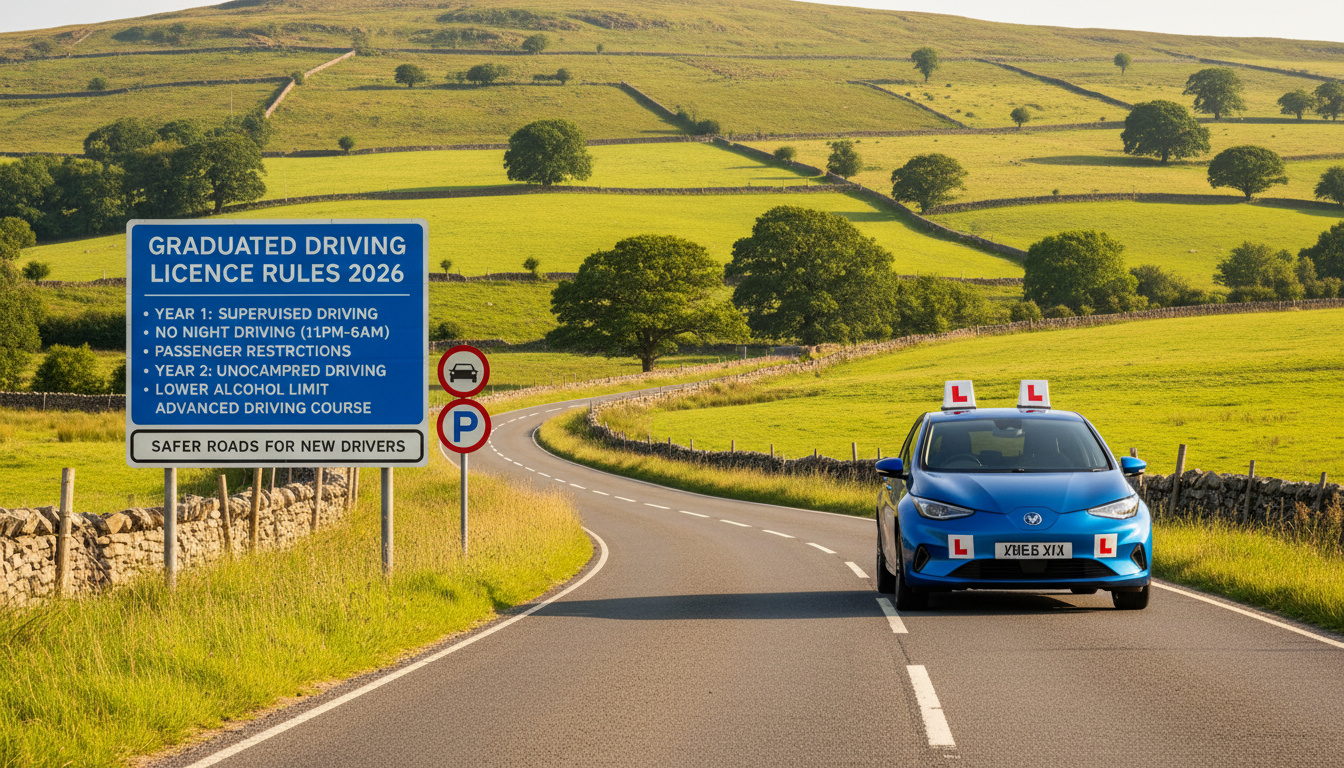
Northern Ireland will introduce the United Kingdom’s first Graduated Driver Licensing system on 1 October 2026, implementing mandatory training periods and night-time passenger restrictions targeting drivers aged 17 to 23. The scheme represents the most significant reform of driver licensing in the region for nearly 70 years, extending the post-test restriction period from twelve to twenty-four months while removing the previous forty-five mile per hour speed cap for newly qualified drivers.
Infrastructure Minister Liz Kimmins announced the framework following extensive consultation by the Department for Infrastructure, with the changes designed to address disproportionate collision rates among young motorists. Drivers in the 17-23 age group accounted for twenty-four percent of all fatal and serious road incidents in 2024 despite holding only eight percent of driving licences, prompting the structured approach proven in the United States, New Zealand, Sweden and the Republic of Ireland.
What Are Graduated Driving Licences?
Graduated Driver Licensing establishes a staged pathway from learner to fully unrestricted driver, imposing specific experience-building requirements and temporary operational limits during high-risk initial periods. Unlike standard provisional-to-full progression, GDL mandates structured education, extended supervised practice, and post-licence restrictions on passenger numbers and night-time driving.
Mandatory six-month learner period and fourteen-module digital logbook before test eligibility.
Twenty-four-month R-plate display requirement, distinguishing novices for twice the previous duration.
Passenger limits for under-24s between 11pm and 6am during initial six months post-test.
Evidence-based intervention targeting human factors like attitude and behaviour in young driver cohorts.
- The UK’s first GDL scheme launches exclusively in Northern Ireland on 1 October 2026.
- Target demographic (17-23) represents 24% of fatal/serious collisions while holding 8% of licences.
- R-plate display period doubles from twelve to twenty-four months.
- Fourteen compulsory learning modules recorded via mobile application or web browser.
- Night-time passenger restrictions apply to drivers under twenty-four for the first six months.
- Penalties reach £1,000 fines and three penalty points for non-compliance.
- Road deaths fell 19% in 2025 (56 versus 69 in 2024), supporting the strategy’s rationale.
| Component | Specification |
|---|---|
| Launch Date | 1 October 2026 |
| Jurisdiction | Northern Ireland (UK first) |
| Minimum Learner Period | 6 months holding provisional entitlement |
| Training Requirement | 14 modules in digital Logbook |
| Post-Test R-Plate Duration | 24 months (increased from 12) |
| Night Passenger Limit | Max one passenger aged 14-20 (11pm-6am) for under-24s |
| Maximum Fine | £1,000 |
| Penalty Points | 3 points for breaches |
| Announcing Authority | Infrastructure Minister Liz Kimmins |
| Strategic Framework | Road Safety Strategy to 2030 |
Are Graduated Driving Licences Coming to Northern Ireland?
The scheme is confirmed for implementation. Infrastructure Minister Liz Kimmins announced the 1 October 2026 launch date as the culmination of Department for Infrastructure consultation proposals, establishing Northern Ireland as the first UK region to adopt statutory GDL provisions. The reforms remove the previous 45 mph speed restriction for R-plate holders while introducing the new passenger and training mandates.
How Does This Compare to Great Britain?
While England, Scotland and Wales operate standard provisional and full licence categories without graduated phases, Northern Ireland’s system mirrors successful programmes in the Republic of Ireland, the United States, New Zealand and Sweden. This divergence creates distinct regulatory environments within the UK, requiring cross-border drivers to observe different rules when travelling between Northern Ireland and Great Britain. Vodafone Share Price UK – Current Levels and Key Metrics reflects broader infrastructure investments, though the GDL scheme remains specific to Northern Ireland’s road safety jurisdiction.
Current Legislative Status
The Department for Infrastructure published the Road Safety Strategy Action Plan on 27 January 2026, operationalising the GDL framework established through the 2024 consultation period. The 2024 GDL Monitoring Report provides baseline statistics for evaluating the scheme’s future impact, with annual assessments planned to measure effectiveness against the 2023 and 2024 datasets.
What Restrictions Would Graduated Licences Include in NI?
Mandatory Learning and Training Requirements
Prospective drivers must hold provisional car entitlement for a minimum six months before attempting the practical test, a requirement exempting motorcyclists but applying to all car licence applicants. Fourteen learning modules must be completed and recorded in a digital Logbook, accessible via mobile application or web browser, with sign-off required from an approved driving instructor or nominated supervisor such as a parent.
The post-test restriction period extends from twelve to twenty-four months. During the initial six months, new drivers must display a distinctively coloured R-plate, transitioning to the standard R-plate for the remaining eighteen months. This prolonged identification alerts other road users to novice status while eliminating the previous 45 mph speed limitation.
Night-Time Passenger Limitations
Drivers under twenty-four face strict passenger restrictions during the first six months post-test. Between the hours of 11pm and 6am, these drivers may carry a maximum of one passenger aged between fourteen and twenty. Exemptions apply for immediate family members or when a fully qualified driver aged twenty-one or older with three years’ experience occupies the front passenger seat.
The passenger limit does not apply when transporting siblings, parents, or children, nor when supervised by an experienced driver. Breaching these restrictions carries penalties of up to £1,000 and three penalty points.
Motorway Access and Testing
Learner drivers may access motorways when accompanied by approved instructors, a provision expanding practical training environments. Upon passing the test, new drivers may travel at posted speed limits, the removal of the 45 mph cap representing a significant change from previous Northern Ireland regulations.
Non-compliance with R-plate display rules, passenger limits, or logbook requirements attracts enforcement action. Offenders face maximum fines of £1,000 and three penalty points on their licence, with authorities using the digital registration system to identify graduated licence holders.
What Support Exists for the Scheme and What Are the Expected Benefits?
Official Endorsement
Minister Kimmins described the reforms as the most substantial driver licensing changes in nearly seventy years, positioning the Department for Infrastructure’s strategy as evidence-led and internationally benchmarked. Departmental publications emphasize structured exposure to risk during supervised periods rather than immediate unrestricted access.
Road Safety Rationale
The intervention targets behavioural and attitudinal factors prevalent in young driver populations. Departmental statistics indicate the 17-23 cohort’s overrepresentation in serious incidents justifies extended phased introduction to high-risk driving conditions. The 19% reduction in overall road deaths during 2025 provides contextual support for enhanced safety measures, though causation requires ongoing monitoring.
When Will Graduated Licences Start and How Will Implementation Proceed?
-
GDL Monitoring Report published, establishing baseline statistics for evaluation frameworks.
-
Road Safety Strategy Action Plan published, detailing immediate preparatory measures.
-
GDL scheme launches, requiring all new car licence applicants to comply with six-month learner periods and fourteen-module logbooks.
-
First cohort of graduated drivers enters the twenty-four-month R-plate phase with night-time passenger restrictions.
-
Annual monitoring reports track collision rates among GDL cohorts versus historical data.
What Is Definitive and What Awaits Further Detail?
| Established Provisions | Monitoring and Review Areas |
|---|---|
| Launch date fixed at 1 October 2026 | Specific enforcement protocols for complex exemption scenarios |
| Six-month minimum learner period | Real-world effectiveness of digital logbook completion rates |
| Fourteen compulsory training modules | Long-term behavioural impact on the 17-23 age cohort |
| Twenty-four-month R-plate display | Potential adjustments to passenger limit exemptions based on data |
| £1,000 maximum fine and 3 penalty points | Correlation between GDL phases and insurance premium adjustments |
| Night passenger curfew 11pm-6am (under-24s, first 6 months) | Comparative analysis with Republic of Ireland’s system outcomes |
Why Is Northern Ireland Leading on Driver Licensing Reform?
The Department for Infrastructure identified graduated licensing as central to the Road Safety Strategy to 2030 following decades of international evidence demonstrating reduced collision rates among young drivers subject to phased access. Northern Ireland’s distinct legal jurisdiction enabled legislative progression ahead of Great Britain, where similar proposals remain under consideration.
The strategy addresses human factors—particularly risk tolerance, peer influence, and night-time exposure—that traditional testing regimes fail to modify. By mandating extended supervision and structured learning modules, the system delays independent access to high-risk scenarios until drivers accumulate measurable experience.
What Do Officials Say About the New System?
The introduction of Graduated Driver Licensing will be the most significant reform of driver licensing in almost seventy years. It will save lives and reduce serious injuries by ensuring our most vulnerable drivers are better prepared for the demands of the road.
— Liz Kimmins, Infrastructure Minister
The evidence from other jurisdictions is clear: structured training and phased access reduce collisions among young drivers by addressing the attitudes and behaviours that put them at risk.
— Department for Infrastructure
What Should Northern Ireland’s New Drivers Prepare For?
Learners and prospective drivers should anticipate a minimum six-month provisional period, completion of fourteen digital training modules, and strict adherence to passenger limitations during night-time hours for the first six months post-licence. The extended twenty-four-month R-plate requirement demands sustained compliance, though the removal of the forty-five mile per hour speed cap offers increased practicality. Drink Drive Limit Calculator – UK Limits and BAC Guide provides additional regulatory context for those preparing for the new licensing era.
Frequently Asked Questions
How do graduated licences work in other countries?
The United States, New Zealand, Sweden and the Republic of Ireland operate similar schemes featuring learner periods, passenger limits, and night-time curfews for young drivers, consistently showing reduced collision rates among novice motorists.
Will the new rules affect drivers who already hold licences?
No. The GDL requirements apply only to new applicants testing on or after 1 October 2026. Existing full licence holders remain under standard regulations.
Who can sign off the fourteen training modules?
Approved driving instructors or nominated supervisors, typically parents or guardians aged twenty-one or older with three years’ full licence experience, may verify logbook entries.
What happens if I drive without completing the logbook?
Candidates cannot sit the practical test without demonstrating six months’ provisional entitlement and fourteen completed modules, verified through the digital system.
Are motorcyclists subject to the same restrictions?
No. The six-month minimum learner period applies specifically to car licence applicants; motorcyclists follow separate provisional testing requirements.
Can I appeal a penalty for breaking passenger limits?
Standard penalty appeal procedures apply to GDL breaches, though the £1,000 fine and three point endorsement are statutory maximums subject to court discretion.
Will GDL restrictions apply when driving in Great Britain?
Northern Irish licence holders must comply with their licence conditions regardless of jurisdiction, though enforcement mechanisms rely on vehicle registration recognition systems currently implemented only in Northern Ireland.
Related stories





Marcus Walsh is Politics & Public Affairs Editor, covering Westminster, councils and public policy.