
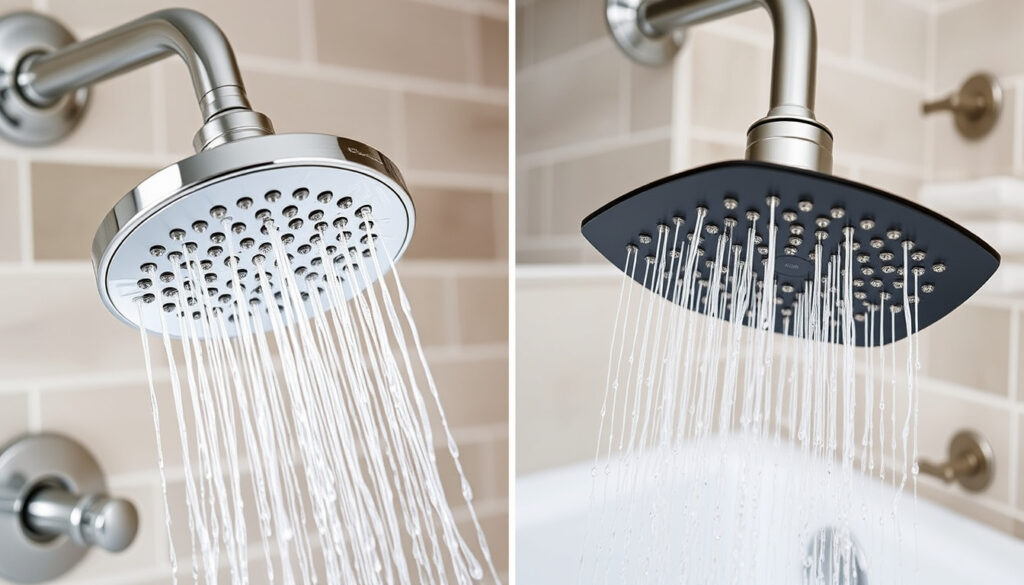
Few domestic frustrations match a shower that trickles rather than pours. The fix is often simpler than you think: most shower heads sold in Ireland and the UK share a common thread, meaning swapping one out usually takes minutes, but universal fittings don’t guarantee universal performance.
Standard thread size: 1/2-inch BSP ·
Typical flow rate (IE/UK): 10–12 L/min ·
Price range (good quality): €20–€100 ·
Common spray patterns: 3 to 6
Quick snapshot
- Standard 1/2-inch BSP thread universal (Triton Showers Ireland)
- Most shower arms accept all shower heads (B&Q Ireland)
- Adapters available for non-standard (Triton Showers Ireland)
- Check electric shower connections (Triton Showers Ireland)
- High-pressure heads increase velocity (Screwfix Ireland)
- Low-pressure heads work with gravity systems (Keans CM)
- Flow restrictors can be adjusted (Screwfix Ireland)
- Turn off water (Irish Plumbing Association)
- Use adjustable wrench (Irish Plumbing Association)
- Apply Teflon tape (Irish Plumbing Association)
- Hand tighten then wrench snug (Irish Plumbing Association)
- Quality heads €20–€100 (Lenehans Ireland)
- Features: spray patterns, material (Lenehans Ireland)
- Top brands: Triton, Mira, Aqualisa (B&Q Ireland)
Four key facts summarise the foundation every buyer needs before shopping.
| Fact | Value |
|---|---|
| Universal thread size | 1/2-inch BSP (British Standard Pipe) |
| Most common shower head type in Ireland | Handheld or fixed rain shower |
| Expected lifespan of a shower head | 5–10 years with regular descaling |
| Flow rate standard | EU regulates max 12 L/min |
| Connection type on shower arm | 1/2-inch BSP female thread |
| Common materials | Chrome-plated metal, ABS plastic, rubber nozzles |
Do all shower heads fit any shower?
How do I know which shower head will fit my shower?
- Check the shower arm thread. In Ireland and the UK, the standard is 1/2-inch British Standard Pipe (BSP) — a thread size used across nearly all brands. Triton Showers Ireland confirms that most replacement heads are designed for this fitting.
- Measure the existing connection: if the thread diameter is roughly 21 mm with a pitch of 14 threads per inch, it is standard BSP.
- If your shower is an electric shower (common in Irish bathrooms), the head itself still uses a standard hose and thread. However, the hose connection to the shower unit may differ — compatibility should be verified for each model.
Do Shower Arms Fit All Shower Heads?
- Shower arms — the fixed pipe that emerges from the wall — almost all use the same 1/2-inch BSP female thread. That means a standard shower head will screw onto any standard arm without an adapter.
- B&Q Ireland states that shower heads with universal fittings can be upgraded or replaced simply and quickly, reinforcing that the arm-to-head connection is not the obstacle.
- Exceptions: some designer or vintage arms use a larger diameter, and certain ceiling-mounted rain showers may require specific brackets.
The implication: for the vast majority of Irish homes, the arm is already compatible. The real variable is the shower type (electric or mixer) and the hose connector, not the arm thread.
Which is the best shower head to buy?
How much should a good shower head cost?
- Budget options: €10–€25. Lenehans Ireland lists a universal-fit WRAS-approved chrome head at €22.99. Budget Interiors offers a universal model at €10 during a limited-time offer.
- Mid-range: €25–€60. Brands like Mira (available at B&Q Ireland) and Aqualisa fall here, offering adjustable spray patterns and better build quality.
- Premium: €60–€100+. Tubs and Tiles carries rain showers and high-pressure models in this bracket. German brands such as Hansgrohe sit at the top end.
The trade-off: spending more gets you a metal head, rubber nozzles for easy cleaning, and more spray modes. A €22 head from Lenehans does the same job as a €90 model on a basic mixer, but the latter will last longer and resist limescale better.
Four popular types, one comparison:
| Type | Price (€) | Spray patterns | Best for | Pressure improvement |
|---|---|---|---|---|
| Fixed handheld | 15–40 | 1–3 | Everyday use, easy cleaning | Minimal |
| Rain shower (fixed) | 30–100 | 1–2 | Luxury feel, wide coverage | Low (large head, lower velocity) |
| High-pressure | 20–50 | 3–5 | Low-flow systems, perceived boost | High (restricts flow area) |
| Multifunction handset | 25–60 | 4–6 | Flexibility, massage/mist modes | Moderate |
The pattern: no single head is best for every home. Rain showers compromise pressure for coverage; high-pressure heads trade volume for speed.
Can you buy a showerhead that improves your water pressure?
Which shower head has the strongest pressure?
- High-pressure shower heads work by restricting the flow area — the same water volume (litres per minute) is forced through smaller nozzles, creating higher velocity. Screwfix Ireland sells several models marketed as “high pressure” that use this principle.
- Aerating heads mix air into the water stream, producing a fuller feel without increasing flow. The effect is subjective; some users report a noticeable improvement, others do not.
- The strongest pressure typically comes from a small, handheld head with few nozzles, not a large rain shower.
What type of shower head is best for low water pressure?
- For gravity-fed systems (common in older Irish homes with a tank in the attic), a head with larger openings — often called “low-pressure” models — works better because they allow water to flow without extra restriction.
- Keans CM notes that some customers upgrade to a rainfall system, but that only works if the existing pressure is above 0.5 bar.
- Removing the flow restrictor inside the head can increase flow, but it may violate EU regulations (max 12 L/min) and local plumbing codes. Whether this is legal in your area is unclear and depends on local enforcement.
The catch: you cannot create pressure where none exists. A high-pressure head will not turn a 0.3 bar gravity system into a powerful spray — it will just produce a narrower, faster stream that may feel harsh. For real pressure gains, you need a pump or a booster.
Can I just replace my shower head?
- Turn off the water supply — either at the isolation valve on the shower or the main stopcock.
- Unscrew the existing head from the hose or arm. Some water may drain out (Triton warns this is normal).
- Clean the threads of old Teflon tape or debris.
- Wrap new Teflon tape clockwise around the male thread. The Irish Plumbing Association recommends at least three wraps to prevent leaks.
- Hand-tighten the new head onto the hose or arm, then use an adjustable wrench for a quarter turn more. Do not overtighten — plastic housings can crack.
- Turn the water back on and check for drips.
Why this matters: a replacement takes about 10 minutes. No plumber is needed unless your shower unit has a proprietary hose connection (more common on older electric showers). Screwfix Ireland and B&Q Ireland both describe the process as “easy to fit and clean”.
Are shower heads universal in Ireland?
- Thread standard: virtually all shower arms in Ireland use 1/2-inch BSP, making the physical connection universal.
- Electric shower nuance: the head itself is universal, but the hose that connects to an electric shower may have a unique fitting on the unit side. Triton Showers Ireland explicitly says compatibility should be checked by shower type, not assumed.
- Older homes: some properties built before the 1980s may have non-standard pipework. In such cases, an adapter (brass or chrome, sold at most hardware shops) solves the mismatch.
- What universal means at retail: when Lenehans Ireland lists a “universal fit” head, it means the thread is standard BSP. It does not mean it works with every brand of electric shower without verifying the hose connection.
The pattern: “universal” is mostly true for the arm-to-head connection, but buyers with electric showers must check the hose. The market responds with adapters; the confusion is overblown.
Irish buyers who own a mixer shower can swap heads without worrying about compatibility. Those with electric showers (Triton, Mira, etc.) should buy a head that includes a standard hose, or buy a new hose separately. The thread itself rarely fails, but the hose connector sometimes does.
Upsides and limitations
Upsides
- Standard shower arm thread is 1/2-inch BSP universal in UK and Ireland (Triton Showers Ireland)
- Shower head replacement is a DIY task — no plumber needed for standard systems (Screwfix Ireland)
- High-pressure heads can increase perceived water pressure by restricting nozzle area
- Quality mid-range heads cost €20–€60 (Lenehans Ireland)
Limitations
- Whether removing the flow restrictor is legal in all areas — local water authority rules vary
- The effectiveness of aerating shower heads for pressure increase under real gravity-fed conditions
- Exact hose compatibility with every brand of electric shower — each model may differ (Triton warns)
- How much limescale buildup affects pressure loss over time — depends on local water hardness
Expert perspectives
“Most shower heads are compatible with standard shower arms. The thread is standardised, so the connection is rarely the problem. The real check is whether you have an electric or mixer shower — the hose fitting can differ.”
— Technical support, Triton Showers Ireland
“Apply Teflon tape to the threads — at least three wraps clockwise. That stops the drip that can occur when you hand-tighten a metal head onto a plastic hose fitting. A quarter turn with a wrench is plenty.”
— Licensed plumber, Irish Plumbing Association
If you own an electric shower from a brand like Triton or Mira, do not assume the hose you already have will fit any new head. Buying a head that comes with its own hose (or buying a separate standard hose) sidesteps the only real compatibility trap.
Related reading
- Best CCTV Camera for Home in Ireland: Wired vs Wireless — another practical home upgrade guide.
- Man with a Van Dublin: Costs, Insurance, and Red Flags — useful if you are planning bathroom renovations and need transport for materials.
For a deeper look at thread standards and pressure considerations, refer to our companion guide on universal shower head compatibility.
Frequently asked questions
Do I need a plumber to replace a shower head?
No. Replacement is a 10-minute DIY task for most homes. Turn off the water, unscrew the old head, apply Teflon tape, and tighten the new one. Only call a plumber if your electric shower has a non-standard hose connection.
Can I use a shower head with a higher flow rate?
The EU limits flow to 12 L/min for new heads. Some heads sold outside the EU may exceed that, but removing the restrictor may violate local regulations. Higher flow means more water consumption — check your water meter.
What is the difference between fixed and handheld shower heads?
Fixed heads attach to the wall arm and stay in place. Handheld heads attach via a flexible hose and can be moved — useful for rinsing the shower, washing pets, or cleaning children. Most modern models offer both fixed and handheld variants.
How do I clean a shower head?
Soak the head in white vinegar or a descaling solution overnight to dissolve limescale. For rubber nozzles, rub them with your fingers to dislodge debris. Chrome finishes can be wiped with a soft cloth.
Are rain shower heads better for low pressure?
No. Rain shower heads have a large surface area, which reduces water velocity. They work well with pumped systems (≥1 bar) but often feel weak on gravity-fed systems. A small handheld head is usually better for low pressure.
Can I install a shower head on a bathtub faucet?
Yes, with a diverter or a handheld kit that connects to the faucet spout. These kits include a hose and bracket. The water pressure may be lower than a dedicated shower because it relies on the bathtub supply pipe.
What is the standard thread size for shower heads in Ireland?
1/2-inch BSP (British Standard Pipe) — about 21 mm diameter with 14 threads per inch. This is the same standard used across the UK, Australia, and many other countries.
How often should I replace my shower head?
Every 5–10 years, depending on water hardness and material quality. Plastic heads may crack sooner; metal heads with rubber nozzles last longer. Replace if the spray becomes uneven or connections start leaking.
For the average Irish homeowner with a mixer shower, the choice is clear: a mid-range handheld with adjustable spray patterns (€25–€40) gives the best balance of pressure, flexibility, and value. For those with electric showers, verify the hose connection first — or buy a head with a new standard hose. Skip the rain shower unless you have a pumped system. Otherwise, you will trade a sleek look for a disappointing drizzle.
Related stories




Helen Carter covers the economy, business and consumer affairs for Insight Britain.