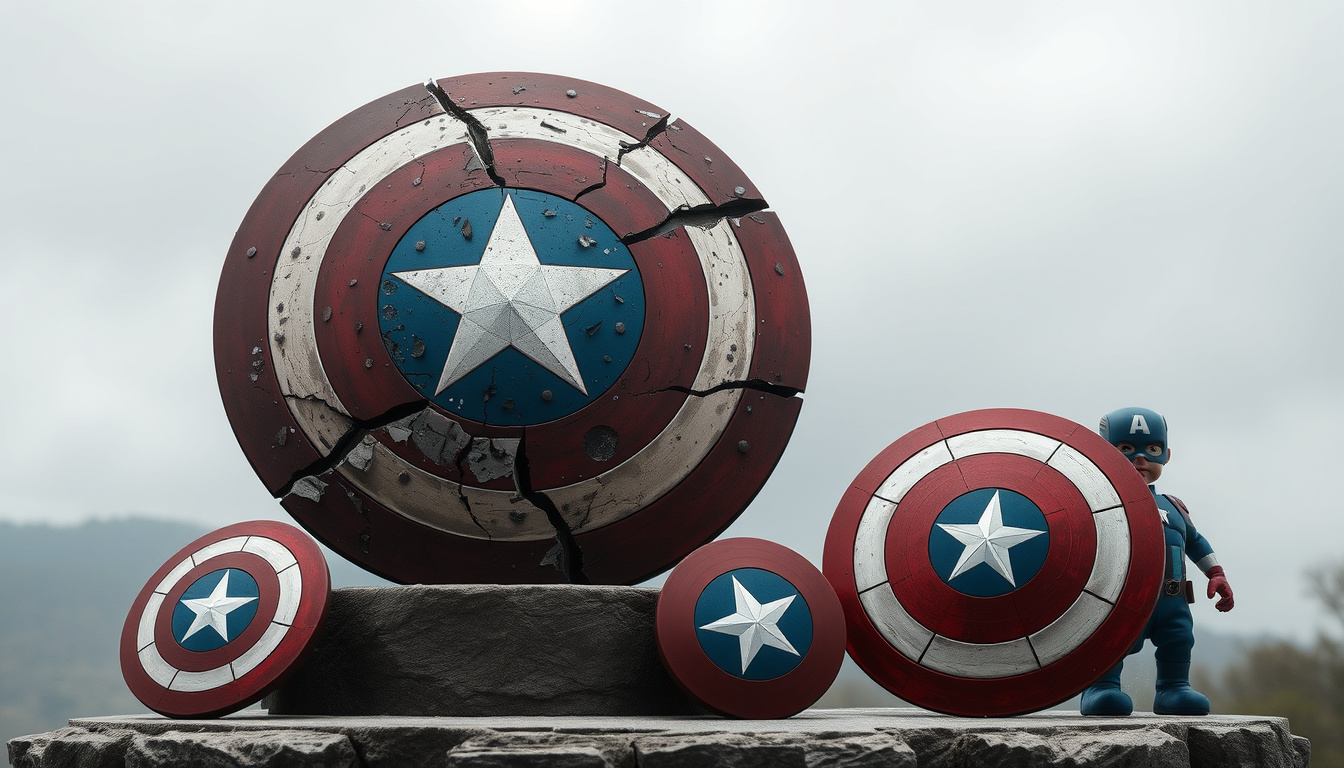
Even people who have never opened a comic know the picture: a star-spangled soldier with a round shield, planted in the middle of a fight that everyone else is running from. Captain America has held that ground since March 1941, when Joe Simon and Jack Kirby introduced Steve Rogers in Captain America Comics #1.
First Comic Appearance: Captain America Comics #1 (March 1941) · Creators: Joe Simon and Jack Kirby · Alter Ego: Steven ‘Steve’ Rogers · Marvel Cinematic Universe Debut: Captain America: The First Avenger (2011) · Number of Solo MCU Films: 3 (plus multiple Avengers appearances)
Quick snapshot
- Steve Rogers received the Super-Soldier Serum during World War II and became Captain America (Marvel’s official character profile).
- Bucky Barnes served as Captain America’s sidekick during WWII missions (Marvel’s official character profile). (Marvel’s official character profile)
- Captain America joined the Avengers in The Avengers #4 after the team revived him from suspended animation (Marvel’s official character profile). (Marvel’s official character profile)
- Whether Steve Rogers had children with Peggy Carter after Avengers: Endgame is implied, not confirmed (Nerdist’s Marvel media coverage).
- How vulnerable Captain America is to psychic attacks changes from writer to writer (Marvel’s official character profile). (Nerdist’s Marvel media coverage)
- Which version of Steve Rogers’s family “counts” depends on which continuity you are reading (Nerdist’s Marvel media coverage). (Nerdist’s Marvel media coverage)
- March 1941 — first appearance in Captain America Comics #1 (Marvel’s official character profile). (Encyclopaedia Britannica’s Avengers history)
- July 22, 2011 — MCU debut in Captain America: The First Avenger (Encyclopaedia Britannica’s Avengers history).
- April 26, 2019 — retirement in Avengers: Endgame (Nerdist’s Marvel media coverage). (Encyclopaedia Britannica’s Avengers history)
- February 14, 2025 — Captain America: Brave New World with Sam Wilson (Marvel’s Sam Wilson profile).
- Sam Wilson is the current Captain America in the MCU (Marvel’s Sam Wilson profile).
- Steve Rogers is retired, not dead — the shield has a new hand (Encyclopaedia Britannica’s Avengers history).
- Sam Wilson headlines the next Captain America film, Brave New World, on February 14, 2025 (Marvel’s Sam Wilson profile).
Eight identifiers, one pattern: one serum, one shield, and a standard that keeps resetting in every decade.
| Label | Value |
|---|---|
| Real name | Steven Grant Rogers |
| First comic | Captain America Comics #1 (1941) (Marvel’s official character profile) |
| Creators | Joe Simon and Jack Kirby |
| First movie | Captain America: The First Avenger (2011) (Encyclopaedia Britannica’s Avengers history) |
| Portrayed by | Chris Evans (MCU) |
| Primary weapon | Vibranium shield (Marvel’s official character profile) |
| Sidekicks | Bucky Barnes, Sam Wilson (Marvel’s official character profile) |
| Children (comics) | Steve Rogers Jr. (alternate timeline) (Nerdist’s Marvel media coverage) |
What are Captain America’s weaknesses?
Short version: the serum made Steve Rogers exceptional, but it never made him invulnerable. The more interesting part is which weaknesses actually matter when he fights, and which ones villains keep exploiting.
Physical limitations without the serum
- The Super-Soldier Serum enhanced Steve Rogers’s strength, speed, agility, endurance, reflexes, durability, and accelerated recovery (Marvel’s official character profile).
- The same profile states the serum did not make him invulnerable (Marvel’s official character profile).
- He is not a mutant; the serum is his only power source.
Marvel’s official profile lists exactly what the Super-Soldier Serum gave Captain America: enhanced strength, speed, agility, endurance, reflexes, durability, and recovery. What it did not give him was a force field. Powerful physical attacks, energy weapons, toxins, magic, psychic attacks, and restraints can all take him down, depending on the story and the writer.
That ceiling is why so many Captain America fights are tactical rather than brawls. He cannot out-tank the Hulk or out-magic Thor, so he has to out-think them.
Psychological vulnerabilities
- His morality and compassion are consistent exploitable angles for villains.
- His loyalty makes his next move predictable.
Steve Rogers’s real weak spots have always been the things the serum never touched. He will step in front of a threat before he calculates the cost. He will risk a mission to save one person. Villains have used that for decades, because a man who refuses to sacrifice others is a man whose options the bad guys can predict.
This is what separates him from soldiers who just hit harder: his compassion is a tactical opening, and the stories know it.
Strategic weaknesses
- Losing the shield reduces his tactical options, even though his enhanced body remains (Marvel’s official character profile).
- His enhanced body still ages; the serum does not grant immortality.
Marvel’s profile describes the shield as Captain America’s primary defensive and offensive tool. Without it, Steve is still a peak-level fighter, but he loses his best way to control distance, deflect gunfire, and end fights without killing. In a battle, that is a real drop in options.
Time also keeps scoring against him. The serum keeps him in the fight far longer than a normal human, but it does not stop aging — which is why the MCU could show him growing old and handing the shield to Sam Wilson.
Every physical advantage Steve Rogers gained comes with an opening: because he is built to protect, villains can always exploit the one thing the serum never touched — his willingness to stand in front of the blast.
The implication: Captain America’s true vulnerabilities are moral, not muscular. Take the shield away and he can still fight; put an innocent in danger and he will hand the villain exactly the opening they want.
Who are some of Captain America’s sidekicks?
Captain America’s sidekick history is really a history of partners outgrowing the label. Two names matter most: the original wartime kid and the man who eventually took the shield.
Bucky Barnes (Winter Soldier)
- Bucky Barnes was a young ally who served as Captain America’s sidekick during World War II (Marvel’s official character profile).
- Marvel notes Bucky had formidable skills of his own — he was not a powerless companion (Marvel’s official character profile).
- He survived Baron Zemo’s plane explosion and was later brainwashed by Russian operatives into becoming the Winter Soldier (Marvel’s official character profile).
Bucky is the original sidekick, introduced as a young partner fighting alongside Steve Rogers on WWII missions. Marvel is careful to frame him as formidable in his own right, even before Soviet brainwashing turned him into the Winter Soldier. That transformation ended the neat “kid sidekick” dynamic: after the Winter Soldier years, Bucky and Steve relate as equals who keep rescuing each other.
Sam Wilson (Falcon)
- Sam Wilson, originally Falcon, became one of Captain America’s principal partners (Marvel’s Sam Wilson profile).
- Sam later operated as Captain America in multiple Marvel continuities (Marvel’s Sam Wilson profile).
- In 2014, Sam took over the Captain America title in the comics.
Sam Wilson began as Falcon, a hero who flew with a mechanical wing harness, and became Captain America’s closest partner. Marvel’s Sam Wilson profile places him among the characters who have worn the stars and stripes themselves, and the 2014 comic relaunch made him the official Captain America. In the MCU, Steve hands him the shield after Endgame, and Sam headlines Captain America: Brave New World in February 2025.
- Sharon Carter is a recurring partner and ally of Steve Rogers, but Marvel does not classify her as a sidekick (Marvel’s Sharon Carter profile).
Is Captain America still an Avenger?
The honest answer depends on which Captain America you mean. The MCU retired Steve Rogers; the comics kept him in rotation; Sam Wilson is the current titleholder in both worlds.
MCU status post-Avengers: Endgame
- Steve Rogers retired at the end of Avengers: Endgame, released April 26, 2019 (Encyclopaedia Britannica’s Avengers history).
- Sam Wilson is the current Captain America in the MCU (Marvel’s Sam Wilson profile).
- Steve’s retirement implies a full life with Peggy Carter, but the movies never show it directly.
In the Marvel Cinematic Universe, Steve Rogers’s story ended with a choice rather than a funeral. Avengers: Endgame sends him back in time to live with Peggy Carter, and he returns as an old man to pass the shield to Sam Wilson. He is alive in that universe — he simply left the roster.
That makes the MCU’s answer simple: the title Captain America is still an Avenger; Steve Rogers is not, because he chose a different mission.
- Jeremy Renner: Hawkeye, Accident, Family & Latest Updates — the MCU’s veteran archer, his near-fatal accident, and the recovery road since.
- Martin Freeman: Religion, MCU Role, Relationships & Net Worth — the actor whose MCU character sits inside the same political machinery that Captain America keeps crashing into.
Comic continuity
- The Avengers debuted in The Avengers #1, cover-dated September 1963 (Encyclopaedia Britannica’s Avengers history).
- The original lineup was Iron Man, Thor, Hulk, Ant-Man, and Wasp (Marvel’s Avengers team page).
- Captain America joined in The Avengers #4 after the team revived him from suspended animation (Marvel’s official character profile).
Comic continuity tells a different story. The Avengers formed in 1963 with Iron Man, Thor, Hulk, Ant-Man, and Wasp — no Captain America. He joined in The Avengers #4, when the founding group found him frozen and brought him back to active life. Since then, Steve has left and rejoined multiple times, and Marvel has repeatedly used him as the team’s moral anchor when the lineup gets too tangled.
In the comics’ current status quo, Steve Rogers is active and a recurring Avenger. Sam Wilson is the living symbol of the title in the MCU. The shield is still Avengers property; the original arm behind it retired.
Who are the children of Captain America?
Short answer: none in the main Marvel timeline, several everywhere else. This is one of those questions where “canon” depends entirely on which universe you ask.
Biological children in comics
- In the main Earth-616 continuity, Steve Rogers is generally unmarried and without biological children in the modern status quo (Nerdist’s Marvel media coverage).
- Alternate universes and future settings do give Steve Rogers children (Nerdist’s Marvel media coverage).
- The MCU implies he had children with Peggy Carter after Endgame, but none is shown on screen (Nerdist’s Marvel media coverage).
The most accurate answer is “it depends on the universe.” In the core Earth-616 continuity, Marvel keeps Steve Rogers single and childless in the modern status quo, despite the long history of romantic subplots in his books. Nerdist’s breakdown of Captain America’s children across Marvel media walks through the same conclusion: the main timeline has no kids; the surrounding universes have plenty.
In the MCU, the implication is there but the camera never confirms it. Endgame sends Steve back to live a full life with Peggy Carter, which Marvel’s wider storytelling treats as exactly that — a full life — but no child is ever named or shown on screen.
Relevant multiverse versions
- Earth-8342 includes Steven Rogers Jr. and Nicky Rogers as Steve’s children (Nerdist’s Marvel media coverage).
- Next Avengers: Heroes of Tomorrow introduces James Rogers, son of Steve and Natasha Romanoff (Nerdist’s Marvel media coverage).
- Alternate material also includes Sarah Rogers and a character named Sharon Rogers — not to be confused with Sharon Carter (Nerdist’s Marvel media coverage).
Once you leave the main timeline, Captain America’s family tree gets busy. Earth-8342 gives him Steven Rogers Jr. and Nicky Rogers. The animated film Next Avengers: Heroes of Tomorrow gives him James Rogers, the son of Steve and Natasha Romanoff. And alternate material adds Sarah Rogers plus a Sharon Rogers who is a different character from Sharon Carter entirely.
None of these children appear in Earth-616’s modern stories. They are what-if versions — proof that Marvel likes testing how Steve’s life changes when he gets the domestic ending his main timeline keeps denying him.
Marvel keeps Steve Rogers deliberately unattached on the main timeline, then hands him a family in nearly every alternate universe — the character’s children only exist where the story is explicitly not the canon.
The trade-off: giving Steve children in alternate universes lets Marvel explore a version of him who gets a happy ending, without disturbing the lonely soldier who anchors the core comics. The family he cannot have is what makes the families he does have in other worlds feel meaningful.
The implication: Steve Rogers’s family remains a narrative variable across the multiverse.
Is Red Skull actually Captain America’s son?
No. The rumor survives because Marvel once told a clone story that people keep summarizing as a son story — and that summary game turned into fan canon.
Origin of the rumor
- Red Skull is not Captain America’s biological son in mainstream continuity.
- The confusion comes from the 2010 storyline Steve Rogers: Super Soldier #1-4, which involves a clone.
- The clone is sometimes called “Captain America’s son” but is not Red Skull.
In the primary Marvel timeline, Red Skull and Captain America share a rivalry, not a bloodline. The mix-up dates to 2010’s Steve Rogers: Super Soldier, a storyline in which a clone of Steve Rogers is created. Some summaries describe that clone as “Captain America’s son,” which is a loose reading of the story — and the clone is a separate character from Red Skull.
Comic facts
- Red Skull was created as a villain, not as a family member.
- The “son” label applies to a clone, never to Red Skull.
The reason the rumor circulates is that Red Skull and Captain America are already so bound together that a father-son framing feels inevitable. Red Skull is the wartime villain Captain America was created to stop, a mirror image of everything Steve Rogers refuses to be. The comics never made that rivalry biological.
The pattern: comic book rumors usually start with a kernel of real story — a clone, a retcon, a trick timeline — and the kernel gets flattened into something simpler every time it is repeated. “Captain America has a son” is the flattening; the source material is a clone, a different character, and a 2010 story that most fans never read.
Captain America through the decades
Six dates, one pattern: Captain America keeps disappearing, being found, and being handed to the next person who needs him — usually with the same shield.
| Date | Event |
|---|---|
| March 1941 | First appearance in Captain America Comics #1 (Marvel’s official character profile) |
| 1964 | Revived by the Avengers from suspended animation in The Avengers #4 (Marvel’s official character profile) |
| July 22, 2011 | MCU debut in Captain America: The First Avenger (Encyclopaedia Britannica’s Avengers history) |
| 2014 | Sam Wilson becomes Captain America in the comics (Marvel’s Sam Wilson profile) |
| April 26, 2019 | Steve Rogers retires in Avengers: Endgame (Encyclopaedia Britannica’s Avengers history) |
| February 14, 2025 | Captain America: Brave New World, with Sam Wilson as the title hero (Marvel’s Sam Wilson profile) |
The takeaway: every generation of Marvel has found a reason to pull Captain America out of storage. The character works because each revival asks the same question — what does this soldier owe the people he protects? — and the answers keep changing.
Confirmed facts about Captain America — and what’s still unclear
Many Captain America debates boil down to continuity mixing: someone quotes a multiverse story as if it were the main timeline. This split keeps the record straight.
Confirmed facts
- Steve Rogers received the Super-Soldier Serum during World War II (Marvel’s official character profile).
- Bucky Barnes was Captain America’s sidekick during WWII (Marvel’s official character profile).
- Red Skull is not Captain America’s biological son in mainstream continuity.
What’s unclear
- Whether Steve Rogers had children with Peggy Carter after Endgame — implied, not shown (Nerdist’s Marvel media coverage).
- How far Captain America’s vulnerability to psychic attacks extends — it shifts with each writer (Marvel’s official character profile).
- Which version of Steve’s family tree counts — Earth-616, Earth-8342, or an animated future (Nerdist’s Marvel media coverage).
- What comes next for Sam Wilson’s Captain America after Brave New World — the MCU slate keeps shifting.
What this means: before you repeat any Captain America claim, ask which universe it comes from. The MCU, Earth-616, and a dozen alternate worlds all have different answers — none of them is wrong, exactly, but they are not interchangeable.
In their own words: what Captain America’s creators knew
Captain America is rare among superheroes: the people who invented him explained why at the moment of creation, and the explanation held up for 80 years.
“The time was right for a patriotic hero.”
Joe Simon, co-creator
Simon said that about the character’s 1941 launch — a moment when a star-spangled hero resonated because the world was already at war.
“He represents the best of us.”
Stan Lee, former Marvel editor
Lee said that decades later, long after Captain America had become a symbol bigger than any single war. The two quotes bookend the character: born as a wartime recruit, reborn as a moral compass.
What this means: Cap worked in 1941 because he said what people needed to hear, and he worked again in the 1960s because he stood for something larger than punching. Simon and Lee are describing the same character at two stages of the same idea.
The future of Captain America
Steve Rogers spent 80 years proving the shield matters less than the person raising it. Sam Wilson now has to prove that a person without the serum can carry the same moral weight — and Marvel has bet a full film slate on that idea. For Marvel Studios, the calculation is straightforward: if Captain America: Brave New World lands, the franchise has a new anchor for its next decade of Avengers films. If it does not, the studio will have to explain why the universe’s most reliable hero stopped working the moment the original soldier retired.
marvel.fandom.com, en.wikipedia.org, ign.com, nerdist.com, marvel.com, en.wikipedia.org
Frequently asked questions
What is Captain America’s shield made of?
Vibranium — a nearly indestructible fictional metal. Marvel’s official profile describes the shield as Captain America’s primary defensive and offensive tool (Marvel’s official character profile).
How did Captain America get his powers?
Steve Rogers volunteered for a World War II experiment and received the Super-Soldier Serum, which enhanced his strength, speed, agility, endurance, reflexes, durability, and recovery (Marvel’s official character profile).
Does Captain America age?
Yes. The serum keeps his body in peak condition, but his enhanced body still ages. In the MCU, Endgame shows him living out a full life after retiring from the Avengers.
Is Captain America dead?
No. In the MCU, Steve Rogers is alive and retired, and Sam Wilson now carries the shield. In the comics, Steve remains active in the current status quo.
Can Captain America lift Thor’s hammer?
In the MCU, yes. During the final battle of Avengers: Endgame, Steve Rogers proves worthy and wields Mjolnir against Thanos.
Who is the new Captain America after Steve Rogers?
Sam Wilson. In the comics, Sam took over the title in 2014; in the MCU, Steve passes him the shield at the end of Endgame, and Sam headlines Captain America: Brave New World (2025) (Marvel’s Sam Wilson profile).
Why did Captain America become a villain in comics?
Marvel’s 2017 “Secret Empire” event turned a version of Steve Rogers into a Hydra agent as a deliberate shock twist. The story was framed as an alternate take, and Marvel restored the classic hero by its end.
Related stories





Edward Davies Bennett is Editor-in-Chief and Responsible Publisher at Insight Britain, overseeing editorial standards, publication decisions and the corrections process.