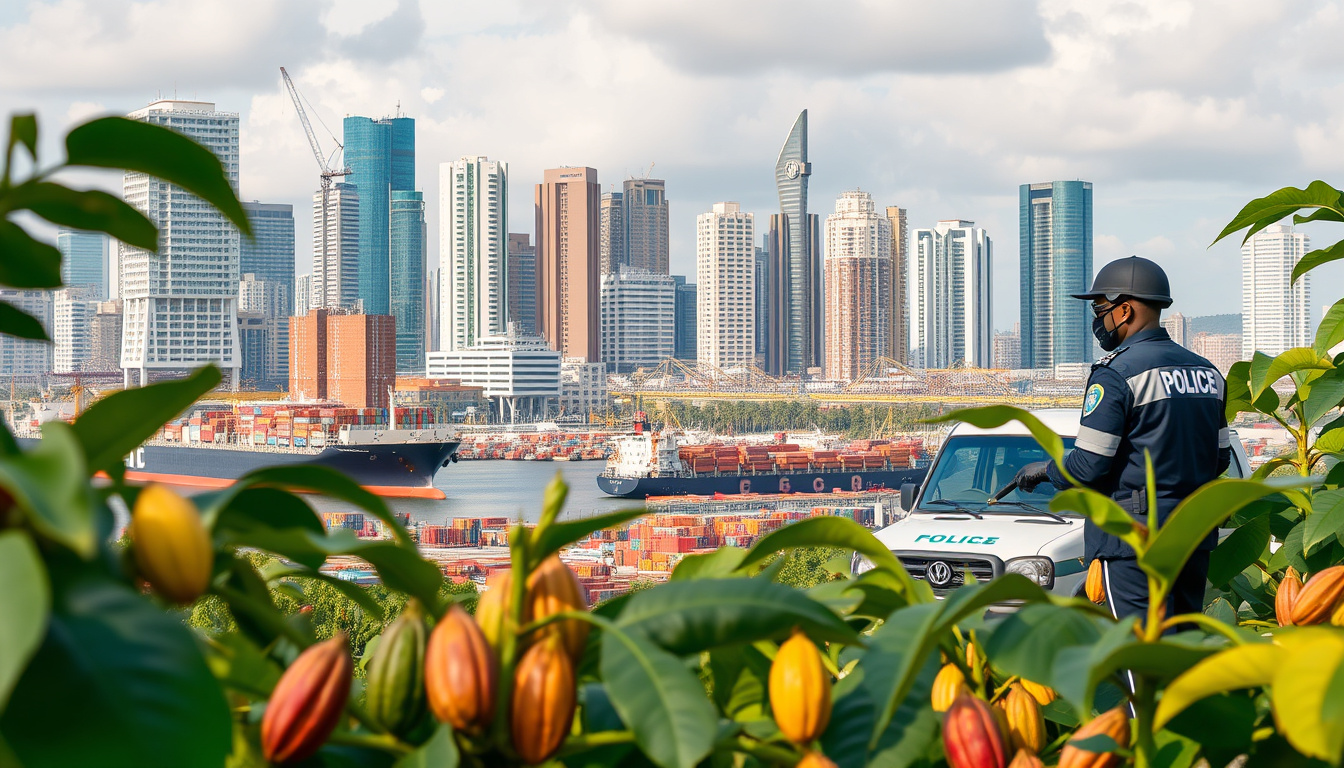
You’ve probably seen the name on cocoa labels or heard it in travel conversations — Côte d’Ivoire, a West African nation of roughly 29 million people, is a country of striking contrasts. It’s the world’s top cocoa producer and one of Africa’s fastest-growing economies, yet it carries a Level 2 travel advisory and a complicated dual-capital system that confuses even seasoned travelers. This fact-checked guide cuts through the headlines to give you a grounded view of its economy, safety landscape, and cultural identity.
Official Name: Republic of Côte d’Ivoire · Capital: Yamoussoukro (political), Abidjan (economic) · Area: 322,463 km² · Population: ~29 million (2024 est.) · Currency: West African CFA franc (XOF)
Quick snapshot
- Largest cocoa exporter globally (World Bank country office)
- Lower-middle-income classification (IMF country report)
- GDP per capita ~$2,600 (2023); middle tier in Africa (World Bank overview)
- U.S. Level 2 advisory: Exercise increased caution (U.S. Department of State travel advisory)
- UK FCDO advises against travel near Mali/Burkina Faso borders (UK Foreign Office guidance)
- Petty crime common in cities; tourist areas generally safer (OSAC security report)
- Official name: Côte d’Ivoire (since 1985) (CIA World Factbook)
- “Ivory Coast” is the English translation (Britannica country entry)
- Government prefers French name in all languages (Britannica country entry)
- ~42% Muslim, ~33% Christian, ~19% indigenous (CIA World Factbook)
- Constitution guarantees religious freedom (U.S. State Department religious freedom report)
- No official state religion (Constitute Project – 2016 Constitution)
A single country harbours both world-beating cocoa wealth and border-region danger zones. For a traveler or investor, the difference between Yamoussoukro and the northern Savanes region is not just geography — it’s a drastically different risk and opportunity profile, backed by concrete government advisories and economic data.
Is Côte d’Ivoire a rich or poor country?
The short answer is that Côte d’Ivoire is a lower-middle-income country with a growing economy — it’s neither among Africa’s wealthiest nor its poorest. The World Bank classifies it as lower-middle-income, with a GDP per capita of approximately $2,600 in 2023, placing it in the middle tier of African nations (World Bank country overview).
What is the economic status of Côte d’Ivoire?
GDP growth is the headline story. The World Bank projects Côte d’Ivoire’s growth at 6.3 percent in 2025, up from 6.0 percent in 2024 (World Bank macroeconomic outlook). The International Monetary Fund confirms the same 6.3 percent projection for 2025 (IMF country report, 2025). Inflation has fallen sharply — from 3.4 percent in 2024 to just 0.1 percent in 2025 according to the World Bank, and the IMF reports annual average CPI inflation dropping from 4.4 percent in 2023 to 3.5 percent in 2024, with further declines expected.
The African Development Bank, cited by Xinhua (state news agency), forecasts real GDP growth at 6.3 percent for both 2025 and 2026, with inflation at 2.9 percent. Attijari CIB’s analysis puts actual 2025 growth even higher at 6.5 percent, with headline inflation easing to 0.1 percent (Attijari CIB economic insight). The budget deficit is forecast to fall to 3.0 percent of GDP in 2025, from 4.0 percent in 2024.
How does Côte d’Ivoire rank in Africa?
- World’s largest cocoa producer — accounts for roughly 40% of global supply (International Cocoa Organization statistics)
- GDP per capita ~$2,600 — ranks 20th out of 54 African nations (mid-tier) (IMF World Economic Outlook database)
- One of West Africa’s largest economies by nominal GDP, behind Nigeria and Ghana (World Bank Africa Pulse)
- Extreme poverty rate has declined from ~46% in 2015 to ~34% in 2021 (World Bank Poverty & Equity Database)
Côte d’Ivoire’s economy grows at a blistering 6+ percent per year — faster than most of its West African peers — yet its per-capita income remains modest. The growth hasn’t translated into widespread wealth partly because the cocoa sector, which drives exports, employs many smallholder farmers at thin margins. For the Ivorian government, the challenge is converting cocoa-fueled GDP growth into household-level prosperity.
Is it okay to say Ivory Coast?
You’ll hear both names used interchangeably — even by airlines, news outlets, and the United Nations. But the official answer from the Ivorian government is clear: since 1985, the country’s government has requested that Côte d’Ivoire be used in all languages.
What is the official name of the country?
The official name is the Republic of Côte d’Ivoire (République de Côte d’Ivoire). “Ivory Coast” is the English translation of the French name, which references the historical ivory trade along its coast (Britannica country entry). The government made a formal diplomatic request in 1985 that the country be referred to as Côte d’Ivoire in all languages, not just in French (CIA World Factbook).
Why do people use both names?
- “Ivory Coast” remains the conventional English name in many media outlets, including the BBC and major newspapers (BBC country profile)
- English-language map data, airline booking systems, and UN documents often still use “Côte d’Ivoire” as primary, but “Ivory Coast” appears in subtext (UN member states list)
- No law forbids using “Ivory Coast” — it’s a diplomatic preference, not a legal requirement (Constitute Project – 2016 Constitution)
What this means: if you’re writing a formal document, a travel itinerary, or a business correspondence, using Côte d’Ivoire shows respect for the government’s stated preference. But calling it “Ivory Coast” in casual conversation won’t start a diplomatic incident — just don’t be surprised if an Ivorian gently corrects you.
Is Côte d’Ivoire a safe country?
The honest answer: it depends on where you go. Côte d’Ivoire has areas that are relatively safe for tourists and expatriates, but also zones the UK Foreign Office advises against all travel to. The U.S. State Department sets the country at Level 2: Exercise Increased Caution, citing crime, terrorism, civil unrest, and health risks (U.S. Department of State travel advisory).
Is Côte d’Ivoire safe for white tourists?
There is no official data on incidents specifically targeting white tourists — government advisories don’t break down crime by race of victim. However, the OSAC (Overseas Security Advisory Council) security report notes that travelers, regardless of appearance, should exercise increased caution due to crime, terrorism, and civil unrest (OSAC security report).
In practice, tourist areas in Abidjan, Grand-Bassam, and Assinie are considered safer than inland regions. But “safer” doesn’t mean risk-free: petty theft, bag snatching, and scams targeting foreigners are common in urban markets, hotel lobbies, and public transport hubs (OSAC security report).
What are the safety concerns for travelers?
The UK FCDO advises against all travel to areas within 40 km of the borders with Burkina Faso and Mali, as well as Northern Zanzan and Savanes provinces, plus Comoé National Park. It also advises against all but essential travel to within 20 km of the Liberia border due to serious violence by local militias (UK Foreign Office travel advice). That’s multiple border regions effectively off-limits — not a one-line advisory.
- Crime: Petty crime is the most common threat for visitors. Violent crime is less frequent but does occur (OSAC security report)
- Terrorism: The northern border region carries a do-not-travel warning due to terrorism risk, linked to militant groups active in the Sahel (OSAC security report)
- Civil unrest: Demonstrations and protests can occur, sometimes with little warning (U.S. Department of State travel advisory)
- Health: Malaria is endemic; yellow fever vaccination is required for entry (CDC travel health notice)
What does the US travel advisory say?
The U.S. State Department’s Level 2: Exercise Increased Caution is the same advisory level given to countries like France, the UK, and Germany — not an alarmist rating. It means “be aware of heightened risks,” not “don’t go.” Compare that to Somalia (Level 4: Do Not Travel) or Mali (Level 4), and Côte d’Ivoire is clearly in a different risk category (U.S. Department of State travel advisory).
Is Côte d’Ivoire an Islamic country?
No — Côte d’Ivoire is a religiously pluralistic society with no official state religion. The constitution guarantees freedom of religion (Constitute Project – 2016 Constitution).
What is the religious composition of Côte d’Ivoire?
Data from the CIA World Factbook and the U.S. State Department’s International Religious Freedom Report show the following breakdown (CIA World Factbook, U.S. State Department religious freedom report):
Four major groups, one pattern: Côte d’Ivoire’s religious landscape is balanced and regionally varied, not dominated by a single faith.
| Religion | Estimated share | Notes |
|---|---|---|
| Islam | ~42% | Predominant in the north; largely Sunni Maliki |
| Christianity | ~33% | Concentrated in the south and Abidjan; Catholic and Evangelical |
| Indigenous beliefs | ~19% | Animist traditions practiced mainly in rural areas |
| No religion / other | ~6% | Includes small Buddhist and Hindu communities (expatriates) |
Is Islam the state religion?
Article 1 of Côte d’Ivoire’s 2016 constitution affirms the country as a secular republic that ensures equality for all citizens before the law, without distinction based on religion (Constitute Project – 2016 Constitution). There is no state religion. Muslims and Christians coexist in most cities and towns, and interfaith marriage is common.
The catch: despite formal secularism, religious identity has at times overlapped with political and ethnic tensions, particularly during the civil wars of 2002–2011. Northern Muslims and southern Christians were sometimes pitted against each other by political actors. That said, the post-2011 era has seen a concerted push for national reconciliation, and daily life in Abidjan is brightly multi-religious — churches, mosques, and traditional shrines often sit side by side.
What is the capital of Côte d’Ivoire?
Côte d’Ivoire has two capitals — one political and one economic — a situation that surprises many first-time visitors. The official political capital is Yamoussoukro, a city of around 350,000 people located in the centre of the country, designated as the political capital in 1983 under President Félix Houphouët-Boigny (Britannica – Yamoussoukro entry).
But Abidjan, with a metro population of over 5.5 million, remains the economic and de facto capital. It hosts almost all foreign embassies, government ministries (many never fully moved from Abidjan), the country’s main port, the international airport, corporate headquarters, and the stock exchange (CIA World Factbook).
Why are there two capitals?
- Yamoussoukro was the birthplace of President Houphouët-Boigny, who invested heavily in building it as a political showcase, including the Basilica of Our Lady of Peace — one of the largest churches in the world (Britannica – Yamoussoukro entry)
- The move was partially completed in the 1980s, but the 2002–2011 crisis halted further relocation of government functions (CIA World Factbook)
- Today, the National Assembly meets in Yamoussoukro, but most daily governance happens in Abidjan (Britannica – Abidjan entry)
What this means: if you’re traveling for business, you’re almost certainly flying into Abidjan. If you’re visiting the political centre, you take a 2-3 hour drive north to Yamoussoukro — often to see the basilica and the presidential palace, not to conduct government affairs.
Key facts at a glance
The table below distills the country’s defining attributes into a single reference: nine key facts that highlight the duality of Côte d’Ivoire’s identity.
| Attribute | Detail | Source |
|---|---|---|
| Official Name | Republic of Côte d’Ivoire | CIA World Factbook |
| Political Capital | Yamoussoukro | Britannica |
| Economic Capital | Abidjan | Britannica |
| Area | 322,463 km² (roughly the size of Germany) | CIA World Factbook |
| Population | ~29 million (2024 est.) | CIA World Factbook |
| Official Language | French | CIA World Factbook |
| Currency | West African CFA franc (XOF) | CIA World Factbook |
| GDP Growth (2025) | 6.3% (projected) | World Bank |
| US Travel Advisory Level | Level 2: Exercise Increased Caution | U.S. State Department |
Pros and cons of visiting Côte d’Ivoire
Upsides
- Rich cultural diversity with vibrant music, festivals, and cuisine
- World-class beach destinations like Grand-Bassam and Assinie
- Fast-growing economy means improved infrastructure and hotels
- Relatively stable in Abidjan and southern tourist zones
- Low inflation (0.1% in 2025) keeps costs predictable
Downsides
- Level 2 US travel advisory and multiple UK FCDO no-go zones
- Petty crime common in Abidjan markets and transport hubs
- Northern border regions off-limits due to terrorism risk
- Malaria risk year-round; vaccination required for entry
- Limited English spoken; French proficiency is essential outside hotels
Confirmed facts and open questions
Confirmed facts
- Côte d’Ivoire is a lower-middle-income country (World Bank)
- World’s largest cocoa exporter (ICCO)
- US travel advisory Level 2: Exercise Increased Caution (State Department)
- UK FCDO advises against travel near Mali, Burkina Faso, and Liberia borders (UK FCDO)
- Religious composition: ~42% Muslim, ~33% Christian, ~19% indigenous (CIA World Factbook)
- Constitution guarantees religious freedom; secular republic (Constitute Project)
- GDP growth projected at 6.3% for 2025 (World Bank, IMF)
- Inflation fell to 0.1% in 2025 (World Bank)
- Yamoussoukro is the political capital; Abidjan is the economic hub (Britannica)
- Official name: Côte d’Ivoire since 1985 government request (CIA World Factbook)
What’s unclear
- Exact crime rates for tourists in specific regions — no official data on incidents targeting white tourists (OSAC report)
- Future economic growth projections depend on political stability and global cocoa prices (World Bank overview)
- Inflation estimates vary slightly across sources (SECO: 5.6%; World Bank: 0.1%; AfDB: 2.9%) — reflects different periods and measures (SECO report)
- Effectiveness of national reconciliation since the 2011 crisis is hard to measure in daily life data
Key perspectives from expert sources
“Côte d’Ivoire has been one of the fastest-growing economies in Sub-Saharan Africa over the past decade, driven by robust cocoa exports and infrastructure investment.”
— World Bank country overview, citing the country’s sustained growth trajectory
“Exercise increased caution in Côte d’Ivoire due to crime, terrorism, civil unrest, and health issues. Some areas have increased risk.”
— U.S. Department of State travel advisory, Level 2 warning with specific regional exceptions
“The constitution provides for freedom of religion and prohibits religious discrimination. No official state religion exists.”
— U.S. State Department International Religious Freedom Report, 2023, affirming secular governance
“Côte d’Ivoire’s economic growth remains resilient, with GDP expanding 6.5% in 2025, while headline inflation eased to 0.1%.”
— Attijari CIB economic insight, supporting the World Bank’s growth projection
Related reading: George Weah: Ballon d’Or Winner, Liberian President · Coral Reef: What It Is, Irish Cold-Water Reefs and Threats
seco.admin.ch, incotedivoire.net, ebrd.com, gov.uk, economicdatagdp.com
Frequently asked questions
Do I need a visa to visit Côte d’Ivoire?
Most nationalities require a visa. E-visas are available online through the official government portal (Côte d’Ivoire e-visa portal). Check with your local embassy or consulate for specific requirements.
What is the best time to travel to Côte d’Ivoire?
The dry season from November to February is the most comfortable, with lower humidity and less rain. The rainy seasons run April–July and October–November in the south, and a single rainy season June–October in the north (CIA World Factbook).
Is English widely spoken in Côte d’Ivoire?
No. French is the official language, and over 60 indigenous languages are spoken (including Dioula, Baoulé, and Bété). English is not widely spoken outside of hotels, international businesses, and some tourist areas. Basic French phrases are useful for any traveler (Britannica country entry).
What are the main tourist attractions?
Top attractions include the Basilica of Our Lady of Peace in Yamoussoukro (one of the world’s largest churches), Grand-Bassam’s colonial architecture and beaches, Taï National Park (a UNESCO World Heritage site and rainforest), and Abidjan’s vibrant markets and Plateau district (Britannica country entry).
What should I pack for a trip to Côte d’Ivoire?
Lightweight clothing for tropical heat, a rain jacket, insect repellent (especially for malaria prevention), sun protection, and comfortable walking shoes. For formal settings, modest dress is advisable. Bring a universal power adapter (Type C/E plugs, 230V).
How safe is public transportation in Abidjan?
Abidjan has extensive shared taxis (“woro-woro”), buses, and the SOTRA metro bus network. Safety is generally okay during daylight, but petty theft is common on crowded buses and in taxi ranks (OSAC security report). Use registered taxis, agree on fares in advance, and avoid traveling after dark.
What is the food like in Côte d’Ivoire?
Ivorian cuisine is built on attiéké (fermented cassava couscous), foutou (mashed yam or plantain), rice, and fresh fish, often served with spiced sauces like sauce graine (palm nut) or sauce arachide (peanut). Street food is popular and affordable, especially grilled fish at beachside “maquis” restaurants.
What is the 1 richest country in Africa by GDP per capita?
Seychelles has the highest GDP per capita in Africa at roughly $20,000 (2024 IMF data), followed by Mauritius. Côte d’Ivoire’s ~$2,600 places it in the middle tier (IMF World Economic Outlook).
Côte d’Ivoire is a country of living contrasts — economic dynamo and travel caution zone, secular republic with deep religious roots, French-named by preference but English-named by habit. For the traveler or investor considering a visit, the decision is not whether the country is “safe” or “rich” in an absolute sense, but whether the specific region and purpose align with your risk tolerance and interests. For the Ivorian government, the challenge is clear: sustain the 6.3 percent growth rate, narrow the gap between Abidjan’s prosperity and northern poverty, and maintain the religious coexistence that makes the country a West African outlier.
Related stories




Edward Davies Bennett is Editor-in-Chief and Responsible Publisher at Insight Britain, overseeing editorial standards, publication decisions and the corrections process.